Craig Calcaterra aptly answers Andy Martino’s questions about Sandy Alderson’s suitability for the Mets’ GM position.
Is Sandy Alderson the right man for the Mets’ GM job?
Reply

Craig Calcaterra aptly answers Andy Martino’s questions about Sandy Alderson’s suitability for the Mets’ GM position.
Sean McAdam from CSNNE.com joins the show to weigh in on a couple of GM candidates with Red Sox ties:
Going with a three-man rotation during the final two playoff rounds last season was a less complicated call for the Yankees. For one thing, they did not have a better alternative for Game 4. Chad Gaudin was an unappealing candidate who was never truly considered, and in that light, Sabathia was the only possible choice.
This year, the Yankees have Burnett, whose 5.26 E.R.A. was the highest in franchise history among pitchers who threw at least 180 innings. Girardi was noncommittal when asked whether Burnett would start in the A.L.C.S., but giving him a start in a seven-game series would be less risky, especially because the postseason schedule is not nearly as favorable.
Last year’s A.L.C.S. had an extra day off between Games 4 and 5 that allowed Sabathia, in a dominant Game 4, to be the only one to pitch on short rest. Burnett worked Game 5 on normal four days’ rest and Pettitte, after a rainout, started Game 6 on five days’ rest. Barring rainouts, no such flexibility exists this year. Major League Baseball, bowing to complaints that last year’s series took too long (6 games in 10 days), eliminated that superfluous off day. It means that over a potential seven games for the Yankees — if they committed to using three starters — their final four games would be pitched on short rest.
We should all have such problems. But at first consideration, it strikes me that the Yankees — and for all I know this flies in the face of game theory — should reserve a decision on what to do in Game 4 until they know what happens in the first three games.
If they emerge from those contests up 2-1 or 3-0, then they might as well roll the dice with Burnett in Game 4, knowing that at very worst they’ll be looking at a best-of-3 series with their three best pitchers on regular rest.
If they’re down 2-1 or with their backs to the wall, then they probably need to go with the big fella, as there’s almost no chance they should risk burying themselves with Burnett on the mound.
The problem with that, I imagine, is that Sabathia, Hughes and Pettitte would have to prepare differently if they were planning to start on three days’ rest than on regular rest. So, you know, nevermind.
On The Happy Recap radio show last night, we talked a little about the known candidates for the Mets’ GM job and which one I’d choose if I were in position to make that decision. I waffled and hedged like I always do, and stuck to my stance that I really have no idea. But I said something about personality that doesn’t jive with anything I normally write here, so I think I should probably clarify:
I don’t know any of the men interviewing to run the Mets, but I would like to know that whoever gets hired is confident enough to ignore the inevitable onslaught of nonsense he or she will face at some point in the near future.
It has always seemed as if the Mets are run by people conscious of public perception. Omar Minaya, as I mentioned on the show, talked about how he heard from Mets fans about addressing the bullpen whenever he went to get bagels in the winter of 2008.
That’s just a quote, a joke Minaya made to make the J.J. Putz acquisition seem like a no-brainer.
But it would be nice if the Mets could find a general manager cocky enough to turn to the guy on the bagel line — or the guy on the radio, or the guy writing for the newspaper, or the guy who owns the team — and say, “Bro, I appreciate the feedback, but I know a hell of a lot about how to build a baseball team, and I’ve got things under control.”
In other words, while I think the bluster about the particulars of the New York market is normally little more than the New York media overemphasizing the impact of the New York media, in this one instance I think it’s important the Mets hire someone they feel can withstand the pressure to compete immediately, shoulder the comparisons to the winning team across town, and exercise the requisite patience to turn the Mets into a successful, sustainable franchise.
Does that mean anything at all? I don’t know. Theoretically all of the candidates have reached the top of their profession, and that type of climbing usually requires a good deal of confidence.
The Mets have a nice crop of halfway decent young players and, in the right hands, I suspect it won’t be as hard as many think to turn the club around. But it’s going to take some time, and in the interim there are going to be a whole lot of airwaves and newspapers and blogs to fill, and so every move the new GM makes and doesn’t make is going to meet with a hell of a lot of criticism.
And so, basically, the Mets need to hire someone who won’t care.
This evening at 6 p.m., I will join the good gentlemen of the Happy Recap radio show to discuss all sorts of Mets stuff. Check it out by clicking the headline.
I just Tweeted about this, but I’ll mention here: Thanks to deft TiVo juggling, I somehow managed to get this deep into the postseason without seeing the new Joe Girardi/Mariano Rivera Taco Bell commercial — in which Rivera is called in from the bullpen (here, a table in the corner of Taco Bell) to help a customer finish his XXL Chalupa — until this morning.
Obviously the XXL Chalupa is notable, and I owe you a writeup about that and the two new taco sauces, all of which I hope to eat at some point today and discuss here early in the week.
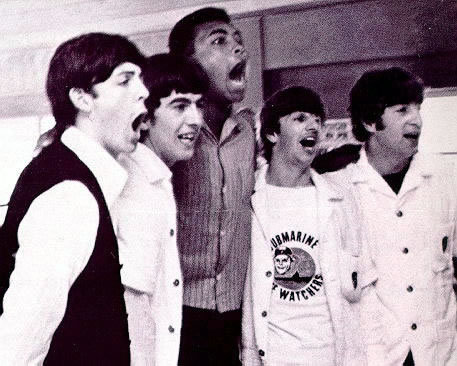
But the real story here is that we now have documented evidence that the great Rivera has been in the perhaps equally great Taco Bell. It is a historic confluence of awesomeness on par with the time the Beatles met Muhammad Ali.
Something about this post at The Book Blog didn’t sit right with me, but because I never studied economics and don’t know anything about game theory I figured I’d run it by TedQuarters resident maverick economist and former roommate extraordinaire Ted Burke.
He also struggled to grasp what MGL was trying to get at when he writes:
If batters and pitchers adjust their approaches according to what the other has done in the past during a game, then one or the other is NOT performing (in terms of their approach/strategy) optimally! Game theory tells us that.
Baseball is a game of adjustments only in terms of learning – a player improving upon his skills and strategy and learning new things about his opponent. It should NOT be about the kind of adjustments during a game that you hear from commentators all the time.
My gripe was that, though certainly it makes sense that a player should rely on the largest sample he has to determine an opponent’s tendencies, there are myriad minor in-game factors that might impact those tendencies (most obviously the pitches a pitcher has the best feel for on any given day) and so it seems reasonable that an opponent should be adjusting to the in-game sample.
Ted Burke’s issues ran a bit deeper, and were perhaps more semantic. Our conversation went like this (apologies in advance for the cheapshot at Jersey drivers):
Burke: He’s assuming that a Nash Equilibrium exists for this situation, which pretty clearly isn’t the case.
Berg: You’re assuming that I have any idea what a Nash Equilibrium is.
Burke: It’s a nerd name for a concept you fully understand as a sports fan and human in society. In a situation where multiple parties each have to make a choice or series of choices, its Nash Equilibrium is the outcome where each party made the right choice for them given the choices of the other parties.
Say the two of us are driving on two different roads and we’re approaching the intersection of the two. Your road has the green light, and my road has a red light. We each have a choice to make: stop at the intersection or continue through it. We’re both licensed drivers, so we have certain expectations about how other licensed drivers will behave in this situation. You figure that if you keep going through that intersection, there’s a slim chance that I will plow into you, but there’s a much greater chance that you’ll pass through the intersection safely.
If you stop at the green light, you eliminate the chance of getting smashed by me, but you realize that doing so will almost certainly result in you being rear-ended by the truck behind you. So you choose the safer expected outcome and drive through the intersection. Similarly, I know that stopping at the red light carries a very small possibility that I will be rear-ended, but there’s a much greater chance that I’ll smash into another car if I attempt to drive through the intersection. So I choose to stop on red. Our paths cross safely, like two handsome ships passing in the night.
So every time we get in that situation, I stop and you keep driving. That’s the Nash Equilibrium.
Berg: And you’re saying that doesn’t exist in baseball (or in some parts of Jersey).
Burke: There are plenty of situations in baseball that have a Nash Equilibrium, but this isn’t one of them. Actually, if there were a Nash Equilibrium in this situation, the game of baseball wouldn’t be nearly as interesting as it is. One primary reason for throwing different pitches at different speeds in different locations is to prevent the batter from knowing if, when, and where to swing. In that sense, game theory would fit perfectly with the adjustment process the announcers described.
If the Yankees are swinging aggressively at first pitches, Pavano would want to start at-bats with a breaking ball or something out of the zone, which would in-turn lead to the Yankees choosing to be more patient, which leads to Pavano throwing fastballs over the plate on first pitches. And the cycle repeats itself.
Berg: It seems like his point is based on the fact that the Yankees should know going into the game that Pavano is going to throw fastballs over the plate and should base their expectations on those tendencies.
Burke: But if Pavano went through the whole game throwing first-pitch strikes and the Yankees spent the whole game swinging at them, the Twins would have to be idiots.
Game theory tracks the decisions people make over time to maximize their own utility. It would never suggest that the Twins continue making a decision that’s getting them pounded when a simple “adjustment” would at least give them a chance of not getting pounded.
Berg: Yeah, which is a big part of why it made no sense to me.
Burke: What the announcers were describing is basically the essence of game theory.
Excellent work from the Wall Street Journal, and a hat tip to Can’t Stop the Bleeding for the link. Pretty funny interview highlighted by the fact that the guy’s real name is Wiley Wiggins, which seems like it would make a decent enough nickname for Lincecum.
I need to get back into my Monday-Thursday shaving schedule:
I have therefore started to move away from the Mets as a fan and have started to look into some other sites and other teams. When I buy a DVD-player from Panasonic and it’s terrible and breaks down, I don’t keep buying Panasonic DVD players. If I get a crappy sandwich from a restaurant and every time I go there the sandwiches stay crappy no matter what I order, guess what, I stop frequenting that restaurant. These players love to say “baseball is a business.” Owners couch their talk in business-speak all the time – “Best product on the field!?” If they want to treat it like a business, fine. I’m starting to feel like I’d be better served by putting my time and devotion and emotions in a team that knows how to reward that dedication.
– Shamik, comments section yesterday.
Whoa, whoa, whoa, first things first, Shamik: Other teams we’ll discuss in a sec, but other sites, no way. Keep it locked on TedQuarters. You can skip the Mets stuff and just read about Taco Bell and dinosaurs or whatever.
As for the first part, I think Shamik’s comment raises an interesting discussion for a number of reasons. For one, I’m with him on being turned off by the business-speak thing. That comes down to a big-time divide between the rational and irrational minds, I think. We all recognize that sports teams are, in fact, businesses, but I don’t think anyone hopes to hear their teams’ owners speak about them as such, referring to the product on the field and the customers in the seats and everything.
But my public-relations quibbles aside, I don’t think I could ever actually stop pulling for the Mets, even if at times I’ve felt like I wanted to. Remember that I said I’d quit if they traded for Jeff Francoeur, then they did and I stuck around like a shmo. Perhaps moving away would make it possible — transplanted New Yorker Tim Marchman has discussed how he finally stopped caring about the Mets last year — but I fear it might be too deeply ingrained in me to change allegiances now, and I don’t think I ever want to know baseball without a rooting interest.
I could imagine taking up a second team if I moved elsewhere. When my wife was applying to medical schools a couple years back I gave her pretty simple qualifications for places I was willing to live: Anyplace with a Major League team except Philadelphia.
I argued that case based on my career, but really I just wanted to know I’d be able to get to big-league baseball games when necessary. And though I harbored some small bit of excitement that we might move somewhere with a team that actually won something every so often, I knew all along I’d really still be rooting for the Mets from wherever we went.
I think it’s the rational vs. irrational thing again though. I can recognize that, as a fan, I owe the Mets nothing and should be free to change sides if I so choose. But in my gut it doesn’t work like that, and — though I certainly don’t begrudge him the decision — I wonder if Shamik would (or will) actually find the transition as easy as switching from Panasonic to Sony.
 Tedquarters