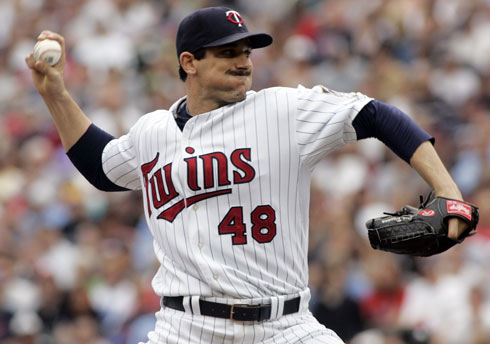
Carl Pavano now sporting hilarious mustache
4

Word passed around on Sunday that Jose Lima died of a massive heart attack. He was not yet 38 years old. They had a moment of silence for him at the stadium in Kansas City, before the Royals-Rockies game, though I’m not sure that in this case that was quite right. It probably should have been a moment of music — Lima never cared for silence. They could struck up a mambo band — maybe played one of his most popular lyrics as relayed by Sports Illustrated’s Kostya Kennedy: “Parate a batear que te voy a alimar.”
Step up to the plate. I’m going to strike you out.
And I thought about that image of Jose Lima, smoking his cigar, smiling happily, telling stories, all in the aftermath of his own loss and the Royals’ 15th straight loss. Over time, most of the people around baseball came to understand that Jose Lima was just having fun. That’s all. Baseball was fun. Life was fun. As he would say to friends and strangers and kids who wanted autographs: “What time is it?” The correct answer was “Lima Time.”
Even if you lost, it was still Lima Time.
“Man, if I see a guy with his head down, I know I’ve got him,” he told me that day in the clubhouse. “We can’t put our heads down. We can hurt, man. But we’ve got to hurt on the inside.”
In my memory, then, he took one more puff of his cigar and blew out the smoke and smiled. In show biz, they say, “The show must go on.” In the clubhouse, Lima said: “That’s what baseball is, man. You hurt on the inside. On the outside, we’ve got to win some games.”
– Joe Posnanski, JoePosnanski.com.
I was privately, snarkily wondering if Jose Lima’s obituaries would neglect to mention how Lima spent much of his career being one of the worst pitchers imaginable. All due respect and all, but I hated Lima when he came to the Mets. Lima Time in Flushing remains the only time I can ever remember being put off by a player’s on-field antics.
 Lima, I was certain, hadn’t earned the right to dance in the dugout. He hadn’t even earned the right to be on the team. He came to the Mets with a 5.21 ERA and only managed to raise that in his four starts.
But Posnanski, as he often does, puts everything in perspective. Jose Lima’s badness felt closely tied to Jose Lima’s brief goodness, and Jose Lima’s apparent madness. And it seems somehow fitting, if still tragic, that a guy like Lima would die so young. Everything Jose Lima did was loud, obnoxious, extreme, and kind of awesome. Guys like that aren’t made to fade away.
So rest in peace, Jose Lima. Here’s hoping heaven has some poorly run franchises.
Simply put: Oswalt is being paid like he can still be expected to be one of the game’s elite pitchers and that’s simply not a safe bet. Moving that contract for a good return on his talent is going to be a chore for Ed Wade, although the San Diego Padres proved such a move is possible. Of the recent high-priced starting pitchers to be traded, only Jake Peavy’s current contract had more annual money remaining than Oswalt’s. The Padres even had the unfortunate break of Peavy missing most of the season and holding a no-trade clause. Somehow, they got the White Sox and him to agree to a deal, and thus ridded themselves of his three-year, $52M deal.
Scott Kazmir was owed nearly $34M over three years and the Rays didn’t receive an elite prospect in return for him last August. Cliff Lee only had a season and $9M remaining when the Indians (and then Phillies) traded him. Even Roy Halladay was owed less money ($15.75M) than Oswalt will make next season when the Blue Jays traded him to the Phillies this past winter. Those contracts look cost efficient when stacked next to Oswalt’s, and those were for two of the game’s absolute best arms.
I’m happy Anderson wrote this, because he says basically all the things I planned to write this morning anyway. And it’s a beautiful Saturday and I’ve got lawn to mow.
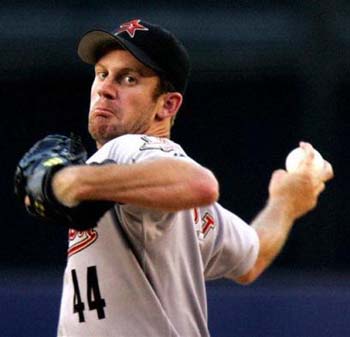 Roy Oswalt is still a good pitcher. But he showed signs of a decline in 2008 and 2009, and his early-season dominance in 2010 is more likely due to the whims of small samples than any real change.
And Oswalt is being paid like an elite pitcher. I know Mets fans are incredibly eager for the team to pick up Oswalt, who spent most of this decade as one of the best, steadiest pitchers in the National League. But trading premium prospects for the right to pay Oswalt $25 million over the next year and a half would be foolish. If the Mets were willing to trade Wilmer Flores and Jenrry Mejia, two top-100 prospects, they should look for a more efficient return — a pitcher under control for more years and signed to a more reasonable contract.
It’s not my money, of course, so if the Mets were able to acquire Oswalt on something closer to a salary dump, I’m all for it. Like I said, he’s a good pitcher, and the Mets don’t have many of those. But it’s bad business to mortgage the future for an expensive, aging pitcher in a year the team’s no safe bet to contend even with Roy Oswalt on the staff.
And for what it’s worth, there’s a reasonable chance Oswalt wouldn’t waive his no-trade clause to come to the Mets. Check out Oswalt’s “preferred” destinations, according to Jayson Stark. Now check out the Google Map for Oswalt’s hometown in Mississippi. Doesn’t seem to hard to decipher why he favors the Rangers, Cardinals and Braves, in the three Major League cities geographically nearest to where Oswalt grew up.
Bob Ojeda and I discuss bunting and mental health days:
The only question I have is who was actually criticizing Epstein over this? I value my brain cells so I don’t listen to Boston talk radio, but were people actually considering this to be some sort of issue? I’d wager $10,000 that Theo Epstein works more hours and is better at his job than every single person who considered this to be a legitimate problem.
– Craig Calcaterra, HardballTalk.
This. For those of you who don’t know the backstory: Theo Epstein went to a Pearl Jam concert instead of watching a Red Sox game (which he very well might have TiVo’d), and apparently Boston fans were so broken up about it that Nick Cafardo wrote a column defending Epstein.
The Red Sox endured an 86-year championship drought. Then the Curse of the Bambino magically ended the year after Epstein took the reins. It’s amazing how a series of smart moves can undo an age-old hex. And then the Sox won again in 2007, just to quiet any talk that the first could be a fluke.
Even with their team underperforming this season, Boston fans should wake up every morning and give thanks for whatever series of circumstances brought them Theo Epstein. His record is certainly not perfect, but he’s as good a GM as any in baseball. His teams have won two World Series in the seven seasons he has been at the helm.
And the funny thing is, that’s sort of implicit in any anger toward Epstein for taking a night off. As mad as they are over their team this season, Sox fans still want their GM working to try to better the club. I have to imagine there’d be plenty of Mets fans excited to hear that Omar Minaya was at a Pearl Jam concert if it meant he had his hands off the controls for a night.
I asked him to do Tsuyoshi Shinjo just for you, TedQuarters readers:
What I have come to understand is that everybody believes they can be a general manager.
That makes me realize that NOBODY UNDERSTANDS WHAT THE GENERAL MANAGER’S JOB REALLY ENTAILS!
Most fans (I am including talk show hosts as fans) believe that the general manager’s job is all about putting together the major league team. Certainly that is a major part of the job, but it is far from the entirety of it. There are many more responsibilities that a general manager has beyond just building the 25-man roster in the big leagues. Let’s take a look at some of those duties and then we will look at the major league roster construction….
So despite what you might believe know this — not everyone can be a general manager.
In fact, there are very few that are capable.
– Steve Phillips, AOL Fanhouse.
In a lengthy and vaguely patronizing column, Phillips reminds readers that there’s a lot more to being a Major League GM than putting together a 25-man roster.
 Like talking to the scouts, for one. And talking to the manager. And talking to the owner. And talking to the team doctor. And talking to the press. And sometimes, depending on the GM, talking to the players.
I have no doubt that being a GM of a Major League team takes an unbelievable amount of hard work and requires insane hours, but it does seem pretty damn obnoxious to suggest that there are very few people capable. There are a lot of really smart people in the world, and a lot of them are probably willing to work extremely hard for a seven-figure salary and the right to run a baseball team.
I’m not saying I’m one of them; I’ve worked my share of 80-hour weeks in my life, but it’s not something I have the capacity to do regularly.
But I’m certain I know plenty of intelligent, hard-working, driven people who would know better than to trade for Mo Vaughn. And all of them probably recognize that Carlos Beltran is a great baseball player.
Someone started keeping score at our weekly pickup baseball games in Brooklyn, which seemed sweet when I realized it meant we could start keeping our stats, and then significantly less sweet when I noticed I profile similarly to Luis Castillo (after two games, I’m slashing .285/.375/.285).
Anyway, on the bench Sunday we got to wondering why a strikeout is scored a “K.” I figured it wasn’t “S” because of sacrifices, but we couldn’t determine why it would be “K” instead of “T” or some other letter in the word “strikeout.”
The use of “K” for a strikeout was invented by Henry Chadwick, a newspaper journalist who is widely credited as the originator of the box score and the baseball scorecard. Both the box score and scorecard persist largely unchanged to this day, as the game itself is largely unchanged except for the number of balls and strikes allowed to the pitcher and batter. The letter “S” was used to coin “sacrifice” so Chadwick decided to use “K”, with “K” being the last letter in “struck.” Chadwick also invented many other baseball scoring abbreviations, such as using numbers to designate player positions (progressing from the batter, pitcher [1] and catcher [2], through the infield, with the shortstop counted after the basemen, at number 6, to the right fielder [9]).[2]
That Chadwick first established the convention of using the “K” abbreviation is well-founded, with reliable and authentic primary materials surviving (see citation above). Those unaware of Chadwick’s contributions have speculated that “K” was derived from the 19th century pitcher Matt Kilroy‘s last name. If not for the evidence supporting Chadwick’s earlier use of “K”, this speculation would be reasonable: Kilroy did much to raise the prominence of the strikeout, setting an all-time record of 513 strikeouts in 1886, only two years after overhand pitching was permitted. Kilroy’s record, however, is forever confined to its era: the pitcher’s mound during his record-setting season was only 50 feet (15 m) from the batter; it was moved to its current distance of 60’6″ in 1893. The modern record (1901-) is 383 strikeouts, held by Nolan Ryan, one better than Sandy Koufax’s 382.
That makes sense, I suppose. “K” somehow does seem more appropriate than “T” or “I” or whatever, but probably only because I’m used to it. Plus those letters can’t be written backwards to denote called third strikes.
But I like the Kilroy story better, for Styx-related reasons.
Not only did Justin Bieber throw out the first pitch, but the teen sensation’s hit “Baby” blasted through U.S. Cellular Field when Teahen came up to bat. Teahen usually plays a reggaeton song by former teammate Jose Lima’s band and mixes in other tunes like “Barbie Girl” by Aqua and “A Bay Bay” by Hurricane Chris.
Not this night. With Bieber at the park, Teahen figured why not use “Baby”? Although he’s not necessarily a die-hard fan of the singer, he said he got turned on to the song a few months ago by his girlfriend and even has it on his iPhone.
– Andrew Seligman, Associated Press.
I’ve got to assume those choices are drenched in irony, which catapults Mark Teahen toward the top of the list of my favorite baseball players. I can’t imagine anyone takes “Barbie Girl” seriously. And bonus points for using Jose Lima’s band. Just the reminder of Jose Lima’s existence is probably enough to make a hitter salivate as he walks to the plate.
Also, Teahen operates a Twitter feed in the name of his dog, Espy.
H/T to Baseball Think Factory for the link.
I read what young baseball fans write on their blogs and various comment sections. I get the sense they aren’t haven’t fun with the game, but rather analyzing the game. It’s ok to do that, but it gets to a point where they bog everyone, including themselves, down. Years from now they won’t have stories for their kids, like a Greg Prince, but print outs of graphs of David Wright’s pitch recognition.
Ironically the volume of information, as much as it has helped the game in the front office, has hurt the quality of the fan in the stands. It used to be fun scouring the internet for good baseball discussion. Now I feel like I should be sitting in a classroom with a #2 pencil. I don’t want to be dramatic and say this is the “day the music died”, but with advanced stats and information it very well may be the day it became harder to have fun, dream, and enjoy a summer rooting for your favorite team.
– Mike Silva, NY Baseball Digest.
Look: I’m not out to tell anyone how they should enjoy baseball. I can only speak for myself, and I don’t feel much need to defend my love for the sport. You’ll just have to trust me on this one: I love baseball. Absolutely f@#$ing love it.
 I love every in and out and up and down, every dribbler up the middle and crushed foul ball, every called strike three on the outside corner and every ill-timed mound meltdown. Baseball is meant for entertainment, and it is great theater. So I even love it when the Mets blow a seven-game lead in September or trot out a lineup filled with Triple-A caliber players. Heartbreak, as torturous as it can feel, is entertaining too.
And my enjoyment is only furthered by understanding — or trying to understand — the various metrics used to quantify every element of the sport.
I recognize that plenty of people are probably content to appreciate the natural beauty of a sunrise without bothering to learn that it’s caused by the earth spinning on its axis. And I don’t begrudge them that right. I just happen to think understanding the elegance of the mechanisms prompting that sunrise makes the effect even more spectacular.
The numbers driving baseball are dictated by very subtle differences. Anyone can watch a few basketball games and recognize that the guy who put up 30 points in each is probably the best player on the court. But the distinction between a great hitter and a crappy one is as small as safely reaching base once more in every ten plate appearances. If you think you will notice that a .320 hitter gets one more hit over 20 at-bats than a .270 hitter, well, good for you.
I don’t think I can, though, and so trying to know the tendencies and probabilities involved in every play help me better appreciate both the completely predictable events and the staggeringly improbable ones.
Knowing that Rod Barajas has a .275 on-base percentage doesn’t in any way diminish the awesome aesthetics of his moonshots. It does, however, help me realize how unlikely he is to continue homering at such a ridiculous rate, and watching a player triumph over the odds is pretty spectacular, too.
And that’s — to me at least — the redeeming thing about statistics, and maybe about baseball as a whole. We get to watch people succeed against the odds all the time. Adam Kennedy once hit three home runs in a playoff game. If you only watched the games and never studied the numbers, you wouldn’t realize how crazy that was. But just glance once at the back of Kennedy’s baseball card and you recognize it as a beautiful, hilarious, unbelievable, uplifting feat.
That makes baseball more fun.
Maybe other fans don’t care to know more or understand more thoroughly every aspect impacting a baseball game. Again, I can only speak for myself.
I know this: When I come across something that excites me like baseball does, I want to know everything about it. And part of what has made following baseball and writing about baseball so enjoyable, to me, is that every time I think I know everything, someone uncovers some new, deeper way of understanding the game.
It can be frustrating sometimes, and the breadth of information available can be overwhelming, for sure. But the time spent learning to sort through that information to better appreciate all the wonderful intricacies of the game creates a positive feedback loop: Everything I learn about baseball just makes me like baseball more.
 Tedquarters