
Tolstoy digs the longball

This piece on strikeouts and the Anna Karenina principle, from David Roher at something called the Harvard Sports Analysis Collective, is an interesting read.

I’m not certain exactly what Roher is concluding, and I wonder if he’s not either misstating or overstating something that is merely common sense. He notes that hitters who strike out more at the Major League level statistically produce more offensively, and writes:

For a hitter to be good enough to get at least 3.1 plate appearances per game in Major League Baseball, he has to possess some skill that prevents him from being unduly penalized by strikeouts. … hitters who are too vulnerable to the strikeout will get weeded out and thus won’t move up any further than that level.

I definitely see how selection bias, as he suggests, would produce the situation he demonstrates statistically: That strikeouts are inversely correlated to offense in the low Minors, and directly correlated to offense in Triple-A and the Majors.

His conclusion is shrouded in some loose (and perhaps forced) connection to the Anna Karenina principle, but all he seems to be saying is that strikeout-prone players are more likely to put up big offensive numbers in the Majors than they are in the low Minors.

And that strikes me as plain common sense. To get to the Majors and stick around while striking out a ton, a player almost has to be adept at hitting home runs and earning bases on balls. No one’s going to abide a slap-hitter who strikes out a lot, because slap hitters need to put the ball in play frequently to succeed.

So in most cases, the guys with the highest strikeout totals are mashers like Mark Reynolds and Ryan Howard. Then, naturally, high strikeout totals correlate to offensive production.

Also, Roher cites wOBA but doesn’t even mention how walks factor in. Players who strike out a lot at the big-league level are most likely taking more pitches than their less whiff-prone colleagues, and so they’re not only more likely to swing at a pitch they can drive when they do swing, they’re also more likely to end up ahead in counts and earning free passes.

So in other words, it’s not that strikeouts are a good thing. They’re not. It’s just that, to make it to the Majors while striking out a lot, you have to be very good at other important aspects of hitting. And that seems like it could be the cover story on Duh! Magazine.

H/T to Baseball Think Factory.
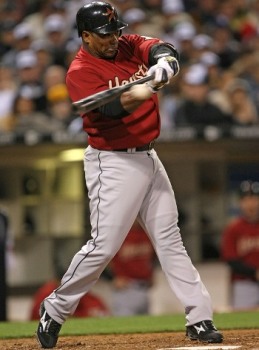
Huh?

The NL MVP Award voting is back, and Albert Pujols is the deserving winner.

One interesting note:

Someone thought Miguel Tejada was the eighth most valuable player in the National League last year.

Huh?

If you wanted to argue Tejada was the eighth most valuable shortstop in the National League last year you’d have a strong case.

Tejada posted a .795 OPS while playing a below-average defense for the 74-88 Astros in 2009.

Does anyone remember how crazy that was?

Reading about Stanford runningback, Heisman hopeful and MLB prospect Toby Gerhart in the Times last week made me think about Bo Jackson, for obvious reasons.

I was six years old when Bo Jackson first joined the Raiders, but I was head over heels for baseball by then and starting to grasp football, so I recognized that it was cool.

I guess, naive as I must have been then, I didn’t really think about how crazy that was.

In 1989 and 1990, Bo Jackson totaled 60 home runs, 41 steals and a 132 Major League OPS+. In those same years, he combined for nearly 1800 yards from scrimmage with 9 touchdowns and 5.5 yards per carry.

Then Deion Sanders, just a couple of years later, posted a 130 OPS+ with the Braves in the same year he picked up over 1000 return yards for the Falcons.

To be honest, I didn’t remember Neon Deion being any good at baseball. His baseball career seemed like a gimmick, and so I was surprised to learn he was actually a decent player for a couple of seasons.

Jackson, though, was different. Bo Jackson was a star in two professional sports at the same time. Again: Bo Jackson was a star in two professional sports at the same time.

That’s nuts. It’s so hard to imagine nowadays, in an age of such advanced specialty workouts and everything else.

And maybe it shouldn’t be surprising that Jackson got that terrible hip injury and flamed out so quickly.

But man, Bo Jackson was a stud.

I read his autobiography, Bo Knows Bo, pretty soon after it came out. It dealt with a bit with his childhood and a whole lot, if I recall correctly, with his college sex life. I was nine. I think the entire time I was reading it, I was thinking, “I obviously shouldn’t be reading this.”

Now everyone wants Nelson Cruz

I have spent — maybe wasted — thousands upon thousands of words advocating for the Mets to give a Major League opportunity to one of any number of Triple-A mashers with nothing left to prove in the Minors.

And nearly every time I do that, someone in an email or a comments section or message board somewhere will respond with the same arguments:

If this guy’s so good, why hasn’t any team given him a chance? If he’s really a Major Leaguer, why do teams keep letting him go?

I have no answer. Sometimes it just doesn’t work out.

Case in point: Nelson Cruz became a Flushing Fussing favorite during Spring Training 2008 when I was certain the Mets needed an extra right-handed power bat to replace Moises Alou when he inevitably got hurt.

I have no idea what the Rangers would have wanted for Cruz at the time, nor did I claim to. But Cruz had, to that point, spent 442 Major League at-bats not hitting like a capable Major League outfielder and appeared buried in Triple-A Oklahoma.

So I suggested (twice) that the Mets inquire about Cruz, and for all I know they did. That’s not the point here.

My point is that sometimes even 442 at-bats across a few seasons is not long enough for a player to adjust to the Major League level, and usually, when a guy mashes the crap out of the ball in Triple-A, he can be expected to eventually continue doing so in the bigs.

Because now everyone wants Nelson Cruz, apparently.

You know Cruz. He’s the same guy the Mets traded for Jorge Velandia and the A’s traded for Keith Ginter and the Brewers packaged with Carlos Lee for Francisco Cordero, Laynce Nix and Kevin Mench.

So he’s a pitch-perfect example of a player some would say three different teams “passed over,” who made it to age 27 without big-league success, and who still, it turned out, could contribute to a Major League club.

So with that in mind, check out Meddler’s Rule 5 draft preview at Amazin’ Avenue. The Mets are the first team in the Rule 5 draft that currently has openings on its 40-man roster, so they should have their pick of this litter.

A bad free-agent class?

One popular mainstream media meme is that this year’s is a weak free agent class. But one popular independent media meme* is assuming that everything the mainstream media agrees upon is nonsense.

Anyway, in an effort to figure it out, I added up the 2009 Fangraphs.com WARs of the top 20 players on MLB Trade Rumors’ top-50 free agents list (who has time to do all 50?) and the 2008 WARs of the top 20 players on last year’s list.

I skipped Aroldis Chapman, since he has no Major League data yet, and so added the 21st player — Adam LaRoche — this year. Similarly, I skipped Mike Mussina, who retired, and Ben Sheets, who was injured, from last year’s set, adding Orlando Cabrera and Jamie Moyer.

For a variety of reasons, it’s an imperfect way of calculating the depth of a free-agent class. I only measured the top 20 guys in each year and I only used one year of data.

Anyway, last year’s top 20 free agents totaled 72.1 WAR, and this year’s totaled 65.1 WAR.

So yeah, last year’s class was stronger. Not by a ton, but probably by a significant margin.

Of course, last year’s class was a lot better at the top. It had three players — CC Sabathia, Mark Teixeira, and Manny Ramirez — with 6.0 or greater WARs, while the current class can boast only one: Chone Figgins. But last year’s list had five players with 2.0 or lesser WARs, while this year’s has only three.

That said, this year’s list has two players with WARs below 1.0: Vlad Guerrero and Jose Valverde. Last year’s didn’t have any.

Anyway, that’s all just an exercise. Tim Dierkes at MLB Trade Rumors doesn’t rank his free agents by the prior season’s WAR — nor should he — so mine is a flawed study. Obviously one season’s worth of WAR is not a perfect measure of a free-agent’s value.

But I wonder if this is really a one-year blip in the free-agent market or indicative of a larger trend. Recently, we’ve seen lots of teams — including small-market ones — locking up their best players to long-term extensions before they hit arbitration, as the Mets did with Jose Reyes and David Wright.

The Rays have options on Evan Longoria’s contract that could keep him under team control until 2016, so, even though he made the Majors at a young age, he might not hit free agency until he’s 31.

There are also cases like Johan Santana’s, wherein a player with a no-trade clause approaching free agency agrees to waive that right to sign an extension with a club that trades for him. The same thing could happen with Roy Halladay this offseason.

Those are very, very isolated examples, but if the trends continue, I have to imagine we’ll see fewer and fewer excellent players hit free agency in the midst of their primes, as Sabathia, Teixeira and Matt Holliday have.

The 2011 free-agent class could be stronger than this year’s, but there’s reason to believe many of the top players on this list will sign extensions with their current clubs before the 2010 season is out.

*- As Sam points out below, this is likely an inappropriate use of the term “meme.”

Anonymous sources say the darndest things

James Kannengeiser at Amazin’ Avenue, obviously as giddy as I am about the Georgetown hoops game that starts at 4 p.m. today, posted a pretty amazing rundown of things he heard from his anonymous sources.

My favorites:

– My anonymous sources are familiar with the thinking of people who have knowledge of a league official’s inside man.

– My anonymous sources are trying to find the words to describe Bengie Molina without being too disrespectful.

He included a few from my Twitter feed, which I appreciate, though I should note that I completely stole the idea to tweet about anonymous sources from James’ Twitter feed.

Anyway, here’s some more undeniable insight from the MLB Hot Stove, courtesy of my giant network of baseball insiders:

– According to a person familiar with the Cubs’ thinking, it doesn’t happen very often.

– An MLB insider close to Brian Sabean says he has terrible B.O.

– A well-placed source with connections to the Mets organization says, “I’m Keith Hernandez.”

– According to a Yankees insider, Brian Cashman has suggested to ownership that the team trade Derek Jeter, and even maintained a straight face for about 10 seconds before cracking up.

– According to a Japanese baseball expert, Hideki Matsui 大人のビデオの印象的なコレクションを持っている。

– An anonymous MLB source tells me he was just speculating, and that it was really irresponsible of me to spin that into an entire column.

(Slams head against desk)

Mike Silva of NY Baseball Digest spoke to a “high-ranking official with one of the 30 big-league clubs” about the concepts stated in the book Moneyball (sort of), and the executive said this:

Moneyball geniuses have flopped like DePodesta, Ricciardi, and even the infamous Billy Beane whose exploits have all lacked a World Series trophy. It is all a tool to be used by the uninitiated. I’ll take a good scout and player development people anytime; the statistics are very secondary. How do you account a .220 hitter for being the hero of the World Series or a guy who hits three home runs a year wins the pennant clincher with a home run?

With all due respect to this high-ranking official, this high-ranking official is a dunce.

I do not pretend to have “all the answers,” as Silva suggests many sabermetricians do. I have far more questions than answers, and I’ve never said otherwise.

I know this for sure, though: If you don’t understand why a .220 hitter could be the hero of the World Series or a guy who hits three home runs a year can win the pennant-clincher with a home run, you do not deserve to be a high-ranking official with one of the 30 big-league clubs.

And to him, I’d ask the same question so frequently lobbed at sabermetricians from sanctimonious and misguided old-school baseball minds:

Do you even watch the game?

Or are you suggesting to me that a seeing-eye single is somehow the product of a player’s skill or will? Are you saying that a hard-struck line drive hit right at the shortstop is bad form, not bad luck? Do you really mean to tell me that some .220 hitter — some guy who can’t hit better than .220 in the regular season — can actually magically make himself a better player when it counts more? Good lord, if someone had the ability to make himself a better player when it counted, why wouldn’t he do it all the time? Is there somehow really not enough pressure in a regular-season for that .220 hitter to morph into Albert Pujols? And in that case, wouldn’t he be the exact type of player you’d label a headcase and eschew from baseball?

It’s random. It’s a random game and a random world and randomness pervades everything. Sometimes things don’t need explanations. They just happen, especially in extremely small sample sizes.

I really don’t even want to fight this battle anymore. I recognize that some people will never agree, and they’ll just think A-Rod magically became clutch this year after being unclutch for three postseasons and clutch in the two before those. I mean, hey, it’s the magic of Kate Hudson!

But I bring it up here because it’s scares the crap out of me that people like the guy Silva quotes — who not only demonstrates a fundamental misunderstanding of what Moneyball was really about, but also a fundamental misunderstanding of the way baseball actually works, not to mention a fundamental misunderstanding of the rules of standard written English — are in positions to make decisions for the baseball teams we all love. It’s a pitch-perfect justification of what I wrote about yesterday, asserting that people in Major League front-offices screw things up all the time.

And holy crap, no one ever said that book was about canning every scout and letting calculators make decisions. It wasn’t called Numbersball. It was about exploiting market inefficiency, and just because Beane hasn’t done a good job of it over the past few years doesn’t mean GAGLWEJHRKJ^@#$. I’m done.

“Dadadadadadadada.” – Marcel Duchamp.

Quick and dirty stats guide

Chris asked for an explanation on a couple of stats in the comments for the last post, and I started responding there, but the post got really long and I figured I’d throw it in the main feed here instead.

Anyway, Fangraphs.com and baseball-reference.com have pretty extensive glossaries, so I urge you to read (way, way) more about the subject there.

I normally use stats to inform my writing more than drive them, but the stats Chris asked for all might very well come up here, so here goes:

Briefly: WAR stands for Wins Above Replacement, and uses both offense and defensive stats in an attempt to determine precisely how many wins a player is worth to his team above the replacement-level player at his position (think Alex Cora).

WAR relies on UZR, or Ultimate Zone Rating, to measure a player’s defense. UZR is a pretty complicated metric, but it essentially tracks how many outs a player converts on balls hit within his “zone of responsibility.” A 7.6 UZR would mean a player saved his team 7.6 runs defensively over the replacement defender at his position over the course of a season.

OPS+ and ERA+ are just versions of OPS and ERA that are scaled a bit differently. Essentially, they’re park- and league-adjusted to better compair players of different eras and ballparks, and they’re weighted so the average is 100 and higher numbers are better. So a player with a 160 OPS+ hit 60 percent better than the average hitter would in his same situation.

The good general point of reference those two stats — and they’re two of my favorites, since they’re quick and easy but still fair for comparisons — are SAT scores, since they’re weighted the same way and the range is usually about the same. The worst players in the league will score around 60 and the best around 160, though there are always a few outliers.

BABIP refers to batting average on balls in play. It is mostly used to measure luck, because a player’s BABIP usually remains around the same level across his career, and years in which it is abnormally high or low might signify good or bad luck. It’s a bit more complex than that, of course, because BABIP corresponds pretty closely to line-drive rate and a player might be getting more hits on balls in play because he’s actually hitting the ball harder.

Regarding payrolls

Joe Posnanski did a typically tremendous job discussing the Yankees’ payroll and why, even though the Bombers may not win every year, the current system in Major League Baseball is patently unfair.

You’ll get no arguments out of me, but I’ll reiterate: It is not the Yankees’ fault they spend so much money. The Yankees are doing precisely what they should do. They have by far the largest budget for payroll because they gross by far the most money.

The onus is on Major League Baseball to fix the system, something that, as Posnanski points out, the league hasn’t appeared all that eager to do.

There have been billions of proposed solutions to baseball’s payroll disparity. Revenue sharing from online assets and the luxury tax may slightly even the score, but clearly do not do enough to let the Royals and Pirates compete for free agents with the Yankees, Mets, Red Sox and the like.

So the simplest conclusion is that baseball needs a salary cap, either a soft one like the NBA’s or a hard one like the NFL’s.

Both are problematic, though. The NBA’s system creates situations like the Knicks’ current dilemma, wherein it will take them several years to get out from under the weight of past mistakes. The NFL’s cap relies on a weak players’ union, as players under contract can be cut without penalty to the club.

They’re a bit more complex than that, of course, but it’s immaterial: The MLBPA is strong enough that even the hint of a salary cap would likely spell a strike, and no one wants that.

You’ll find few answers here. Back when I was in college and I thought I knew a whole lot about everything, I thought the answer was a true free-market system. (Oh, me at 21. What a beautiful fool.)

I recognize now that’s not a perfect solution, because I realize cable revenues and ad sales are inflated in large markets like this one, and concentrating a greater number of teams in the large markets would probably choke off interest in the rest of the country and ultimately hurt the sport.

Still, it strikes me that in some ways, the Yankees have the most money to spend because they must have the most fans. The largest fanbases then get rewarded most frequently, and so, from a purely utilitarian standpoint, the system is working.

So I wonder if the best way to mitigate the Yankees’ financial dominance would be to add another team to the market. Instead of punishing the Yankees for having the most fans, perhaps the league should do something to diminish the size of their fanbase.

As fans, of course, we say: No way that affects anything! I’m a (insert team here) fan for life, and no new team in my area would ever change that.

But cable ratings for the Mets and Yankees tell a different story. There are likely as many bandwagoneers in the area as there are die-hards, and a winning team will always prompt people to tune in or show up. A third team in the market would create more competition for fan and advertising revenue, even if there would still be plenty of both to go around.

There’s a reason a Google Maps search for McDonald’s in New York, NY looks like this and the same search in Pittsburgh looks like this. More mouths to feed necessitates more franchises.

I don’t know. I assume people much smarter than me have thought about this a lot harder than I have and done a lot more research and everything else. I’m just thinking out loud is all.

All I’m sure of is that it’s silly to fault the Yankees for taking advantage of their situation. We should only fault the situation.

Ham fighting for ham with ham

Every time I’m close to entirely losing faith in humanity, someone comes out of the woodwork to restore hope.

In this case, that someone was reader A.J., who created this new proposed mascot for the Nippon Ham Fighters, the Japanese baseball team that recently celebrated Tsuyoshi Shinjo.

Ham, fighting on behalf of ham, with ham.

I’m not even entirely certain what’s going on here, but I know that it’s awesome. As I mentioned yesterday, I was disappointed to learn that the Nippon Ham Fighters were the “Nippon Ham” Fighters and not actual fighting hams.

What A.J. has heroically done here depicts an actual ham — our familiar friend Porky — prepared to fight. And he fights using a sword laden with ham, and, I assume, he fights on behalf of ham. It’s really quite remarkable, and rather meta, and very hammy all around.

Oh, and the ham is made of baseball. I think A.J. just blew my mind.

And speaking of mind-blowing, that Shinjo video from yesterday wasn’t nearly the only Tsuyoshi Shinjo commercial available on YouTube:

And also this:

And this: