Where they’re at

I wrote on Friday — and plenty before that — that this year for the Mets is mostly about next year for the Mets. Obviously the full season will provide the best and broadest wealth of information with which the team can assess its players moving forward. But since the trade deadline is nearly upon us and Mets fans everywhere are looking for ways the team could improve its standings in the short- and long-term future, I figured it’s a good time to look around the roster and try to determine which of the Mets’ young (and youngish) players should figure into their plans for next year and beyond.
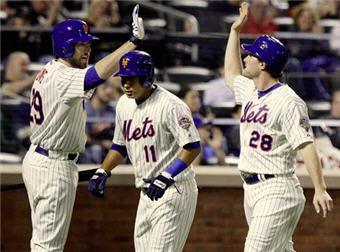
The following are all the position players who have played in the Mets this year and are in their age-27 season or younger.

Josh Thole: Thole is 25. He has struggled at the plate a bit this year, but by all accounts his defense has improved. It seems reasonable to expect Thole’s offense to bounce back toward his career norms and, given his age, improve a little bit from there. That’d make him only about a league-average catcher, but since the Mets don’t have much in the way of catching prospects in the high Minors and since going big for a free-agent catcher seems like a bad risk, Thole seems like a passable option to start games behind the plate for the Mets in 2013 and beyond. Ideally, they will find a decent, righty-hitting catcher with which to platoon him.

Ike Davis: Fun with arbitrary endpoints! Since June 6, Davis has a .958 OPS. That’s the good news. The bad news is that he started out so poorly that a month and a half’s worth of excellent production has only brought his season rate up to a .718. Davis appears to have suffered a few more defensive hiccups this season than he did in the past. A strong finish to the 2012 campaign from Davis will go a long way toward convincing the Mets and their fans that he should be their everyday first baseman moving forward, and I’d bet on that. Davis’ career OPS is now at .785, a touch above league average for first basemen even despite his youth and his woeful first half to this season.

Daniel Murphy: While the rest of the Mets have slumped, Murphy’s second-half resurgence has raised his season rates to his career norms. This is Murphy: High batting average, solid but unspectacular on-base percentage, doubles power without many home runs. Murphy’s defense hasn’t been good, but it seems to have improved to the point that it’s worth carrying at second base to keep his bat in the lineup. He’s never going to be Joe Morgan there, but if he hits he can play.

Ruben Tejada: The future looks bright for Tejada, once dismissed as a non-prospect due to his lack of obvious physical talents. For the second straight year, he has gotten on base a lot and played good defense. The biggest thing, of course, is that he’s 22. Just being able to not embarrass yourself in the big-leagues at Tejada’s age is impressive. His .297/.361/.352 line over the past two years suggests he could be a capable-to-plus Major League middle infielder for a long time coming.

Lucas Duda: Duda, as you know, got demoted a couple weeks ago. His defense in right field was atrocious and he didn’t hit enough to make up for it. But despite his offensive struggles this season, Duda has been good enough in the Majors and Minors the past few years to suggest he has a Major League career ahead of him. It’s just not in right field, and it might not be with the Mets. There aren’t many teams on which hitting left-handed is a detriment to your chances of making the roster, but Duda’s handedness doesn’t help his case for the club as long as so many other lefty hitters are around. (For what it’s worth: Duda has been better against lefties than Jason Bay this year.) He needs to start playing left field in Triple-A. If, for whatever reason, he can do that better than he can play right, maybe he resurfaces in the Mets’ starting lineup before long. If he can’t, he’s trade bait or a Triple-A hedge for Davis at first.

Kirk Nieuwenhuis: I argued on the podcast recently that Nieuwenhuis is the young outfielder most likely to emerge as a Major League regular. It’s not now, of course, with the once bro-tastic center fielder heading back to Buffalo to make way for Mike Baxter. Nothing Nieuwenhuis did or didn’t do in the Majors this year should surprise anyone who has been following him since the Minors: He played solid defense wherever the Mets put him, he hit for a little bit of power, and he struck out way too much. The good news is he’s 24 and — though it’s easy to forget — coming off a mostly lost 2011 season. With more reps in Triple-A, Nieuwenhuis should be able to pull it together and become, at the least, a platoon outfielder in the future. Unless the Mets bring in a couple of everyday type players, look for that to happen as soon as next year.

Justin Turner: Justin Turner is great at throwing pies and coming up to the plate to “Call Me Maybe,” and is by all accounts an awesome dude. He’s a justifiable Major Leaguer on a team that needs a second baseman in a pinch or needs a low-cost backup middle infielder. With Murphy looking more like a reasonable starter at second base, though, and Ronny Cedeno around to backup second and short, Turner appears rather redundant on the Mets’ roster. That’s not his fault and it’s not necessarily the case moving forward, but if anyone’s willing to give up anything of value for Turner’s services, the Mets should probably go for it.

Jordany Valdespin: Without looking, how many times has Jordany Valdespin walked this season? Any guesses? It’s twice. He has walked two times in 111 plate appearances: once May 8 and once July 6. His early-career power outburst has been awesome to watch, but it is unsustainable. If Valdespin doesn’t start taking more pitches, he’s not going to get any to drive. Still, his transition to the Majors and to the outfield at his relatively young age has been strong enough to suggest he’ll probably have a big-league career. I can’t think of a great comp, but I’d guess his upside is as a solid utilityman, playing all over the outfield and filling in at second, maybe third, and shortstop in a desperate situation.

Mike Baxter: It’s easy to glorify Baxter based on a tiny, 65 at-bat sample and one heroic moment, so let’s do just that: Mike Baxter is the best. Remember that catch he made? Remember all the timely hits? The Pride of Whitestone returns tonight, and if he hadn’t cemented his status as a folk hero yet, he’ll do it now by taking playing time away from Bay.

Josh Satin and Zach Lutz: Neither of these guys got much of a chance in the Majors this year, but they’re both right-handed and both routinely hit well in the Minors. If Lutz — the more powerful hitter of the two — can stay healthy, it wouldn’t be terribly surprising to see him spend more time with the big club next year as a right-handed bench bat and backup to Davis.

So what’ve we learned so far this season? The Mets have a bunch of guys who appear apt to become capable Major League role players or platoon guys, a few who look like solid regulars, and no offensive player (beyond David Wright) who looks likely to become a bona fide star.

There’s no rule that you must have any set number of guys labeled stars to succeed, of course, and if the Mets happen to get career years out of Davis, Tejada, Thole and Murphy next year along with typical production from Wright, their offense could be very good. They should be looking for outfielders, though — especially outfielders than can hit lefties.

 

Friday Q&A, pt 2: The randos

https://twitter.com/James_Tierney/status/228884044123881472

Well, Shea Stadium. But if you’re asking about the parks I’m not biased toward, it’s a great question. By my count, I’ve been to 30 Major League parks, and seen home games in every big-league city but San Diego, Oakland, Anaheim, Toronto and Tampa Bay. I haven’t seen the new or newish parks in St. Louis, Miami and Minnesota yet. Obviously I’m dealing with pretty small samples here. In many cases, I’ve only been to one or two games at the park, so my perceptions could easily be biased by good weather, good crowds or good games.

Anyhow, I think it’s Camden Yards. And I just asked my friend Scott, who has been to games in every city but Boston, and he agrees. Maybe it has something to do with being the first of the new-old ballparks, or maybe it was just so particularly well done that it prompted the trend.

It’s worth noting that I’m not nearly as hard on most ballparks as some fans. As far as I’m concerned, if they’re playing baseball there and I can see it, it’s a beautiful place. The baseball itself biases my opinions of the buildings in which it is played. But I just ranked the ones I’ve been to (rather haphazardly) and it came out like this:

Camden Yards
Coors Field
Dodger Stadium
PNC Park
Progressive Field
AT&T Park
Kauffman Stadium
Safeco Field
Nationals Park
Wrigley Field
Comerica Park
Ballpark at Arlington
Great American Ballpark
Yankee Stadium III
Fenway
US Cellular
Turner Field
Chase Field
Yankee Stadium II
Minute Maid Park
Miller Park
Citizens Bank Park
Busch Stadium II
Metrodome
Sun Life Stadium
RFK Stadium
Stade Olympique
Veterans Stadium

https://twitter.com/DShaw31/status/228884325570080768

Ah yes, a bands-with-bassists-as-singers question. I like both but I’m not way into either, but I’ll pick Cream because Jack Bruce is sweet and I find most of Sting’s solo work infuriating.

https://twitter.com/robValcich/status/228895097671000064

The site is burgundy because our man Adam Rotter had to color in the logo above and he said, “hey, Ted, what color do you want the logo to be?” And I said, “I don’t know, how about burgundy?” This site featured handsome autumnal tones for a while a couple years ago, and I thought it was about time to bring some of them back. I’ll probably mix up the colors on this new theme periodically.

Speaking of: The new theme is something of a work in progress, though I think it’s getting there. We often use TedQuarters as a guinea pig for changes on our blog network. People generally dislike changes to the way sites look, but the new setup should allow me (and, ultimately, many of our other bloggers) to do some cool stuff really easily that makes the sites more enjoyable. I haven’t quite figured it all out yet, though. Also, if you’ve sent me an email through the contact form in the last couple of days, I haven’t seen it. We’re working on that, too.

I also miss the Eddy Curry wheel, but all things must pass. Luckily it’s still here with me in the office, behind the dartboard on my desk, so I can unfold it and look at it if I ever get overwhelmed by nostalgia for the old site design.

https://twitter.com/Devon2012/status/228884027938062336

Like “jif,” like the peanut butter.

Friday Q&A, pt. 1: Mets stuff

https://twitter.com/Miss_Met/status/228884299250798592

That, Shannon, is an important question with a pretty easy answer: It’s R.A. Dickey in a landslide. The only identifiable sleeper candidate is Manny Acosta, who has in the past boasted the team’s most underrated hair. But if I’ve seen Acosta hatless since his return, I can’t remember it.

https://twitter.com/tpgMets/status/228884626251345921

At that rate? Sure. Hairston has done all sorts of valuable Scott Hairston things in his tenure with the Mets: He crushes lefties, he seems willing and comfortable working primarily as a reserve player, and he plays passable to decent defense at all three outfield positions. And almost all the Mets’ outfielders with a shot at a roster spot next season hit left-handed: Kirk Nieuwenhuis, Lucas Duda, Mike Baxter, Matt den Dekker. They’ve got righty-hitting Jason Bay and switch-hitting Andres Torres under control for next year, but it wouldn’t be particularly surprising if neither breaks camp with the 2013 Mets.

https://twitter.com/DanDotLewis/status/228884943546228736

This is really Toby’s department, but I’ll sort of bite: This might as well be a trick question, since the Mets appear to have about eight outfielders in the Majors and Triple-A who look capable of being Major League pieces but probably not Major League starters. At this point, it seems safe to figure that none of Hairston, Torres, Bay, Fred Lewis and Adam Loewen will be more than a Major League piece. There’s still hope for Duda, Nieuwenhuis and den Dekker to emerge as Major League starters, but they’ve all got warts to address before they do.

Duda will hit again, and probably hit enough to be a Major League regular in some form. It’s almost certainly not in right field at Citi Field, though, so for him to emerge as a Major League starter as an outfielder he’s going to have to take to left. Nieuwenhuis might have the best chance of anyone to wind up an everyday player, regardless of his recent struggles. He’ll have to cut down on the strikeouts and improve against lefties, obviously, but he looks good enough to play anywhere defensively and his offensive numbers look palatable if you consider his relative youth and all his missed time last season. It won’t take much improvement for him to become a low/middle-of-the-pack offensive center fielder.

https://twitter.com/TooGooden16/status/228885631395315714

I’ll guess no. Picking up Ramon Hernandez (if it’s only for money) seemed to make sense a week ago, but if the Mets want Johnson around to foster Harvey’s development, I doubt Hernandez’s bat is good enough to make it worth carrying three catchers. And I don’t think it’s time to give up on Thole. By most accounts, his defense has improved a lot this year. His offensive numbers have fallen off a bit, but he’s only 25 and his career Major League rates — the largest available sample — suggest he’s already nearly a league-average catcher.

Calm after the storm

A fierce storm pounded my neighborhood last night, violent enough to merit watching from my stoop under cover of the doorway. Rain pounded the street and sidewalk and kicked up so much mist that even the few parts of the air that weren’t occupied by raindrops seemed still somehow full of rain. Lightning strobe-lit the sky in sharp bolts and dull bursts. Thunder cracked… thunderously.

By an hour later when I walked to the grocery store, the streets were still quiet in the storm’s aftermath but the rain had subsided to a haphazard drizzle. I got home, made a sandwich, and sat down to watch Matt Harvey pitch.

Let’s talk about the weather: The Mets got caught out in an awful tempest after the All-Star Break, a storm like the one a couple years ago that dropped a tree into my parents’ living room and forced me to drive a half-mile in reverse on the pitch-black Taconic Parkway. Johan Santana and Dillon Gee went on the disabled list, David Wright hicupped for the first time this season and the team’s offense stagnated, the bullpen sucked to new lows, Lucas Duda got demoted, pitchers called out catchers, Terry Collins called out pitchers. Everything went wrong. Cats and dogs, you know.

Then Matt Harvey pitched.


Harvey probably isn’t all the Mets need to get through this. He’ll probably allow some runs this year, and he probably won’t strike out more than two batters an inning. At some point, even if he proves a clear upgrade over the Mets’ other options and a capable Major League starter,  he’ll probably show some evidence why some scouts insisted he wasn’t quite ready for the show. Hell, he probably won’t wind up the best pitcher in Major League history, and he probably won’t lead the Mets to a rash of World Series dominance.

But we don’t have any Major League evidence to suggest otherwise just yet, so we can revel for these next few days in undaunted hope. And even if we’re willing to be reasonable about it and accept right now that he probably isn’t all of those things, we can see the obvious signs of a strong big-league pitcher: a blazing fastball, a biting slider, a heartbreaking curveball. And we can imagine a near future with R.A. Dickey, Harvey and Jon Niese cementing the Mets’ rotation and recognize how it might become a strength. And then, holy hell, Zack Wheeler’s supposed to be better?

Even if the addition of Harvey isn’t enough to reverse the fortunes of the 2012 Mets, last night he established himself as must-see material, a reason to watch and dream on the Mets. 2012 was always supposed to be about 2013 and 2014 anyway, and now we better understand why.

From the Wikipedia: Pesäpallo

I’m way down the rabbit hole and figured I’d bring you along. I stumbled upon this page while revisiting an old From the Wikipedia post I once intended to make about discontinued Olympic sports after Dan Lewis’ excellent Now I Know newsletter reminded me that Tug of War was once an Olympic competition. The following was never an Olympic sport, but it was a demonstration sport at the 1952 Summer Olympics in Helsinki.

From the Wikipedia: Pesäpallo.

Pesäpallo, or Finnish baseball, was invented in the 1920s by a two-time Olympian, Finnish civil war propagandist and eugenics supporter named Tahko Pihkala.

Pesäpallo sort of seems like what would result if someone with no prior knowledge of baseball saw a couple of innings of a baseball game while hopped up on hallucinogens then returned to Finland and tried to recreate it from memory. I don’t think that’s what happened with Pihkala, it just seems that way. There are nine players on defense, three bases and home plate, and three outs in an inning.

But instead of a nine-inning tilt, the game is split into two four-inning periods. The team that scores the most in each period wins the period, then the team that wins the most periods wins the game. You don’t really see many best-of-two contests in sports because they don’t make all that much sense. But in Pesäpallo, if the game is tied at one after two periods, the teams square off in one super-inning, which is presumably exciting as sitting front row at an Apocalyptica concert.

Oh, also: The pitcher stands on home plate and throws the ball straight up in the air and the bases are aligned in a zig-zag formation. Balls hit over the fence on a fly — home runs — count as foul balls, so batters try to find holes in the defense and hit balls with elusive spin. The aggressive defensive shifting that has recently come into fashion in Major League Baseball has been the norm in pesäpallo for a long time. Each team can use up to three designated hitters per inning in addition to the nine position players in their lineup, and the designated hitters are called “jokers.” Based on what I can tell, players slide into just about every base. And there’s enough on-field celebrating to make Lastings Milledge blush.

Finland’s top pesäpallo division is called Superpesis and comprises 11 men’s teams and 10 women’s team. The last place finisher (ha!) every year is relegated to Ykköspesis. Every three years, there is a World Cup of pesäpallo, and it so happens this is a World Cup year. From October 8-13, the top pesäpallo players from Finland, Sweden, Germany, Switzerland, Australia, Japan and Estonia will square off in Australia for national pride.

I have spent the better part of the last hour reading about pesäpallo on the Internet and mostly I’ve just learned that I know almost nothing about Finland. I have no idea what’s going on in the following video, but I can see that it’s pretty awesome. I would definitely be down for joining an after-work social pesäpallo team if someone started a league. Looking at you, hipsters.