That’s baseball

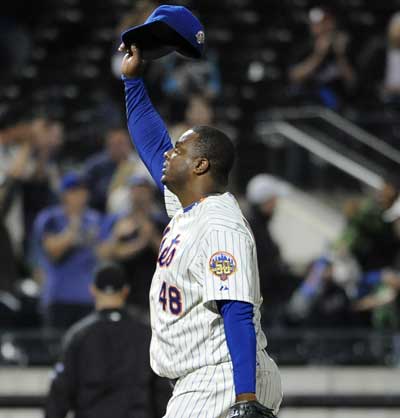
Yeah, we did [consider leaving Bobby Parnell in for the eighth inning after he threw only five pitches to strike out the one batter he faced in the seventh]. But this is what we’ve been doing. We’ve been using Jon, he’s been pitching very, very well in the eighth inning, and that’s what we’ve done thus far this season, so we wanted to go and do it again tonight.

Terry Collins, after the Mets’ 6-3 loss to the Reds last night.

Good thing the Mets’ relievers have such defined roles. Could you imagine how bad their bullpen would be if they didn’t?

Hindsight is 20/20, naturally. But leaving Parnell in for another inning after he faced only one batter, when he’s been the Mets’ best reliever this season and the team had nearly been burned by the exact same thing two days earlier, seemed like the right move there. Of course, I’m no manager, and neither are any of the guys on my TV who doubted the choice at the time. But it seems like Terry Collins is doing his bullpen no favors, and vice versa.

Man enough to bunt

Among average to poor hitters, the breakeven point is that much lower.  Whereas the breakeven point for a great hitter is 45% to 50% success rate on bunts, for an average hitter, it’s all the way down to close to 40%, and for a bad hitter, it’s around 35%.  And, we’d expect average hitters to be able to bunt better than great hitters (because of experience), and similarly, the bad hitters may be the best bunters (because they need to learn whatever to survive as hitters).

So, to shift against an average or worse hitter is about the worst defensive alignment you can imagine, and the average or worse batter needs to bunt any chance he gets, when the bases are empty.

Tom Tango, The Book Blog.

Tango makes the case that the smartest counter to aggressive infield shifting is to bunt against it every time. It’s an interesting read, though I wonder if the expected success rate for bunting for base hits, even against shifts, is as high as he suggests. At the very least, more frequent bunting against shifts would likely make defenses more hesitant to use them, allowing the hitters in question to go back to swinging away.

Today in awesome home-run events

The Naval aircraft carrier USS Yorktown participated in Pacific Theater battle campaigns during both World War II and the Vietnam War. Next month, the old battleship will serve as a launching pad of a different kind.

On June 18, the Class A South Atlantic League plans to stage the first round of its Home Run Derby on the flight deck of the Yorktown, which since 1975 has been a museum ship located at Patriot’s Park, which sits at the mouth of the Cooper River in Mount Pleasant, S.C., a suburb of Charleston. The championship round will then be held the next day as a lead-in to the Sally League’s All-Star Game.

Dom Consentino, Deadspin.com.

Get your sea legs, Travis Taijeron.

Teenagers be teenagers

After a few minutes, I noticed that someone had drawn a bunch of d—s all over the grease board by the door. So I pointed at them and asked, “Hey, who drew all the d—s?” One of the sound engineers immediately jumped up, ran over, and erased them with his sleeve. This is the new and mature Bieber. We can’t have d—s being drawn all over the place. People might get the wrong idea about filthy-rich 18-year-old pop stars.

Drew Magary, GQ.

Magary’s profile of Bieber for GQ is good and worth reading for Beliebers and skeptics alike. I felt silly censoring it, but you have to pick your battles. Also, it reminded me of something:

It doesn’t matter where or when, but once, while I was waiting in a dugout to interview a particularly young Mets Minor Leaguer, a chagrined media-relations dude emerged from the clubhouse.

“Yeah, ahh… I’m really sorry, this is going to take a minute,” he said. “He’s, ahh… he’s drawing d—ks on stuff.”

Later, I saw his handiwork. On a chalkboard in the clubhouse, a coach had drawn a stick figure. presumably as part of some demonstration. Once that drawing and the chalk were left behind for a group of college-aged guys, it was only a matter of time before someone added a huge cartoon wiener. From there, it appeared something of a wiener-drawing contest developed, with my interview subject and some of his teammates competing to draw the best or silliest one, or something. The payoff was a big chalkboard o’ wieners of all shapes and sizes, and, of course, a reminder that the prospects we track and follow and hype and debate and anticipate are still, in many cases, in their prime wiener-drawing years.

Kids.

This is a theme I hit on with some frequency, and there’s no strong conclusion here except to say that when you’re pouring over the stats of guys in their late teens and early 20s, it’s probably worth considering that they’re still very much guys in their late teens and early 20s, and there’s a lot of emotional and physical and mental development ahead of them. And it seems like, well, just a d–k thing to do to crap all over a guy with whatever platform you have when he’s still young enough to be drawing wieners on stuff without it seeming bizarre.

And I know some might point out that baseball players make the choice to play baseball professionally, and they sign up for the scrutiny when they do. And that’s definitely true. But they also make that choice at wiener-drawing age, right?

This

And when I say things like “that doesn’t mean it’s the right call”—thinking that it’s unlikely to have much if any benefit is not the same thing as being certain it has no benefit. It takes nothing away from the serious study of baseball—and in fact adds quite a bit to it, in my estimation—if we can be humble enough to admit that we aren’t certain when we shouldn’t be certain. In this case, there is still some unresolved doubt, and the Angels probably ought to have the benefit of it.

Colin Wyers, Baseball Prospectus.

This is why Wyers is among my favorites of the numbers-heavy baseball writers going on the Internet these days. The borderline-to-downright arrogant air of authority that comes with much of the contemporary sabermetric analysis bothers me, because if anyone knew everything there is to know about baseball there’d really be no reason to keep studying it. Maybe it weakens conclusions to admit you might be wrong about something — and it doesn’t seem like there’s much accountability anyway — but I prefer honesty and humility to confidence where it should not exist.

Loud noises

During an otherwise awful night for the Mets, Terry Collins and David Wright got into a bit of a spat in the dugout that turned out to more or less embody what we like about both men. Patrick Flood has all the details and the interpretation.

For what it’s worth, David Wright seems like — understandably, and smartly — a pretty guarded guy, but absolutely every bit of evidence we have suggests he really, really loves playing baseball. Like even more than most professional baseball players. That’s awesome, and so is David Wright. Also, he’s hitting .408.

A couple weeks ago, I pointed out that you could isolate stretches of Wright’s merely good but not totally awesome 2009-2011 campaigns in which he fared as well as he had in his first 20 games of 2012. That’s still true: In 33 games from May 30 to July 5 of 2010, Wright posted a .414/.456/.662 line. And over a 38-game stretch from May 4-June 16, 2009, Wright hit .415/.503/.606. Maybe you could find another if you play around with the baseball-reference gamelogs. Which is to say, again, that this is a small sample size and maybe this is the best Wright will hit all season, and maybe he’ll go into an awful slump soon and people will start crying “traid” again.

But those are arbitrary endpoints, and there’s no arguing that it’s encouraging he’s started this season this way. Obviously.

Actually, here’s something funny: Wright has been so good in the first 33 games of this year that if you tack them on to the 102 games he played last year, it makes for a .291/.381/.470 line with a 139 OPS+, or a hell of a lot like vintage David Wright.  The power’s not where it was from 2005-2008, but that’s the case around the Majors.

As for Collins: The only blowback I’ve seen to his removal of Wright and Murphy from last night’s game is that it sends a negative message to the rest of the players if he’s only protecting his two best hitters. Yeah, whatever. Maybe they’ll see the type of treatment they’d get if they became one of the team’s best hitters.

Saves are stupid

OK, look: Once Terry Collins said he was going to use Frank Francisco as his closer before last night’s game, he practically had to use Frank Francisco as his closer in last night’s game. He doesn’t owe Francisco much after the reliever’s performance over the weekend, but a big part of a manager’s job is keeping his players happy, and rolling back on his word with a pitcher with shaken confidence would not be the best way to do that. Plus, pretty much everything in Francisco’s history — not to mention his contract — suggests he’s a hell of a lot better than he has been for the Mets in 2012, so getting him straightened out should be a priority for the team if it aims to have a fully functioning bullpen later in the season.
But saves are stupid, and managing to the stat — as is typical in Major League bullpen usage — is ludicrous. Presumably you know this. Everyone knows this. And yet it still happens everywhere with no signs of stopping, and for all the vitriol spilled over stats that actually correlate to meaningful baseball events. there seem to be shockingly few outbursts about this nagging and ubiquitous silly habit.

Here’s the deal, in case you’ve missed it: Since the dawn of the one-inning closer, teams maintain their ninth-inning leads at exactly the same rate they did before the dawn of the one-inning closer.

The argument for defined bullpen roles is that relievers like to know the jobs they’ll be asked to do when they get to the ballpark. And that makes some sense. If I showed up to work one day and my boss said, “hey Ted, instead of being an editor today, we need you to operate the lights at the studio,” I’d get all worked up, plus I’d probably suck at it. I have no idea how to do that.

But then getting guys out in the ninth inning doesn’t seem like an appreciably different task than getting guys out in the seventh inning, it just happens at a different time. Certainly there are some differences in mental and physical preparation. But maybe if instead of telling a reliever his responsibility is the eighth inning or the ninth inning when his team is ahead, the team told him his responsibility is to pitch in relief if necessary on Wednesdays, Fridays and Sundays, he might still feel comfortable that he understands his task. I don’t know; I’ve never been a Major League reliever.

There’s a money thing too, of course. Closers get paid lots of money, so presumably relievers want closers to exist so they can earn the role and get the big bucks. But it seems likely that if some better stat than saves came into widespread use for assessing relievers, it would soon be used to compensate relievers, and with the amount of money in baseball there’d no doubt be plenty of handsomely paid bullpen arms regardless.

Point is, if the Mets weren’t committed to having a closer to aggregate saves — as basically all teams are — and committed specifically to using Frank Francisco as their closer, they almost certainly would have left their best reliever, Bobby Parnell. in last night’s game to face the middle of the Brewers’ order in the ninth after he retired the two batters he faced in the eighth on only five pitches.

But since it was important to use Francisco as the closer and give him the save opportunity because he’s the closer, they wound up not only using their third reliever of the night for the ninth, but needing to warm up their fourth — Jon Rauch — when Francisco struggled. And from here, it seems hard to figure how whatever advantage gained from having relievers know their roles isn’t more than mitigated by that type of forced inefficiency in their usage.

And you complain about Thole…

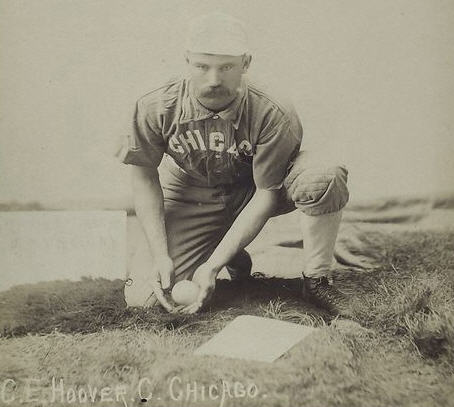
On a tip from Craig Calcaterra, I was checking out BuzzFeed’s 21 Weirdest Things about Old-School Baseball and this terrifying looking mustache man caught my eye:

That is, I assume, Charlie Hoover, the only C.E. Hoover to ever play professional baseball, according to baseball-reference.com. Hoping, in accordance with his name, Hoover would turn out to have been a good defensive player, I looked up his stats. He was not.

In his one full season in the American Association, Hoover played in 71 games, 66 of them behind the plate. In those 66 games as a catcher, he made 34 errors and allowed 58 passed balls.

Of course, those numbers aren’t atypical for the American Association, when games must have been so excruciating to watch it’s a wonder baseball even caught on. Hoover’s teammate Herman Long, a rookie shortstop nicknamed “Germany,” made 122 errors in 136 games, leading the league*.

And two catchers allowed more passed balls than Hoover did that season. Louisville backstop (to use the term loosely) and incredible mustache-haver Farmer Vaughn allowed 60 passed balls in 54 games behind the plate. His teammate, fellow mustache man Paul Cook, allowed 77 passed balls in 74 games at catcher to lead the league. Perhaps they were mesmerized by pitcher Guy Hecker’s razor-sharp mustache.

If you took in a Louisville Colonels game in 1889, it was better-than-even-money there was a passed ball. Also, they probably lost. The Colonels finished 27-111 that season. The upside is that 65 of their games were managed by an outfielder named Chicken Wolf. Chicken Wolf also had an amazing mustache.

As for the passed balls: Catchers didn’t wear shin guards until 1907 and, according to this, the chest protector was first invented in 1886, so depending on how quickly that caught on, it’s possible ol’ Charlie Hoover was out there behind the plate wearing little more than a mask, a mitt and what you see above. Except he wasn’t wearing that uniform in the American Association — he played for the Kansas City Cowboys. His lone season playing in Chicago came in the single-A Western Association in 1888.

*- For the sake of the disappointingly clean-cut shortstop Long’s honor, it’s worth noting that he also led the league in putouts by a pretty wide margin and finished third in the league in stolen bases, so it seems likely his high error total was at least in part due to his range. You get to the most balls in 1889, you boot the most balls in 1889. Like, 122 of them. Also, perhaps he was distracted on throws by first baseman Dan Stearns’ enchanting mustache.