Is David Wright awesome again?

In 20 games in April 2012, David Wright hit .389 with a .494 on-base percentage and a .569 slugging. Wright performed well in the 10 games he played in July of 2011, but has not enjoyed a full month of this type of production since 2010, when he hit six home runs and posted an 1.130 OPS in June. Moreover, his strikeout rate is sitting at 15.7 percent, right around where it was in his pre-Citi Field halcyon days, and he’s walking and hitting line drives at higher clips than he has in any full season in his career.
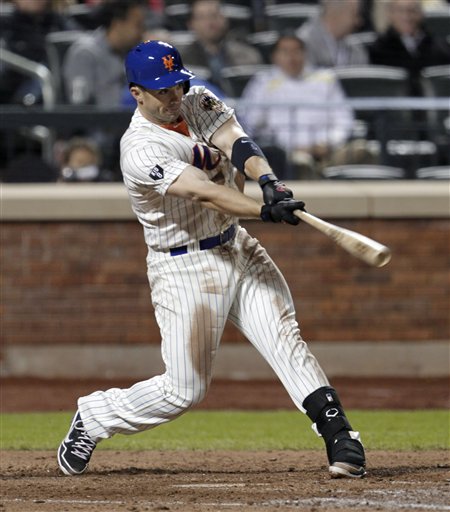
So what does all that mean? In the grand scheme of things, not much: It means he had 20 consecutive mostly good games that so happened to be the 20 games he played in the days determined to be part of April by Pope Gregory XIII in 1582, and, more importantly for the purposes of this discussion, that so happened to be the first 20 games of his 2012 season.

Wright was nearly this good for a 22-game stretch from Aug. 24 to Sept. 16 of 2011 — the worst season of his career — posting a .973 OPS that no one would ever have noticed because those endpoints are utterly arbitrary and it was bookended by slumps. Which is to say that no matter how great Wright has looked in his first 20 games of 2012, it’s still too soon to rule out another woeful season — at least by Wright’s standards. We might just be seeing his best stretch. Small sample size, you know.

That these 20 games did come to start this season, though, with the adjustments to Citi Field and everything else, means Mets fans can reasonably wonder if Wright is awesome again — not just awesome in the 2009-2011 good-guy, good-player sense, but awesome in the 2005-2008 top-few-players-in-baseball sense.

And that’s fun. Since we have no real idea what precipitated Wright’s precocious decline — if it was those walls, the 2009 beaning, the giant arm muscles, the various injuries, the general malaise surrounding the Mets the last few years, the economy, global warming, whatever — we can sit here and dream on the possibility that whatever happened stopped happening and now David Wright is his old awesome self.

He’s not going to hit .389 all year and he’s not going to maintain a .446 batting average on balls in play. But the longer he keeps crushing the ball, the more likely he is to keep crushing the ball.

They see me trollin’

It seems the general sentiment among Mets fans is that Terry Collins should never have let Manny Acosta start the eighth inning in Houston last night with the game tied at 3. And in hindsight, obviously, they’re right: Acosta allowed an infield single to Jordan Schafer, then Schafer stole second when Josh Thole bobbled a pitch in the dirt and scored the game’s deciding run on Jed Lowrie’s line drive single back through the box.

To me, though, the most frustrating part of Collins’ bullpen management this season has been his quick hook and the frequency with which he has warmed up and used all of his relievers. The Mets lead the league in relief appearances in 2012, and it seems like for every guy that gets in a game, another is in throwing in the bullpen ready to go. That taxes relief arms and could be one of the reasons for the bullpen’s general ineffectiveness.

Acosta has been mostly awful this year, no doubt. But he threw a strong seventh inning without a ton of pitches and bringing him back out for the eighth presented Collins an opportunity to keep some of his more frequently used relievers on the shelf. Acosta was the only member of the bullpen who didn’t throw in Sunday’s 11-inning game, recall, and multiple innings from Acosta would have benefited the Mets if Monday’s game also went to extra frames.

Also, don’t forget that Acosta was (perhaps by default) pretty much the best reliever the Mets had down the stretch in 2010 and 2011. He has started off poorly in 2012, yeah, but that’s no reason to expect it’ll continue. He allowed a squib swinging-bunt hit to Schafer, retired the for-some-reason-bunting Jose Altuve, and yielded a sinking liner to Lowrie. It’s not like he was knocked around the park.

To stop the bleeding, Collins wound up using Tim Byrdak and Bobby Parnell in the inning as well, so it wound up being the worst of both worlds: Acosta starts the eighth and allows the run and Collins still needs three relievers to get through the inning.

But I think if your primary gripe with Collins’ management is his heavy usage of relievers — as mine is — you can’t also complain when he lets a guy who just threw a strong inning come out for a second.

It didn’t work out last night. Sometimes it doesn’t.

Some stuff about Roger Connor

Don’t ask me how I wound up on the Polo Grounds’ Wikipedia page, but I did. And while there, reading about the O.G. Polo Grounds on the north end of Central Park — the only version of the Polo Grounds where people actually played polo — I saw this:

An early highlight of Giants’ play at the Polo Grounds was Roger Connor‘s home run over the right-field wall and into 112th Street; visitors to the site today can judge for themselves that this was an impressively long home run for its time or any time.

There’s not much in the way of a citation for the fact on the page, but a Googling led me to this excerpt from Roy Kerr’s book about Connor:

The Giants, New York’s National League team, were making their first appearance at home since mid-August, having just returned from a disastrous road trip that included seven consecutive losses to the league leaders, Chicago and Detroit. Boston’s ace, Charley “Old Hoss” Radbourn, son of an immigrant English butcher, was in the pitching box (there was as yet no”pitching mound”) in the first inning as a tall, powerfully built left-handed Giants hitter who hailed from Waterbury, Connecticut strode to the plate. Games accounts report that Radbourn gave the towering batsman a “good ball,” which was met squarely, and then “it soared upward with the speed of a carrier pigeon. All eyes were turned on the tiny sphere as it flew over the head of Buffington, in right field, and when it finally disappeared over the fence a shout of joy went up from the 2,600 spectators.” It was the only ball ever hit out of the original Polo Grounds, sailing over “an eight foot wall surmounted by a sixteen foot fence,” and landing in a field on 112th Street. The Giants slugger “trotted the circuit around the bases, and when he finally reached home base he looked at the fence and appeared happy. The members of the team shook the hand of the successful batsman, and he was gazed upon in wonderment by Radbourn and the other members of the Boston team.”

The book later estimates the shot at 435 feet, so nothing outrageous by today’s standards — though still pretty awesome — and probably utterly crazy in 1886. This Hardball Times post suggests home plate was around the corner of 5th Ave. and 110th St., for anyone interested in walking out Connor’s shot.

This post at NYCStrayCat.com passes along the account from the Sporting News that “members of the New York Stock Exchange, occupying box seats, were so smitten by the Herculean clout that they took a collection for the slugger. When the contributions were totaled, the fans were able to present a $500 gold watch to their hero.”

Connor’s Wikipedia page says his 6’3″, 220-pound stature gave the Giants their nickname, but the Giants’ Wikipedia page suggests otherwise.

What’s certain is that Roger Connor had an amazing mustache:

He was also awesome at baseball.

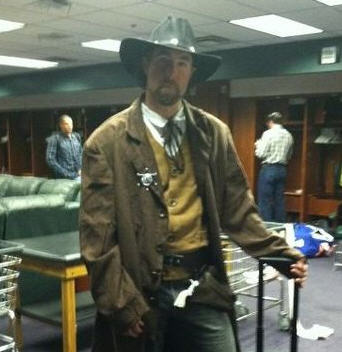
R.A. Dickey makes remarkably convincing Old West sheriff

The Mets took their Western road trip to heart and wore costumes to match the occasion. Amazin’ Avenue and ESPN New York have photos. Daniel Murphy is the least convincing cowboy, which makes sense because I imagine if someone in 1850 were like, “Hey, Old West Murph, come help me rassle some steers,” he’d be all, “not now bro, got to get my cuts in first.” And everyone would wonder what the hell he was talking about, at least until a barnstorming base ball club moseyed on into town and Old West Murph promptly hit .320 against them.

R.A. Dickey’s look wins in a landslide, so much so that you have to figure Dickey just dresses like this sometimes and the rest of the Mets agreed it was cool enough for them to make a whole thing out of it. Only then once they did they realized none of them could pull it off like Dickey can so it was a bad move to try to compete, like that time in college I bought a leather jacket like the one Brad Pitt wears in Fight Club thinking it’d help me look like Brad Pitt.

Everything about Dickey seems to work as an Old West lawman. You figure Sheriff R.A. Dickey would be wily and just, contemplative and empathetic but aware of his responsibilities and willing to bear their burden to keep scoundrels at bay.

Here we go

Lots of baseball fans who are not Nationals fans (so: most baseball fans) already hate 19-year-old Bryce Harper for a bunch of the silly things he has said and done as a teenager, which is silly because teenagers should never really be held accountable for the silly things they say and do if they’re ultimately as innocuous as the silly things Harper has said and done.

But I do hope Harper turns into the great baseball heel he appears destined to become. Here’s what I wrote last year:

Take the low road, Bryce Harper. In fact, as far as I’m concerned, by blowing that kiss to that pitcher, Harper flipped over the end of the spectrum from intolerable entitled brat to completely lovable heel. Remember that this is the kid who grew up rooting for the Yankees, Lakers, Cowboys and Dukeand who, when asked to describe himself in one word, first considered “gorgeous” then settled on “Hercules.” This is a Shooter McGavin in the making.

And yeah, you know and I know that he’s just a kid and that kids do and say stupid kid things all the time like we did when we were kids, but at this point — with the hype and the money and the expectations and the eye-black and everything — there’s pretty much nothing Harper can do that will endear him in the eyes of baseball fans outside of DC by the time he reaches the Majors, if and when that happens.

Obviously the big drawback is the beanballs, which will likely only pick up as Harper advances and will probably serve to tone down his act a bit in the long run. But make ‘em teach you, Bryce. Admire your moonshots. Maintain that godawful mustache. And maybe armor up a bit. The baseball world needs bad guys, and due to your unique situation, the crosshairs have apparently settled on you. Smile back and blow a kiss. Here’s hoping you make the bigs in time to have A-Rod pass you the torch.

All that still holds. The pesky thing about Harper, though, is that he still hasn’t hit much above A-ball. It’s a small sample, but he posted a .256/.329/.395 line in 37 games at Double-A last year and a .250/.333/.375 mark in his first 20 games at Triple-A this year. He’s young and purportedly talented enough that it seems a safe bet he’ll be good eventually, but it doesn’t seem likely he’ll do much to help the Nationals in 2012.

Check this out: In the history of baseball, only 10 teenagers have ever proved better than league-average hitters in any season in which they’ve had over 200 plate appearances. Only two have done so in the last 30 years: Ken Griffey Jr., whose Minor League stats trumped Harper’s, and Edgar Renteria, who had a full season of Double-A ball under his belt and who wasn’t again a better-than-league-average hitter until he was 25.