Sober Hall of Fame stance from drunk Jays fan

In their quest to erase their own involvement, if not illicit participation, in the widespread use of performance enhancing drugs from the history books, while simultaneously imagining an obviously non-existent moral code for members of the club that they act as gate keepers for, baseball writers will render themselves irrelevant in a little over a year’s time when they refuse to allow Barry Bonds, the greatest baseball player many of my generation, and quite possibly any generation, have ever seen play the game, into its no longer hallowed Hall.

Dustin Parkes, TheScore.com.

Parkes, one of the aforementioned Drunk Jays Fans, takes the same stance I’ve had on the Hall of Fame for a while now: If Barry Bonds — the best player of his generation — doesn’t make the Hall of Fame, then the Hall of Fame is dumb.

I’m not sure I even blame the baseball writers anymore: I’m certain they would endure as much animosity for electing Bonds from fans certain Bonds does not deserve to be enshrined as they will from people like me when they exclude Bonds, and it’s on the Hall of Fame itself to eliminate the morals clause and let everyone know it’s a place to honor great baseball players for great baseball playing, righteousness be damned.

Even the only vaguely conscious voters must recognize by now that the Hall of Fame is riddled with racists, drunks, cheaters and wife-beaters of the vilest ilk, but as long as today’s voters are charged with considering “integrity, sportsmanship and character” they are forced to subject the players on their ballots to their own nebulous and innately biased standards of decency. And that’s frustrating to fans because it’s so utterly murky, and because we have our own standards and our own guys we want voted in to the Hall of Fame and nothing we can damn do about it.

That’s all I really want to say on the matter until next year when Bonds does or doesn’t get elected, and then… well, we’ll see how I feel then, if I still feel feelings. It’ll be sad to me if I have to stop caring about the Hall of Fame entirely then, because I think Cooperstown is an awesome baseball Mecca, and because it’d be sweet to someday take my kids there (assuming they like baseball [and they better]) and tell them about the ridiculous things I saw Bonds do on baseball fields before they were born.

And, you know, that Piazza guy.

More-a Melvin

Since Melvin Mora retired last week and I’m pretty busy with meetings and such today, I figured I’d repost this interview I did with the man last year. He remains one of my favorite Baseball Show guests of all time. It was pouring rain, which is why my hair was so wet.


Canada disowns Jason Bay

The Toronto Sun published its list of the 100 most influential Canadians in baseball, which includes, among others, noted man-about-the-Internet Jonah Keri, true SABR Tom Tango, former Mets pitching coach Dave Wallace, and Ben Nicholson-Smith of MLBTradeRumors.com.

Not on the list or even in the honorable mentions? You guessed it: Jason Bay, the active Canadian home-run leader. Recent retiree and total hero Matt Stairs was also slighted, perhaps because Matt Stairs belongs to the world now.

The Drunk Jays Fans were also excluded, calling into question the validity of the entire endeavor.

Hat tip to Amazin’ Avenue fanposter Bobby Baseball.

Omar comin’

The Mets signed Omar Quintanilla to a Minor League contract today, according to ESPNNewYork.com.

The team has been linked in rumors to light-hitting middle infielders like Jack Wilson and Ronny Cedeno, and I was actually plotting a post about that supposed pursuit.

The Mets should be pursuing a good-gloved backup middle infielder. Even if you’re excited about Daniel Murphy’s ability to eventually handle second base, you must recognize the reasons for skepticism: Very few players have successfully made mid-career shifts to tougher defensive position, and Murphy has endured season-ending injuries at the keystone in consecutive seasons.

Plus, young Ruben Tejada is hardly a known quantity at shortstop and Justin Turner isn’t the world’s rangiest backup middle infielder, so it would behoove the Mets to find a suitable glove man as a hedge in case any one of the three falters.

What’s frustrating about the Wilson and Cedeno rumors is that neither can hit even a little. But then I suppose if there were a good-fielding middle infielder available on the free-agent market who could hit even a little, he’d a) be looking for a starting job and b) be too rich for the Mets’ tastes.

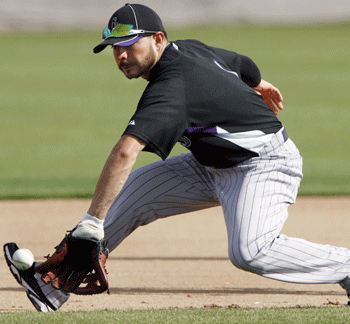
Quintanilla spent parts of five seasons with the Rockies from 2005-09, during which he posted offensive numbers that made the Colorado faithful yearn for the days of Neifi Perez. The guy has been Rafael Belliard bad at the plate in his Major League career, rocking a stunning .213/.268/.284 line. Rockies fan Ted Burke reports Quintanilla always looked solid defensively, which you’d have to assume given the “production.”

The small, pathetic glimmer of Mets-fan hope to Quintanilla’s offense rests with the fact that he’s never been nearly so awful in the Minors. His numbers have been bolstered by some very favorable hitting environments, but he has a career .308/.370/.445 line on the farm. His .298/.369/.452 line at Round Rock in 2011 was a touch better than league average for the ridiculous Pacific Coast League, but the ol’ MiLB equivalency calculator doesn’t seem to be functioning right now. Also, for what it’s worth: He hits left-handed.

If I had to guess, I’d bet Quintanilla’s signing is for Minor League depth — someone to make fancy plays behind Matt Harvey and join the Mets only in case of emergency. But then it wouldn’t be surprising at all if he outhit Jack Wilson at whatever level in 2012, so if it comes down to signing Wilson for some non-zero sum or using Quintanilla in that role with fingers crossed…

Oh man. The 2012 Mets, huh?

Top Thing of 2011 No. 2: Reyes and Beltran, June

It’s funny or ironic or at the very least interesting that Carlos Beltran’s too-often controversial tenure in Flushing ended with such a universal lovefest. Beltran stayed healthy and productive for the first four months of 2011, got traded to San Francisco before the deadline in a deal everyone knew was necessary, earned praise for his leadership all year and bought his teammates dinner on his way out, and, in a final flourish, returned from the Giants the promising right-hander Zack Wheeler, who now ranks among the Mets’ top prospects.

And the positivity surrounding Beltran’s departure especially stands out in juxtaposition with the way the Jose Reyes Era ended in Flushing. Reyes spent large swatches of July and August on the disabled list, returned in September looking tentative on the basepaths, earned talk-radio vitriol by bunting his way to a batting title then asking out of what would be his final game as a Met, and finally shed his Mets blue and orange for the Marlins’ weird sherbet in December in a he-said they-said drama fraught with speculations, allegations and 20/10 hindsight.

But neither exit ranks anywhere near the top 10 things that happened in 2011, so for the purposes of this exercise I must put them aside and focus instead on the awesome things Reyes and Beltran did when they carried the Mets through the month of June.

Reyes was spectacular for that stretch, hitting .385 with a .425 on-base percentage and a .598 slugging. He played the way we always suspected he could if everything went right for him, someplace even above the superstar level he established from 2006-2008: churning out triples, stealing bases, gunning down runners from deep in the hole. It was an amazing spectacle, one you no doubt can still remember if you can block out the image of him in that stupid Marlins jersey, and one I (and many others) wrote about at great lengths at the time.

Beltran was merely regular old Carlos Beltran that month, posting a modest (by his standards) .286/.377/.467 line but, thanks in part to Reyes’ explosion, driving in 26 runs in 27 games. In truth, Beltran performed better in May and July, but I’m using his solid June here to stand-in for his strong final campaign with the Mets.

Because it was in June that the Mets, without Ike Davis or David Wright or any evidence of a frontline starter on the roster, managed a 16-11 record on the strength of 5.5 runs per game from their offense. And 16-11 is hardly a playoff pace (UPDATE: yes it is), mind you, plus one month is a tiny sample and the run totals were bolstered by an absurd four-game outburst and a bunch of role players playing above their heads.

But it was that month, with Reyes and Beltran healthy and playing the way they were, that you could squint at the Mets and dream on them, even if it was often a hopeless dream full of ifs and buts. “If only Wright could…” “What if Davis hadn’t…” “And imagine if Santana…”

It was fun. It was fun to watch, and — for me at least — it was fun in some pathetic way to consider all the better ways it could have played out for the last vestiges of the Mets’ last good team if too much hadn’t been lost to mishandled injuries and mismanaged rosters.

But more than anything, it’s thrilling to see two superstars playing superstar baseball for your favorite baseball team, regardless of that team’s place in the standings. And while great teams can be constructed without multiple capital-s Superstars, and while we can search for and probably find some silver linings in the maelstrom of black clouds swirling around the Mets these days, the truth is it’s probably going to be a while before we see anything like Reyes and Beltran going full-tilt in the same lineup again.

Top Thing of 2011 No. 10: Pascucci pwns Hamels

It’s easy to pick out Valentino Pascucci at the Mets’ Minor League complex in Port St. Lucie in early March. He’s massive, for one thing: Six foot six and mountainous. And he’s about a decade older than everyone but the coaches in camp early for the team’s STEP program aimed at preparing its best prospects for a long season of professional baseball.

He’s not there for the same training as 19-year-old Wilmer Flores or 21-year-old first-round draft pick Matt Harvey. He’s there hoping his early arrival will allow for some Grapefruit League at-bats with the big-league club when the David Wrights and Jason Bays rest or don’t travel, opportunities to show off in person the prodigious power he has been demonstrating in Triple-A most seasons since 2003, a few scant chances to leave the Mets’ new manager and front office impressed enough to consider him if at any point during the season they find a roster spot open and a need for some right-handed pop.

And maybe he’s there because hitting a baseball is awesome and he’s pretty damn awesome at it, and when you’re pretty damn awesome at hitting a baseball there probably aren’t many better ways to pass time than doing just that in fine Spring weather in Florida on beautifully manicured fields.

By now you must realize I’ve got a thing for Minor League mashers. I’ve followed Pascucci in particular because he has been the best in the Mets’ system for three of the past four years, and because I’ll go to my grave insisting he could have made a difference for the 2008 team that fell one game short of the playoffs, got a .624 OPS from its pinch-hitters and somewhat inexplicably carried three catchers and/or Marlon Anderson for large swatches of the season.

We all want to be Carlos Beltran, to have the unbelievable natural ability and grace and drive to achieve great things in whatever it is we endeavor. But I think the truth is, for the billions of us who are not Carlos Beltran, when we look at ourselves in the mirror and try to honestly assess our various skill sets we find we’re just average in most departments and damn near subpar in some others. If we’re lucky, we’ve got just a couple of things we’re confident we’re good at, and hopefully those things are the ones we enjoy doing. And maybe in life we’ll get a couple of times when everything just lines up right and we get a chance to do that one thing well at a most rewarding moment.

By “we,” of course, I mean “me” here. Maybe you’re good at everything. I’m pretty certain I suck at most stuff. You should see my jumpshot. Atrocious.

Point is, Valentino Pascucci’s not going to chase down balls in the left-center field gap like Beltran once could or steal bases at a historic clip. The guy hits home runs, he appears confident in his ability to hit home runs, and it seems like he likes hitting home runs. Again: Who wouldn’t?

And on September 24th, a couple weeks after the Mets called up Pascucci to reward him for another season of thrilling the good people of Buffalo, he got a chance to pinch-hit against Cole Hamels in the eighth inning with his team down 1-0.

Hamels is that dude none of us can really hope to be: He’s handsome (if you’re into that look), he’s unbelievably talented, he pitches for a perennial contender, and, let’s be frank, he can regularly pose for downright humiliating photos and listen to Lifehouse and Nickelback without shame because he’s probably so confident he’s better than us in every way that he just doesn’t care what anyone thinks.

But Hamels is human and Pascucci hits home runs, and if Hamels leaves something out over the plate, Pascucci’s going to do what he does. And it’s so f@#$ing awesome:

Watching it again, I regret not ranking this higher on the list. But it’s what I wrote first, so here it is.

Studying the hit and run

Mike Fast at Baseball Prospectus — who seems to consistently produce the most interesting baseball research I read these days — takes his best stab at evaluating the merits of the hit-and-run play. It is, by his own admission, based on imperfect data, but it’s a great read regardless.

For whatever it’s worth, I’ve heard ex-players and coaches praise the hit-and-run as a manager’s means of forcing a struggling hitter’s hand in the right situation. By that thinking, if a skipper feels his player is not seeing the ball or approaching his at-bats well, calling for a hit-and-run when he’s likely to see a strike makes him adjust his approach while simultaneously taking the onus off his shoulders if the at-bat goes awry. I don’t know if there’s anything in there that’s quantifiable or if a manager is actually more likely to call for the hit-and-run with a struggling hitter, but I’ve heard it mentioned frequently enough that I thought it worth noting.

Mets cut rookie-ball team

The Mets cut their Gulf Coast League team yesterday. Toby Hyde has more.

It’s certainly not a good thing, and I suspect it won’t be the last we hear of the team making cost-cutting moves that appear to harm its long- and short-term futures. The club is, we know, financially insolvent, reportedly losing $70 million in 2011 alone. So depressing though it may be, it should come as no surprise that the Mets are looking for ways to save money.

For what it’s worth, though, the Mets were one of only three franchises that fielded nine Minor League affiliates in 2011. With eight, they will still have more than 16 Major League clubs.

Still, it’s hardly a good PR move for a club busy selling that the best way to field a perennial contender is to build from within. I’m not sure of the ways fielding one fewer rookie-ball team actually impacts their ability to do so, but I’m certain it doesn’t help it look like they’re trying.