Clone army scenario

In some sort of vague follow-up to the Army of McGwires scenario much-discussed in this space, I polled Twitter earlier this afternoon about which Met readers would clone if they had to field a team of 25 of one guy.

There were a ton of votes for a slew of guys, from Tsuyoshi Shinjo to Bobby Bonilla to Joe McEwing to George “the Stork” Theodore, all of which would be entertaining for certain.

The clear winner was Johan Santana, presumably for his athleticism, followed by Ike Davis because everyone knows he can pitch. Carlos Beltran, R.A. Dickey and David Wright got a couple votes each, and several people voted for Justin Turner, apparently excited about the redhead’s first day back with the club.

Three people ironically voted for Jeff Francoeur.

Problem with both Santana and Davis is that they throw left-handed, which would make for a good deal of awkwardness at every infield position besides first. A healthy Santana, you’d figure, could compensate some with great range, but Davis would likely be something of a nightmare in the middle infield.

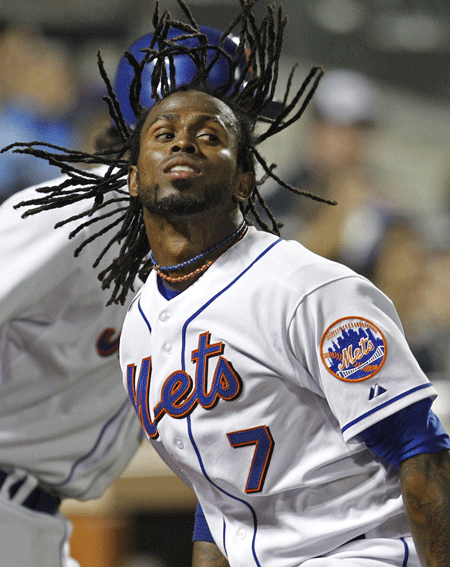
Shockingly, only one person voted for my choice: Jose Reyes. Reyes, I figure, has the athleticism to play anywhere on the field and the arm strength and accuracy to succeed as a pitcher. The Reyeses wouldn’t score as many runs as a team of David Wrights, but they’d likely prevent more.

Plus, think of the dancing! Imagine the handshakes a clone army of Jose Reyeses could come up with. It’d be amazing for their fans and infuriating for everyone else.

Usually I don’t like to include polls after I’ve already shared my opinion, but I figure you’re all smart people who can think for yourselves. So let’s hear it:

[poll id=”22″]

Or they could do that

Remember what I said this morning about how Brad Emaus should get plenty of opportunities to prove his merit as a Major Leaguer? Forget all that. The Mets have DFA’d him and called up Justin Turner from Triple-A.

Seems like sort of a knee-jerk move to me. We’ll see if the Blue Jays don’t want Emaus and he can pass through waivers, but it’s hard to figure why 42 plate appearances would be enough to give up on a guy to whom they were willing to hand the starting second-base job not even a month ago.

Like I said during Spring Training, Turner has done more than Emaus ever did in the Minors and is probably a better hitter right now. The move likely improves the Major League roster, it’s just not great for organizational depth. If the Mets’ front office concluded Emaus is never going to be any sort of Major League contributor, then yeah, might as well send him packing. But it’s unclear why 16 games, no matter how bad Emaus looked, would convince them of that if Spring Training didn’t.

Anyway, the good news is this paves the way for the Murphman-Turner Overdrive scenario I suggested back in November. Turner and Daniel Murphy, in a platoon, should combine to hit like a pretty good second baseman. If they can cut it defensively, they represent a pretty big upgrade over Luis Castillo and some of the dreck the Mets have trotted out to second base over the past few years.

¿Quien es el Gocho?

If you follow Johan Santana on Twitter — which you should, because it’s Johan Santana — you may have noticed that he recently changed the “name” part of his profile to say “El Gocho believe it!”

Santana also has “El Gocho” embroidered in script on his glove.

So what does it mean? Technically it comes from a word for pig. But a brief Internet search reveals that it was the nickname of former Venezuelan President Carlos Andres Perez, and that it is Venezuelan slang for a native of the Andean parts of Venezuela from which Santana hails. In fact, by this list Santana is the only active Major Leaguer from Merida, Tachira or Trujillo, the nation’s Andean states. He comes from Tovar, a town of about 33,000 in Merida.

The term “Gocho” has its own page on the Spanish-language Wikipedia, and using Google Translate reveals it is at least vaguely controversial. Some people believe it has a derogatory connotation and suggests that Andean Venezuelans are less sophisticated than their urban compatriots. Others claim to say it with love.

I guess a decent comp in American English would be the word “hick,” since plenty of people use it dismissively while others proudly self-identify as hicks. Santana probably uses it with a touch of irony, since he’s undoubtedly a smart dude, and you’ve got to be pretty sophisticated to pull off a vest like that.

Another fun fact revealed from a Johan Santana-related Wikipedia tangent? Santana was discovered and signed by Astros scout Chance Partin, the brother-in-law of Cheech Marin.

Feeble-minded Greg Maddux?

My thing is, any time that gets brought up, the misperception is, “This guy’s a head case” or, “There’s something wrong with him.” I know that two guys that Harvey talked to were Greg Maddux and Roy Halladay. There’s not anybody in baseball — that knows baseball — that can say those guys are head cases. I’m not saying we were talking about the same things. But even those guys, I think they understood the value of having somebody around like that.

Mike Pelfrey.

Nice job by Adam Rubin at ESPN New York, chatting with Pelfrey about the way psychology is stigmatized in sports. As I’ve said before: Pelfrey admitted to seeing a psychologist to combat that stigma, and his reward is that every time he struggles we all assume it’s because he’s crazy. To me, I don’t know, his willingness to put himself out there seems like it would take a damn good deal of confidence and stability.

Are the Mets giving up on Emaus too soon?

But Emaus was removed as the everyday starter after only six games. And he’s started half of the last eight. It’s pretty easy to see why — he’s posted an anemic 162/.262/.162 in 42 PA — but is it the right decision, based on such a limited number of plate appearances?…

Face it, the Mets aren’t going anywhere this season. Daniel Murphy isn’t the answer, even as a stop-gap option. If the Mets did the unthinkable and attempted to demote Emaus, the team would have to offer him back to the Blue Jays and have him clear waivers. There’s no way the Mets hold onto him under those circumstances.

Eric Seidman, FanGraphs.com.

OK, here’s the first thing that strikes me about this: Why is Murphy simply dismissed as “not the answer, even as a stop-gap option”?

I know Murphy is not an aesthetically pleasing defender at any position — he knows it too. But he looked to be a rangy defender at first base and hasn’t yet shown he can’t handle second. At 26, Murphy is only a year older than Emaus. And unlike Emaus, Murphy has 741 plate appearances of not embarrassing himself at the Major League level.

The crux of Seidman’s argument is correct: Teams should not give up on young players with promise because of a handful of crappy at-bats. But considering the personnel in the Mets’ case, I’m not sure why it’s so terrible to give Murphy at-bats against certain righties and an opportunity to show can cut it at second base.

It’s true that Emaus, like all young players, would likely benefit from regular at-bats. But Emaus is 25, so it’s not exactly like the Mets have again called up Ruben Tejada to ride the pine or Jenrry Mejia to pitch in mop-up situations. And since it’s entirely likely Emaus will prove to be little more than a platoon player, he’ll probably need to be able to succeed in irregular at-bats, too.

As Seidman notes, Emaus is still starting about half the Mets’ games. With enough time, he should have plenty of opportunities to show whether he’s worth keeping around. And since the Mets have another youngish player at the same position working to prove his merit as a Major Leaguer, it’s unclear why Emaus should be prioritized.

Absolutely nothing

One day in college, I slept late or had too much work to do or for some other college-y reason couldn’t make it out to a Georgetown basketball game at the MCI Center on a Saturday afternoon. I watched it from the couch in my living room, otherwise empty as my roommates were all at the game. I don’t remember the exact situation now, but the game came down in part to a goaltending call against the Hoyas. When it happened, I was certain it was the wrong call, and I stood and yelled and stomped around my living room like a crazy person.
Then they showed the replay. Totally goaltending. The ball had reached the peak of its arc and was on its way down when the Georgetown player swatted it into the seats. He broke the rules. Ref made the right call.

My roommates returned home a bit later and we got to recapping the game. They explained that from the student section they had a great view of the block, and they could say for sure that it was a b.s. call. I told them the replay made it pretty clear it was the right call but they didn’t believe me. They saw it with their eyes, up close.

There was no TiVo then and none of us really felt up to arguing after a Hoyas loss, jaded though we were by that point. I shrugged and they shrugged too, and soon enough we got to our usual early-evening Saturday habits of playing video games and watching The Big Lebowksi for the billionth time.

But I think about that a lot now when I talk to Mets fans, especially so early in the season.

I bluster on all the time about how our eyes can deceive us. In that afternoon, I have a pitch-perfect example: My roommates, smart guys with strong vision all, legitimately saw something that didn’t happen. I don’t think they were just trying to convince themselves of it so they could blame the ref instead of the then-miserable Hoyas for the loss. I don’t know the science behind it, but I’m pretty sure at some point in the pathway between the eyes and the conscious part of the brain some chemical bias altered reality and showed them a b.s. call.

We all do this all the time, I fear. We see things the way we hope to see them, regardless of if that’s the way they really happened. Mets fans certain that Mike Pelfrey is crazy watched him melt down on the mound again on Saturday evening, losing his cool and getting knocked around for 11 hits in five-plus innings.

Those of us who believe — or want to believe — Pelfrey’s early-season struggles are not mental so much as the byproduct of yielding too much contact watched a bunch of bloops and bleepers find holes and victimize the starter, the type of misfortune that tends to even out over time.

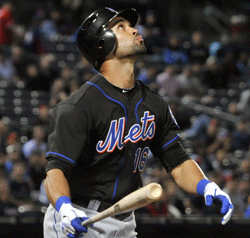
Some Mets fans somehow already know that Brad Emaus is not a Major League-caliber player, so when he whiffs wildly or dribbles out or botches a play in the field, they say, “See? Can’t you see it with your eyes? He stinks!”

Angel Pagan, doing all of the same things, gets the pass he earned by being an excellent Major Leaguer for the last season and a half. He is slumping; we know he can perform at the level so we see he is pressing or struggling or “just not seeing the ball well.”

Pedro Beato, we see, is fearless; he has the closer’s mentality. Bobby Parnell is lost.

You get the point, and it’s one I’ve already belabored plenty. I appeal to evidence more than appearances on this site because I am not a scout; my eyes are not trained to assess baseball players or teams, and even if they were I’m not certain I’d believe them. Most players look crappy when they’re playing crappily. Most players look awesome when they’re playing awesomely. We need lots of data to clearly distinguish the truly awesome from the downright crappy.

What we know about the current Mets is that they’re 5-11 and have endured an awful stretch. But 1/10th of the regular season does not provide enough meaningful evidence with which to draw any conclusions. Emaus and Parnell need more opportunities to show what they will or won’t do this season. Pagan and Pelfrey should be fine if they’re healthy. We shouldn’t go too crazy over Beato or Dillon Gee just yet.

This is all just a long-winded way of saying what I typically say: Absolutely nothing.