Playoffs!? With Toby and Patrick:
On iTunes here.

Playoffs!? With Toby and Patrick:
On iTunes here.
Bottom line: Wright may not go for the jugular with the Mets, but it’s hard to fathom him settling for less than Zimmerman’s $126 million. And since Wright is on the record wanting his next contract to take him to retirement (which the Mets hope to accomplish though options), eight years would seem to be the minimum for which Wright would settle unless he’s feeling benevolent.
Rubin makes a series of good points in his post and typically works with more information on the Mets than just about anyone. And I am a hopeful Mets fan, so my perspective is skewed by my bias.
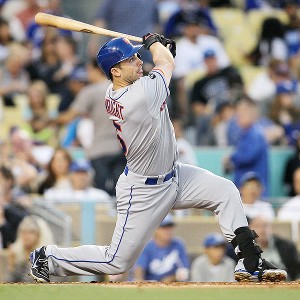 But I wonder if eight years and over $126 million seems a little steep for Wright. Zimmerman’s second extension — the six-year, $100 million deal on top of his existing one — starts in 2014, when he’ll be 29. Wright’s already that old, and since the Mets hold an option on his contract for 2013, an extension beyond that will kick in when he’s 31. But then Wright is a demonstrably better hitter than Zimmerman and has missed less time with injuries than Zimmerman has, so maybe that makes up for their difference in age.
There are some semantic issues at play, too — would we call a six-year extension on top of Wright’s 2013 option a seven-year deal (as Rubin does in Zimmerman’s case), since it puts Wright in the Mets’ control through the end of the 2019 season? It doesn’t much matter and I’m not sure if there’s standard practice for clarifying these things in baseball writing, but either way I suspect there’ll be some confusion ahead.
Completely uninformed, shot-in-the-dark guess: Wright gets six guaranteed years and roughly $110 million on top of the 2013 option with a couple of team options tacked on to the back, and the deal is framed as a seven-year, $126 million extension.
Another hunch: R.A. Dickey does not get an extension, but is not traded before if and when the Mets fall out of contention in 2013.
No sarcasm. Straight to the monkey.
Carlos Beltran hit two home runs last night to help the Cardinals beat the Nationals in the NLDS, because that’s one of the main things Beltran does. That power outburst, of course, inspired a lot of ironic Beltran-blaming from all corners of the Internet and this reasonable observation:
https://twitter.com/PatrickJFlood/status/255461454872977408
Patrick’s is a point I’ve made plenty of times before. July 11, 2011, for example:
No one really blames Carlos Beltran for anything anymore.
A joke that started as backlash to a pesky, ill-conceived idea forwarded in many corners of the fanbase and media has become a tired cliche, embraced now even by many of the same talking heads and columnists whose unsubstantiated insinuations prompted it in the first place.
And sure, a few stubborn fools maintain that Beltran is somehow at fault for all the Mets’ troubles, and in weak times we may turn to their blogs or Twitter feeds to see how their warped minds will twist his latest contributions to fit with their nonsensical narratives. But it is only a macabre appeal, like peeking through our hands at a train wreck. Anyone still blaming Carlos Beltran has long since careened off the rails.
Or later that month:
People who don’t appreciate Carlos Beltran by now don’t deserve to.
But then then there’s stuff like this, still appreciative of Beltran but apparently designed to tweak Mets fans:
https://twitter.com/JonHeymanCBS/status/255456475407867905
And I am tweaked. Beltran had a .978 OPS in his only postseason with the Mets. Sure, that’s below the absurd standards he has set for himself as the greatest postseason hitter of all time, but it’s still well within the range, I’d say, of “completely awesome.” And Beltran hit THREE home runs in the series for which he is blamed. Beltran’s 115 career postseason plate appearances make for an inadequately small sample, for sure, but you know what else is a small sample? ONE AT-BAT. It was an incredible curveball! Adam Wainwright is awesome. Babe Ruth wouldn’t have hit that!
Deep breath. Inhale. Exhale.
Don’t indulge; just enjoy. Carlos Beltran is so completely totally awesome — in the postseason, in the regular season, in Spring Training, whenever. And if you know and I know he would have been similarly awesome in later postseasons with our New York Mets if they had ever again managed to put a legitimate postseason team around him, there’s no real reason to harp on it.
So here’s something.
 Postseason baseball is awesome. But since our Mets have not partaken in it of late, this is the time of year for many of us to focus on rooting against the Yankees or rooting through baseball-reference.com for signs of hope. Since I’ve got no particular distaste for the Bombers beyond the boilerplate stuff, let’s engage in the latter.
Near the bottom of nearly every player’s page at baseball-reference, you’ll find his “Similarity Scores,” with lists of other players. The scores were invented by Bill James and are formulated through a process described here. Though every player is his own unique snowflake, the idea is that by comparing a current player to his nearest historical match, we can attempt to predict how he will perform moving forward. For active players, one of the lists provides the top 10 most similar players through that player’s current age. For Nick Swisher, say, the player who performed most similarly through age 31 was Jermaine Dye — though who’s to say if Dye could bro it down quite so hard?
It’s hardly a perfect way to predict how a player’s career will proceed, and it is indeed not even the best method for that. And certainly it’d be silly to expect Swisher to enjoy a career year at age 32 just because Dye did. But then there’s no perfect way to predict the future — what with, you know, the future — and looking at a player’s historical comps provides a handy, accessible guideline for guessing how guys will go forth. Players who produced like this to that age tend to produce like this afterward. That’s the idea, at least.
Anyway, with that in mind I took a look at the Mets’ position players’ age comps to try to figure which one has the best career in front of him.
Want to guess? Take a second and think about it: Which Met position player will be the best from 2013 through the end of his tenure in the big leagues?
There’s no right answer, of course. You might say it’s Justin Turner, and though I could point out that the players most like Turner through age 27 have averaged about one season’s worth of similar production afterward, I obviously can’t guarantee it will go that way for Turner. Plus the accuracy of the comparisons differs with every player, and in some cases we’re comparing contemporary players with guys who played in the 1890s when they might still get diptheria and such.
By this imperfect method, though, one Met is pretty clearly the safest bet to be the best from here on out. It’s David Wright and it’s not even close.
That might seem incredibly obvious to some of you: Wright is, after all, by far the best current Met and has established a level of production far more reliable than those of any of his teammates, so even though he’s a bit older and may have a shorter career in front of him, he comes with the least risk of collapse. But to others — especially those arguing for Wright’s departure this offseason — let it serve as a handy reminder. No player currently on the Mets is likely to be better than Wright for the rest of his career.
Hell, you could even argue that Wright might be the best of these current Mets five seasons from now, toward the end of a rumored extension, should he sign one. About half the guys on Wright’s list enjoyed healthy All-Star caliber seasons at age 35 or older — Chipper Jones, Carl Yastrzemski, George Brett and Carlos Beltran among them. Only two of them tanked. The average player on Wright’s list produced over 1,000 hits, 23.1 WAR and a .287/.376/.483 line after his age-29 season. And that average includes Beltran and Aramis Ramirez, who are both still playing and producing.
Does that mean Wright will definitely be worth whatever extension his agents are currently in the process of negotiation? Of course not. But it means it’s far from a guarantee that he won’t be worth it, since guys as good as Wright tend to stay good well into their 30s. It depends on the deal, of course.
Using the same method, the rest of the under-control Mets in descending order by projected future WAR: Ruben Tejada, Ike Davis, Daniel Murphy, Lucas Duda, Josh Thole, Jason Bay, Turner. That feels generally right, no?
Point is, David Wright is very, very good. Players of his caliber don’t typically fall apart at his age or immediately thereafter. Just because the Mets don’t appear primed to contend in 2013 doesn’t mean Wright won’t be an important part — if not the most important part — of their next contender.
https://twitter.com/TheSeanKenny/status/254230607763222528
There were a ton of questions about Wright and Dickey, so let this stand in for all of them. I don’t know that it necessarily comes down to one or the other and obviously any extensions depend on the deals — both players could easily be seeking more than the Mets should reasonably pay for their services, regardless of how awesome they are.
I think Wright is more important to the Mets’ success in the short and long terms than Dickey is, which is not to diminish Dickey’s excellence so much as to trumpet Wright’s. I don’t think enough Mets fans recognize and appreciate how great a baseball player David Wright is. Even in his down years he’s still very valuable, and in years like this one he’s among the tops in the Majors. He’s the best position player in franchise history, by all accounts he keeps himself in great shape and is a great teammate, and he seems like a generally excellent dude.
A few people noted that because the Mets don’t appear primed to contend in 2013, they should trade Wright now and rebuild for the future. And, again, if someone wants to give the Mets some crazy package of talented young players for Wright, then sure, peace out. But it’s downright silly to just say, “trade him for prospects” and assume one of the prospects will grow up to be even half as good as Wright. Wright’s certainly not a Hall of Famer yet, but he’s on that trajectory. Did you know he’s second only to Miguel Cabrera in career WAR among position players under 30? Guys as good as Wright don’t come around very often. That’s why the Mets have never had a better position player in their 50-year history.
Time can catch up with players pretty quickly, but I don’t see why anyone would expect Wright to stop being awesome before the Mets can cobble together a contending team — especially since Wright makes them all that more likely to contend. Plus, figuring the money allotted to Wright could then be redirected elsewhere later assumes that a free agent of Wright’s caliber at a position the Mets need will hit the open market — far from a guarantee.
Dickey’s status is less clear, and the case for trying to trade him this offseason, I think, is a bit stronger. (Depends on the deal, again.) Obviously it’s not a possibility I’d like to consider right now, but he’ll be 38 in a couple of weeks, he’s coming off an extraordinary season, and there’s an extremely inexpensive option on his contract for 2013. Knuckleballers don’t age like most pitchers, of course, but Dickey is not like most knuckleballers. And though starting pitching depth can be fleeting, the Mets appear to have way more on the mound than they do at the plate.
But the Mets’ best chance to contend in 2013 requires Dickey fronting their starting rotation, and since I’ve seen baseball before and I’m not willing to count a team out six months before the season even starts, I’ll hope they make a go of it with both Wright and Dickey.
https://twitter.com/Briligerent/status/254230330410688512
I suspect there’s some lingering animosity among Mets fans over the pond-scum stuff from the late 80s, but I’m all for the Cardinals provided they are led straight to the monkey by Carlos Beltran. Yesterday’s poll here pretty accurately reflects my rooting interests on the National League side, actually: Beltran, the Reds, the Nats, then a big break, then the Giants and Braves. As an added bonus to any Beltran glory, the Cardinals defeating the Braves in the play-in game might help expose how silly the play-in game is, since the Braves proved six games better than the Cardinals over a 162-game regular season.
In the AL, I’m first and foremost for the YOLOrioles because I know enough long-suffering Baltimore fans to sympathize and want something good for them. The A’s and Tigers are cool, too.
https://twitter.com/FlagrantFan/status/254230279395360769
Bryce Harper and Tim Bogar.
https://twitter.com/tpgMets/status/254230957148762112
I’ll go with my birthday, Jan. 22.
https://twitter.com/mikerudner/status/254230743235055622
No, but it’s close. As fun as the public shaving was, the highlight still has to be the day I spent with Ralph Kiner doing the Kiner’s Korner Revisited videos a couple years ago.
https://twitter.com/sabometrics/status/254229729295601666
None, unfortunately. Keith’s mustache powers are non-transferable, and the mustache is lifeless and limp without Keith’s lip. The two share a synergistic relationship.
Toby, Patrick and this guy give out end-of-season awards:
On iTunes here.
Here’s the messed-up part of it all: I think the Mets could be good next year. That’s not spin and it’s not something I’m writing for the sake of getting your attention. I believe that.
 There’s work to be done, no doubt. But the Mets should return a solid young infield featuring a bona fide superstar and a deep staff of starting pitchers led by R.A. Dickey, Jon Niese, Matt Harvey and — given health — Johan Santana and Dillon Gee. That’s a nice place to start, and though the horizon would appear quite a bit sunnier if we knew they had any money whatsoever with which to secure some outfielders this offseason, I’ve still got enough faith in Sandy Alderson and baseball’s pervasive randomness to reasonably hope the Mets leave Spring Training with a squad fit to compete in a tough division.
Would I bet on it? No. But then I certainly wouldn’t have bet on the A’s or Orioles being alive today a year ago.
That’s only the logical presentation, though. Part of being a fan, I think — or at least part of being a Mets fan — is the odd balance of suspecting your team is irreparably doomed but maintaining some real sense of hope they’ll prove otherwise. Because another part of me — a big part, an angry part — expects the Mets will suck next year and suck the year after that just like they sucked last year and the year before that and the year before that.
I spent some time on the podcast this morning agreeing with Patrick and Toby that this season’s Mets had more than their share of great moments and stories for a 74-88 team: Johan Santana’s no-hitter, David Wright’s return to form, R.A. Dickey’s Imperial March over the National League. But then as we talked, I remembered the great things of 2011 — Jose Reyes and Carlos Beltran — and even the great things of 2010, the fleeting heroics of Rod Barajas and Jeff Francoeur.
Every year, right? Every year there are great things among the disappointments. And every year there is hope, every year hope is crushed, and every year we come back hoping. This might be the weirdest thing I do. And the Mets exist in such splendid juxtaposition with their rivals across town, who practically never disappoint. How does a Yankee fan distinguish season from season? Does he need to isolate the small victories from the mire of failure, or is it reversed — is 2007 the year they gave way too many at-bats to Melky Cabrera and lost to Cleveland in the ALDS? Or is it as simple to a Yankee fan as Years It Happened and Years It Didn’t?
I started off with a point to make and it’s fast slipping away from me. I think I’m trying to justify how I can emotionally invest in something practically bound to disappoint me, then still come away oddly satisfied when it does.
Is baseball that good? Certainly; baseball is the best. But I suspect, too, there’s something oddly enjoyable about being Mets fans that leaves us better prepared than most for our daily and monthly and yearly challenges. How often is anything all it’s cracked up to be? And what better way to shoulder reality than to celebrate the small triumphs and hope there are grander ones to come?
One time I was randomly cast in a Jack in the Box commercial, and another time Francoeur walked twice in a game. I think the Mets could be good next year.
This is hardly a perfect poll — I wish I could figure out a more customizable form — but I tried this last year with Jose Reyes and it turned out surprisingly close to the deal Reyes actually got, so I figured I’d give it another go.
If for some reason you were the Mets’ general manager, knowing you had finite resources, what is the most you’d be willing to give David Wright in terms of money and years in a contract extension this offseason? For the purposes of this silly exercise, assume the extensions listed below imply beyond the 2013 option, so a three-year extension would keep him under control through the end of the 2016 season.
And again, not what you’d hope to sign Wright for. The ceiling.
 Tedquarters