
You’re purchased?

The Wilpons said they will not sell a controlling stake, and Trump isn’t known to be a passive investor.

“That’s been the rumor,” he said.

Asked whether he would consider investing without gaining control, Trump responded: “I haven’t thought that far down the line. We’ll see what happens.”

Major League Baseball has rules against casino ownership by its team owners, which could prove an impediment if Trump chooses to make a deal with the Wilpons.

“If I can help, great,” Trump said. “And it not, that would be OK.

Ronald Blum, Associated Press.

A couple people asked me about this so I figured I should weigh in. My opinion: Meh.

Sure sounds to me like another case of, “Hey, here’s a famous rich guy with ties to New York, let’s ask him if he wants to buy the Mets” and then the famous rich guy being like, “well, now that you mention it, I am really rich, and I do like being famous, so let me say nothing particularly committal to see if I can get my name in the headlines for a couple of days because I so enjoy that.”

In other words: I’d be pretty surprised if Donald Trump ends up with a minority or majority share of the Mets anytime soon. For one thing, and as I’ve said before, there are lots of non-famous rich people out there who are probably equally likely to buy a share of the team (and who would presumably be more content to be silent partners) as any famous rich people. Second, I bet that casino thing is a pretty big deal for MLB. The league does not look kindly upon involving the sport with gambling.

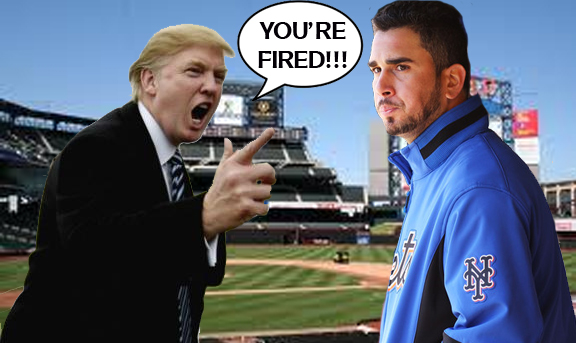
People seem to have pretty strong opinions about Trump one way or the other, but I haven’t followed enough of his business ventures or TV show to know much about him besides that he’s got silly hair and seems like something of a blowhard. Some say he singlehandedly ruined the USFL. While I go read about that, enjoy this Photoshop from reader Glenn:
What he said

Here’s the thing I don’t get: why say this at all? Mejia’s own performance will dictate where he will land eventually. That and the organization’s evaluation of his performance. There’s just no question that a top-line starter is more valuable than a short-reliever….

Warthen was being honest, and I suppose he deserves our approval for that. However, sometimes, tact is as important as honesty. I don’t know what question from what reporter prompted this discussion. Nor do I really care. The issue here is that there are other people with the Mets who think Mejia has the potential to be a starting pitcher and he is being developed with that goal in mind this season. Warthen, while expressing a personal opinion, is essentially publicly expressing disagreement with others in the organization.

Toby Hyde, MetsMinorLeagueBlog.com.

People seem to be making a lot about Warthen’s comment that Mejia profiles as a Major League reliever, but I’m with Toby: It doesn’t really matter much. If we’re assuming that decisions about the way the team’s top prospect is handled are now the dominion of the front office — sigh! — the Major League pitching coach’s opinion probably doesn’t much impact the way the team develops Mejia.

(Oh man, remember all that last year? Holy hell, did that happen?)

Anyway, it might be better if Warthen kept opinions like this one to himself, just for the sake of public relations. But though I’ve ripped Warthen for things he has said in the past, Mets pitchers publicly and privately rave about him, so he must be doing something right. It’s probably not fair to judge him just based on what he says to the press.

Oliver Perez shows up early

Well there’s this: According to David Lennon of Newsday in a subscriber-only piece, Oliver Perez showed up to Mets camp a couple days early yesterday, only to find the complex locked. Perfect. Lennon reported that Perez then picked up some workout clothes and left to exercise on his own.

In the grand scheme of things, the report means very little, of course. But for some reason fans seem to use the date a player reports for Spring Training as a barometer for his commitment. If he is there a week early, he is focused and prepared, a dedicated team player. If he only arrives the day he is contractually obligated to show up, hellfire and sanctimony, fire and brimstone.
Of course, there’s some confirmation bias at play. Fans note when Perez is not listed among the players that arrived early to camp because they have already decided that he is lazy and unfocused. No one even notices that Mike Pelfrey’s not there — hey, he’s got a young kid and another on the way; maybe he wants to spend time with this family!

Neither Pelf nor Perez nor anyone else should be faulted, ever, for failing to show up before the mandatory reporting date. For one thing, no one has any idea what type of work a player does on his own time, in his home gym or with his personal trainer or whatever. Second, showing up early is voluntary. I rarely come into the office on weekends. I could, and I’m sure my bosses would appreciate the extra effort, but I’ve got lots of other stuff to take care of.

Maybe some players determine that showing up a couple days early will help them get a leg up on the competition or earn good standing with the team, but maybe others want time to get in the best shape possible before they show up to camp so they can make a good impression when they do. And maybe some really just don’t want to put in the extra work. Who knows? I don’t.

Point is, we can knock “not showing up early” to camp off our list of complaints about Oliver Perez. We’re going to have to instead focus on the big ones: “Owed $12 million” and “Not very good.” The former is certainly not his fault. The latter might be.

There have always been mixed reports on Perez’s work ethic, and it’s difficult to tell to what extent they’re true and to what extent he’s simply an easy punching bag for media because he’s a) already disliked by fans and b) not a great quote. The only concrete evidence we have of his selfishness is his refusal to go to the Minor Leagues last year, something well within his rights as a Major League veteran. Of course, as fans, it’s well within our rights to boo him for occupying a roster spot.

Twitter Q&A-style product

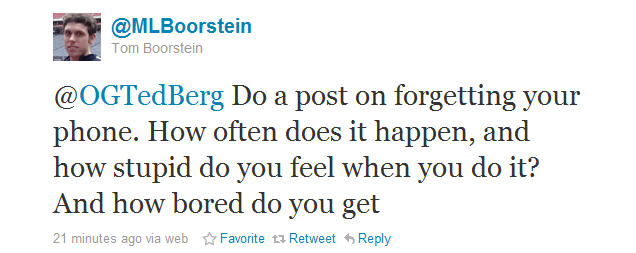
Kind of a long story that I might touch on later, but I don’t have my phone, which had the audio of the interview I intended to transcribe today. So in lieu of that, here’s some Twitter Q&A-type stuff. Actually, these ran long so I’m breaking them up into two posts.

One of the inevitable downsides of a sports reporter’s affecting or achieving disinterest in his subject is that readers will perpetually speculate which team he or she favors. I am lucky in that I am able to come right out and tell you I’m a Mets fan so there’s no doubt where my rooting interest lies, and even so I have been accused of being a “fake” Mets fan — though it was never clear if those people meant I was faking my favoring of the Mets or just a fake human, perhaps some sort of bot developed by SNY to forward the company line.

Anyway, I’m reasonably sure that in 90% of cases, the fan guessing at the journalist’s rooting interest is wrong — either it’s simply a matter of confirmation bias on the part of the fan, or the journalist quietly roots for some team the fan hasn’t even considered, or the journalist unknowingly favors the players and teams that make his job easier, or the journalist really doesn’t care. But Stark, here, lends credence to the common Mets-fan theory that he’s a big-time Phillies fan, formed partly because of his past as a Phillies reporter and partly because he dedicates thousands of words to trumpeting the Phillies’ grit and hustle and greatness.

The section about the Mets’ offseason in Stark’s column is so silly it doesn’t even really merit a response. It starts with a joke about how Sandy Alderson probably didn’t know what a Ponzi scheme was before this offseason (with no mention of how he went to Dartmouth then Harvard Law), then goes on to… oh lord, it’s not even worth my frustration. Basically every single thing he writes in the section is wrong or poorly considered.

I was actually thinking about it, so here’s a good excuse. It doesn’t often happen to me — usually I check for my phone, watch and wallet before I leave anywhere. But today I had a small notebook in my coat pocket, and I must have mistaken that for my phone. I had a doctor’s appointment in the morning so I took the train into the office in the middle of the day.

When I finished the Daily News and reached in vain for my phone, my reaction to not finding it wasn’t disappointment or annoyance, but something closer to terror. Then when I realized I was terrified by not having my phone on me, I grew even more terrified because of the implications of that response. What the hell is wrong with me? It was only a little over a year ago that I got a smartphone, and now I’m so dependent on the thing that I completely panic when I don’t have access to it.

I mean, granted in this particular situation I had work I wanted to be doing that required the phone, plus it was technically in the middle of my work day and I work on the Internet, so I have a couple of excuses. But still. Kinda got me thinking of the Matrix, and wondering if the first people that plugged into those pod things did so on a voluntary basis.

I am generally of the mind that the technology that enriches our lives makes us smarter, and I have no doubt that the awesome breadth of information now almost perpetually available at my fingertips has better prepared me to succeed on Jeopardy. But I do wonder sometimes if the constant distraction affects the depth of my thoughts, and if I wouldn’t be better off putting the damn thing on the shelf for a few days every so often to better convene with whatever the hell is out there that’s not on Twitter.

A conversation about Matt Cain

Interesting read for baseball nerds. Dave Cameron and Rory Paap try to investigate why Matt Cain consistently outperforms his peripheral numbers. If you’ll recall, I struggle a bit with xFIP. I have no doubt that most pitchers’ HR/FB rates will normalize over time, but I’m unwilling to go all-in on the idea that no pitcher can consistently yield weak fly-ball contact. Also, I wonder if the organizational angle that Cameron and Paap seem to settle on would also pertain to the A’s. I think it’s eminently reasonable to consider that the nerds in Major League front offices and dugouts could be a step ahead of us nerds on the Internet on this one.

BREAKING: Rich guy could buy the Mets, probably won’t

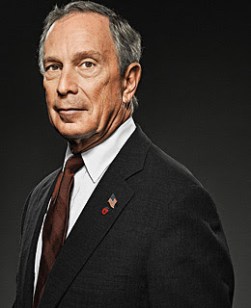
With his excellent seats at Citi Field, Michael Bloomberg says he won’t upgrade to the owner’s box.

The billionaire mayor was asked Thursday if he was interested in purchasing the 20%-25% stake the Mets’ current owners, Fred Wilpon and Saul Katz, are selling off to raise cash for potentially crippling litigation involving their ties to Bernie Madoff’s collapsed Ponzi scheme.

“I don’t think I should own a baseball team,” answered Bloomberg, smiling.

Nathaniel Vinton, N.Y. Daily News.

So is this how it’s going to be now? We’re just going to start speculating that every single rich person with even vague ties to baseball or New York might purchase the Mets? Because that’s going to get tedious.

First of all, it seems likely that anyone with $250 million lying around to invest in a baseball team didn’t come into that money without being pretty careful about his or her investments, so outside of a few outlying eccentrics I imagine most billionaires aren’t going to come out and be all, “HELL YEAH I WANT THE METS! TRADE DAVID WRONG!”

Second, there are a ton of extremely rich people who aren’t celebrity rich people, meaning that there are prospective buyers beyond Bloomberg and Mark Cuban and James Dolan and Derek Jeter and whoever else. It might not make for an interesting story if some hedge-fund manager from Chappaqua that no one outside the financial world has ever heard of emerges as a candidate to buy all or part of the team, but I can’t imagine it makes much of a difference to the Wilpons or, for that matter, to the Mets in the long run.

Speaking of: The 20th richest man in America, per Forbes, is a New York hedge-fund manager named John Paulson (Ed. note: His name is John Paulson). Forbes says Paulson is worth $12.4 billion, and yet I had never heard of him until right now. What’s up with that, Mr. Paulson? What’s the point of making $12.4 billion if your name’s not going to ring out through the streets?

Anyway, I’ve got an easy solution for you, John Paulson: Give me a billion dollars. That’s less than 1/12 of your riches. I keep a sports and sandwich blog of moderate repute, and if you made me rich, I’d probably dedicate half my posts to writing about how awesome you are. Think of the publicity! Sandwich of the Week: Lobster and Caviar on saffron-infused brioche with diamond aioli. And bacon. All thanks to Mr. John Paulson, billionaire philanthropist and patron of the sandwich-oriented arts.

Long story short, guessing that the rich people you’ve heard of will buy the Mets is probably a fool’s errand, because there are likely way more rich people you haven’t heard of. And it’s certainly going to take a while before anything concrete gets done, so it’s probably fruitless to spend the interim picking billionaires out of hats and assuming they might be interested in investing in a baseball team supposedly carrying considerable debt.

Remembering Rick Reed, even if the video games didn’t

Patrick Flood continues his countdown of the greatest Mets of all time with No. 27, Rick Reed, who crossed the picket line during Spring Training in 1995 and was thus excluded from MLBPA-licensed video games. I remember John Franco had a great quote when the Mets’ clubhouse finally came around to Reed in 1997 — something about it being hard to hold a grudge when a guy’s got an ERA under 2 (as Reed did until early June that season).