Apparently the Mets have suspended popular longtime equipment manager Charlie Samuels indefinitely and without pay for what they’ve deemed “an ongoing personnel matter.” Weird.
Things getting weird in Flushing
19

Apparently the Mets have suspended popular longtime equipment manager Charlie Samuels indefinitely and without pay for what they’ve deemed “an ongoing personnel matter.” Weird.
Caryn at Metsgrrl has a nice writeup with a ton of details following a conference call with Mets VP Dave Howard. The list of “Amazin’ Perks” apparently includes a visit to the SNY studios, so if you get that, you should absolutely demand to meet me, and throw around phrases like “sandwich authority” and “hotshot GM candidate” and “transcendent genius.”
The Mets picked up Jose Reyes’ $11 million option yesterday, a no-brainer. Mike Lupica seems to think otherwise, as does at least one reader of this site. But Fangraphs valued Reyes at slightly over $11 million even last year, when he straight-up sucked for the better part of two months after returning from his thyroid issue.
 People seem to think shortstops who can adequately field the position and hit a little bit grow on trees. They don’t. Even in 2010 — undoubtedly a down year statistically — Reyes ranked fifth among Major League shortstops in OPS and fourth in wOBA.
Reyes is worth $11 million even if he performs only as well as he did last season, and way, way more if he produces like he did from 2006 to 2008. Certainly there exists the risk of injury, and if Reyes is going to post a .322 on-base percentage he shouldn’t be hitting leadoff.
But the investment now buys the Mets time to determine how much they’re willing to offer on a long-term extension, plus it’s not like there are any better in-house options laying in wait.
The more interesting roster move, I think, is a minor one: The Mets added Minor League reliever Manuel Alvarez to the 40-man roster, presumably to protect him from the Rule 5 Draft.
That’s good. I mentioned Alvarez a couple times here while wading through the Mets’ bullpen issues. I can’t say I know a damn thing about the guy except that he absolutely dominated High-A and Double-A hitters in 2010.
For the season — including a six-inning stint at Triple-A — the 24-year-old Venezuelan posted a 2.17 ERA and struck out 84 batters in 78 2/3 innings while walking only 12. That’s a near Cliff-Leeian 7:1 K:BB ratio, the type of performance that suggests he could probably contribute to a Major League bullpen soon.
Alvarez did not pitch well at all in his first four Minor League seasons, but the stats suggest he made some sort of adjustment before his 2010 campaign. Toby Hyde described him as a four-pitch pitcher in a post in July, so I wonder if Alvarez added or improved one of those offerings in the offseason. Whatever it was, it worked.
Perhaps Alvarez succumbs to the same fate as Carlos Muniz, drifting between Triple-A and the Majors for a little bit before suffering the inevitable injury setbacks, but if the Mets are hoping to be more careful about letting valuable arms like Heath Bell slip away, protecting Alvarez is a nice first step. Bell’s Minor League peripherals — especially once he hit age 24 — were about as impressive as Alvarez’s, but, of course, he lacked Jon Adkins’ Major League pedigree.
According to El Nuevo Dia, via MLBTR, the Mets have invited Carlos Beltran to meet with Sandy Alderson. I don’t know why, I don’t have any inside information and I don’t know if or when they’ll actually meet. But if they do, I hope Alderson says something like this:
 “Hey, Carlos: I know you might feel like you haven’t gotten an entirely fair shake here — from the team, the fans and the media. And I have no idea what happened last year with the miscommunication around your surgery, and frankly, I don’t care.
I know that you are a great player, and for us to compete in 2011 we’re going to need you healthy, happy and productive. I know it’s not much, but I will take every opportunity I can to stress your importance to this club.
And we feel you would be especially valuable to us if you could move to right field this season. I trust you’ve seen the way your friend Angel Pagan covers ground in center, and we think his presence gives us the luxury of moving you to the corner to take a little bit of strain off your knees.”
And then they share a bro-hug or something, and Beltran buys Alderson a beer for being such a straight shooter, and they all live happily ever after.
Duda alone would not get a deal done as it would take at least one more player – probably someone with even better prospect status, as Duda himself failed to rank in Kevin Goldstein’s top 11 list this past winter. For that reason, the Mets may have little to no interest in Garza as it is, but their depth makes them an interesting candidate for a trade. Even if nothing comes from it.
Wait, really? A deal for Matt Garza centered around Lucas Duda? Do it. Do it.
 Look: I like Duda as much as anyone; it really seems like something clicked for him this year and he blossomed into a legit power-hitting prospect. But he’ll be 25 on Opening Day, he has only one year of Minor League excellence on his resume, and he’s not much of a defender.
Garza is 27, under team control through arbitration through 2013, and has pitched well and stayed healthy in baseball’s toughest division since 2008.
I imagine it would take a good deal more than Duda to net Garza in a trade. But the Process Report is a sabermetrically inclined Rays blog, not a bunch of delusional Mets fans proposing senseless deals on talk radio. And their main point here is a good one — the Mets have a lot of young depth at the corners and need pitching, the Rays have pitching to trade and need someone to replace Carlos Pena.
Since Garza would likely help the Mets both in 2011 and down the road, dealing for him would not represent the type of imprudent spending I advised against here. If the cost in prospects is reasonable, acquiring Garza would mean taking advantage of a rare opportunity to grab a reliable and cost-controlled starting pitcher, albeit one with a disgusting chin beard.
The Mets have hired former Blue Jays GM J.P. Ricciardi as Special Assistant to the General Manager.
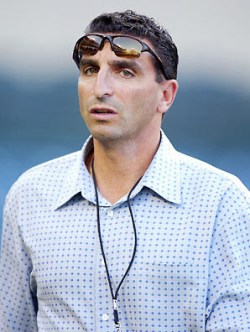 Ricciardi, if you’ll recall, once ripped Adam Dunn on talk radio, claiming that he “doesn’t really like baseball that much.” Then he said he called Dunn and apologized, but Dunn denied ever speaking to Ricciardi. Ricciardi maintained that the person on the other end of the phone said he was Adam Dunn and said, “That’s quite a prank to pull.” All this is available on Ricciardi’s Wikipedia page.
On the upside, he put together a decent young core of pitching talent in Toronto that didn’t really take hold until after he was fired at the end of the 2009 season.
Ricciardi played infield in the Mets’ system for two seasons in the early 1980s. He told reporters he had a standing offer from Theo Epstein to join the Red Sox front office, but decided to join the Mets when Sandy Alderson got the job. He said he hopes to bring the Mets to where the Red Sox are (in the organizational sense, not moving them to Boston). He stressed the importance of building a farm system through the draft and international scouting.
He said he’s excited to work for a team with the resources that the Mets have.
Adam Rubin alludes to inside information he can’t print that would prevent the Mets from hiring Wally Backman. Let the rampant speculation begin!
A few years ago, I painted the interior walls of an apartment with a friend. Neither of us had ever endeavored a paint job of that magnitude before, but we figured it wasn’t exactly rocket science — tape the moldings, paint the walls.
 The actual painting part wasn’t terrible, but taping all the edges turned out to be a huge pain in the ass. We spent at least as much time taping as we did painting, and the project took us about twice as long as we expected.
Just before we finished, the cable guy came. He complimented our paint job, and asked if we had taped up all the moldings. We said that we had, and he informed us to the existence of paint edgers, an inexpensive tool that paints the edges of walls without the need for all that tape.
We cursed ourselves for not doing more research and cursed fate (and probably Cablevision) for sending the cable guy so late in our process, but at no point did we curse the paint edger.
That’s why it’s a bit weird to me, as I sort through all the reactions to Sandy Alderson’s introductory press conference at Citi Field on Friday, that so many people seemed to get so riled up about sabermetrics.
For one thing, I don’t even know what “sabermetrics” means. I know it involves baseball and statistics, and I know that lots of people seem willing to speak or write on behalf of all so-called sabermetricians. But which stats define sabermetrics? It’s not batting average; we know that. Is it on-base percentage, or is that still too basic? It strikes me as strange that we should need a fancy term for those who recognize the merits of hitters that get on base often.
My understanding has always been that the numbers we throw under the umbrella of sabermetrics are those that aim to give us a more precise understanding of a player’s value than the so-called traditional ones on the back of a baseball card, and that “sabermetrics” itself refers to the pursuit of those more precise metrics.
The book Moneyball, contrary to widespread belief, was not just about sabermetrics. It was about a cash-strapped baseball team identifying an inefficiency in the market and taking advantage of it. Running a successful business.
So I get a bit confused when I see debate over when Alderson first started using sabermetrics, like he at some point flipped on a light switch to enact sabermetrics, and from there his team was a sabermetric team. I’m pretty sure it doesn’t work like that. All stats are just tools, and every team uses stats, among other tools, to evaluate players.
That’s all. No real point in getting frustrated about it. Some teams use the tape and some teams use the edger, and probably most teams use both depending on the circumstances, and everyone’s got an opinion on which option works better. The point is there’s no real good reason to get upset and say, “f@#$ you, it’s tape!” or to be all, “yield to the dominance of the edger!” because it’s really silly to get so worked up over tools.
If you hope Sandy Alderson uses sabermetrics and Moneyball to run the Mets, then great. If you hope he doesn’t, that’s fine too. Both of those words are just big sweeping labels assigned to reasonably simple concepts, and if you want to use them or not use them to describe what Alderson does as Mets GM, you know, whatever.
All I care is that he seems dedicated to running the team the right way, and appears apt to do so.
Originally published June 3, 2010.
In his second consecutive column about Oliver Perez, Mike Lupica tells us not to get “overly worked up” about Oliver Perez. But that’s, well, whatever. That’s not what disgusted me about the column. Check out this part:
And we can all go ’round and ’round the mulberry bush about how [Perez’s contract] is the worst Mets contract this side of Beltran’s.
Ahhhhhhhhhhhhh…
 Ahhhhhhhhhhhhhhhhhhhhh…
Excuse me? All due respect, sir, but what the f@#$ are you talking about? Did you really just suggest that the three-year, $36 million contract handed to Oliver Perez — a guy who has posted a 6.62 ERA since inking the deal — is not as bad as the hefty one the Mets gave Carlos Beltran before the 2005 season? Is that what you’re saying? Because it really sounds like that’s what you’re saying.
And that’s ridiculous.
Look: I know everyone wants to get in their potshots at Scott Boras, because god forbid an agent be excellent at getting his players tons of money. And since Beltran’s hurt now it’s not as if his contract is a steal. But did you somehow forget the production he provided the team from 2006-2008, when he was one of the very best players in the Major Leagues on both sides of the ball?
Even if you’re on Team Phillips, that galumphing horde of ingrates unappreciative of greatness, you must recognize the difference between paying $12 million a year for Ollie Perez, a guy actively hurting his team, and paying even up to $18.5 million a year for Beltran, a guy actively hurting, but a guy who has only helped the Mets when healthy.
Wait, hold on, we have stats for this. Spreadsheets from our nerdery. Fangraphs converts WAR to a dollar scale to evaluate what a player should make in free agency. Over the course of his contract, even with his injuries, Beltran has already been worth $101.5 million to the Mets. That’s not including any value he might provide this year if and when he returns, or next year when he’s still under contract. So the Mets have already gotten nearly a full return on the $119 million they committed to Beltran before 2005, at least according to that stat.
Perez has been worth -$5.5 million since the start of 2009. Negative 5.5 million. Oliver Perez has been costing the Mets wins since they signed that deal. He cost them wins by pitching terribly, and now he is costing them wins by occupying a roster spot he doesn’t deserve. Oliver Perez should be paying the Mets for the right to pitch awfully, like some sort of absurd and masochistic vanity pursuit — the type you can afford when you’re earning $12 million a year for no reason in particular.
Whatever. Whatever. I’ve made no secret of the fact that I love watching Carlos Beltran play baseball, and so I am, as always, hopelessly biased. Maybe Mike Lupica falls in line with the Joe Benignos of the world, those that are sure Beltran hates baseball, and that he’s a lousy player who hasn’t brought the Mets championships and struck out looking one time to end an NLCS in which he hit three home runs.
Here’s what I know: I remember standing in the scrum of reporters around Beltran on the last Friday night of the 2007 season, after Beltran homered but the Mets lost to the Marlins and the team finally fell out of first place. Beltran faced the crowd and said all the right things, a bunch of words that couldn’t in any way convey the shock and horror on his face. With apologies to Tom Glavine, the dude looked devastated.
And I remember a night late in the 2008 season, when the Mets’ bullpen tried to blow Pedro Martinez’s last start with the team but Beltran wouldn’t let them, lining a walkoff single with two outs in the bottom of the ninth. Before that game, Beltran had told reporters that he learned to stay measured during the ups and downs of that strange season, but that his wife took the late-season losses hard. Then after the game, someone asked him how the missus would feel about the win. He paused for a moment, then burst into a mile-wide smile.
“It’s gonna be a good night,” he said.
You can tell me Beltran isn’t a winner, doesn’t care about baseball and isn’t worth is salary, but I just won’t believe you. And you can bombard me with conspiracy theories about his knee surgery and slow recovery, but I’ll remain skeptical. I have no idea what went down this winter in the he-said, they-said drama, but at this point, based on empirical evidence, I trust Beltran’s baseball instincts more than I do those of the Mets’ front office.
And if he’s only in it for himself and slowly working to come back so he can play for his contract, answer me this: Why the hell did he come back last September, with the team out of the race, with his bone-on-bone knee issue and everything else? I don’t know, but I think maybe Carlos Beltran really, really likes baseball. Or maybe it seizes him in some way I could never understand without being that good at something.
The Flaming Lips:
Tell everybody waiting for Superman
That they should try to hold on as best they can.
He hasn’t dropped them, forgot them or anything
It’s just too heavy for Superman too lift.
 Tedquarters