Yup, sounds just like an uninterested, selfish player who doesn’t hustle and is only doing it for the money
7

Probably not, but you’ve got to respect the guy for donning that hat in ATL Georgia. Blue and orange hat tip to Tommy Bennett for the link.
Following up on our interview from August. Cohoon’s a cool player to talk to in that he seems interested in actually discussing technical baseball stuff, on and off camera:
Carlos Beltran hit his fifth home run of his injury-shortened 2010 campaign last night. It looked like this:
In the waning days of the season, much of the talk around the Mets has focused on how the team will likely try to move Beltran and the $18.5 million left on his contract this offseason.
And given the presence of Angel Pagan to play center field and the nature of Beltran’s bone-on-bone knee condition, it might not be a terrible idea if the new front office can find a trade partner willing to take on a reasonable portion of the money owed Beltran.
But, as discussed here before, it hardly seems wise for the Mets to eat the bulk of Beltran’s contract just to get rid of him, especially as Beltran — quietly and across a tiny sample, mind you — begins to hit a little bit like the Carlos Beltran of yesteryear.
Hothead fireballer K-Rod once beat his girlfriend so badly she had to be hospitalized, a Queens prosecutor said Wednesday.
The chilling assault was revealed in court as Assistant District Attorney Scott Kessler painted Mets closer Francisco Rodriguez as a manipulative bully who flouts the law.
Ugh. Just, ugh.
 Though there were rumblings of similar violence earlier in Rodriguez’s recent saga — I believe from an Adam Rubin report I cannot find now — I’ll take this news with at least a tiny grain of salt because it comes straight from the prosecutor in the case, with no word at all from K-Rod’s side.
This site has never been the place for sweeping value judgments and that’s not about to change now, but the thought of domestic violence turns my stomach.
That said — and this is not to excuse the behavior, at all — I’m reminded of a story Peter Botte wrote on Mother’s Day a couple years ago about how Rodriguez hasn’t talked to his parents in 15 years and was separated from half his siblings in infancy. I don’t know Francisco Rodriguez even a little, but there’s a whole lot of evidence suggesting he’s a deeply messed-up dude.
Again, he’s got the resources to get help and by no means should be taking out his issues on his girlfriend and the mother of his children. But it’s too easy to dismiss someone as “evil,” and I think pure evil is something that only exists in action movies. I’d guess that in reality, when you peel back enough layers, you generally just find a whole lot of sadness and desperation.
So there’s that. Shifting tones, the news inarguably lessens the already slim-seeming chances that K-Rod will be closing games for the Mets in 2011. He might be in jail, for one thing. But even if he isn’t, it sure seems like the team won’t want the P.R. hit of breaking camp with the ninth inning assigned to a wife-beater who raises hell in the family room.
How they go about getting rid of him remains to be seen. Same goes for how they replace him.
While de facto closer Hisanori Takahashi has said he kind of likes it here, he has an out clause in his contract and maintains that he would prefer to start.
Takahashi’s peripherals in his starts suggest he might be a bit better than his 5.01 ERA, but he’s a short 35-year-old with the stigma — regardless of if it is more true for him than other pitchers — that his stuff is more effective in relief.
Should he not find an opportunity to compete for some team’s rotation, he seems like a decent and likely reasonably priced option to close out games. Though his arsenal doesn’t profile like that of a traditional closer, Takahashi has struck out 53 batters in 51 innings and pitched to a 2.29 ERA in relief in 2010.
Many Mets fans decried Jerry Manuel’s unwillingness to use the recently shut-down Bobby Parnell as closer. Parnell, after all, throws fastballs about a billion miles an hour. And to his credit, he did it much more effectively this season than last, posting a higher strikeout rate and a lower walk rate and yielding only one home run in his big-league stint.
Just throwing really hard does not a great closer make, but Parnell’s marked improvement in 2010 bodes well for his future and he appears a viable candidate to close out games in 2011.
But that’s probably it for reasonable internal options. Former Nats closer Chad Cordero pitched decently over 16 innings at Buffalo and a guy named Manuel Alvarez dominated High-A and Double-A hitters over 72 2/3 innings, but both seem like mega-longshots.
The worst move, I think, would be to go out and spend a ton in terms of money or prospects on a name-brand closer. If the Mets are going to have limited resources to throw around this offseason, it would seem a big mistake to allocate any big portion of them toward a widely overvalued position best filled from within.
Awesome. “The fact that Omar Minaya could wrangle a functioning human man of any
kind in a trade for Frenchy ’78 OPS+’ Francoeur is a minor miracle.” And you know, I think I kind of miss Frenchy in some messed-up way. Not watching him hit, that’s for certain. But he was at least a source of endless — if endlessly frustrating — entertainment. Sigh.
Mike Pelfrey has been a confusing pitcher to watch this year. At the all star break, he looked terrific and many Met Fans felt he was snubbed for a spot on the All-Star team. Then he hit a rough patch (well, he hit the rough patch a few starts before the all-star break, but you get the point). Then he seemed to get a few good starts here and there. But all in all, he has not panned out as we thought he would after a great April and May. Pelfrey’s xFIP (a measure of the actual skill-level of his performance) for each month has been in order: 4.29, 3.85, 4.15, 5.81, 4.67, and 5.12. You should note that the first 3 of those xFIPs are pretty good, while the last three are mediocre to just plain bad.
Making matters more interesting, Pelfrey’s pitch repertoire has changed this year: He added a split-finger fastball in a move that seemed to provide dramatic success in the early season. He also has maintained his slider and curveball from last season and has two fastballs (a four-seam and two-seam fastball) to go along with this new split-finger fastball. Which of these pitches is responsible for his erratic performance this year? Is his poor performance from July onwards the result of him doing something different? Or simply pitches not being as effective as they were earlier?
Garik16 does an excellent job here breaking down a ton of pitchFX data that might look overwhelming to sabermetricians lost in the early days of DIPS. I urge you to check it out and read the text, even if the graphics appear a bit scary.
 The long and short of it: Pelfrey’s split-finger didn’t fool nearly as many hitters in July, August and September as it did in April, May and June, which probably shouldn’t be too big a surprise. But it’s cool to see it quantified.
Pelfrey’s 2010 peripherals will ultimately look a lot like they did in 2008 and 2009. He’ll finish with around 5 K/9 and 3 BB/9, nothing special, and a groundball rate just shy of 50 percent. His ERA is back down around where it was in 2008, when everyone was heralding the coming of a new ace, and his win total is up to a new career high, but even with the new pitch he has remained consistently unspectacular.
I think a lot of Mets fans still hope for more from Pelfrey because he was such a high draft pick and so highly touted coming through the system, but three seasons of league-average production is nothing to sneeze at from any young pitcher, and really as much as anyone could reasonably hope for from a pitching prospect.
And I think what gets missed a lot when discussing Pelfrey’s value — and a lot of similar pitchers, for that matter — is that he has been healthy and able to make 30+ starts in each of the past three seasons. Even if most of the starts are hardly dominant, just finding guys who can be relied on to provide 200 league-average innings every year is no easy task.
Barring unforeseen circumstances, the world’s best defense or a massive run of good luck, Pelfrey is unlikely to pitch like an ace for any great length of time anytime soon, or, probably, anytime ever. But that he has thus far proven durable and is under team control through arbitration for the next three seasons means he’s a valuable guy to have around as long as we can stomach the incessant speculation about his mental health.
After starting his Major League career 1-for-33 with four walks, Lucas Duda is now 7-for-his-last-14 with three doubles and two home runs.
Neither subset of his tiny sample is particularly meaningful, nor is his .170/.264/.383 line over 53 plate appearances in the bigs.
Truth be told, we won’t see enough of Duda with the Major League Mets in 2010 to know if he should be a viable part of the 2011 team, either as a platoon starter or an everyday player or a bench bat or whatever. One month of playing time just isn’t enough to judge anything reasonably.
But the home runs are cool.
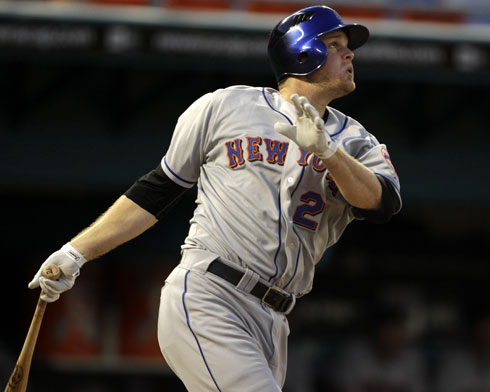
Also some Lucas Duda action:
On Duda: We talked to him last week, back when he was one for the season, so if he seems a bit down, that might explain it.
Kirk Nieuwenhuis, meanwhile, continues to look like a giant Toby Hyde.
Lots of Mike Piazza discussion:
 Tedquarters