In the link above (click the title to get there), Mark Simon tackles a question I touched on last month: How will Mets fans treat Chipper in his last game in Flushing?
How will we send Chipper out?
3

In the link above (click the title to get there), Mark Simon tackles a question I touched on last month: How will Mets fans treat Chipper in his last game in Flushing?
Matt Cerrone passes on news from Newsday’s Ken Davidoff (a worthy Twitter follow, if you’re not doing so already) that the Mets “like the idea of getting Ted Lilly.”
 Moving past the requisite jokes about trade-rumor language, I like the idea of the Mets getting Ted Lilly, too. He’s no Cliff Lee, mind you, but he’s a nice pitcher with good control and a reasonable history of staying healthy. Plus he yields an absolute ton of flyballs, which hurts him in Wrigley Field but would probably play well at Citi.
The big issue, of course, is the cost. Lilly is owed about $6 million over the rest of the season, which should drive his price in prospects down a little bit. But his contract is up after 2010 and he stands to be a Type A free agent, meaning an acquiring team would have to present the Cubs with a package more enticing than the two draft picks they’ll receive if they hang onto Lilly and let him walk after the season.
I have no idea what that means. But it sounds like the price on Cliff Lee is getting steeper by the moment, and that certainly factors into any team’s pursuit of Lilly.
If getting Cliff Lee would indeed require Angel Pagan — a trade I wouldn’t make in the first place — and getting Lilly would not, then Lilly probably makes more sense for the Mets.
The difference, in terms of wins, between Pagan and his replacement in the outfield playing every day for the rest of the season is likely at least as big as the difference between Lee and Lilly. Factor in that Pagan will be under team control through 2012 and there’s really no question Lilly would be a smarter target.
That assumes a lot, though. It assumes the Mets will continue starting Pagan regularly after Carlos Beltran returns, that Pagan will continue playing this well, and that a trade for Lee will require a player of Pagan’s caliber and a trade for Lilly will not. And I don’t know if any of those things are true.
Most importantly, Ted Lilly is a proud member of Team Ted, an exclusive group. Plus his full name is Theodore Roosevelt Lilly, which is awesome.
This won’t sound great to Mets and Yankees fans:
After hitting six bombs in 45 games in AA, Duda has eight in 21 in AAA. He’s hitting a combined .300/.406/.582 for the year and .329/.395/.750 in 21 games in AAA. Three of his eight homers have come against lefties against whom he’s hitting .200/.286/.640 compared to .392/.448/.804 versus righties.
– Toby Hyde, MetsMinorLeagueBlog.com.
I don’t want to bandy about unfounded rumors, but I believe it’s entirely reasonable to start speculating that Mets farmhand Lucas Duda has sold his soul to Satan for home-run power or is otherwise benefiting from a recent foray into the dark arts.
Duda’s previous career high was 11 home runs in St. Lucie in 2008. He averaged about one home run for every 46 at-bats in his first three Minor League seasons, but has stepped it up to about one per every 17 at-bats this season, including a downright Ruthian 1/9.5 rate since his promotion to Triple-A.
Will Duda keep that up? No. Not unless he really entered a contract with Lucifer. But the outburst has to at least earn him consideration as something more than organizational roster filler. By most accounts he’s a pretty terrible fielder in the outfield, and he’d be redundant on the big-league club with Chris Carter already in tow. But he’s probably a better option than Mike Jacobs to get a call if the Mets need left-handed pop in a pinch.
The start was an important one because it was Niese’s second of the season against the Reds. (He gave up four runs in a no-decision on May 5.) A young pitcher like Niese may be able to befuddle hitters the first time around, but the second time, they lose the advantage that comes with their unfamiliarity.
– Thomas Kaplan, New York Times.
This is a point I hear made pretty frequently, and one I’ve definitely considered here numerous times. But I wonder if it’s true. Is there any evidence to back up the claim that a pitcher does better against his opponents the first time he faces them?
 Also, even if there is, I’d have to guess it is at least partly attributable to the same logic that explains the beginner’s luck fallacy. The notion of “beginner’s luck” exists because people who win when they first start gambling are more likely to keep gambling, since they’ve been rewarded. If they lost from the outset, they’re more likely to leave the casino. When they win from the start, they stay long enough for the odds to catch up to them, and so when they see someone else win early they say, “aww, beginner’s luck.”
If a young pitcher gets rocked by an opponent in his first start against them, there’s a pretty good chance he’s getting rocked by lots of opponents and he’s not going to last in the Majors long enough to make a second start against any team. If he succeeds his first go-round, he’ll get more chances, and so more opportunities to fail. I’m pretty sure that’s a big factor in the Verducci Effect and “sophomore jinx,” too — no one’s looking for regression from pitchers who sucked in the first place.
Anyway, that’s just something I’m thinking of and has nothing to do with Jon Niese. At least not yet, I guess.
Niese lost last night and got tagged for a couple homers, but he struck out eight guys while walking only one in 7 2/3 innings. That’s excellent.
In fact, Niese’s 2.61 K:BB ratio is the best among Mets starters this year. He’s inducing 49.5% groundballs. Straight up, the kid is good.
People always seem to talk about him as, at best, a middle-of-the-rotation innings eater. But considering his strong start to his career and very good Minor League peripherals, I don’t think it’s unreasonable to expect a little more than that. He could certainly struggle with a little more exposure, like the quote above suggests, but there’s no evidence that he’s been unduly lucky in his rookie campaign.
Niese has been one of the least heralded reasons for the Mets’ success this year, I think. If he keeps this up, though, that will change. With Jason Heyward hurt and Stephen Strasburg’s innings set to be limited, Niese may contend for NL Rookie of the Year.
In the aforementioned hallway outside the Mets’ clubhouse, which we now know is too dark for video interviews:
Hilarious point, and spot-on.
Wright’s got a lot of Derek Jeter in him, on and off the field, and part of that means he’s not going to reveal very much about himself, for better or for worse…
Wright fielded questions yesterday about his remarkable turnaround at the plate without offering any real insight into how he did it.
“I don’t know if you can really put your finger on it,” he said, and then, in typical Wright fashion, proceeded to link it more to the way the team is playing than himself.
It was admirable, and Jeter would have been proud, but it does leave you wanting more. Did he have demons to fight on balls up and in? Did he have doubts about getting back to the form that has made him an All-Star again? Did all the strikeouts make him crazy?
No, no, and no, said Wright.
– John Harper, N.Y. Daily News.
I don’t have a direct link to Harper’s column. It was in the early edition of the paper and is not online. It’s almost entirely based on conjecture, but to Harper’s credit, I don’t think it’s unreasonable to speculate about the lingering effects of last year’s beaning on Wright early this season.
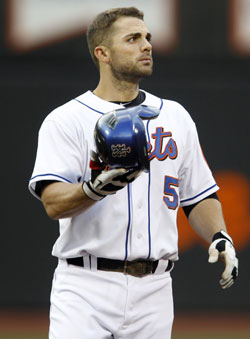 The most interesting quote in the column is Wright saying, “I don’t care about the strikeouts.” That’s cool, because neither do I. Since this year’s uptick hasn’t prevented him from producing as well as he ever has in the Majors (especially when you adjust for the park), and since even when Wright seemed to be striking out every other at-bat he was still maintaining a respectable on-base percentage, they’re just not that big a deal. Wright will probably finish this season with a career-high strikeout total. It won’t have stopped him from being awesome.
And that’s the thing I think everyone needs to keep in mind when we spend so much time analyzing Wright psychologically and in every other which way. Wright’s going to slump again, he’s going to strike out in some big spots again and he’s going to get booed again. It’s just part of it. That’s just baseball; these things happen.
But Wright will always come back to being awesome. Wright is a great, great baseball player, probably the best position player the Mets have ever had. It’s not fair (or safe) to call him a Hall of Famer yet, but there’s no doubt he’s on that trajectory. And players of that caliber simply do not roll over in the face of adversity. All the different things that made David Wright this great in the first place will keep him great moving forward.
And since inevitably Wright’s psyche will be assessed from armchairs the next time he struggles — and that will suck — it only seems fair to share a feel-good story about the man while he’s going well. Corny fodder for Wright’s loyal admirers among us:
While the Mets were taking batting practice yesterday, I waited outside their clubhouse with our video producer and intern, prepping to interview Ike Davis for the Baseball Show. Every person that passed commented on the sweltering heat. Players walked by soaked in sweat, looking a bit wilted, conserving energy.
Then came Wright, bouncing down the hall, no worse for the wear. Alongside him was a kid, about 8, wearing a “Make-A-Wish” t-shirt and a Mets hat. The kid looked a bit overwhelmed. Wright looked positively giddy.
“Here’s our indoor batting cage, and here’s our video room,” Wright said, sounding himself like an excited 8-year-old showing his friend his parents’ new home or something. “You wanna see our clubhouse?”
They emerged a few minutes later and proceeded toward the dugout. “You wanna meet some of the players?” Wright asked as they walked down the hall, away from where we were standing. “You know a lot of the players? Who’s your favorite player?”
The kid mumbled something inaudible.
“Well you have to say that,” we heard Wright say before they moved out of our earshot. “Because I’m walking with you!”
We were the only media anywhere close, and no cameras were rolling.
There needs to be a word for what Johan Santana did to the Reds tonight. Considering all the frivolities we keep track of in baseball, there should be an isolated stat for pitchers who throw complete game shutouts in which they also hit a home run. Shut ’em out, hit one out.
 I know Jason Jennings did it against the Mets in his Major League debut because I was there. (Incidentally, there was a rain delay in the game and we moved down to the first row behind home plate and wound up taking advantage of an unbelievable opportunity to heckle Steve Phillips point blank.)
According to the Mets’ game notes, the only other Met to accomplish the feat was Pete Falcone in 1981. (For what it’s worth, that game featured both Mark Davis and Sparky Lyle pitching for the Phillies. Davis started the game, but the duo represent 22% of pitchers who have won the Cy Young Award as relievers.)
I assume Babe Ruth did it at least once.
Anyway, what’s important is that we come up with some formal way of documenting whenever a pitcher single-handedly dominates his opponent like Santana did tonight. What could that be called? A pwn? A Little League Shutout, since the feat happens all the time at that level?
Or what about “a Newk,” in honor of Dodgers great Don Newcombe, one of the best power-hitting pitchers of all time? By my count Newcombe only did it once himself, but he was a pioneer, plus he has spent his retirement working with ballplayers with substance-abuse issues. Seems like a good enough dude to commemorate.
Plus the name works perfectly as a noun or a verb. Johan Santana hopes to compile more Newks in his career. Johan Santana Newked the Reds tonight.
Hmm… on second thought, maybe “Newking the Reds” sounds a little too Cold War-oriented for a baseball frivolity. I’m open to suggestions.
Back in 1990, in a baseball card shop just a few Chicago suburbs over from where I grew up, a 13-year-old named Bryan Wrzesinski bought one of the iconic 1968 Nolan Ryan/Jerry Koosman Topps rookies for $12.
Twelve bucks was a whopping sum for us early teen types back then, but Wrzesinski knew it was a wise investment and couldn’t get his wallet out fast enough. The card was normally valued at $1,200, but a card shop worker who didn’t know very much about baseball cards put a decimal point in a spot where there shouldn’t have been one when pricing it.
‘Duk does a great job recapping a story from 1990 that I entirely missed at the time, despite being in the prime of my baseball-card collecting career. Turns out Chicago-area human interest stories didn’t really get to Long Island back before anyone knew about the Internet.
 Anyway, it’s a good one and worth a read. I mention it here for a couple reasons:
1) I have the card in question. Inherited it from my brother. Sadly, it’s not worth $1,200 or whatever it should be worth now because there’s a pinhole in Jerry Koosman’s head. No idea how that happened, but it has been there as long as I’ve known the card. We didn’t do nearly enough to protect the condition of our baseball cards back in the day.
Luckily, I guess, it doesn’t really matter since I have no intention of ever selling off my baseball cards anyway. They’ll stay in storage at my parents’ house where they belong.
2) My brother and I pulled a pretty similar stunt, only on a much smaller scale. Our parents dragged us to an antique shop upstate once, and we found the lady in the store selling her son’s old cards based on a price guide from 1979. I don’t think anything we bought back then is really worth all that much now, but we stocked up, thinking we were savvy as all get-out for taking advantage of an old woman.
 Tedquarters