
Pascucci gone off

It is a testament, I guess, to the Mets’ improved roster management that there’s really no place for Val Pascucci on the 2010 team. For once, they are not devoting a roster spot to a useless bench player that could easily be upgraded with a Quadruple-A masher like Boss. Even though Alex Cora is eminently replaceable, he can at least sort of play the middle infield and so is way more valuable to his club than Marlon Anderson was back in 2008.

But Pascucci soldiers on in Triple-A regardless. And what a show he’s giving the people of Buffalo.

Pascucci has 10 hits in his last 30 at-bats. Nine of them have been for extra bases. Six have been home runs. Over the stretch, he’s slashing .333/.412/.1.033. For the season, he has a .934 OPS. For his six-year Triple-A career, he’s at .907.

Quad-A mashers like Pascucci, and hell, all so-called “organizational” players fascinate me. Are they just ignorant of all the indicators that they’ll never have a Major League career, or do they persevere in spite of them? Does Val Pascucci love playing baseball enough to put up with the crappy accommodations and poor pay that come with the level, or does he shoulder them hoping he’ll finally get a shot, something a little longer than his ill-fated 62-at-bat cameo in 2004?

Who knows? Maybe Pascucci simply loves hitting home runs, and is just thrilled people keep paying him to do so. What a stud.

Oh, and Jesus Feliciano has two three-hit nights in the Major Leagues. No one can take those away from him, even if he’ll likely be the odd man out when Carlos Beltran returns. That’s kinda awesome.
Do the Mets have to trade Mejia to get Lee?

Reader Todd used the fancy new contact box (linked from the tab at the top right of this page) to send in a question:

Ted, I have to ask, why does the media always tries to perpetuate this notion that it will take the Mets’ best prospect to acquire anyone of note?

Everyone’s busily discussing whether or not they’d part with Mejia, however, a look at recent history suggests that’d be an overpayment.

Todd went on to reiterate (in greater detail) a point I made last week: the hauls for Lee in the recent past have never been overwhelming, and have never included a prospect of Mejia’s caliber.

I should note that this may all be a moot discussion if Mejia’s shoulder injury keeps him out for any extended period of time. But my response to Todd was similar to the point Tim Dierkes made at MLBTradeRumors.com this morning: It might not take a prospect of Mejia’s caliber to land Lee, but the dropoff between Mejia and the Mets’ next-best movable prospect is big enough that some other team would be able to land Lee if the Mets didn’t include Mejia.

Fernando Martinez has been injured for some parts of the season and struggled for the other parts. Reese Havens is injured. Brad Holt has been terrible. Ike Davis, Ruben Tejada and Jon Niese are important contributors to the Major League team. The Mets would have to build a deal around a prospect with less perceived upside, like Josh Thole, or a prospect who is further from the big leagues, like Wilmer Flores.

Since Lee isn’t owed a lot of money this season and comes with the draft picks for any acquiring team (assuming it doesn’t re-sign him), every contender can afford to make a play for him. And I find it difficult to believe that another MLB club wouldn’t better any package the Mets offered that didn’t include Mejia.

Of course, the trade market is a weird and fickle thing, and I didn’t think the Mets had the horses to land Johan Santana way back when.

As Ruben Tejada goes…

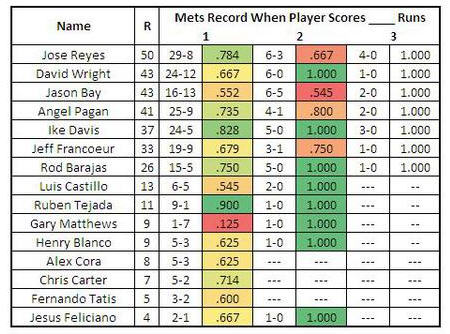
Outstanding work from Twitter Mets expert @tweetthemets putting together this chart, which should — but definitely won’t — put to bed the incessant “As Jose Reyes goes…” refrain.

This echoes a post I made a month ago. When players on the Mets score runs, the Mets tend to win. When players on the Mets score two runs, the Mets tend to win even more frequently. When players on the Mets score three runs, the Mets always win.

Should that take away from Jose Reyes? No. Jose Reyes is awesome, and a huge part of the Mets’ success over the past month and a half. But there’s no need to cite meaningless and decontextualized statistics to try to quantify Reyes’ import to the team. He’s a 27-year-old All-Star shortstop. He’s a good hitter, a good fielder and one of the game’s very best baserunners. Even when he doesn’t score a run he’s helping the team win.

Why do the Mets have a better record when Ike Davis scores a run than when Reyes or Jason Bay scores a run? I’m going to go with “random noise.”

The funniest — and hell, perhaps the most telling part of this graph — is that the Mets somehow managed a losing record when Gary Matthews Jr. scores a run. Obviously a lot of that is randomness, too, but a lot of it is probably that even when Matthews happened to find home plate, he was so bad in every other aspect of the game that the Mets couldn’t overcome it.

Pat Andriola on the fourth outfielder fallacy

The other is what I’d like to call the “Fourth Outfielder Fallacy.” This is the fallacy that just because a player can play all three outfield positions, he is best served as a fourth outfielder. Most of the time, said outfielder did come up as a bench player who rotated around the outfield positions, but after a good time of solid play, still couldn’t shed the title of “fourth outfielder.” Fans are human, and humans love consistency and purpose. Fourth outfielders make them comfortable. It also causes people to doubt whether or not a fourth outfielder could ever be a real starting outfielder, because, well, I don’t know if there’s a real logical reason as to why, but people still say it anyway. Angel Pagan may become the latest casualty of the Fourth Outfielder Fallacy. If so, we can only hope he’s the last.

Pat Andriola, Fangraphs.com.

Andriola makes this interesting point at the end of a solid post arguing for Angel Pagan to get more playing time than Jeff Francoeur once Carlos Beltran returns, a topic I’ve touched upon with some frequency.

But I link Andriola’s piece here because it deals with the labels fans — and sometimes teams — seem to assign to baseball players somewhat arbitrarily.

Jeff Francoeur is an “everyday player” even though he has been a comfortably below-average Major League right fielder for several seasons. Certainly he deserves to be praised for his impressive durability, but he has been an everyday player for his entire career only because the Braves were amazingly patient with his development.

Angel Pagan, like Andriola suggests, is a “fourth outfielder,” even though he has been a better player than Francoeur for the past year. Francoeur is a power hitter even though Pagan has a higher career slugging average.

Labels are meaningless; teams should play their best players as frequently as possible.

It’s all immaterial if Pagan doesn’t get healthy, of course. An injury is the only thing that should keep him from being an “everyday player,” at this point.

I brought this up in Spring Training in regards to Mike Jacobs and Chris Carter. Mike Jacobs was a Major Leaguer; Chris Carter was a Minor Leaguer. Sometimes these things have a way of sorting themselves out.

Where are the Puerto Rican players going?

There is frequent talk in baseball circles about creating an international draft to level the playing field, but it has just been talk. Until Puerto Rico is taken out of the draft, or everyone else is included, the trends are unlikely to change.

“Teams have moved on and put more money and scouting in Venezuela and the Dominican because it’s not part of the draft,” said Omar Minaya, the general manager of the Mets. “The key is that you’re getting more kids from the Dominican and Venezuela, and you have a hand in developing them.”…

By contrast, the Mets’ academy in the Dominican Republic, which opened in 2005, has already produced Fernando Martinez, Jenrry Mejia and Ruben Tejada, who have all played in the major leagues.

Baseball has also pledged to support the Carlos Beltran Baseball Academy, said Noelia Lugo, the school’s executive director. The high school will open next year in the town of Florida with about 150 students and an English-language curriculum. Beltran has donated $2 million, about a quarter of the school’s cost, Lugo said.

Ken Belson, New York Times.

Lots and lots of interesting stuff here. I mentioned back in April that it seemed strange that there were so few Puerto Ricans on Major League rosters, and Belson offers an explanation why: Once Puerto Rican players were added to the draft in 1989, MLB teams had to wait until they turned 18 or graduated high school to take them, at which point they were competing with players from the continental U.S. the same with access to much better coaching and facilities. Dominican and Venezuelan players can be signed at 16 and brought up through team academies.

Also, Tejada is from Panama. It’s entirely believable that he went to the Mets’ Dominican academy and I have no reason to doubt Belson’s reporting, but assuming it’s true, man. Did Tejada really move from Panama to the D.R. at 16, then play in the Venezuelan league at 17, then onto the Florida State League at 18? That’s a well-traveled 20-year-old.

Finally, the Carlos Beltran Baseball Academy. Awesome. All schools should teach kids to play baseball like Carlos Beltran.

On trading Mejia for Lee

I joined the guys at Seven Train to Shea last night to discuss the Mets’ approach to the trade deadline, among other things. They asked if I would trade Angel Pagan for Cliff Lee and I reiterated my opinion that Pagan is too good to be given up for a rental player, since the outfielder will be under team control through 2012.

Then they asked if I would trade Jenrry Mejia for Cliff Lee and I provided a rambling and incoherent response. Here’s what I wanted to get out:
Yes, if the Mets stay in this thing — and it appears that the Mets are staying in this thing — I would trade Jenrry Mejia for Lee. Pitching prospects are nearly impossible to rely on, even if they’re as talented as Mejia. No matter how good he looks now, Mejia is still only 20 years old and probably several years away from reaching his potential as a Major League starter. Many, many things can happen between now and then, things that could damn his prized, electric arm.

But I would trade Mejia with great reluctance, and not just the reluctance I express when the Mets trade any promising young player. Mejia appears to be the pitcher in the Mets’ system most likely to emerge as a frontline starter. An ace. And aces do not grow on trees.

Nor can aces reliably be found on the open market in free agency. By the time pitchers reach free agency they are generally in their early 30s, ready to begin declining. Yet due to the production they provided their prior club, they are given massive, lengthy contracts — often backloaded.

Thanks to a negotiating window, the Mets signed Johan Santana to a six-year extension at the market rate before he was even eligible for free agency, while he was still only 28. Now they’re on the hook for $77.5 million over the next three seasons, and Santana is beginning to show his age.

So when I hear reports that the Mets will only trade Mejia for Cliff Lee if Lee provides a negotiating window, I cringe. Lee will certainly not sign for less than what his agents believe to be fair market value. So instead of giving up their top pitching prospect to rent a great starter for a half season, the Mets would be giving up their top pitching prospect for the right to sign a guy to the same contract they could have given him as a free agent come the offseason, and a contract that will likely be an albatross in a few years.

Don’t get me wrong: Cliff Lee is amazing. But he will also be 32 by season’s end, and there’s no way he’ll be this good five years from now. And some team will be paying him as if he were.

That team should not be the Mets. Trade Mejia to rent the guy, sure, because world championships are invaluable and Lee significantly increases the chances of winning one. But don’t strive for the negotiating window. Let him walk and use the draft picks aggressively to try to find a guy who will develop into an ace in the future.

R.A. Dickey refutes reports that he’s a nerd

I asked Dickey about the Daily News article that mentioned how he was looking up stats on the Internet before his last start, hoping to find out precisely which stats he was looking up and how he used them. But he told me it wasn’t true. He said there may have been stats up on the computer when he sat down, but he wasn’t looking at them.

Josh Thole appeared amused by the entire conversation, either because of Dickey’s elocution or because I had the gall/stupidity to ask a baseball player about his stats. Ike Davis, on his way to the shower, chimed in that they only look at their record.

Dickey said the team goes over hitters’ tendencies and baserunning habits in their pitcher meetings at the beginning of each series, but that most players he knows intentionally avoid looking at their stats or anyone else’s during the season.

Jerry Manuel on Johan Santana

And, you know, duh. There’ll certainly be columns and blog posts written suggesting that Johan Santana pitched poorly today because of the news that came out about his since-dismissed sexual assault charges from October. But the truth is, Santana hasn’t been sharp all year.

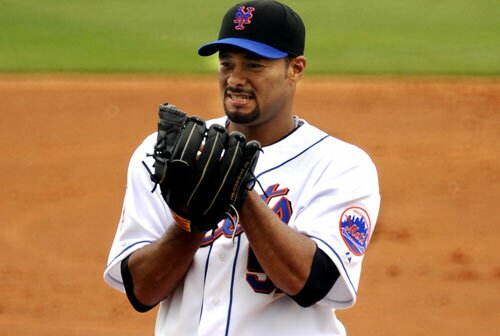
Here's what Johan Santana looks like. In fact, Saturday’s start was Santana’s fourth straight with at least four earned runs allowed. He’s only done that once before, back in 2004. And, of course, even when he was succeeding this season he wasn’t striking guys out.

Manuel suggested that opposing teams have become too familiar with Santana’s fastball-changeup pattern, and Santana didn’t disagree. Rod Barajas said, essentially, that maybe the league has finally caught up to Santana.

Both Manuel and Santana said the pitcher plans to mix in his slider more often, and said that doing so in the later innings today helped make his changeup more effective.

Santana said his struggles are “not the end of the world,” and stressed, “at some point, everything will turn around.”

Also, vaguely related fun fact: No one has ever described Johan Santana without using the word “competitor.”