Mets Minor League Report: Cory Mazzoni
Video
Reply

Toby, Patrick, stuff:
[sny-libsyn url=”http://html5-player.libsyn.com/embed/episode/id/2050821/height/360/width/640/autoplay/no/autonext/no/direction/forward/thumbnail/yes”%5D
On the iTunes.
Chipper Jones’ retirement tour hit San Diego this week, where the third baseman received a surfboard from the Padres organization. Here’s his stupid grin:

Over at Big League Stew, Kevin Kaduk ranks Larry’s retirement gifts so far. Which brings up the question:
It is Aug. 27 and, as far as I know, I have yet to troll a newspaper column about the Mets in this space this season. That used to be a regular and somewhat popular part of this blog’s constitution, but after a couple of petty but informative email exchanges with ranking members of the local media, I decided that to react to sensational or needlessly needling material is to indulge it, and I should aspire to loftier things. Like, you know, writing about Taco Bell and stuff.
 I made the same resolution last season but only made it to early May before I blew it. The big difference this season is that I mostly stopped reading anything that’s going to annoy me. I’m still exposed to it via Twitter and occasional reader email, so I know most of the general themes in contemporary LOLMetsing. But if I click on something now and find myself getting frustrated, I can usually click away without ever thinking about it again. Maybe that’s maturity or professionalism, but I’ve never been very mature or professional. I suspect it’s more apathy than anything else — not for the actual on-field Mets or their roster, but for the bizarre, antagonistic culture surrounding them in some parts of the media and fanbase. Blame Beltran, I guess.
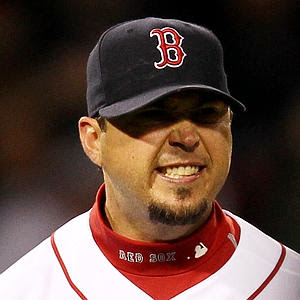
Which is all a long lead up to say that I have no idea why I allowed myself to read all the way through this column from Joel Sherman in the New York Post, which asserts that somehow the Mets were the losers of the recent, giant Dodgers-Red Sox trade. It’s not all incorrect: Sherman points out that six months ago, the Mets and Dodgers appeared in similar financial straits and now the Dodgers, under new owners, are spending like mad. That’s definitely true, and it’s true that the Mets could benefit from the type of short-term financial flexibility that the Red Sox earned through the trade and the long-term wealth that the Dodgers can now apparently boast.
The arguments break down in the particulars, though.
Sherman suggests that if Johan Santana had performed better this season, the Dodgers would be willing to take on the $31 million left on his contract, as evidenced by their willingness to put a waiver claim on Cliff Lee and to accept Beckett in the trade. He writes Santana’s contract “probably would not have deterred the money-is-no-object Dodgers,” and maybe he’s got some inside info to back that up.
But check it out: Sherman doesn’t note that Santana is owed $31 million for next year alone, while the $31.5 million remaining on Beckett’s contract covers 2013 and 2014. Beckett, like Santana, has both struggled and missed some time with injury this season. But Beckett was one of the best pitchers in baseball in 2011 while Santana sat out the entire season following shoulder surgery. And Beckett, moving to an easier division and a more pitcher-friendly park, can be expected to improve in Dodger Blue. The same can not be said for Santana. How much better would Santana have had to pitch in 2012 to convince another club to take on $31 million for one year of one pitcher with a surgically repaired throwing shoulder?
Also: Cliff Lee is awesome. He was awesome last year, he was awesome the year before that and the year before that, and he was still pretty awesome when he was 2-6 and the Dodgers claimed him. Lee averaged 225 innings the past four seasons. I’m not sure taking on an aging pitcher at $87.5 million for three years seems like smart baseball business, but then that he was claimed and not traded appears to imply the Phillies think Lee will be worth it. And to their credit, he hasn’t provided much evidence yet to suggest he won’t be.
The column goes on to argue that the Mets are the losers in the deal because they do not have an ownership group dedicated to energizing a fanbase by signing and taking on a bunch of potential albatross contracts, because nothing energizes a fanbase like gutting your farm system and committing over $100 million through 2017 to Carl Crawford — who was, by OPS+, worse with the Red Sox than Jason Bay has been with the Mets. Bringing on Adrian Gonzalez, Beckett and Hanley Ramirez definitely gives the Dodgers a better chance of winning it all in 2012 and 2013, and flags fly forever. But things will seem pretty different by 2015, when they’ve got over $80 million locked up in four players, with only one of them — awesome, awesome Matt Kemp — likely to still be in his prime.
The crux of the argument, I guess, is that the Mets are losers because they were not able to get rid of or take on bad contracts, and implicitly that they’re losers for having another big-spending team in the National League with which to compete for free agents. Some of that makes sense. The Mets could become on-field winners sooner if they could part with their 2013 contractual obligations to Santana and Jason Bay and spend that money (or even more money) elsewhere. But unstated is that the Mets have spent their last four years weighed down by big contracts, and that the struggles of the Red Sox and Phillies and Marlins this year should help show why dishing out a bunch of massive, long-term contracts doesn’t guarantee victories.
Bay and Santana are on the books through the end of next season. Crawford is signed through 2017 and Beckett through 2014. If the Sox didn’t force the issue by including Gonzalez (and the estimable Nick Punto, of course), it would be years before they could clear up that cash. The Mets should gain financial flexibility after next year’s campaign.
Which is to say, I guess, that none of the pieces involved are comparable and it’s just a totally different situation, so it seems like piling on the currently awful Mets to label them losers in a deal they had nothing to do with. Then, as a kicker, Sherman adds:
The Dodgers, playing Luis Cruz at third, needed an upgrade at that position as badly as they do first base. So why exactly couldn’t the Mets have been bold with David Wright, as long as they could attach a bad contract or two with it to gain a total financial reset along with prospects?
That implies, I think, that Sherman believes the Mets could have sent Wright along with Bay and/or Santana to the Dodgers for prospects — that they had that option. But as you know and I know and Sherman certainly knows, Wright’s 2013 option only belongs to the Mets, so trading him this season would mean the acquiring team gets him for only the rest of this season. Would the Dodgers really take on $21 to $51 million’s worth of 2013 obligation and trade away prospects for a month and a half of David Wright? That’s not a rhetorical question. Again, maybe Sherman’s privy to some information I don’t have, like that the Dodgers’ new ownership group consists entirely of WFAN callers that somehow stumbled their way into billions of dollars and are currently pounding their fists on the boardroom table yelling,”TRADE! TRADE! TRADE!”
But if that were by some chance the case, wouldn’t the Mets be reasonable to expect even more in return for Wright in just a couple of months, after they exercise his option and can trade away his services for all of 2013?
Once again, and for any Mets fans who have made it this far: The change you are seeking has already been made. We don’t know yet to what extent the team’s owners are willing to invest in the Mets’ payroll, but everyone should realize by now that spending money for the sake of spending money is no way to build a consistent winner. Sandy Alderson, we have seen, is dedicated to building a club from within and retaining the players worth retaining. Not all his moves have been great ones, for sure, but he has done nothing to hamstring the club for the future. Hopefully at some point soon the Mets will appear to be a piece or two away from fielding a certain contender and Alderson will have the financial flexibility to bring those pieces on via free agency. That’s the model. It’s the model everyone seemed to agree was the right one when Alderson was brought on board a couple years ago, and it’s not something they should deviate from now just because we’ve grown bored of it.
No research. Straight to the monkey.
https://twitter.com/DanDotLewis/status/239020745152417793
My thoughts are: Meh? It’s an interesting idea, but it’s wholly dependent on Santana being able to physically handle the new role so it’s impossible to say if it’d work. From what we’ve seen this year, it seems Santana’s performance has become a bit finicky in his old age and hampered health, and we’ve heard him suggest that in certain starts he couldn’t get loose. Would he be able to throw three nights in a row if necessary? Would he have games in which he just doesn’t have it? While I realize that starters converted into relievers usually meet with success, I’d be very hesitant to transition a guy with Santana’s injury history.
https://twitter.com/BokGwai/status/239027935015731200
Wait, do you mean more production from the players, or a greater quantity of productive players? I think it’s safe to expect the former in many cases: Josh Thole, Ike Davis, Ruben Tejada, Jordany Valdespin, Lucas Duda and Kirk Nieuwenhuis are under 27 and presumably growing more productive — whether they’re in the team’s plans or not. And cutting Jason Bay will mean replacing him with a more productive player, because basically no player has been less productive than Bay.
As for quantity? Beats me. I don’t have any idea what the Mets have to spend or what they’re willing to part with. But they’ve got some depth in the starting rotation from which to deal — though that might mean trading a prospect. Speaking of:
https://twitter.com/happyhank24/status/239024337452146688
Yes. Maybe Zack Wheeler will be awesome, but he’s a pitching prospect so he’s no sure thing and he’s subject to injury at pretty much any time. Upton had a down year in 2012, but he’s a 24-year-old with a superstar resume and he’s signed through the end of the 2015 season.
I got a lot of trade questions asking if the Mets should deal certain guys and if they should pursue certain guys. The answer to every single one is always the same: Depends on the trade. Should the Mets trade Daniel Murphy for the sake of trading him? Hell no: He’s a valuable Major Leaguer. Should the Mets trade Daniel Murphy for Justin Verlander? Yes.
The same is really true for R.A. Dickey and even David Wright. I don’t think there’s much of a chance Wright gets traded, but if it looks like he wants to test free agency after the season and someone’s offering you a package of young Major League and Major League-ready players that you feel will provide more in their careers with the team than Wright will for the remainder of his contract, then, you know, duh. But that’s always true.
https://twitter.com/koosman3669/status/239030180088279040
Well, David Wright is the pb-and-honey sandwich minister in the clubhouse, so I suspect it’d be hard to associate the sandwich with poor play.
https://twitter.com/ProfessorStem/status/239064390312284162
Good question. Presumably the evaluation phase should never really end, but I think the Mets should have a pretty clear sense of what they’ll get from Dickey, Jon Niese, Bobby Parnell, Murphy, Wright, Scott Hairston and Andres Torres moving forward. The rest still feature question marks due to age, injury, sample size, or pretty broad fluctuations in performance.
A somewhat depressed show with Toby and Patrick:
[sny-libsyn url=”http://html5-player.libsyn.com/embed/episode/id/2045344/height/360/width/640/autoplay/no/autonext/no/direction/forward/thumbnail/yes”%5D
On iTunes here.
I’m not the GM, though. I’m a fan. And, what I know is that it’s time to make moves. It has to be. Mets fans are shockingly patient and tolerant, but only to a point. Alderson had two years to rip the house down, which he’s done. He’s had two years to evaluate and develop talent and take stock in what he has to work with. He’s had two years to create a new infrastructure and shed bad contracts (with one, maybe two more to go). He’s had two years to let it bleed, and let us anticipate, and imagine, and be patient, which I think we’ve done rather well considering the soap opera we were forced to root for in the four seasons prior to his arrival. He’s done his due diligence and demolition, this off season it’s time to start building.
I hardly disagree with most of the general points Matt made in his post this morning, but I’ll offer this (mostly semantic) counterpoint: This is building. This is what building looks like. It’ll try our patience, for sure, but our patience is only one of the myriad aspects of the process that Sandy Alderson and his SABRos must manage.
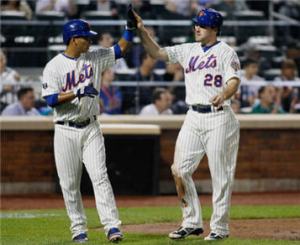 The Mets have looked atrocious the last few weeks. Straight-up old-timey LOLMets stuff. The bullpen and defense stayed bad and an offense with one too many holes in it stopped hitting for power. Maybe these Mets could string together enough singles to score runs with a couple of more good on-base guys, but they’ve suffered with too many easy outs in their lineup. Check this out:
Last year, the Mets gave 185 plate appearances all season to position players with on-base percentages lower than .300. This month alone, they’ve given 183 plate appearances to position players with on-base percentages below .300. That’s based on their season lines so it’s hardly a perfect way to make this point (and Ike Davis, one of 2012’s sub-.300 culprits, has been one of their best hitters this month). Last year, none of their top 11 contributors finished with an OBP below .320. This year, more than half of them might. Again — arbitrary endpoints and not perfect, but that’s essentially what’s happening here. The 2012 Mets’ on-base percentage has gotten worse every month. So now, with the team getting on at a futile .309 clip in August, pitchers can work around the few guys who might do damage with one swing. David Wright has been intentionally walked five times this month and has yet to homer. Ruben Tejada leads the team in extra-base hits in August. They stopped getting on base and they stopped scoring runs. Not a coincidence.
Is that lethargy, or is that a lack of good players? Maybe a little from Column A, a little from Column B. I don’t know and I’m not sure it matters. Players who fade down the stretch — whether due to packing it up or lacking it entirely — will see their season stat lines and their team’s perception of them suffer. It’s part of the building process: The Mets work to determine which players look like parts of their next contender and which they should cast off. That should — and probably does — happen primarily on the field, but certainly it happens out of sight too.
Step back from this misery and take stock of what we’ve learned: Before this season, neither the Mets nor their fans could know what to expect from Ike Davis coming off injury, from Daniel Murphy playing second, from Ruben Tejada as an everyday shortstop, from David Wright after the worst year of his career, from Lucas Duda in right field, and from Kirk Nieuwenhuis and Jordany Valdespin in the Major Leagues. Uncertainty dominates baseball and everything, but we will enter 2013 with a much better understanding of which positions the Mets can fill (or already have filled) internally and which require help from the outside. I’d say they need outfielders most of all, but then I suppose there’s still over a month left for someone else to go in the tank.
Also, before this season, many — myself included — expected the Mets would ultimately need to look outside the organization for starting pitching. The only certainty in the rotation appeared to be Mike Pelfrey’s 200 mediocre innings. Now we know R.A. Dickey and Jon Niese are fine building blocks for a rotation, we suspect Matt Harvey is a real and possibly very good big-leaguer, and we’re fairly certain Johan Santana will pitch again. Actually, if Santana and Dillon Gee show up to Spring Training healthy — far from a safe bet, of course — the Mets could open camp with their Major League and Triple-A starting rotations looking reasonably flush. Dickey, Niese, Harvey and a healthy Santana and Gee make a fine first five, with Collin McHugh and Jeremy Hefner around for depth in Triple-A or the bullpen and Zack Wheeler, Jeurys Familia and Jenrry Mejia ironing out the kinks in Buffalo with eyes on midseason openings in the big-league rotation. And that’s without the team bringing back Pelfrey or Chris Young.
While it’s true that no team can ever have too much pitching, the Mets will need to give something to get something this offseason and starting pitching suddenly looks like an organizational strength. I did not see that coming.
Part of the process, though, right?
Yes, as Cerrone and Alderson agree, the Mets need an infusion of productive players. They should go about getting some, using the resources and knowledge they’ve gained from this season. And since they’re not on the brink of certain contention, they should aim to get players that can help them win games in 2014 and 2015 instead of just spending money on some old dude for the sake of it. And next offseason, the Mets should use the resources and knowledge they’ve gained from 2013 to infuse themselves with even more productive players at the positions they need, and so on.
As for their attitudes? I’m less concerned. It seems pretty rare that guys become productive players in the big-leagues without winning attitudes, or at least the potential for them. Certainly some guys can seem like prima donnas at times or fold up under duress, but I don’t imagine it takes much more than good players to foster good attitudes across the clubhouse. Spirals of awful negativity like this one could probably be avoided if the team were better at hitting and pitching and fielding and base-running.
 Tedquarters