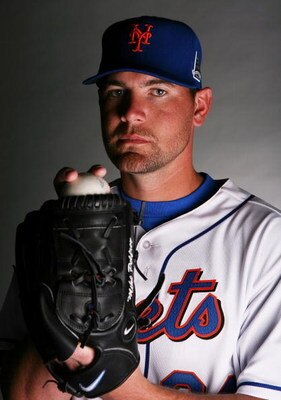
Big Pelf pulls a Bernazard

Fun fact: I once received a “lifetime” ban from a mini golf course on Long Island for breaking a putter over my knee in quasi-mock frustration.

I put lifetime in quotes because I went back a couple weeks later and no one said anything. I think a lot of times places doll out lifetime bans and don’t really mean it. Maybe I should have tried playing intramural football again after that incident my freshman year.

Anyway, apparently Mike Pelfrey had a bit of a meltdown on the golf course, broke some clubs and challenged his teammates to fight him.

That’s not going to do much for the whole “Mike Pelfrey is a head case” stigma, but I say awesome.

I really like picturing Pelfrey challenging a crew of entertained Mets in ridiculous golf pants to line up for their beatdowns. I wonder if in fights, Pelfrey only throws the same punch over and over again. Like I bet Pelf has a solid right cross, but he never throws a jab or a hook or an uppercut.

He kept his shirt on, which is probably for the best.

Penultimate Pedro?

So Pedro Feliciano wants to be the Mets’ eighth-inning guy. Everybody wants to be the Mets’ eighth-inning guy. We all want to anoint the new eighth-inning guy.

OK, let me start right off by reiterating that I think the whole need for a specific, dedicated eighth-inning guy is silly. Again, there’s little evidence that even having a one-inning closer helps teams finish out games more successfully than they did in the time before the trend started up in the late 80s:  “In the 20 seasons since LaRussa’s brainstorm, teams holding late leads have won at about the same rate they did in the 20 seasons before.

Regardless, looking at Feliciano specifically, there may be some merit to the concern voiced by SNY’s Gary Cohen, among others, that Feliciano is too valuable to the Mets in his current role — as a middle-inning lefty specialist — to consider moving to a setup position.

Fangraphs charts Leverage Index, “a measure of how important a particular situation is in a baseball game depending on the inning, score, outs, and number of players on base, created by Tom Tango.” A pitcher’s average Leverage Index when he enters a game is called his gmLI.

According to that stat, Feliciano entered games in, on average, the fourth highest-leverage situations of any Met reliever. Ahead of him were Casey Fossum, whose gmLI was certainly driven up by a tiny sample, J.J. Putz and Francisco Rodriguez. Feliciano finished third on the team behind Luis Ayala and Billy Wagner in 2008.

Turning to the list of 2009 Major League leaders in gmLI, the highest-ranked non-closer is Seattle’s Mark Lowe, decidedly an eighth-inning guy — 50 of the 71 1/3 frames he tossed last season were that game’s penultimate one. The next, Jeremy Affeldt, had the eighth inning account for 36 2/3 of his 62 1/3 innings.

The next two pitchers on the list, though, were Matt Thornton and Phil Coke, a pair of lefties, neither of whom threw more than half his innings in the eighth (although both pitched plenty in that frame).

So what does that mean? Not a ton. Relief pitchers traffic in small sample sizes, and I guess the moral of the story is that though eighth-inning guys tend to enter the game in pretty high-leverage situations, lefty specialists often do too.

Putz, in his short stint of full health, may have entered games in more important situations than Feliciano on average, but no setup man that lasted the year entered games in tougher spots than Perpetual Pedro. And by situational wins, Feliciano was the top pitcher on the team.

There’s no doubt, then, of Feliciano’s value to the team in his familiar role. He might be slightly more valuable as the elusive eighth-inning guy, for sure, but only if he could handle it.

And therein lies the rub. There’s been some talk of Feliciano’s developing cutter, and Feliciano seems earnest in his desire to use it get righties out. Good. He should want to be the best pitcher he can be, always. He’s a professional athlete.

But Feliciano was working on new strategies to get righties out last offseason, too. And righties responded with a .264/.365/.486 line, pretty similar to the .272/.364/.425 mark they’ve tallied off him across his career.

Feliciano’s long been one of my favorite Mets, so I’m rooting for him to succeed in any role. Maybe that cutter will work for him, and then, yeah, he’ll be ever so slightly more valuable to the Mets as a setup man than he was as a lefty specialist.

I’m just not sure it’ll work out that way, though.

Season in preview: Starting pitchers

With Opening Day now a week away and with little else to write about, I’m going to attempt to preview the 2010 Mets, position by position, over the next seven days. Or maybe do a few posts like this one and then run out of steam. We’ll see.

I’ll start with starting pitchers, because starting pitchers have “starting” right there in their description, and because pitchers are “1” in the lineup card. I’ll end with relief pitchers, even though they’re also technically No. 1 in the lineup card, because we’ll have a better sense of who they are by then.

The format will be whatever the format is on this post. I’m going to figure it out as I go. That’s jazz, baby.

The starting pitchers in April: Johan Santana, Mike Pelfrey, Oliver Perez, John Maine, Jon Niese.

Overview: Yesterday, during WFAN’s coverage of the Mets’ Grapefruit League game, Wayne Hagin lamented the team’s need for a pitcher like Chris Carpenter, who could do to the N.L. East what Carpenter did to the Central last season.

“HELLO!?” – Herm Edwards.

Now, look: Carpenter went 10-0 against the Central last year, and that’s pretty nuts. But few pitchers in the Major Leagues are as qualified to dominate opposing hitters as the one fronting the Mets’ rotation. Johan Santana, assuming health, is not the problem.

Behind him lay question marks that have dotted just about every Mets season preview before this one: Pelfrey, Perez and Maine.

Color me slightly more bullish than most about the prospects of those three. Pelfrey, as noted earlier this offseason, was more a victim of the defense behind him than the demons inside him in 2009. He has been hit hard this Spring, but he has been throwing more breaking balls — something that should help him stop relying on Luis Castillo’s (complete lack of) range for groundball outs.

I’m mildly concerned that a more varied arsenal could make Big Pelf more vulnerable to injury, but assuming Jose Reyes regains most of the range he had before his hamstring injury, Pelfrey should bounce back from his rough 2009 as more of those groundballs bounce into the gloves of able defenders.

Perez enters the season to about the lowest expectations of anyone ever making seven figures not named Gary Matthews Jr. (or Andruw Jones, or maybe Barry Zito. OK, there are a few, but you get the point). It’s becoming increasingly clear that he’s not Sandy Koufax, no matter what Scott Boras says, but thanks to either a return to health or his conditioning program or new-found focus upon his first wedding anniversary, his velocity appears to be back to its 2008 levels.

If the results follow, the Mets will have a wild and frustrating but ultimately league-average middle-of-the-rotation starter in Perez. It’s annoying, but the Good Ollies and the Bad Ollies balance out and make for Just OK Ollie.

As for Maine? Well, I’m a little concerned about Maine. Not about his couple of shaky Spring Training outings or his talent — he’s got that, I think — so much as his ability to stay healthy. Maine has pitched progressively fewer innings in each season since throwing 191 in 2007, and the vagaries of his “shoulder weakness” last year are at least a bit concerning. I’ve speculated before that Maine might have flourished under Rick Peterson, noted for his expertise in biomechanics, but what do I know?

I know this: Maine’s strikeout rates have plummeted nearly as quickly as his innings totals, which is concerning. That could be a whim of the reasonably small sample of innings he pitched last season, but it could mean whatever Maine was using to fool hitters so effectively in 2007 isn’t doing the trick anymore. The velocity on his fastball has remained static and he has thrown a very similar mix of pitches, only less effectively. It could be the injuries, but it’s troublesome regardless. I’m rooting for the guy, but there are red flags all over the place.

The fifth guy, Jon Niese, I like. This I’ve covered.

The starting pitchers in September: Santana, Pelfrey, Perez, Niese and Nelson Figueroa.

Why’d I put Figueroa there? Just a guess. Trying to pick what will happen in September in March is a fool’s errand, and there’s a reasonable chance Figueroa is not even on the team next week, no less six months from now. Consider his name on that list as a stand-in for whatever fifth starter/long-man/fill-in guy they settle on when one of their starters gets injured or proves ineffective, assuming Jenrry Mejia has either hit his innings limit or been made a reliever.

I’m guessing Maine will be the starter that doesn’t last the year based on the red flags listed above. Pelfrey has been a horse for the last two seasons, Perez will have to suck really hard for the Mets to give up on his contract, and Niese’s only major injury has been the freak one he suffered last year.

There’s also a solid chance the Mets go out and trade for a starter if they’re in contention near the trade deadline and one or more members of their rotation is hurt or performing poorly. But we’ll cross that bridge when we get there.

How they stack up: I always think it’s a bit silly when, before every postseason series, newspapers run down the teams position-by-position to determine which team has the advantage where, because it doesn’t work like that. Derek Jeter isn’t facing Jimmy Rollins in the World Series, he’s facing the Phillies.

But I’m doing that here because it’s easy and I’m already 900 words deep into this post and I need to find a quick way to wrap it up. Jazz, like I said.

The way I see it, the Mets’ starting rotation is probably the third best in the division, behind the Braves and Phillies and ahead of the Marlins and Nationals. (Ooh, bold stance Ted!) I came to this conclusion via an incredibly complex scientific process which is far too complicated to detail here.

Next up: Catchers, which won’t take nearly so many words.

Bobby O is on board

Bob Ojeda also doesn’t seem to think Jenrry Mejia should be in the Major League bullpen:

Q: Do you think Jenrry Mejia is major league ready?

A: I am a big believer in you can’t get by with one pitch. When I was [in Florida] earlier in spring training, his other pitches were coming along, but the fastball is the only pitch he can depend on. And if there is a day when that fastball doesn’t show up, then he would have no plan B.

So there’s that.

Probably the coolest thing about Jon Niese

Shamik reminds me of probably the coolest thing about Jon Niese: He was born the day the Mets won the World Series in 1986.

And check this out: Josh Thole was born the day of the 1986 Mets’ ticker-tape parade. (Also, that is a hilarious Wikipedia find.)

After they dropped the first two games of that Series to the Red Sox at Shea, the Mets had an off-day on Oct. 20. In South Carolina, Reese Havens was born, and then the Mets took four out of the next five to take the championship. Coincidence? Yes. But still.

If that’s not enough to blow your mind, chew on this: Brad Holt was born when the Mets and Astros were tied at two games apiece in the NLCS that year, right before the Mets took a pair of marathons, the latter prompting the epic and notorious flight from Houston.

Also, draw your own conclusions here, but Captain Kirk Nieuwenhuis was born on Aug. 7, 1987, just a little over nine months after the conclusion of the ’86 series.

The Chris Carter Movement

In all the Jenrry Mejia hype, I haven’t spent a lot of time discussing the Mets’ 25th roster spot, which will ostensibly go to a left-handed bench bat.

According to Newsday’s David Lennon, the race is between Frank Catalonotto and Mike Jacobs, and Chris Carter has “no shot.”

Given the choice between the two, I’d take Catalonotto. Jacobs’ lone skill — his power — is not as valuable as Catalonotto’s combination of on-base ability and defensive flexibility. The Long Island native plays first base way more capably than Jacobs, plus can play the corner outfield spots and backup second base in a pinch.

It’s too bad if Carter really has no shot, though, because though he can’t boast the Major League experience of his competitors, he seems to blend a nice mix of their assets. He’s got power, as evidenced by the .493 slugging percentage he’s posted at Triple-A over the past four seasons. He can get on base, based on the .373 OBP he’s posted in that time.

And though he’s certainly no Keith Hernandez, he’s likely a better defender than Jacobs at first, and he can back up the corner outfield spots as well.

So why doesn’t Carter have a shot? Beats me. A bad attitude? Mental mistakes? His work ethic has earned him the nickname “The Animal” from Jerry Manuel, and he graduated from Stanford in three years.

Most likely, Chris Carter has no shot because Chris Carter is not a Major Leaguer. He only has 26 Major League plate appearances.

And that’s a funny thing.

What makes people Major Leaguers? Why is Mike Jacobs a Major Leaguer?

Mike Jacobs is a Major Leaguer because he was on the Mets’ 40-man roster and so got called up from Double-A at 24 in 2005 when Mike Piazza got hurt but didn’t go on the Disabled List. Jacobs hit a pinch-hit home run and then, when the Mets tried to send him back to the Minors, Pedro Martinez threw a hissy fit. So Jacobs stuck.

He went on a tear that lasted the rest of the season, and so from then on, Mike Jacobs was a Major Leaguer.

Maybe if Piazza didn’t get hurt, or if Esteban Loiaza didn’t leave that pitch over the plate or if Pedro wasn’t Pedro, Jacobs would’ve ended up in the Majors anyway. After all, he was crushing the ball in Double-A when he got the call. He had a .965 OPS. Mighty stuff.

But you know who else could crush the ball at Double-A? Chris Carter did. He posted a .960 OPS in his one brief stint there in 2005, then followed it up with four straight solid-to-excellent performances at Triple-A.

And so it’s not hard to imagine a situation in which Carter, and not Jacobs, could have been blessed with a timely opportunity, a whimsical ace and a month-long hot streak to carry him to four years of big-league fortune.

It was not that way, though. It was the other way. Jacobs is the Major Leaguer, Carter the career Minor Leaguer. Maybe the superior player and maybe the better fit for the Mets, but seemingly the less likely candidate for the Opening Day nonetheless.

Carter leads all Mets still in camp this spring with a 1.476 OPS. Of course he hasn’t had very many opportunities.

But I guess that’s just the thing.

There’s a movement brewing to get him on the club. I sense it’s in vain, and that it won’t be as loud as the movement to keep Jenrry Mejia off the club. Regardless, I’m on board.

And I’m not alone:

A poll on Amazin’ Avenue today on the matter yielded a shocking 80-percent support for Carter. Patrick Flood wrote a post a few weeks ago that touched on similar topics to this one and combined two of my favorite subjects: Quadruple-A players and The Clash.

Sign up. Join the movement. Free Chris Carter.

Something good

I’ve now referred several times to the post I made Sunday and subsequently took down because I deemed it too negative, even by my standards.

One of the reasons I didn’t like the post was that in it, I toyed with the idea that if Jon Niese hadn’t distinguished himself from the Mets’ other fifth starter candidates by the end of Spring Training, he should be sent to Triple-A Buffalo to hone his game. I argued that since Niese has options left on his contract, the Mets should simply demote him until they inevitably need him in the rotation rather than risk losing a different starter before the season even started.

A few hours later, I remembered that I don’t really believe that. Niese has distinguished himself from the rest of the Mets’ fifth-starter candidates. Maybe not this spring, but across the course of his young career.

He’s the one, after all, with the big looping curveball he can control, and the solid fastball and good cutter. He’s the youngest of the bunch, and the one with the biggest upside. He’s the one who posted ground-ball rates above 50-percent in Triple-A the last two seasons and managed to get batters out in Buffalo last year despite a hilariously horrendous defense behind him.

Niese, a 23-year-old homegrown prospect with enough Triple-A success to suggest he’s ready to help the Major League Mets, is exactly the type of player I should advocate for in Spring Training position battles. And yet Sunday, temporarily blinded by the Mets’ frustrating decision-making process with Jenrry Mejia and the rest of their bullpen, I found myself considering that Niese should be back in Buffalo to start the season.

He should not be. And the good news is it appears he will not be.

I have no idea by what method Jerry Manuel came to decide that Jon Niese should be ahead of his competitors in the race for the Mets’ fifth-starter job. It sure seems like Spring Training results matter a whole lot in some of the team’s position battles and not at all in some others, and heck, for all I know, there’s some good reason for that.

Whatever. I’ll avoid getting too bogged down in the process this one time. What matters here is the outcome: The man — the young man — best suited to winning games for the Mets in April (not to mention down the road) now appears most likely to be in the position to do so.

That’s something good.

Oh good lord

This is a food coma of epic proportions. I’ll try to do my best reporting about what I sampled at the Mets’ second-annual Taste of the Citi event at Citi Field today because I feel it is my responsibility, but holy lord, you’ll have to excuse me if the thoughts aren’t exactly cohesive.

Struggling to stay awake. So much eating.

I should say that, though a good portion of the food at the event will be served at the stadium’s various restaurants and clubs, I stuck mostly to the stuff that will be available at the regular concessions, because TedQuarters is for the people. I certainly don’t begrudge anyone who chooses to dine in the Acela Club, and someday I figure I’ll get up there myself, but it’s not really my scene.

That said, I did try something called the Chocolate Epiphany, a brownie sundae served in the Empire Suites. It was like the full breadth of chocolate’s awesomeness was revealed to me in a single, stunning moment of divine intervention. I wish there was a word for that.

There’s Korean fried chicken at the World’s Fare Market now, too. I didn’t realize this variety of fried chicken was as popular among Mets fans as it apparently is until I Twittered about it from the event, but then I guess I should have considered that it’s delicious fried chicken.

If you’re unfamiliar, the crust is a little stickier and a lot spicier than the fried chicken you probably know, though the particular Korean fried chicken from Cafe Hanover that’s served at Citi wasn’t as gooey with sauce as Korean fried chicken I’ve had in the past. It was damn spicy though, and really good. So that’s something to look out for.

There are also a bunch of new pizza varieties, if that’s your thing. There’s buffalo chicken, chicken parm, veggie, and grandma pizza with vodka sauce. I tried the latter, and the vodka sauce was creamy and delicious.

I almost never get pizza at the game, for what it’s worth. At both of these events I’ve been impressed by how good the pizza is, but for some reason I just never feel like pizza when I’m actually at Citi. Maybe it’s because I’ve lived in two spots — Brooklyn and a very Italian part of Westchester — where great pizza is abundant.

The best thing I ate? The new garlic-parmesan fries from Box Frites. They’ve got garlic butter on them. How could that be bad?

There are Disco Frites, too, with cheddar cheese, gravy and fresh cheese curds. Those were good too, because, you know, they’ve got all those things on them, but not as good as the garlic-parmesan fries. The cheese curds weren’t really sticking to the fries, so they seemed kind of extraneous. Still awesome, mind you, because hey, cheese curds. But why are there cheese curds with this delicious poutine? (Ed. note: For perfectly good reason. See the comments.)

Still good? The chicken tacos.

One major disappointment? The new Nathan’s pretzel dog was nowhere to be found. I’m convinced that I invented this sometime in the early 1990s. I swear I’ve been going on about how someone need to put a hot dog in a pretzel since my first exposure to bagel dogs and I realized that hot dogs could be put in stuff.

The pretzel seems like a natural home for the hot dog since they’re both delicious ballpark foods that people like to cover with mustard. And I put ketchup on my pretzels, because I’m weird like that.

I have been told of instances of pretzel-dogs before, but I’m certain it’s due to fallout from all the campaigning I did for their creation in my teenage years. I know that sounds absurd, but hey, I’m hallucinating from all this food. Just indulge me.

Regardless, I have yet to actually enjoy a pretzel-dog, and so I look forward to doing so on Opening Day at Citi Field.

Also, another great example of the hot-dog-in-something-that’s-not-a-hot-dog-bun is the hush puppy from Ben’s Kosher Deli, which is a hot dog in a knish. They definitely need to get those at Citi Field.

OK, I’m done thinking for now. There’ll be video to follow, someday.

Oh, and pears! They have pears. I have a pear, here at my desk, from Citi Field. I like pears a lot.

Best work day ever?

Not really, but it’s close.

I’m heading to Citi Field today for the Mets’ second-annual “Taste of the Citi” event, during which they provide samples of all the food they will serve at Citi Field during the season.

It is spectacular.

The video segment we’re filming should be ready early next week sometime, at which point I’ll post it here. I’ve posted last year’s video below. Lawrence, the NYC Food Guy, is back with us for a second go-round. I’ll have a lot less hair this time.

Why are they sending me back to do a very similar video segment a second time? I don’t know, and I’m not asking questions. Free Shackburgers, that’s what I’m saying. And with no lines.


You’re not helping anything, Sean Green

Jenrry Mejia didn’t fail today. He was awesome, because Jenrry Mejia’s pretty awesome. He tossed a 1-2-3 inning with a strikeout, hit 97 on the gun, and even threw a couple of consecutive breaking pitches over the plate.

The last note is the most important one. It provides a glimmer of hope that, should he make the Major League staff, Mejia can continue using and honing his secondary stuff instead of relying on fastballs while allowing the rest of his arsenal to atrophy.

One of the men he’s sort of competing with for a bullpen job, Sean Green, was not nearly so impressive. The sidearmer walked one batter and hit another in yielding two runs to the Braves in the ninth, demonstrating more of the control issues he has shown in most of his Grapefruit League action.

Another bullpen competitor, Bobby Parnell, allowed three hits and a run in his frame. He walked one and struck out one. So no great shakes there, either.

Ryota Igarashi managed to get out of his inning unscathed, but allowed one line-drive hit and one walk.

I still maintain that the Mets can have a perfectly fine — and markedly improved — bullpen without hindering Mejia’s development as a starter or losing rotation insurance-person Nelson Figueroa by simply sending Mejia to Double-A to start games and Green and Parnell to Triple-A to work out their various kinks.

That would leave a bullpen of Figueroa, Igarashi, Francisco Rodriguez, Kiko Calero, Pedro Feliciano, Hisanori Takahashi and Fernando Nieve, whom the team does not appear willing to risk losing through waivers.

Maybe none of the eighth-inning candidates in that situation has Mejia’s “electric” stuff that everyone keeps raving about, but Calero has been an excellent Major League reliever when healthy, Takahashi has been at least as dominant as Mejia in the Grapefruit League, and Igarashi can dial it up into the mid-90s.

So though Green doesn’t appear all that likely to help the Mets out of the gate — and I don’t want to read too much into the Spring Training results, but it’s his inability to get the ball over the plate with his new delivery that is concerning — the Mets certainly have options beyond him.

And to ask fans if they’d prefer to see Green or Mejia in the eighth inning of Opening Day in 2010 neglects the crux of the argument against using Mejia out of the bullpen this season.

That one says this: The short-term cost of having a pitcher inferior to Mejia pitching the eighth inning of Opening Day 2010 will be far outweighed by the long-term benefits of having a fully developed Mejia pitching the first innings of many Opening Days to come.