
Upon rooting for Mejia to fail

I’m rooting for Jenrry Mejia to fail today.

This sucks.

Since I started writing for SNY.tv — back when I was still of prospect age myself — I’ve been singing the praises of young players, and arguing that the Mets promote from within and put faith in their prospects.

And today, I want to see their best young pitcher take the mound and crap the bed.

I wish that weren’t the case. I wish I could find a way to root for Mejia in these games, because I am rooting for Mejia. I want him to be great, obviously. I want that so badly.

But I want him to fail today, because I don’t think he should be in the Major League bullpen come Opening Day.

It’s just that I think Mejia’s best chance at becoming great involves more time in the Minor Leagues, strengthening his arm and improving his arsenal. And I don’t think 10 2/3 very good Grapefruit League innings should be enough to discredit the 44 1/3 unspectacular Double-A innings Mejia threw last season.

Simply put: I’m not sure Mejia is even ready to be in a Major League bullpen, and even if he certainly were, it wouldn’t be the best thing for his development.

But I’ve said this a billion times already and I’m not writing now to rehash the argument.

I’m writing in part to detail this weird, visceral sensation of rooting against the Mets’ top prospect.

I’m also writing because of a tweet from James Kannengieser that named the Mets’ beat writers “accomplices” to their crimes, which set me thinking.

For all the fan backlash to the team’s treatment of Mejia — and there has been a ton — I’m pretty certain the only newspaper writers that have even suggested calling him up into a bullpen role would be a bad idea are Ken Davidoff and Joel Sherman, and only the latter drummed up a full column out of it.

Some of the beat writers were using Twitter today to engage readers on the subject, and the outcome struck me as funny: Nearly all the readers want Mejia in the Minor Leagues so he can develop into an elite starter down the road, while nearly all the beat writers seem to think he should be an eighth-inning guy helping the team now.

It’s hard to doubt a contingent of men who spend so much time around the team, for sure. But then, most prospects and development experts appear to agree that Mejia needs more time on the farm.

And so I wonder, when we hear the common rhetoric that “New York is a results-based town” and “the Mets need to win now” and “teams in this market need to compete every year,” where does that talk come from? I was always led to believe it came from the people reading the papers, not the ones writing them.

I don’t think there’s anything malicious to it, though. Everyone covering the Mets in Spring Training is likely exclusively covering the Mets in Spring Training. Maybe it’s hard to see the big picture when you’re standing so close.

Mejia looks awesome, I’m certain. And probably when you’re down in Port St. Lucie, and everyone’s smiling in the sun and having fun, everything looks pretty awesome. And you start thinking, “heck, with one really good eighth-inning guy like Jerry’s looking for, this team can really put things together.”

I bet you don’t necessarily think about the Phillies and how good their lineup is or the Braves and how good their rotation is or, perhaps most importantly, how marginal a difference a great eighth inning guy really makes over a merely solid eighth-inning guy.

But the important thing for fans to remember is, it’s not any beat writer’s job to decide whether Jenrry Mejia cracks the Major League roster or not. And it’s not Jerry Manuel’s either.

That responsibility falls on the Mets’ front office, the same one I was so eager to credit with foresight in February. Beat writers are charged with relaying the details of what happens to the team. Manuel is charged with getting the best performance out of the players he has on his roster for this year’s Mets.

This decision will be all on Omar Minaya and his crew. Pay no attention to the men in front of the curtain.

Fifth starter by committee

OK, I’ll get to the links in a few minutes, but I’m riled up about all this fifth-starter stuff that seems to be the talk of the Internet today. Howard Megdal wrote a column for SNY.tv advocating Nelson Figueroa for the fifth spot in the Mets’ rotation.

Sam Page responded to my post from yesterday and Howard’s column, among others, with a comprehensive post at Amazin’ Avenue laying out a series of scenarios. He ultimately concluded that the most competitive rotation for the Mets would involve sending Oliver Perez to the bullpen something he and everyone else knows they won’t ever actually do.

Meanwhile, at Fangraphs, Marc Hulet suggested a new approach to the fifth-starter’s role. He thinks teams should employ a “three-man job share,” where three different pitchers rotate in the fifth spot in the rotation.

In turn, Rob Neyer weighed in on Hulet’s plan and pointed out that it’s a bit specific to the Blue Jays — the example he uses — and that, though the current system of trotting out unqualified retreads is certainly flawed, it’s not clear Hulet’s is markedly better.

Last night, before I read Hulet’s post or Neyer’s response, I began a post about a completely hypothetical idea for the Mets based on something I noted in this item on The Book Blog.

I don’t have The Book handy, but the e-mailing reader points out that “MGL states that most teams would be better served to use three long relievers instead of their fifth best starter.”

It makes some sense, based on the premise that batters get progressively better with increased appearances against a particular pitcher in a game.

It’s not going to happen for the Mets out of the gate, and I’m not certain it should. The team will certainly give Johan Santana, John Maine, Mike Pelfrey and Perez spots in the rotation, and the guy who appears most likely to win the fifth spot, Jon Niese, also appears reasonably likely to be better than all but Santana.

But once one of those guys suffers an injury or proves ineffective, the Mets could feasibly have Figueroa, Hisanori Takashi and Fernando Nieve on the squad as potential replacements, assuming they follow my suggestion, which they won’t, which is part of what makes this completely hypothetical.

None of the potential starters would be ready to throw deep into a game, so, in reality, the Mets would likely ask one to start and pitch a few innings and work on stretching him out in subsequent starts.

But what if they didn’t?

What if, for one turn in the rotation, the Mets just used three relievers?

In theory, it would maximize the effectiveness of all three in that game, since likely none would have to face the same batter more than twice. And it would keep all three fresh enough to allow them to maintain their bullpen roles during the rest of the rotation, so the Mets could essentially have eight relievers while only carrying 12 pitchers. Plus it would guarantee regular work for the long man in the ‘pen, probably an added benefit.

It would require deft management of the bullpen, and I’m not sure Jerry Manuel would be the guy to handle that. Plus, the reliever rotation spot would almost certainly have to be sandwiched by the Mets’ two most reliable starters — Santana and someone — since the bullpen would be shorthanded the day before and after.

It’s not going to happen, but I wonder if it would be more effective than simply inserting one of Figueroa, Takahashi or Nieve into the rotation. I imagine the plan’s downfall would actually be the rest of the Mets’ rotation, which probably — and depressingly — isn’t good enough to endure a couple of days a week with a short-staffed bullpen.

Nelson Figueroa wins tacos for the people

Amazing:

While manager Jerry Manuel went north to watch Jon Niese face the Astros Sunday, Figueroa started against a college team at a half-empty Tradition Field. The biggest applause for Figueroa came when he struck out Anthony Toth to end the third inning, and it wasn’t entirely for him.
As part of an in-game promotion, one section in the stands won free tacos as a result of the strikeout. Figueroa laughed and pointed to the crowd.

“No disrespect to the batter,” he said, “but tacos are good.”

You’re damned right they are.

Figueroa appears to be on something of a press tour of late, with lengthy features on him popping up in just about every local paper. It seems the going story — or at least the story he’s putting out — is that if he doesn’t make the Major League Mets, he’ll refuse his assignment to Buffalo and sign a lucrative deal with a Japanese team.

It makes sense for a player of Figueroa’s age — especially one with a family — to want to shore himself up financially before his career ends, and so good for Figueroa for being honest about it.

Still, I’ve got to figure at least some of the sentiment comes from feeling just a bit jilted by the club he grew up rooting for, since the Mets don’t appear to be giving him the time of day after a stellar year in Buffalo and a solid performance down the stretch in 2009.

And it is perplexing how the Mets could seem so willing to let Figueroa, almost certainly their best in-house insurance option for the starting rotation, leave the organization.

If Jon Niese cracks the rotation out of Spring Training, the Mets will enter the season with four starting pitchers coming off injury-plagued 2009 seasons. The fifth, Mike Pelfrey, plans to throw more breaking balls than ever before.

And yet Figueroa, a rubber-armed craftsman capable of eating innings in the back of the rotation, could very well be pitching thousands of miles away when the Mets inevitably need a fill-in starter.

Francisco Rodriguez, Pedro Feliciano, Ryota Igarashi and Kiko Calero are likely locks to start the season in the Mets’ bullpen, and probably should be.

The Mets appear to want to keep Fernando Nieve in the Major League relief corps as well. He’s out of options, and though he has yet to show he can get batters out as effectively as Figueroa, the club likes his upside and praises his versatility.

So that’s five. That leaves some combination of Jenrry Mejia, Hisanori Takahashi, Bobby Parnell, Sean Green and Figueroa for the two remaining bullpen spots, assuming the Mets carry seven relievers.

Mejia, as discussed many, many times, should not be any where near the Major League bullpen when the season starts. He may be, but he shouldn’t be.

Takahashi has been dominant in Grapefruit League play — even better than Mejia, really: 8 1/3 innings, 4 hits, 0 ER, 10 Ks, 1 walk. I’m skeptical, of course, like I am of all Spring Training stats, especially since Takahashi is a deceptive pitcher most hitters stateside have never seen before.

Both Parnell and Green have options and could be sent to Triple-A Buffalo. Adam Rubin reported yesterday that the Mets would be less likely to demote Green because he’s owed nearly a million dollars — a hilarious failure to understand sunk cost that set me into a tizzy in a post I’ve since deleted because the moves haven’t actually happened yet.

Assuming, for the sake of this argument, Takahashi has earned a role in the bullpen, the Mets can keep Figueroa around by sending both Green and Parnell down and sending Mejia to Binghamton to start games.

It wouldn’t make sense if it was clear that doing so would create a significantly worse Major League bullpen at the season’s outset, but it won’t.

The bullpen — and indeed, the entire pitching staff — is a fluid thing, especially early in the year. The Mets, with so many injury risks, should take caution to hang onto all their chips.

Scene missing

I put up a lengthy post earlier ripping the Mets for a bunch of potential roster moves suggested in Adam Rubin’s article today, but I’ve since decided it was way more negative than I’d like to be at the season’s outset, especially considering none of the  contested moves have actually been made yet.

I’ve taken the post down and I’ve saved all the content for when they actually happen.

Don’t pretend you’re not impressed

After months of vacillating, I bit the bullet and purchased this t-shirt today:

For a while I hoped it might come down in price or that a former MLB.com co-worker might be able to snag one for me at that company’s annual sample sale, but I grew concerned that Extra-Base Omir could be traded from the Mets soon and the shirt become unavailable.

I couldn’t risk moving forward in this life without owning the Omir Santos t-shirt, and so, while I realize there’s a strong possibility it will be hugely discounted in the near future, the extra $10 or whatever was worth the peace of mind I gain in knowing that the Omir Santos shirt will certainly be mine in short time.

Sadly, I imagine I will not be able to resist the temptation to crack the bag open and start wearing it soon after Opening Day, even though I recognize the shirt will get progressively funnier as Santos fades into oblivion.

Or perhaps it will become funnier yet if by some chance his tenure in Flushing proves enough to gain him entry in Major League Baseball’s weird and somewhat arbitrary fraternity of backup catchers, and in 10 years wearing it will be akin to wearing something commemorating Henry Blanco’s rookie season with the Rockies in 1999.

Either way, it should arrive at my doorstep by the end of next week, meaning it is entirely possible the Mets part ways with Santos the same day I begin ironically owning a t-shirt in his honor.

Alex Cora would like to shut me up

I’ve promised no more Alex Cora criticism until Opening Day, but I didn’t say I wouldn’t offer up this space if Alex Cora responded to criticism.

In this LoHud.com report, he does. And to his credit, for a guy reputed as an old-school, hard-nosed grit machine, he doesn’t entirely dismiss the “statistical analysis”:

“People are talking about age and that I’ve slowed down defensively,” Cora said. “There is some statistical analysis out there that says I am losing my range. I will just try to work on a few things, but if that’s something I can improve, I will just keep working on it.

“Let’s put it this way: I have been in the big leagues for 12 years and it’s not because I hit .300.”

Funny card found on disgusting desk

My desk is a mess, as you can sort of tell from the picture in the header (you can’t see the other side, which is worse). I’m using “cleaning my desk” as an excuse to watch some NCAA Tournament action today.

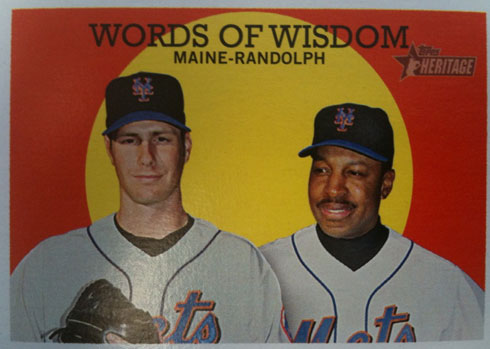
At some point while working here, I acquired a pack of 2008 Topps Heritage cards, probably the first pack of baseball cards I’ve opened in 15 years. They’re all turning up as I clean, and I just uncovered this one:

It’s from a series called “Words of Wisdom,” which I guess highlights great advice given from managers to their players.

The back reads:

When the Mets made a trade in the winter of 2006 with the Orioles to get John Maine — then a little-known prospect — many fans barely noticed. They notice the young right-hander now, as he’s quickly matured into a top-of-the rotation mainstay. His rapid development can be credited, in part, to deft handling by manager Willie Randolph. In Maine’s 1st season, Randolph brought him along carefully, rarely allowing him to work deep into games. By the end of the year, John was prepared for pressure, and he responded with a 2.63 ERA in 3 postseason starts. In 2007, he tied for the team lead with 15 wins, once carrying a no-hitter through 6 innings and another time losing a “no-no” with 2 outs in the 8th.

Oh, pre-2008 John Maine: top-of-the rotation mainstay. Oh, pre-2008 Willie Randolph: deft handler of pitching staffs.

Why the common comps for Jenrry Mejia are not good comps for Jenrry Mejia

I fixate. Anyone who has been reading my writing long enough to remember my unending Val Pascucci campaign in 2008 knows that.

These days, I’m fixated on the idea that Jenrry Mejia should open the season starting games in the Minor Leagues, or, now, stretching out to start games in the Minor Leagues, and not in the Major League bullpen. See here, here and here for details.

I realize that obsessing like this is stupid; by now, Mets fans have all likely made up their minds one way or the other about where they feel Mejia should be pitching in April, and continuing to beat the drum only opens me up for criticism in the event that he does start the season in the Major League bullpen and manage a successful conversion to the rotation down the road.

And I know the Mets haven’t actually put him in the bullpen yet. So it’s pointless to get too upset, since all using him in relief in Spring Training could end up amounting to is a little more time getting Mejia stretched out in April — ultimately keeping his innings total down — plus some needless screwing around with him and a whole lot of wasted words.

But whatever. I persist.

Anyway, plenty of people who are understandably excited about the possibility of Mejia breaking camp with the big club have countered arguments like the ones I’ve made by comparing him to other pitchers who debuted in the Majors as young as Mejia or successfully made the conversion from a bullpen role to the rotation.

But the following pitchers are not like Jenrry Mejia:

Dwight Gooden: Gooden comes up a lot because Gooden also wowed Mets coaches in Spring Training at a very young age despite no Triple-A experience and wound up on the Major League club in 1984. And Gooden went on to win the Rookie of the Year that year and then the Cy Young Award the following year, when he put on one of the most dominant season-long pitching performances in Major League history at the tender age of 20.

But Gooden is not like Jenrry Mejia because Gooden came with a wildly different Minor League pedigree. Look at what Gooden did in 1983. 191 innings, 300 strikeouts, 112 walks. That’s insane, and an insane amount of pitching for an 18 year old. Or anyone, really. If Mejia had dominated High-A ball to the tune of 14.1 K/9 like Gooden did and was going to be used as a starter in the bigs like Gooden was, then there would be no great reason his age should hold him back.

Of course, there’s a case to be made (that I’m not here to make) that Gooden could have used a little more time pitching under the radar, even if he was physically ready.

Adam Wainwright: Wainwright is a great example of  a pitcher who came through the Minors as a starter, was used as a late-inning reliever in his rookie season, then became a successful starter, as some hope Mejia can.

But Wainwright also is not like Jenrry Mejia. By his rookie season in 2006, Wainwright was 24 and had thrown 784 2/3 innings, including 245 1/3 at Triple-A. In them, he developed enough confidence in his curveball to throw it 25.9% of the time in 2006, including, as we all recall, in some pretty big spots.

By most accounts, Mejia still needs work on his secondary stuff. That type of work is best done in the Minor Leagues, which brings me to the next guy:

Johan Santana: Santana is another pitcher who came up in a relief role and became a successful starter, and since he’s on the Mets, he makes for an easy comparison to Mejia.

But Santana is not like Jenrry Mejia because the Twins were likely only keeping him around in their bullpen in 2000, his rookie year, because he had been a Rule 5 pick, and Santana — hard as this is to believe — sucked that year.

Santana didn’t become the awesome Johan Santana we know and love until 2002, when, surprise, surprise, he went to Triple-A for a stint to refine his changeup. The Twins slowly transitioned him into a starting rotation role over the next two seasons as they eased up his innings total, but he was never a one-inning reliever.

Francisco Liriano: The Twins began Liriano in a relief role in 2006 to give him his first taste of the Majors before moving him into the rotation in late May. And though they were careful with him — Liriano never pitched on back-to-back nights, and usually had two days off between appearances — his stellar rookie season was shortened by an elbow injury that ultimately required Tommy John surgery. He has not been the same since.

So I don’t see why Liriano’s a great example to point to for why the Mets should start Mejia in the bullpen. I don’t think the Twins’ handling of Liriano had anything to do with his injury, but a great pitching prospect who threw a half of a really good season shouldn’t be held up as a success story. The Mets want more than that from Mejia.

Still, Liriano is not like Mejia for a number of reasons. He entered the Majors in 2006 after a full season of starting in the high Minors in 2005, including a dominant 14-start stretch in Triple-A. Plus Liriano had a developed a wide enough arsenal of pitches that he threw under 50% fastballs that year and the highest percentage of sliders (37.6%) of anyone in the Majors with at least 100 innings pitched.

So: In truth, Jenrry Mejia is only like Jenrry Mejia, obviously. It’s fun to cite examples when making arguments, and drawing comparisons to players that have come before is a big part of what talking sports is all about. I get that.

And heck, for all I know, Jenrry Mejia can dominate out of the Mets’ bullpen this year while at the same time perfecting that secondary arsenal, then transition smoothly into the rotation next year to become a frontline starter and serve as a comp for all sorts of future young pitchers to come.

But as far as I’m concerned, it’s hard enough for a prospect to turn into a frontline starter without obstacles to his development, and the Mets would be best served making Mejia’s path to becoming a big-league frontline starter as smooth and effortless as possible.

That means a ticket to Binghamton or Buffalo, where Mejia can stretch out and strengthen his arm, gain valuable experience, and fully develop his entire array of pitches before being thrown to the big-league wolves.

The value he’ll add to the Mets’ 2010 bullpen over whomever he’d replace — be it Kiko Calero or Sean Green or Bobby Parnell — is simply not enough to jeopardize all the value he could add to the Mets’ future starting rotations. And just because there are a few vague examples of guys that have come before him in similar situations and succeeded doesn’t make it worth the risk to the Mets.

End of an era

According to Steve Popper’s Twitter, Anderson Hernandez has been claimed on waivers by the Indians.

The timing is a little funny, since the Mets need middle infielders, but Hernandez had no options remaining on his contract (hence being available on waivers) and isn’t very good, so it’s not something to be broken up about.

And I guess I should amend that to say the Mets need decent middle infielders. They have no shortage of crappy middle infielders, although those ranks just thinned by one.

I can’t really continue without it becoming a rant about Alex Cora, and I promised no more of those until Opening Day, so I’ll stop. But I’ll say this: I’m upset that this severely diminishes my opportunities to use the nickname for him forwarded by Dave G in the comments section not too long ago, Anderfail Failnandez.