With Toby and Patrick, as usual:
[sny-libsyn url=”http://html5-player.libsyn.com/embed/episode/id/2037736/height/360/width/640/autoplay/no/autonext/no/direction/forward/thumbnail/yes”%5D
On iTunes here.

With Toby and Patrick, as usual:
[sny-libsyn url=”http://html5-player.libsyn.com/embed/episode/id/2037736/height/360/width/640/autoplay/no/autonext/no/direction/forward/thumbnail/yes”%5D
On iTunes here.
In regards to actual September call-ups, I expect to also see Jenrry Mejia and Robert Carson return to the roster. And I hope to see Jeurys Familia as well, since most insiders I talk to think he could be a terrific closer rather quickly. It might also be smart to get 3B Zach Lutz some at bats at this level to see what he’s all about…
In addition to presenting the news that Lucas Duda has missed the last four games in Buffalo with “dental issues,” Cerrone predicts which young Mets will join the big club when rosters expand in September. That list seems reasonable to me. I’d guess Elvin Ramirez and Pedro Beato come back too, since they’re on the 40-man roster and have arms.
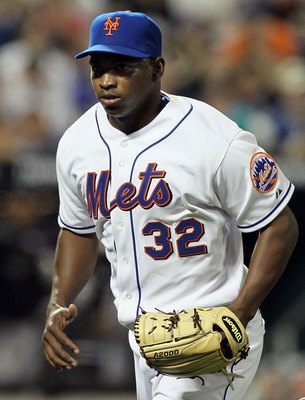 The other Minor Leaguers currently on the 40-man? Rob Johnson and Mike Nickeas, both of whom we’re familiar with, plus Kirk Nieuwenhuis, Wilmer Flores, Reese Havens, Juan Lagares and Cesar Puello. Nieuwenhuis is hurt and Puello hasn’t hit in A-ball, so neither of them seems likely to see lockers in Flushing.
Lagares hasn’t repeated his 2011 success in Binghamton in 2012, though he has been a bit better since the All-Star break and does hit right-handed, play the outfield and steal bases — three things the Mets might want to check out. Havens, depressingly, has missed the last week with a stiff back after hitting pretty well in Double-A since June. Flores has posted a very Murphish .297/.343/.434 in his first 48 games at Double-A, but he’s only 20 and still in the process of finding a home on defense.
Familia has been up and down (and more down than up) all season in Triple-A, but he’s made two straight strong starts (after three clunkers) and hasn’t thrown as many innings yet as he did last year. So maybe he gets a call and a taste of big-league action before he heads back to the Minors next year to work out his control issues.
The most interesting guy on Cerrone’s list is Mejia. What’s the deal with Jenrry Mejia?
Once compared to Mariano Rivera by people who should not have been making such comparisons, Mejia struggled in the Bisons’ bullpen. Supposedly he paces himself better as a starter and tended to overthrow in a relief role. The results suggest something similar: Mejia has a 5.48 ERA in 16 relief appearances at Buffalo and a 0.95 ERA in six starts. Tiny samples abound, though, and Mejia’s underwhelming rate stats have not been way different as a starter than they were as a reliever. Also, his ERA as a starter has benefited from seven unearned runs. I didn’t see any of them and I can’t say to what extent they’ve been the fault of his defense, but it seems safe to say he hasn’t been nearly as good as his ERA.
The big thing about Mejia, though — or one big thing about Mejia, at least — is that 2013 will be his final option year, meaning despite Mejia’s age, the Mets have limited time to figure out what to expect from him at the Major League level. That’s a shame, because it seems like more than anything he needs some reps: Mejia has thrown only 68 2/3 innings this season, has yet to throw 100 innings in any season at any level, and only has 86 innings across three seasons at the Minors’ highest level. By all accounts he has terrific stuff, but the stats say he hasn’t honed it yet.
That’s not all his fault, obviously, but he’s going to need to do so pretty soon if he’s going to make good on his prospect pedigree for the organization that signed him six years ago.
Although Jefferies was a disappointment compared to the hype he received in the minors, he did have a 14-year career in the majors, hitting .289/.344/.421 with a 107 OPS+. His OPS+ was better than league average every year until age 28 when injuries struck, and he had particularly good years in 1993 (.342/.408/.485, 142 OPS+, 5.5 WAR) and 1994 (.325/.391/.489, 130 OPS+, 1.9 WAR in the strike year). He stole 193 bases, was a two-time All Star, and posted a career 21.9 WAR.
– John Sickels, MinorLeagueBall.com.
It’s amazing to look at Gregg Jefferies’ baseball-reference page now and realize he was a pretty decent Major Leaguer. In my memory, outside of 29 games at the end of the 1988 season, he sucked.
 Mets fans often reference Generation K and/or Alex Escobar when reminding each other of the way prospects frequently fail to match their surrounding hype. And I do that too, of course. But to me no former Met better embodies the distinction between expectations and actual performance than Jefferies, largely because I legitimately expected he’d end up in the Hall of Fame.
I followed the Mets in 1987, but 1988 was my breakout season as a crazy, full-tilt Mets fan. When Jefferies came up in late August of that year, with tons of hype surrounding his promotion, he was electrifying. In his first 13 games, he hit .462 with a .500 OBP and a .962 slugging. Small sample size, obviously, but I was 7 years old and knew nothing of the concept. I was watching this guy I had read about all season in Inside Pitch, and he was everything I had hoped he would be and more.
Ultimately he wasn’t, of course. But I can’t say I didn’t spend a significant amount of time that year trying to affect a permanent squint to make myself look like Gregg Jefferies. And in backyard Wiffleball games, I tried to imitate the way he frequently seemed to stumble over second base on doubles.
In 1989, Jefferies stunk it up out of the gate, and I guess my appreciation for him fizzled quickly. I remember a bunch of nonsense in the newspapers involving an open letter to Mets fans, but I can’t recall the specifics. By the time he was traded to the Royals in December, 1991, I was more upset about the departure of another favorite — Kevin McReynolds — than the loss of the 24-year-old Jefferies. And more than anything, I was excited about the All-Star cast the Mets seemed to be pulling together for the 1992 season.
Oh, baseball.
The Mets acquired Kelly Shoppach from the Red Sox today for a player to be named later. Shoppach, a right-handed hitting catcher that’s not half-bad offensively, fills a need for the Mets: He can spell Josh Thole against lefties without creating a hole in the lineup. He’s not Johnny Bench on either side of the ball and he had back-to-back woeful offensive seasons in Tampa Bay in 2010 and 2011, but Shoppach has been a patient hitter with some pop in his bat for most of his career. He doesn’t make a ton of contact, but all things considered he’s about a league-average backstop offensively and represents an obvious upgrade over the woeful hitting the Mets have gotten from their backup catchers this season.
What’s odd is the timing. Shoppach is eligible for free agency after the season, so unless the Mets believe he’ll accept arbitration, he doesn’t factor in their plans for 2013. And though he makes the team ever-so-slightly better for the next couple of months, he’s hardly enough to catapult them back into the Wild Card race from nine games out.
The Red Sox called up prized catching prospect Ryan Lavarnway a couple of weeks ago, and they too are more or less out of the race. So maybe the move is about clearing room for Lavarnway to catch more often, and the Mets’ angle is something along the lines of, “Hey — free upgrade, why not?” But a lot depends on the quality of the player yet named, obviously.
For now, the Mets get a little bit better, which is nice. I suspect the move will make a bit more sense at some point in the future.
If you are a conscious human and fan of Major League Baseball, you probably know by now that the Mets’ bullpen sucks. And if you are not a conscious human or fan of Major League Baseball, it’s extraordinarily unlikely you are reading this blog. And that’s good, because if you’re not ready to get nerdy with this, you’re probably not going to care for this post.
 If you’re interested in what follows, you might want to open up the league-wide bullpen stats at Fangraphs and Baseball-reference to follow along.
The Mets’ bullpen has the worst ERA of any relief corps in baseball despite playing half their games in a park that favors pitchers. It sucks, and we’re past dismissing it as confirmation bias at this point. It sucked at the beginning of the year, it sucked in the middle of the year, and it sucks now.
It’s worth noting, at the very least, that the Mets’ relievers have not allowed the most runs or the most runs per game — a couple other bullpens have been more viciously victimized, at least statistically, by their defenses. And the Mets’ bullpen, as difficult as this may be to believe, falls (barely) outside of the league’s bottom five in save percentage. So there’s some evidence that it’s maybe not quite as bad as we think it is, at least relative to the league.
Still, by Fangraphs’ shutdown/meltdown stat, the Mets have the only bullpen in the Majors that can boast more meltdowns than shutdowns. Even if the Mets’ bullpen is not blowing saves at quite the rate of the Rockies’ or Brewers’, it is more often allowing close games to fall out of reach than it is keeping them close. That’s kind of crazy, considering how much baseball in general favors pitchers.
And any qualifications of the Mets’ bullpen suckitude could only be used to argue that it doesn’t suck quite so hard as a couple other team’s bullpens, and even those arguments would be tenuous at best. There’s just no doubt that the Mets’ bullpen sucks, only a million open-ended questions about why it sucks to this extent. So with that in mind, let’s look at some possible explanations.
Poor construction: As good as Sandy Alderson has been so far at maximizing the fringes of the Mets’ position-player roster, he has been just as bad at putting together competent bullpens. It’s a tiny two-year sample, obviously, but if Alderson is hailed here and elsewhere for his moves that pay off, he should be faulted for those that don’t even if they were difficult to foresee. The GM is ultimately responsible for the personnel on a team’s roster, and the personnel in the Mets’ bullpen have not proven adequate.
Still, who saw this coming before the season? That’s not a rhetorical question; I’d love to see the reasonably argued column or blog post predicting that the Mets’ bullpen would be anywhere below capable. Multiple members of the group — notably Frank Francisco, Ramon Ramirez and Manny Acosta — have pitched way worse than their historical norms. Only Bobby Parnell and Jon Rauch have pitched better than their established levels, and only marginally so — not nearly enough to make up for the difference in their teammates’ performances.
A case could be made that the Mets entered the season relying on too many old relievers. Perhaps, given the sample sizes in which relief pitchers operate, by the time a guy can establish a level of production he is too old to maintain it. None of the best bullpens in the league include nearly so many pitchers on the long side of 30, and the Reds’ league-best bullpen has featured only one 30-plus pitcher all year.
But then, the Cubs, Cardinals and Astros all have bad bullpens with lots of young pitchers, and the few other big-league clubs that count on a handful of older relievers — the Blue Jays, Tigers, Angels and Giants — have all been OK. None have been great, which seems worth noting, but they’ve all been appreciably better than the Mets.
Plus, outside of Parnell, none of the young or youngish pitchers the Mets have tried in bullpen jobs has met with much success. There’s still hope for Josh Edgin based on his Major League peripherals, and some hope too for Pedro Beato, Elvin Ramirez and even Rob Carson based on their youth and Minor League numbers. But none of them was even an average Major League pitcher in their short big-league stints in 2012. You can’t just plug in young guys and assume they’ll be good, obviously. You need good young guys, and the Mets haven’t had many this year.
There’s no sure way to build a bullpen. It does seem like most great bullpens tend to be more reliant on arms developed in-house or acquired via trade than Major League free agents, but that’s certainly not a hard-and-fast rule. So while ultimately the blame for this bullpen must fall on Alderson’s shoulders, it’s hard to say with confidence that it’s all his fault.
They just suck: Well, maybe, but it’s hard to figure out exactly why. They walk a lot of guys, but not the most of any bullpen. They have a slightly below average strikeout rate. Their 1.47 WHIP is bad, but not as bad as the Cubs’ or Brewers’ (though both those bullpens are also bad).
The Mets are near the bottom in the league in zone percentage (pitches in the strike zone), and above only a couple of teams who generate a lot more swings-and-misses. So maybe there’s something there: They don’t fool enough hitters to get away with throwing so few strikes. But they are near the middle of the pack in line-drive rate and contact rate and in the low-middle range in home runs per fly ball.
There are a bunch of pitchFX and batted-ball numbers to show that the Mets’ relievers are underwhelming, for sure, but there’s none that really jumps out as an explanation for why they’re collectively so bad. At least by my understanding — if you’ve got something more definitive, please jump in and say something. I’m hardly an expert on this stuff.
Mismanagement: Early in the season, when the Mets were leading the league in relief appearances by a pretty wide margin, I was eager to pin the struggles on Terry Collins’ quick trigger. But as the Mets’ relievers have continued to struggle, Collins has reined in their use. They’re now merely sixth in the league in appearances, which seems rather remarkable given how often they need to be pulled for ineffectiveness. And the Mets are in the bottom half of the league in relief innings pitched and around the middle of the pack in pitches thrown. They’re sixth in appearances with zero days rest, but they’re below the Rays and Braves in that stat, and those teams have good bullpens.
At times, it has seemed like Terry Collins hasn’t helped things with constant reliance on platoon matchups and established bullpen roles, with some “dry-humping” to boot. But it doesn’t seem like any aspect of Collins’ management has been particularly egregious when you consider the performance of the men he has been charged with using.
Bad luck: There’s some evidence the Mets’ relievers have been unlucky this year. If you subscribe to DIPS theory, you might care to learn that they’ve got the biggest positive differential between their ERA and FIP of any team in the Majors — suggesting they’ve been better than their results and should in time meet with more success. Of course, they’ve combined for 319 2/3 innings this season, and though random fluctuations can play out over more time than that, it’s a reasonably large sample of collective sucking.
At 64.8 percent, the Mets also have the lowest strand rate (LOB%) in baseball, a stat that tends to normalize to around the league-average 72 percent. Part of that is likely because they don’t strike out a ton of hitters, but part of that is almost certainly bad luck. Fortune and randomness make for some of the least satisfying explanations for baseball phenomena, but they’re also very often the best ones. The Mets’ bullpen certainly hasn’t been good, but they haven’t been very lucky either.
Bad coaching: The Mets canned Jon DeBus as bullpen coach after one year last season and replaced him with Ricky Bones, but obviously neither has enjoyed much credit for their role. I have no idea to what extent a bullpen coach might help or hurt a bullpen, though — maybe they’re both really bad at pep talks or something, or they have terrible phone manners that somehow bother Terry Collins enough to make him antagonize his relief pitchers into being awful. That doesn’t seem likely, but hey.
Dan Warthen is the constant, and a constant bugaboo for Mets fans. I’d guess this season’s bullpen will cost Warthen his job, but I might have guessed that in 2008 or in 2011 and it hasn’t happened yet. Personally, I doubt Warthen’s coaching is what ails the Mets; the starting pitchers, after all, have been mostly very good when healthy this year. But since I can’t say for sure what effect a pitching coach has on a staff, I also can’t say if Warthen is good or bad at it.
Bullpen-wide malaise: If I’m trying my best to consider all the tangible explanations than I must consider the intangible ones as well. Maybe the Mets’ bullpen features awful chemistry or a defeatist attitude or some sort of bullpen-wide lack of accountability. Maybe they hate the starters and position players and want them to suffer. I don’t know. All of them seem like decent-enough dudes individually, and they’ve all pitched in better bullpens in the past. But maybe they lack a goofy vocal leader to rile them into effectiveness or something. I doubt it, but, again, hey.
So there’s no clear answer. I’m guessing the Mets’ bullpen has struggled due to a combination of nearly every factor above, with the possible exception of the last two. But then if I could say for sure what’s wrong with them, presumably someone in the team’s front office could too and he or she could get about fixing it.
There’s a lot of chicken-and-eggery here, but eight of the teams with the top 10 bullpen ERAs this season are in the thick of playoff contention, with only the otherwise-flawed Royals and Padres featuring good bullpens and bad teams. The good news is there’s enough randomness and fluctuation in bullpen performance and construction that we can legitimately hope the Mets’ bullpen is better next year, and that it’s good enough to help the team compete all season. The bad news is there aren’t a hell of a lot of guys in house who look certain to be part of that bullpen, so Sandy Alderson’s got a lot of work to do this offseason, and he hasn’t been great at building bullpens so far.
https://twitter.com/ryankelly/status/233920887181701120
Well I’m not going to tell you what to do; like him all you want. For me? No, I’ll never like Chipper Jones. I kind of love him, I think, in some bizarre Freudian way, but I hate his guts. He’s obviously an awesome player and he does some hilarious things — many of which seem aimed at straight-up trolling Mets fans, which I appreciate because I do the same thing sometimes. I’m hoping to write more on this at a later date so I don’t want to scoop myself, but one of the few downsides to this job is it changes the way you are as a fan. Actually, I’m not even sure it’s a downside — it’s just a thing. I’m not the same Mets fan I was six years ago.
My first day with a credential, I went into the Phillies clubhouse after Jimmy Rollins booted a ball that cost Philadelphia the game. Because I hated Jimmy Rollins, I figured, subconsciously, that he’d act like a jerk and prove himself worthy of my hatred. But it turns out Rollins is a disarmingly nice guy.
I’ve never met Larry Jones and he’s pretty much the last Major Leaguer that I actually hate, and I feel like I owe it to my teenage Mets-fan self to hold on to that forever. I’m sure he’s not a bad guy, but he’s the bad guy.
https://twitter.com/RobvanEyndhoven/status/233920066733895682
I see no rush. Duda will be back in September, no doubt, but it’s now clear the Mets aren’t going anywhere this year. Duda’s probably the best offensive option the Mets have for regular play in left, but if the team is actually concerned about his confidence, he might as well get the opportunity to gain it back by feasting on Triple-A pitching for a couple of weeks.
Of course, I’m less certain that’s the issue. The biggest concern surrounding Duda has to be his defense, as it seems pretty clear he’s not going to be a big-league right fielder anytime soon. Since Ike Davis appears entrenched at first — and also probably not rangy enough to play the outfield, for those wondering — Duda needs to play left field until he proves he can’t. I don’t see why he’d have anything close to adequate range in left if he didn’t in right, but maybe he’d at least be better equipped to cover it with his arm in left.
https://twitter.com/GSchif/status/233926888907735040
I assume it’s Colbert, phonetically, because he’s a total Colbert. Also, someone needs to make a weekly Cole Hamels news show called the Colbert Report, sounding out the t’s.
https://twitter.com/JoeBacci/status/233925241389330433
I had heard that, yes. I’m not much of a soccer fan. I don’t want to get into the reasons and start some sort of pro vs. anti-soccer comments section flame war like it’s 2006, but neither the sport itself nor the culture surrounding it really appeal to me. I like the one Italian guy who looks like he’s from the future.
But I would welcome the idea of a soccer team in Flushing if it meant, ultimately, that there’d be more things to do before and after Mets games. This is a purely selfish thing, not an eminent domain thing or a Wilpon thing or anything else: The Willets Point development can’t happen soon enough. I’ve been to most of the Major League ballparks in the country, and I can’t think of any that sit in aesthetically worse immediate areas than Citi Field does. The whole baseball experience would (and hopefully will) be more pleasant if the Iron Triangle were anything but rows upon rows of chop shops. Even if it’s totally corporate and cookie-cuttery, it’d still be nice to have someplace to go within quick walking distance of the stadium and the subway besides the one bar attached to the stadium.
But with Bay inching closer to the Citi Field exit, here’s what likely happens next. He finishes this season in his new part-time role and then returns for spring training next year (for those screaming trade, don’t waste your breath).
At that point, Bay will have roughly a month to prove he can be a productive piece in the Mets’ lineup. That should provide Bay the opportunity to show he can do more than slap grounders to the left side of the infield or strike out, his signature contributions of the past two seasons.
But if that trend continues, and there appears to be no bottom to Bay’s spiral, the solution is unavoidable. He’ll have to be released before Opening Day, with the Mets picking up the remaining $19 million on his tab — $16 million salary, $3 million buyout of his 2014 option.
That sounds spot-on to me. Much was made yesterday of Sandy Alderson saying that the team would not eat Jason Bay’s contract, but what would anyone expect him to say? “Yeah, actually I’m quite sick of seeing him ground out weakly to the shortstop and can’t wait to cut him loose, $19 million be damned.”
Alderson keeps it tight, as he should. Here’s what I said in June:
The Mets will and should give Bay every chance to make good on his contract. Since it hasn’t happened yet and the injuries are piling up, it doesn’t seem likely to happen. And this front office doesn’t seem prone to carrying players that can’t pull their weight just because they’re paying them. I’d guess Bay comes to Spring Training, we read a couple stories about how he’s in the best shape of his life, and the Mets keep him around while the roster picture clears up. If no one gets hurt and he isn’t 2009 (or even 2010) Jason Bay again, they cut him loose late or send him packing in a Gary Matthews Jr.-style deal, provided he’s willing to waive his no-trade clause.
I’m sticking to that story. I’ll add that I expect some segment of the Mets’ fanbase to fret like hell over the possibility of Bay making the team out of the gate in 2013 over some better or younger player, just as some did in 2010 with Oliver Perez and Luis Castillo. Unless Scott Hairston leaves in free agency and the Mets can’t find any other righty- or switch-hitting outfielder who’s anything close to a Major Leaguer or Bay shows up to camp magically and legitimately rejuvenated, it’s hard to see how he fits on a big-league roster.
 Tedquarters