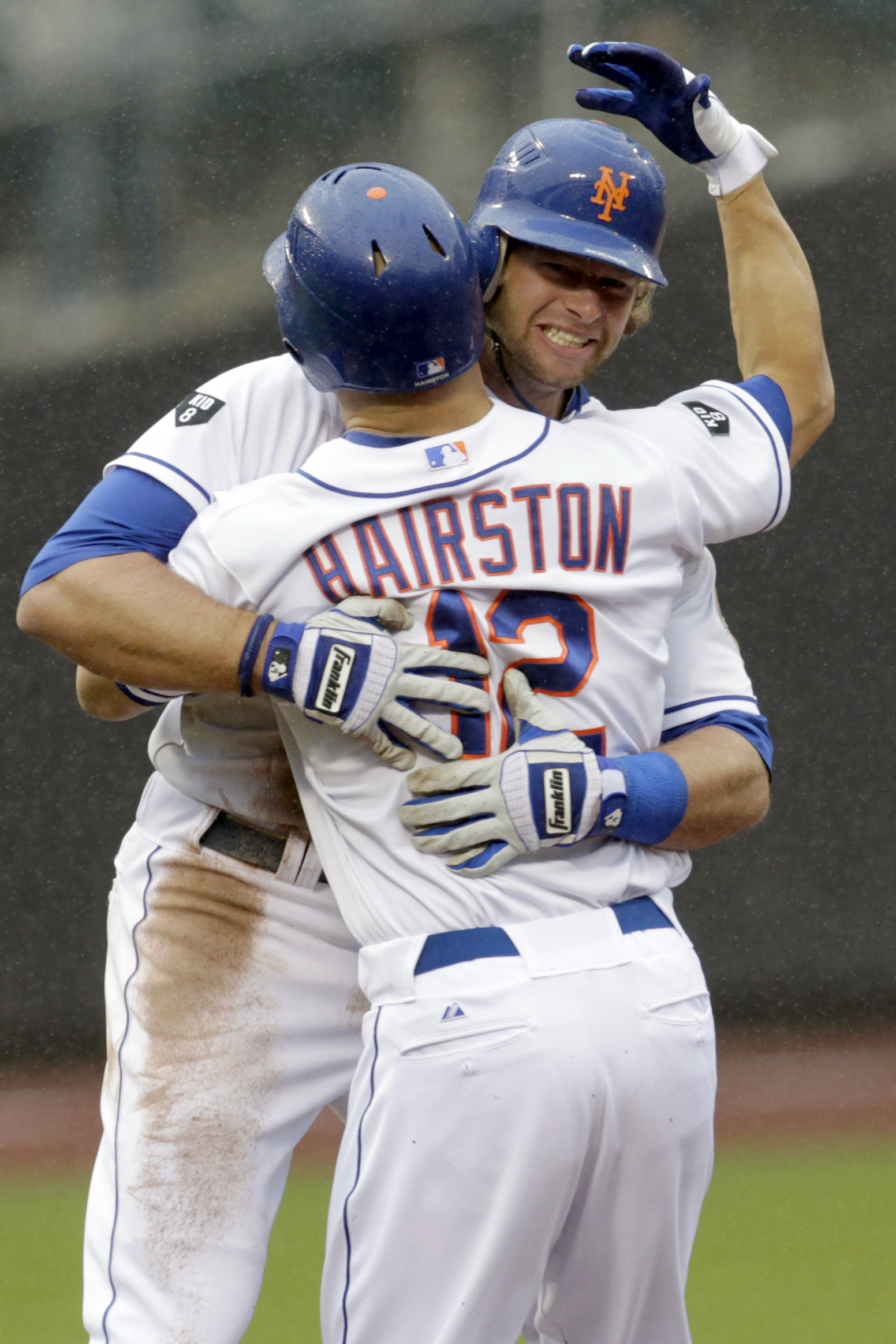
How satisfying was that series? How awful is the Marlins’ bullpen?
Almost everything is awesome right now. Mike Pelfrey’s going to need Tommy John surgery, so that’s less than awesome.

How satisfying was that series? How awful is the Marlins’ bullpen?
Almost everything is awesome right now. Mike Pelfrey’s going to need Tommy John surgery, so that’s less than awesome.
Longtime readers of this site may remember that it advocated the Mets’ acquisition of outfielder before both the 2010 and 2011 seasons. Well it seems like someone in the team’s front office is finally combing the TedQuarters archives for ideas (or, way more likely, combing the waiver wires for outfielders), as the Mets signed Lewis to a Minor League deal yesterday.
 With Jason Bay and Andres Torres out, the Mets are in something of a pinch for outfielders. They’ve got Lucas Duda, Kirk Nieuwenhuis, Scott Hairston and Mike Baxter in the mix now and Terry Collins has said he’s willing to use converted infielder Jordany Valdespin in the outfield as well. Presumably if Torres returns as expected on Sunday, Valdespin will return to Triple-A or be used exclusively as a backup middle infielder, with Nieuwenhuis starting in left field and Hairston and Baxter serving as the team’s fourth and fifth outfielders.
But Lewis is 31 and was a useful Major Leaguer as recently as 2010. He can hit a bit, especially against righties, play good defense in the corners and fill in at center in a pinch. Don’t be surprised if he torches the ball in Triple-A and winds up with the big-league club whenever the Mets next need an outfielder. He’s not on the 40-man roster, so it would require some shuffling, but that’s down the road.
The Mets also signed Brad Emaus, which drew more headlines because he was their Opening Day second baseman last year as a Rule 5 draft pick and LOLMets. With Valdespin and Zach Lutz on the Major League team, the Triple-A Bisons have been stretched thin in the infield, so Emaus helps there. But his 14-game audition in 2011 shouldn’t be taken to mean he’ll never contribute anything at the big-league level. He’s done his Triple-A mashing in hitters’ heavens in Las Vegas and Colorado Springs, but if he can hack it at Buffalo, maybe he’ll have a future as a Major League reserve infielder.
How many times has a shortstop thrown the ball away with Kirk Nieuwenhuis sliding into second base on a potential double play? In my head it’s three times. Is that right? Does anyone have a better memory than mine?
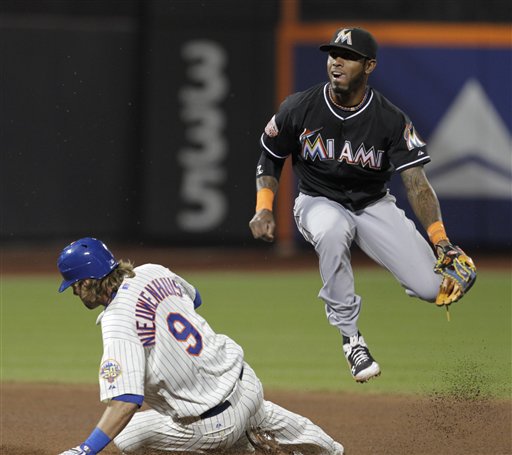 It definitely happened last night. Mark Buehrle hit Nieuwenhuis in his jersey, putting him on base for the only time in the game. With one out and Daniel Murphy hitting, Nieuwenhuis actually broke back toward the first-base bag as Buehrle came home, fearing a pickoff. But after Murphy bounced one to the right side, Nieuwenhuis still wound up bearing down on Reyes as he attempted the double-play turn.
Reyes might have misfired with anyone (or no one) sliding in, and Murphy might very well have been safe regardless. And even if it has happened three times, it’s not nearly enough to call it more than a series of coincidences. But it’s the type of thing we like to credit to Nieuwenhuis’ football build and mentality, which are part of what make him a fun player to watch when he’s going well — even if most players are pretty fun to watch when they’re going well.
In any case, whether due to Nieuwenhuis’ balls-out bro-dom or just good luck, the fielder’s choice wound up making a big difference in the game last night. It provided an at-bat for David Wright with Murphy on first. Buehrle left an 0-2 pitch out over the plate and Wright put it on the Party Deck to give the Mets a 2-1 lead that they’d never relinquish.
It was a pretty good symbolic sequence of things going right for the Mets: new-Met Nieuwenhuis gets on, new-Marlin Reyes throws a ball away to possibly keep the inning alive, and Wright hits a home run that would have been a long out last year (and it likely would have been — watch the replay: Emilio Bonifacio had time to slow up for the wall then try to jump for it). And then for added emphasis Lucas Duda smacked a single.
Oh, and R.A. Dickey threw seven strong innings despite the chill.
Over at Amazin’ Avenue, Matthew Callan takes an entertaining look at Ike Davis’ habit of complaining about called strikes. As Callan notes, Davis has been victimized by some particularly brutal calls lately, but there’s a chicken-egg component to that.
Was at the game last night and by the end we were talking about how Johan hasn’t had a single run scored for him while on the hill this year. So, I’m looking up through some stats this morning for run support and, according to ESPN, not only is he NOT the least run-supported pitcher in the bigs, he’s not even the least run-supported Santana—which goes to Ervin.
Am I just misreading this stat? How people be getting even less run support than the guy who has literally none?
– Bill, via email.
From the looks of it, ESPN’s “Run Support Average” is an oddly calculated stat. It appears to be:
Total runs scored by team in games started by pitcher / (Innings pitched by pitcher/9)
 In other words, though the Mets have not yet scored a run with Santana on the mound, they’ve scored six total in the four games he has started. He has pitched 18 total innings in those four starts, or two full games’ worth of work.
So I guess the stat means to say that if Santana’s Run Support Average is 3.00, the Mets have provided him three runs per nine innings. Only it doesn’t seem to make much sense, since the Mets have scored those runs in (in Santana’s case) twice as many innings as he has actually pitched and, by coincidence, none of the ones in which he was actually pitching. Maybe there’s a logical explanation for calculating it that way — I’m hardly a math guy and my brain’s on short rest.
In any case, it’s a silly thing to worry about. Santana’s lack of run support is as well-documented as it is unlikely to continue. It is unfortunate for him that this season he has matched up with Tommy Hanson, Stephen Strasburg and Josh Johnson pitching well in the games he pitched well. Though it seems the “aces match up with aces” thing is mostly overblown, they do necessarily square off at the beginning of the year and, it seems like, often a few times in the first weeks when they’re on similar schedules.
But then Santana was near the bottom of the league in Run Support Average in both 2009 and 2010, so maybe this is a real thing. Maybe there’s something about hitting with Johan Santana pitching that makes hitters stop producing runs in those games. Maybe they get too tight or too loose or this lack-of-run-support problem is in their heads.
Or maybe this is something we think is a thing that turns out not to be a thing. We’re dealing with 58 total games here for Santana since the start of 2009 — early June if it were playing out in a season — and for most of that span the Mets just haven’t scored many runs at all. Recall that in 2009 and 2010 the Mets were near the bottom of the Majors in runs scored, and consider that several of the other guys who show up near the bottom of that Run Support Average list both years — Zack Greinke, Cliff Lee, Felix Hernandez — seem to be guys who spent at the front of rotations for teams with poor lineups.
The 2012 Mets do not appear short on offense, so I’d bet on them starting to score plenty of runs for Santana soon.
Jose Reyes returned to Citi Field today. By 3:35 p.m., there were some 30 members of the media waiting in a clumsy semicircle around an empty spot in the visitors’ dugout left vacant for Reyes. By 3:50 when Reyes emerged, there were probably 50, armed with voice recorders and video cameras and microphones of various sizes.
“He’s innocent!” Someone shouted as Reyes took his seat.
“You want to interview somebody?” Reyes said, and everyone laughed, and then Reyes answered a bunch of questions and said a bunch more things that you’ve probably already read by now and freaked out about. And then a few hours later the Mets and Marlins played a baseball game good enough to remind everyone that the things baseball players say are generally far less interesting than the things baseball players do on baseball fields, since those are the reasons we care so much about them in the first place.
Which is to say: In the top of the first inning, Reyes torched a flyball to center field that Kirk Nieuwenhuis ran down and Emilio Bonificaio lined a single past Ruben Tejada, then Johan Santana didn’t allow another ball out of the infield until the sixth inning. He struck out 11 batters in 6 2/3 innings, hitting spots with his fastball and flummoxing rubes with his changeup and slider.
Say what you will and already have about the Mets’ injury woes. Jason Bay, Mike Pelfrey and Andres Torres are hurt, sure. But a man who’s practically a medical miracle took the mound for the Mets today and struck out 11 Marlins. Remember that part of it too.
This baseball game also featured:
– Josh Johnson nearly equaling Santana.
– Two plays at the plate — one for each team. Daniel Murphy was caught trying to score on a close play on a pitch that got away from John Buck. In Santana’s last inning, Giancarlo Stanton singled then Gaby Sanchez lined a double off the wall in left and giant awesome Giancarlo Stanton came charging home. Mike Baxter bobbled the ball, then his throw pulled Tejada toward second base. Tejada spun and fired home in plenty of time to get Stanton, but the ball short-hopped Josh Thole and went through his legs.
– With two outs in the seventh, four different Marlins pitchers (Johnson, Randy Choate, Steve Cishek and Mike Dunn) combining to walk four consecutive Mets to force home the tying run. Ozzie Guillen looked like he was endeavoring some sort of performance-art meta-criticism of Terry Collins’ managing. It was great.
– A running, diving catch from the aforementioned Stanton.
– A Lucas Duda line drive that both put the Mets ahead for good and felled pitcher Edward Mujica, prompting parts of the crowd to start chanting, “DU-DA! DU-DA!”, which, given the sight of Mujica splayed in front of the mound, seemed pretty merciless and made the whole scene seem like something out of Gladiator.
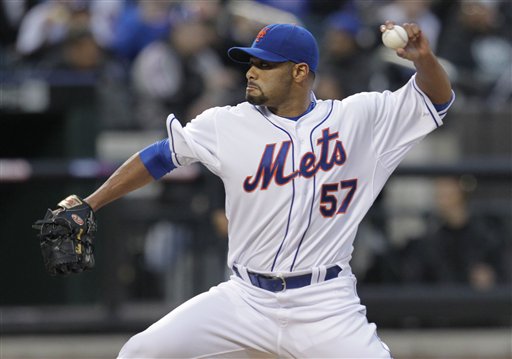
– Did I mention Johan Santana struck out 11 guys in 6 2/3? He looks sad here but he shouldn’t be:
…knocking on wood with crossed fingers, nearly everyone is healthy.
– Me, here, like six hours ago.
Since I wrote that this morning, the Mets have placed Jason Bay on the disabled list with a fractured rib and Mike Pelfrey on the disabled list with right elbow inflammation. Neither gave a timetable for his return. Bay suggested reporters “WebMD it” and said that he’ll return to baseball activity when he’s pain-free. Pelfrey insisted he feels great, though Sandy Alderson did not rule out ligament damage.
So we’ll see how that all goes. In the meantime, we’ll see Mike Baxter, Scott Hairston and likely Jordany Valdespin in left field, and presumably Chris Schwinden on regular rest in Pelfrey’s turn in the rotation on Friday. Lefty Rob Carson will join the team until it needs a starter to replace Pelfrey.
I could point out now that the Phillies still have Ryan Howard, Chase Utley and Cliff Lee on their disabled list, but I assume you don’t want to hear it, even if as of last week you didn’t want to see Pelfrey throw another pitch or Bay top another grounder to the third baseman. The Mets are cursed!
For what it’s worth, I cracked a rib on the first play of my first-ever middle-school football scrimmage. I tackled a running back, and as we went down, he stuck his knee up and into my chest. I thought I just got the wind knocked out of me in some new uncharted middle-school-football way and tried to play through it, then finally broke down crying in my dad’s car after practice two weeks later when the pain hadn’t subsided. I couldn’t breathe deeply without feeling like I was being stabbed. Outside of hernia surgery, it’s the most physical pain I’ve ever endured — and I have M.S. and Crohn’s disease and I’ve broken a few other bones. Obviously every injury is its own unique thing, but it speaks to the typical toughness of the professional athlete, I think, that Bay said he felt “a little sore” today.
*- Unless crossing fingers negates the effects of knocking wood, in which case, my bad.
The Mets put Jason Bay on the disabled list today and recalled infielder Zach Lutz from Triple-A.
Bay had quietly been on something of a hot stretch before fracturing his rib on an attempted catch last night. Lutz has always hit at every level and was destroying the ball to the tune of a .333/.425/.556 line in the early goings at Buffalo. He can’t play left field, though, which means we’ll likely see lots of Scott Hairston and Mike Baxter until Andres Torres returns, and that if Bay’s still out Kirk Nieuwenhuis will probably stick around a while longer once Torres is healthy.
Nieuwenhuis has actually never played left field in the Minors, but presumably he could handle it. And I wonder if the club feels comfortable enough with Jordany Valdespin in center to use him there a couple of times. It’ll be reasonably interesting to see how this shakes out, with two intriguing young players joining the Mets in as many days.
Both Lutz and Valdespin have their issues — Lutz has struggled to stay healthy in the Minors and Valdespin lacks discipline at the plate and on the basepaths. But both have some upside: Lutz has a career .289/.383/.490 line and Valdespin is a terrific athlete.
Mostly I just wanted to make a Lutz reference though.

Juan C. Rodriguez of the Sun Sentinel helps preview the Marlins:
Your browser does not support iframes.
I’ve been struggling with some early-season writer’s block, so I turned to Twitter for some help. Here we go:
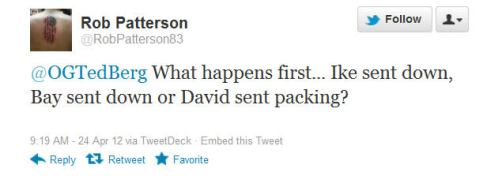 I’m going to go with a shoutout to Montgomery Brewster and say “none of the above.” Wright’s very unlikely to be traded this season, as I’ve covered here ad nauseum. And given Bay’s veteran status and salary, he seems more likely to get benched, pawned off somewhere or even straight-up released than sent to Triple-A.
As for Davis, well, I was hoping someone would ask about Davis and several people did. I’ve noticed suggestions that he should be sent to the Minors starting to creep their way into Twitter and comments sections (presumably they’ve come up on talk radio too, if that’s your fancy), but I didn’t want to dedicate a whole post to a few rogue Twitterers and commenters.
I don’t think Davis will get sent to the Minors and I don’t think he should. He has looked awful this season, no doubt. Yesterday’s double-header, in which he struck out three times and thrice left the bases loaded, might mark the low point of his young career. Plus there’s that looming, mysterious Valley Fever thing, even if he’s never been officially diagnosed with it and has never reported any symptoms.
But it’s April 24th, and three weeks ago many Mets fans and analysts likely would have guessed Davis would be the best player on the team in 2012. It’s way, way, way too soon to panic over a slump, no matter how deep. Davis’ swing features a ton of moving parts, so when he struggles it’s easy to get caught up in scout-speak and start diagnosing all his issues from our couches. Remember, though, that even when he’s going well, nothing about his swing looks particularly pretty until he makes contact. I’m not a scout or a hitting coach so this is far beyond my scope, but it sure looks like Davis’ timing is off right now.
Davis says the ankle injury that ended his 2011 isn’t affecting him now, and I have no reason not to believe that. I wouldn’t be shocked, though, if the five-month layoff prompted by that injury is partly responsible for his current drought. He has also seen fewer fastballs than he ever has before and suffered from what seems like an extremely unfortunate series of bad calls from umpires — none worse than last night.
There’s burgeoning talk that the book on Davis is out and pitchers need only throw him breaking balls in the low outside corner of the strike zone, but that’s way easier said than done. Presumably when Davis straightens himself out, he’ll have no trouble laying off the breaking stuff that misses low or outside and hitting anything that creeps over the plate. Just give it time.
Which is to say, I guess: Small sample size, small sample sample size…
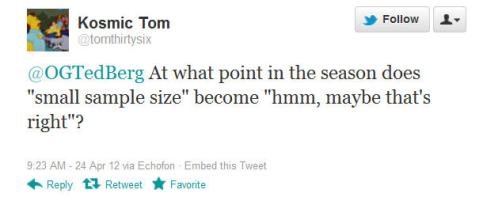 No sooner than Memorial Day. Two months’ worth of games still represents a very small sample, but that’s generally a good benchmark for distinguishing total flukes from things that might actually be happening.
 Sure. I think most Mets fans would have signed up for a .500 start, for one thing. For another, and knocking on wood with crossed fingers, nearly everyone is healthy. Andres Torres is the only regular sidelined, and Kirk Nieuwenhuis has done more than an adequate job filling in. And the big thing, to me, is that Johan Santana’s shoulder is still healthy. Every start he makes without a setback means another. That’s good news.
As for the 4-5-6 hitters, it’s really only Davis that can be called “non-existent” to date. It’s a tiny sample yet and both Jason Bay and Lucas Duda have been frustrating at times, but offensive totals are so far down around baseball that their numbers hold up well against players at their positions and batting order spots. Bay’s .776 OPS to date is more than 100 points higher than that of the average National League left fielder, and slightly better than the average NL fifth hitter. Duda’s .732 mark is a touch below the .759 standard for NL right fielders, but better than the .709 average for sixth hitters in the Senior Circuit in 2012.
And of course, it’s still that time of the year when a good night can lift a guy’s OPS by 70 points or more. There’s a song about that.
 Tedquarters