Good riddance to bad rubbish

Pat Burrell retired yesterday, and as Adam Rubin pointed out, he finished his career sixth all time in home runs against the Mets.

What Rubin didn’t point out (but probably knows) is that every other guy on the list besides is either already enshrined in Cooperstown, will be soon, or will render the whole place obsolete with his exclusion.

Burrell, in comparison, looks like just some guy: Undoubtedly a very good Major League hitter but by no means a superstar, a dude whose top baseball-reference comps include Greg Vaughn, Tim Salmon, Ryan Klesko and Danny Tartabull.

He will not be missed.

The following is skewed by the peculiarities of expansion and divisional play, I realize. List via Rubin’s post. Mays gets the asterisk because I didn’t count the home runs he hit with the Mets as part of his career total:

Guy HR vs. Mets % of career HR
Willie Stargell 60 12.6
Mike Schmidt 49 8.9
Chipper Jones 48 10.6
Willie McCovey 48 9.2
Hank Aaron 45 6
Pat Burrell 42 14.4
Willie Mays 39 6*
Barry Bonds 38 5
Andre Dawson 36 8.2
Billy Williams 34 8

How we overrate prospects, nutshelled

Patrick Flood posts a great question and poll at his blog: Which players will be most valuable to the 2014 Mets? He provides a ton of context, too, but the answer speaks to the current state of the Major League club and the way in which we overrate prospects.

Zack Wheeler, who hasn’t yet pitched above High A, has 80 votes. Daniel Murphy, already a pretty good Major Leaguer, has 11. And two of Murph’s votes are from me.

To be fair, Wheeler is arguably the Mets’ top prospect and Murphy, at 27, probably isn’t getting much better. So maybe people are voting on ceiling. Plus the Mets will only control Murphy through 2015 and could control Wheeler through 2018.

But c’mon: Reese Havens, 25-year-old guy who cannot stay on the field, gets more than twice as many votes as Josh Thole, who is eight days younger than Havens and has already shown he can be an average-hitting catcher in the Majors?

I think y’all might need to temper your expectations.

Also, I’m pretty sure Patrick wrote about 1,000 words and came up with an interesting poll as an excuse to post that Ruben Tejada factoid. Flood is the anti-Sarris.


Twitter Q&A part 2

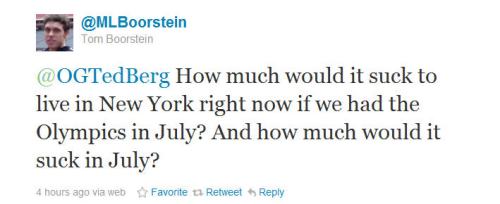
I just moved back to the city in November, so it’d probably be bad form to whine too much about all the theoretical tourists that would have come along with the Olympics, plus the various logistical nightmares it would inevitably bring. All that would certainly suck, though, especially when you consider many longtime New Yorkers struggle with the basics of subway etiquette.

But it would especially suck — and Tom knows I feel this way — to go through that in the name of Olympic sports, which mostly suck. One guy runs faster than the others. Some judge finds some routine more compelling than the rest. Flags are flown and anthems are played, and then within a year no one outside the discipline really remembers what happens. Call me a xenophobe, but I’d rather watch a mid-August Pirates-Astros game every single time.

Badminton is pretty cool though.

To be honest, I don’t eat candy bars very often. When you eat as much fried food and starch as I do, you’ve got to make concessions somewhere to not be dead by now, and for me that generally means cutting out the most intensely sugary foods. Plus, it’s kind of a long and unfortunate story but I’ve been down on chocolate since this summer.

Bottom line, I’d take a piece of cake, a cupcake or some sort of Drake’s Cake over candy most of the time, and if I am eating candy it’s almost always going to be Gummi Bears — Haribo, if possible, and preferably frozen. But that doesn’t mean I don’t think candy bars are delicious. If I had to rank my top five of the ones , I’d probably go:

1) 100 Grand
2) Whatchamacallit
3) Twix
4) Take 5
5) Butterfinger

I guess I’m a big fan of caramel in candy bars. Also, that’s discounting Reese’s Peanut Butter Cups and Reese’s Pieces, since neither is a candy bar proper. Furthermore, Snickers are way better than Baby Ruths even though they have similar ingredients. Also, I really like Heath Bars crushed up in ice-cream concoctions, but I’m not sure I’ve ever had a Heath Bar.

Finally, I’d say David Wright is more likely to rebound than Jason Bay, Andres Torres, or Johan Santana.

Mets rumored to be pursuing Rick Ankiel

Rick Ankiel’s name keeps coming up in rumors related to the last spot on the Mets’ bench. Ankiel hits left-handed and plays center field, so on the surface level he fits the Mets’ needs for the spot.

If the Mets have concerns about Andres Torres’ ability to hold up in center field over the course of a season and Scott Hairston’s ability to back him up, then I guess Ankiel makes some sense. For whatever they’re worth, UZR pegs Ankiel as just shy of average in center field — no small feat — largely because his outstanding arm helps mitigate underwhelming range.

But if the Mets think Hairston can handle center and want Ankiel because he hits left-handed, then the only thing he’s really got over Mike Baxter is a Major League resume. Ankiel mashed righties to the tune of an .890 OPS in his renaissance year in 2008, but his offensive numbers across the board have plummeted since then. In 327 plate appearance against right-handers in 2011, Ankiel mustered only a .678 OPS. By comparison, in Baxter’s last full season of Triple-A play in 2010, his line against righties translates to a .769 OPS in the Majors.

That’s only one year for both players, of course. But if the Mets bring in Ankiel and Terry Collins maintains his insistence on platoon matchups, they could very well be assigning the bulk of their pinch-hitting opportunities to a guy that’s not really fit for them.

Though if you’re playing at home, note now that it’s Jan. 30 and I’m lamenting the way Terry Collins might use a player the Mets are speculated to be considering for the very last spot on their roster.

But hey, the Giants are in the Super Bowl!


Twitter Q&A flavored product, pt. 1

More to come when I’m back from the studio. And on all prospect matters, I normally defer to Toby.

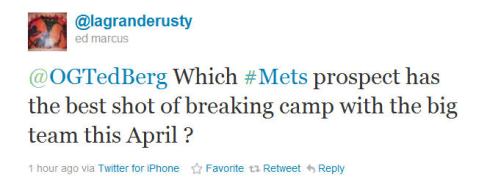
Depends on how you define “prospect.” But unless you count Mike Baxter as a prospect — and I’m assuming you don’t — the odds look pretty long for all of them. Since all the starting jobs appear pretty well set and the front office is unlikely to pull up a well-regarded young player to be a bench player or eighth-inning mop-up guy, it’ll probably take an injury in Spring Training to get a prospect on the Opening Day roster.

But all that said, it’s probably Kirk Nieuwenhuis. Nieuwenhuis missed most of last year with a season-ending shoulder injury, but he has got a few advantages on his peers in the Minor League system: For one, he has about a half a seasons’ worth of Triple-A experience, more than anyone else you’d like call a “prospect” at this point. Plus, he’s 24, he hits left-handed, and he plays the outfield, where the Mets don’t have a ton of obvious contingency plans behind the guys penciled in to start.

Still, it’s unlikely to happen unless a couple things go wrong (and Nieuwenhuis is fully recovered, of course). The Mets will probably want to give Nieuwenhuis more time to develop and show he’s as good as he played in the first couple months in Buffalo last year before they challenge him at the higher level. But since he’s furthest along than the Mets’ trio of young arms and plays a spot where they appear pretty thin, I’d put him down as likeliest to appear in Flushing in April.

Mets sign a Tuiasosopo

It’s true. It’s the baseball-playing Matt installation of Tuiasosopo, not the footballing Marques, Zach or Manu.

Unfortunately, for a big guy with a football pedigree, Tuiasosopo has never really shown a hell of a lot of power in the Minors. He’s got a career .255/.360/.430 line in the hitter-friendly Pacific Coast League, though to his credit he has played his home games in Tacoma, hardly the league’s best place for mashing. That translates to a .223/.307/.357 line in the Majors at a neutral park.

The upside for Wally Backman and the good people of Buffalo is that Tuiasosopo plays all over the place. In the last two seasons with the Rainiers, he has logged time at all four infield positions — though only two games at shortstop — and both corner outfield spots. He strikes out a bunch and he hits right-handed, neither of which bodes well for his chances of spending any significant time with the big-league Mets. But he can draw a walk, and, you know, Moneyball.

Just to clarify

No one is predicting a 94-win season for the Mets. Last I checked, I am not a crazy person. That number was meant to represent the Mets’ best possible outcome, based on very lazy and inexact addition and guesswork. I actually thought it was pretty damning to say that the best the Mets could hope for if absolutely everything went right was a Wild Card — that they’d be limited to second place by their talent, even in the best-case scenario — but the post was nonetheless met with tons of LOLs and readers wondering what I was smoking.

Anyway, just for a point of reference I went through the same routine with all the other teams in the NL East, looking up and down the roster and trying to guess the best possible but still vaguely reasonable estimate for what each player might do in 2012.

As a Mets fan, I’m probably a bit harder on the Mets than I am on their competitors. Plus I’m less informed on the day to day machinations of the Braves and Phillies. But by my total, meaningless guesswork, the best-case scenario, ceiling win totals for the other teams in the NL East look like this:

Phillies: 116 wins
Braves: 106 wins
Marlins: 105 wins
Nationals: 98 wins

Now someone’s going to run to say I’ve just predicted three teams in the same division to win over 100 games, which is — if you’ve been reading — obviously not the case. Everything going right for the Phillies would mean many things going wrong for the Braves, Marlins, Nationals and Mets, so the Phillies winning 116 games would likely preclude the rest of the division from coming close to their here-speculated best-case win totals.

One thing that surprised me was the relative thin-ness of the Nationals, who seem to have become the Internet’s darling this offseason. I’m not sure how much of that excitement stemmed from their rumored pursuit of Prince Fielder, but I tried to be particularly generous with them and still couldn’t come up with a way they’re close to the Braves or Phillies on paper at the season’s outset. They’ve got a bunch of good young players and pitchers, yes, but they’ve also got some pretty big holes in their lineup and at the back of their rotation.

As for the hated Phillies: It’s exceptionally unlikely they’ll be anything like that good. The Phillies’ average hitter was over a year older than every other team’s in the National League last year. Ryan Howard will likely miss the start of the season after surgery on his Achilles tendon, which means 33-year-old Chase Utley, who has missed large parts of the last two years to injury himself, will be the Phillies’ youngest infielder on Opening Day. They’ve still got enough firepower and pitching to remain competitive in 2012, but — though a lot of Mets fans refuse to believe this — no one is immune to time. Their window will close.

And our Mets? Well, this is all a roundabout way of suggesting they have the least immediate upside of any team in their division, but it’s not to say they can’t do a better job capitalizing on their upside than their competitors or that they can’t enjoy a prolonged run of good luck. And since it’s boring to remind you that anything can happen, I’ll remind you this: If you’re absolutely certain in January that any Major League club can not win more than 60 or 70 or 80 games by September, you’re certainly a fool.

Daniel Murphy as the 2012 Mets

This much we know: Daniel Murphy does not look pretty playing the field. Hell, Murphy himself will tell you as much. He rarely appears comfortable at any position, even the ones where he seems to be decent. His instincts in the infield look strong on balls hit near him, but he is prone to errors of aggression and of inexperience. His movements are at best herky-jerky, even awkward – at least by the standards of professional athletes.

Yet last week, Terry Collins called Murphy the favorite to open the Mets’ 2012 season at second base, where he has played all of 43 games in his professional career and where he suffered season-ending knee injuries in both 2010 and 2011.

But that’s a good thing! Not the injuries or the inexperience, of course — those are bad things. Rather, the Mets’ willingness to try the relatively untested Murphy at second base appears to be, given their circumstances, the right move.

As we all know, the circumstances are woeful: They apparently can’t afford to compete for big-name free-agents anymore (though there weren’t any available for the keystone anyway), and for a variety of reasons (Murph’s latest injury among them) it didn’t seem to make much sense to trade Murphy or anyone else to try to bring back a more obviously viable middle infielder. They need good, inexpensive hitters in their lineup, and with Ike Davis at first, David Wright at third and Jason Bay’s contract in left, there’s no better way to get Murph regular at-bats than by trotting him back out to second and hoping no overeager or ill-intentioned baserunner comes at him too hard too early in the season.

So they’ll go with it.  And I think Daniel Murphy the second baseman — in January, at least — stands as perhaps the best metaphor we’ve got for the Mets’ 2012 season.

In penciling Murphy in for second, the front office seems to be making the smartest possible move for a team with such limited resources. But it presents a great risk with the potential for a good reward.

If it goes well and Murphy proves an adequate defensive second baseman, he’ll likely rank among the better players in the league at the position. But since he’ll probably never be as good as Dustin Pedroia was in 2011 on either side of the ball, the best possible outcome for Murphy — like the Mets — appears to be “very good.”

Mets fans have come to celebrate Murphy’s offense and seem to assume, given the offensive standards at second base, he’d be among the very best at that position if he could hack it there. But his strong 124 wRC+ from 2011 would rank him sixth among Major League second basemen in both 2010 and 2011 — not quite elite — and certainly less-than-stellar defense would mitigate his value. Plus, though Murphy will turn 27 in April and might still improve a bit at the plate, his success last year was largely batting-average driven.

That is to say: We strongly suspect Murphy can hit a bit and we really have no idea if he can field. If he proves he can do both and stay healthy, he’ll be good, but he’s unlikely to be good enough at either to be great. And all of that, to me, sounds a hell of a lot like the 2012 Mets.

The very believable downside to playing Murphy at second is the chance that it’s an unmitigated disaster. He could get hurt again, or he could prove so unspeakably bad at fielding the position as to make Mike Pelfrey gnaw his whole damn hand off and R.A. Dickey eschew Shakespeare for Sartre. And no matter what the ultimate outcome, we must recognize now that every one of Murph’s hiccups along the way will be berated and GIFed and plastered all over back pages and blogs.

LOLMets, you know?

It’s important to note that I’m not saying the Mets’ 2012 season hinges on Murph. Not at all. He could be awesome and the team could suck, or — though it’s inherently less likely — vice versa.

What I’m saying, and the conclusion to all that bestcase scenario stuff, is not really all that groundbreaking: At second base and elsewhere, the Mets’ front office seems to be doing the best it can with its limited resources. But because the resources are limited, they have been and will continue to be forced to take risks with limited rewards.

The good news is that they’ve still got enough talent that the rewards, if they all pay off, are high enough to allow the team to contend. And it’s good that many of the players, like Murphy, are homegrown, likable and appear to be dedicated, and are under team control for long enough to be part of the club when next it is they do start fielding more inherently competitive teams.

The bad news is that risks are risky, and spreading first basemen all over the field, going with untested players at multiple positions, relying on several guys to return healthy from long injury absences, counting on a very shallow pitching staff, and hoping that an adjustment to the walls will fix the franchise’s best player add up to a hell of a lot of risk. And the contingency plans are basically Justin Turner, Ronny Cedeno and Miguel Bautista.