If absolutely everything falls right (pt. 3)

I lied when I said this would be a four-part series. I’m running out of steam and ways to say “hope,” so it’ll be three parts. Then for good measure, I’ll throw in a metaphor-heavy summary-type thing pre-previewing the 2011 Mets. That could come later today or tomorrow, depending on how busy I get with other nonsense.
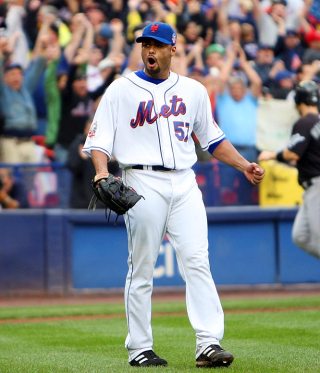
This is the one about the pitching staff.

The rotation: First things first, in a best-case scenario, Johan Santana stays mostly healthy. Given the nature of his injury and recovery, I’d say the best you could reasonably hope for is 25 starts at a solidly above-average but sub-Santanan level.

R.A. Dickey, we know, is totally sweet. And though Dickey’s ERA jumped a little last year, his rate stats all stayed remarkably consistent with his breakout 2010 campaign. The best we can hope for is another season of good health, great facial hair and great knuckleballs from Dickey, all of which should make him — hard as some find this to believe — among the top 25 starters in the league. Perhaps not a True No. 1 Ace, but a legit frontline starter regardless.

Jon Niese is more of a wild card. Niese’s peripheral stats indicate he might be very good, but he has a nasty habit — or, depending on whom you ask, the nasty misfortune — of allowing a ton of base hits. I’m not sure it’s likely, but I think it’s fair to hope the still-young Niese stays strong and healthy through the season, lives up to those peripherals and joins Dickey on the outer fringes of Ace-dom with an ERA in the low 3s.

Mike Pelfrey we’ve pretty much got pegged by now. He’s going to yield a lot of balls in play. The hope is that the Mets prove better than we expect at turning those into outs (or Pelfrey enjoys a run of great luck) and eats up 200 palatable innings with an ERA around 4.

For Dillon Gee, as with all pitchers, the everything-falls-right scenario must include a seasons’ worth a full health — no safe bet. And given Gee’s underwhelming peripherals in 2011, it’s hard to hope for more than the modest improvements suggested by all three of his projections on Fangraphs. In the interest of optimism, though, it’s worth noting that Gee struck out four times as many guys as he walked in the Minors.

And of course, if we’re talking about absolutely everything falling right — and we are, remember — then by sometime in the middle of the season one of Matt Harvey and Jeurys Familia will prove ready for prime time and an improvement over some member of the big-league rotation. Pitching prospects being pitching prospects, it’s probably unreasonable to expect success from both even for the purposes of this exercise. Which one surfaces first is anyone’s guess: Familia has had more success and a handful more starts in Double-A to date, but most prospectors are higher on Harvey.

The bullpen: The Mets put a lot of work into their bullpen this offseason, but bullpen construction tends to be something of a crapshoot. The Mets’ 2012 bullpen looks to have a nice combination of guys with histories Major League success, guys who can actually strike people out, guys who throw really hard and guys who can occasionally find the plate, though, so it’s not crazy to imagine them having one of the league’s better relief corps. It really only requires a couple of dudes having good seasons.

So here’s what I’ve got: I’m painting with very broad strokes here and doing all sorts of shoddy math, but the way I see it if absolutely everything falls right for the Mets, they could get about 33 wins’ worth of production beyond the replacement level from their position players and maybe 14 from their pitchers. If a replacement-level team can be expected to produce about 47.4 wins, these Mets, in this best-case scenario, would wind up with about 94.

Again: I can’t stress enough how inexact a science this is. And I guess the conclusion really isn’t all that stunning: If the Mets enjoy an unprecedented run of good health and every single player on the team produces as well as anyone could reasonably expect at the season’s outset, the team would be good enough to make the playoffs. I expect this would prove true for most teams. And that doesn’t really account for any unexpected Jose Bautista success, which happens on rare occasion (and to lesser degrees than Bautista’s, of course), or much assistance from the farm system.

The counter, of course, is that the Mets need nothing to go wrong to get to 94 wins, and several things will inevitably go wrong. How many things and how wrong they go will determine how far away the Mets finish from their best possible outcome, and since their best possible outcome is probably only a Wild Card berth, it doesn’t make a postseason run look particularly likely.

But in short: The good news is the Mets do probably have the talent to get to the playoffs if absolutely everything goes right. The bad news is that never happens, and they don’t have a lot of flexibility for when it doesn’t.
 

If absolutely everything falls right (pt. 2)

I meant to get to this yesterday but there was a meeting I forgot about. To the half-full outfield:

Left field: Jason Bay is probably the toughest Met to guess about here. If you think whatever happened to Jason Bay when he signed with the team was some sort of light-switch situation and that if someone or something to turns it back on he’ll go right back to being the hitter he was in Boston, then maybe you could guess that the fences will make the difference and he’ll put up an .880 OPS or something. I suspect that for a player of Bay’s age it’s more of a dimmer control than an on-off switch though, and that we should consider ourselves pretty lucky if something can move Bay’s dial halfway back toward full intensity. That’d mean about an .800 OPS, which by last year’s standards would actual put him in the upper tier of left fielders offensively. His defense is what it is.

Center field: It seems too much to ask for Andres Torres to repeat his outstanding 2010 campaign since he’s now two years older and coming off a disappointing season. But if Torres can even hit to his Bill James projections of .255/.332/.405 and play his typically excellent defensive center field, he’ll prove a fine addition.

Right field: Duda falls into the Ike Davis/Ruben Tejada/Daniel Murphy category: The best we can hope for from him offensively is that he puts up a full season of the production he showed in 2011. An .850 OPS will play anywhere, but Duda will need to prove he can handle right field, so in our optimistic projection, he shows he’s at least not-terrible out there.

The rest: Actually, if you want to pen the most dream-world Polyanna scenario, you can hope a) Bay torches the ball in April, May and June, b) some slugger on a contending team with payroll flexibility gets hurt, c) Kirk Nieuwenhuis picks up right where he left off last year in Triple-A and quickly shows he’s ready for the next level and then d) the Mets can trade Bay to the contender, shift Duda to left and call up Nieuwenhuis to play right without losing much. Though I guess if Bay is torching the ball, they would be losing much. So there’s a paradox there.

I think you can pretty much ink in Scott Hairston for an OBP between .300 and .315 and a few big pinch-hit home runs. His optimistic, pessimistic and realistic projections are all about the same.

The fifth outfielder will probably hit left-handed, so you have to hope he can hit righties well because he’s going to have a hell of a lot of pinch-hitting chances against them, given Terry Collins’ appreciation for platoon matchups.

The Mets’ starting outfielders can all boast elements of stardom: Torres has the defense, Duda has the power, Bay has the contract. None of them appears to be a complete player, even in a best-case scenario.

I should probably say now where I’m going with this: I’m using Fangraphs, looking over last year’s positional leaderboards and making very rough estimates at Wins Above Replacement values for Mets if they perform to their most optimistic expectations.

If you’re into that thing and on board with this exercise, take a stab at it: What would you say is the best total WAR the Mets could reasonably hope for from their position players?


If absolutely everything falls right (pt. 1)

This is often considered a depressing time of year even for those who aren’t Mets fans, but it’s especially bad right now for the Shea Faithful, what with… well, pretty much everything except reports of R.A. Dickey doing stuff.

So I’m squinting at Patrick Flood’s pre-preseason-preview and trying to think of if there’s any way the Mets could have one of those magical seasons where everything falls right, as unlikely as that now seems. So this’ll be a four-part series, I guess, in which I look at the position players and then pitchers likely to be on the roster and take a stab at making the most optimistic predictions for what they might produce for the club in 2012 to figure out if even then the Mets would turn out good.

And I’ll try to keep it at least vaguely reasonable. Technically the most optimistic prediction would be that every hitter on the team suddenly busts out a la Jose Bautista 2010, and the Mets become a ridiculous juggernaut that steamrolls the National League. But since Bautista’s case is exceptional, I’m not about to predict a 1.000 OPS for Ruben Tejada in 2012.

Catcher: Josh Thole has been about average offensively for a catcher in his career, and his ability to get on base and youth seem to bode pretty well for his future at the plate. He struggled defensively in 2011 after appearing to improve that part of his game in 2010. So if all goes well in 2012, he keeps getting on base, turns on a few more pitches for extra-base hits, and puts the defensive growing pains behind him. The most optimistic of the three projections on Fangraphs gives Thole an on-base heavy .736 OPS, but let’s go crazy and raise that to .750 and hope he can play average defense.

It’s hard to realistically hope for much from Mike Nickeas offensively, given his career Minor League numbers. But if we’re half-fulling here,  maybe Thole stays healthy enough to play the bulk of the Mets’ games behind the plate, Nickeas’ defense lives up to its billing and he hits well enough to prove an above replacement-level backup catcher. That doesn’t take much: Even a .600 OPS with good enough defense would do the trick.

First base: Ike Davis spent the first month of 2011 hitting about as well as we could reasonably hope he could, but given the long injury layoff I’d say it’s unfair to project a .925 OPS even in this useless exercise. But they are moving the fences in and we are trying to be as optimistic as possible, so let’s say Ike is healthy and stays that way and can maintain an OPS around .880 while playing his typically excellent defense. 

Second base: The most optimistic thing you can hope for at the keystone is that Daniel Murphy can hack it there well enough to avoid injury and embarrassment and keep his bat in the lineup. If Murph can maintain something around his .809 OPS from 2011 and just be better than Dan Uggla defensively, he’s a pretty valuable guy to have in the middle infield.

Third base: It was all the fences. David Wright again performs like his 2005-2008 vintage, when he was one of the very best players in baseball. He’s still probably a step slower defensively, but that part of his game improves a bit too as he grows more confident that he can again be awesome.

Shortstop: As with Davis and Murphy, with Ruben Tejada the most reasonable optimistic expectation would have to be that he’s capable of repeating something close to his offensive performance from 2011 over a full season. And there’s not much in Tejada’s Minor League past to suggest he should do that, but he’s so young and has always been so young for every level that we can still cross our fingers and hope he’s coming of age before our eyes, and that he can play capable defense at a premium position.

Backups: Ronny Cedeno sees some time as a defensive replacement and makes a bunch of fancy plays. Justin Turner forever wins the hearts of Mets fans everywhere with clutchness and grit in a right-handed pinch-hitting role. Neither needs to start that often, obviously, because all of the regular infielders are staying healthy and having career years.

How many wins is that infield worth? The way I see it — and again, I know this is all very unlikely — it’d have two legit stars in Davis and Wright, a solidly above-average player in Murphy and at least average guys in Tejada and Thole.

Ike Davis mending, Mets medical staff… who knows?

Good feature from Anthony Rieber in Newsday about Ike Davis’ recovery process. The bottom line? Davis is ready to go, but his ankle injury could linger in some fashion for the rest of his career. And it was at some point misdiagnosed by the Mets’ medical staff.

That report sparked a flurry of Tweets from Adam Rubin indicating other times the Mets have mishandled player injuries, but though some of them are quite damning, the cases — as Rubin briefly notes — are different than Davis’.

With Davis, the medical staff actually misdiagnosed the injury. Traditionally, it seems, the problem has not been the diagnoses from the medical staff but how the team acts on them, and there’s not a ton to suggest the problem has continued under Sandy Alderson.

Why national baseball writers should avoid writing team-specific articles

A couple of people pointed me to Jeff Passan’s ill-considered rip-job of the Mets for Yahoo! yesterday, but I was struggling to muster up the energy to write something about it, in large part because I didn’t know where to begin and in smaller part because I’ve come to hate indulging stuff like that with whatever little traffic I’d send its way. Luckily, Eric Simon took care of it.

Maybe it’s my fault

I was struck by something on my walk to the subway this morning. I’ve been following sports in earnest since 1987, when I was six years old. I remember watching the 1986 World Series with my family, but I didn’t understand it or recognize its import. I took up the Mets the following offseason, perhaps in part because of that championship but more likely because I was finally old enough to appreciate how awesome baseball is.

Anyway, sometime not long thereafter I started following the Jets and Knicks (to varying degrees). I’m nominally an Islanders fan, but let’s ignore hockey for the purposes of this discussion because, well… because it’s what people so often do.

2012 will mark my 26th year of following sports, and I have not yet known the glory of seeing one of my teams win its sport’s title. Actually, I shouldn’t even say “glory.” I don’t know if it’s glorious. It seems that way, but really I have no idea. I’m going to be 31 next week and I have been following sports for my entire conscious life, and that feeling — the ultimate reward for following sports — is still foreign to me.

I spent part of this morning trying to determine how many other cities might have fans as unfortunate as I have been these past 21 years. Granted, it’s inarguably better to have a perennially lousy professional sports team than no team at all, but I looked up all the cities with MLB, NFL and NBA franchises to determine if it’s feasible any fan in any city, choosing from local teams, might have it as bad as I do. One of those days.

Boston fans, you know, have seen recent successes from their teams in all three of those sports. Chicagoans who favor the Cubs have not seen an MLB or NFL title in the stretch, but can hang their hats on the Bulls’ unbelievable Michael Jordan run in the 90s. It has been mostly bad for them from Detroit, but they’ve got the lone Pistons championship in 2004 to hold on to. And so on.

Things have been nearly so bad for San Francisco Bay Area natives — likely on the Oakland side — who follow the A’s, Raiders and Warriors. The A’s won the World Series in 1989, but those teams have been otherwise quiet since.

Cleveland has a case: Neither the Browns nor Cavs nor Indians has taken its league championship since the Browns won the pre-Super Bowl 1964. And Seattle’s teams have been silent, title-wise, since the Supersonics took the crown in 1979.

But if you want to pick nits here — and I do, because this is about proving to myself how bad I have it — Mets/Jets/Knicks fans can claim this pathetic distinction on a technicality: The Browns, of course, have not operated continuously since 1987, and Cleveland was without a football team for three seasons from 1996-1998. And the Supersonics moved to Oklahoma City in 2008.

So no fan who came of age after 1987 and has followed continuously operating local MLB, NFL and NBA franchises has it quite the same as the Mets/Jets/Knicks fan. Certainly a case can be made that the Mets’ World Series berth in 2000 and the Knicks’ finals appearance in 1999 mitigate the suffering, but in truth it’s all about RINGZZ and my teams have f@#$ing none of them since I’ve been paying attention.

I imagine a lot of you are in the same boat. Let’s wallow in self-pity!

Lots and lots of stuff about Mets managers

Far and away the least-active strategist the Mets have ever had. [Davey] Johnson didn’t issue intentional walks, didn’t change pitchers, didn’t send up pinch hitters, and didn’t change his lineup. Maybe the best managers really do just get out of the way?

Patrick Flood, PatrickFloodBlog.com.

Patrick did a ton of research on Mets managers to try to evaluate Terry Collins objectively. It’s good and you should read it. But of course, as with all evaluations of managers, it’s very difficult to distinguish the skippers from the players on their teams. Maybe Johnson would have made more pitching changes if he had worse pitchers, and maybe Casey Stengel would have intentionally walked more guys if he had infielders he thought could turn a double play.