Ryan Ludwick, or the next Ryan Ludwick?

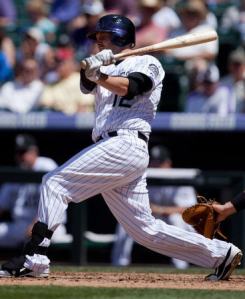
Here's what Andrew Brown looks like.

Rumors have it the Mets would be willing to sign Ryan Ludwick to a two-year deal, for whatever that’s worth. Ludwick hits right-handed, has power, and plays the outfield, so he’d fill a lot of the Mets’ most pressing needs. And he’s coming off a very nice year for the Reds.

But Ludwick is 34 and only one season removed from being essentially a replacement-level player. Twitter fellow and thinking baseball human Marc Normandin suggested Ludwick especially struggles in pitchers’ parks, which seems difficult to prove but would explain why he cratered upon joining the Padres and revived his career in Cincinnati. And it doesn’t speak well for the Mets’ pursuit of Ludwick unless they plan on bringing the walls in even further.

Moreover, Ludwick is the success story I typically trumpet when arguing on behalf of so-called Quad-A mashers, guys who always seem to destroy Minor League pitching but never get prolonged looks in the Majors. Ludwick didn’t settle into the Cardinals’ lineup until he was 28, and the Cardinals were the fifth organization for which he played.

So it seems to me that the Mets would be better served trying to identify the next Ryan Ludwick rather than committing two years’ worth of guaranteed money to the current Ryan Ludwick. Somewhere, almost certainly, there’s a guy the Mets can have for nearly nothing who can serve as an effective right-handed half of an outfield platoon in the Majors. Maybe he’s not likely to hit as well as Ludwick did in 2007, but it’s far from a safe bet Ludwick will, either.

With some quick searching, I found my horse: Andrew Brown. The 28-year-old Brown notched 112 unspectacular at-bats with the Rockies in 2012, then elected free agency last week after the Rockies removed him from their 40-man roster. Brown bats right-handed, has experience in all four corners, and has hit .296/.373/.551 over the last two seasons in Triple-A with a .314/.416/.564 line against lefties.

Brown’s presented here more as an archetype of what the Mets should be looking for than a specific guy the Mets should be signing, and for all I know there are 10 teams currently bidding for Andrew Brown’s services. But if Brown’s looking for Major League playing time, it’s hard to figure a better spot for an unproven righty-hitting corner outfielder than Queens right now.

Naturally, this all flies out the window if the Mets trade for Wil Myers and re-sign Scott Hairston.

Other Winter Meetings stuff pertaining to the Mets

A few items of note:

Alderson asks for Bradley and Bogaerts: Sandy Alderson produced a lot of Internet LOLs and incredulity when he asked the Red Sox for prospects Xander Bogaerts and Jackie Bradley, Jr. in a trade for R.A. Dickey. But if you’re going by what Dave Cameron reasoned through yesterday, that is exactly what Alderson should be requesting for Dickey. Per Jonathan Mayo, Boegarts and Bradley are the Sox’ No.1 and 3 prospects, respectively. Asking for that much at the beginning of negotiations hardly implies any sort of dark Mets conspiracy to keep Dickey drawing fans to Flushing in 2012. Alderson’s merely setting the bar high, as he absolutely should. If the Sox ultimately counter-offer with one of those two guys and a couple of slightly lesser (but closer to Major League ready) prospects, maybe there’s a deal to be made.

Wil Myers deemed “flavor of the moment:” This isn’t to target Andy Martino, merely the lines of thought expressed in his Tweet that seem somewhat common among Mets fans and media. Thing is, sometimes the flavor of the moment is really good. Has anyone had the seasonal Coffee and Doughnuts custard at Shake Shack? Outstanding.

More importantly, I don’t know that the Royals’ apparent willingness to move Myers should necessarily imply anything about his prospects. For one thing, the Royals are the team that signed Jeff Francoeur to a three-year contract, so it’s difficult to attribute much logical thinking to their front office. For another, if they’re really dangling him for pitching, they’re only doing the same thing a lot of us want the Mets to do: Trying to deal from an organizational strength to address an organizational weakness. If the Mets are taking calls on Dickey and Jon Niese, does that mean they’re down on Dickey and Niese? Sure doesn’t seem that way.

Scott Hairston deems his return to Mets “probable:” Good. Hairston’s return seemed unlikely as recently as a few weeks ago, when the Yankees were supposedly hot and heavy for the outfielder. But Hairston fits the Mets’ needs as well as anyone, and if he could be had on a reasonable deal, he should have no trouble finding the at-bats and playing time he’s looking for at Citi Field. Hairston was the Mets’ second best hitter last year, and he seems to hit awesome home runs at the awesomest times.

Nats sign Dan Haren for one year, $13 million: Oof. Seems like a strong move for the already pitching-rich Nationals. There are some red flags surrounding Haren — his struggles and diminished fastball velocity in 2012 first among them. But Haren was one of the best pitchers in the Majors just a couple years ago, and he still pitched like a quality back-of-the-rotation starter this season — which is all the Nats really need him to be. The deal’s not unlike the one Edwin Jackson signed last offseason, benefiting the team as the pitcher tries to prove he’s worth a multi-year contract the next year. Haren’s got more upside than Jackson, though, and a rotation of Stephen Strasburg, Gio Gonzalez, Jordan Zimmerman, Ross Detwiler and Haren makes the Nats appear the early favorites to repeat in the N.L. East.

Everyone wants Dickey: Jon Heyman reports that at least eight teams have contacted the Mets about R.A. Dickey. Of them, it’s hard to find great fits beyond the ones we most frequently talk about — the Royals, Red Sox and Blue Jays. But there might be something to be done with the Dodgers, who have a whole slew of moderately interesting players at positions the Mets need who crushed the ball in Triple-A last year. None of them is terribly young, though, and the Dodgers’ Triple-A home in Albuquerque might be the best hitting environment in affiliated baseball.

Me talking about all this stuff: I’m calling in to MetsBlog Radio at 12:15 p.m. ET to talk Winter Meetings and whatever else comes up. Check it out.

The case for Bobby Wilson

Yeah, I can’t believe I’m making it either: Bobby Wilson is a 29-year-old backup catcher recently non-tendered by the Blue Jays. His career OPS is below the Ordonez Line. He doesn’t hit for much power and he’s never stolen a base. His offensive upside is, to put it kindly, very limited.

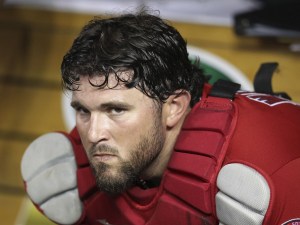
Here's what Bobby Wilson looks like. But unlike nearly everybody not named David Wright on the Mets’ current roster, he can hit lefties a little. Wilson’s got a .770 career OPS in the split, showing far more patience and power against southpaws — though it’s a puny sample. He’s hardly Kelly Shoppach or Ronny Paulino, but by pretty much all accounts the Mets aren’t interested in returning either of those catchers. And Wilson has been, for his career, far better against left-handed pitching than switch-hitting Jarrod Saltalamacchia and right-handed Matt Treanor, both of whom have been much better against right-handed pitchers in their careers.

Wilson also comes with a stellar defensive reputation, and the numbers — what few we have on catcher defense — back it up. Despite logging only 501 2/3 innings behind the plate in 2012, he ranked 10th of 116 catchers on the Getting Blanked Catcher Defense Ratings . And Wilson has thrown out baserunners at a slightly above average rate for his career.

It’s not optimal, obviously. But optimally the Mets would have buckets of money to throw around and could have made a run at Mike Napoli without hamstringing themselves for the long haul. And this assumes Wilson won’t cost much this offseason, what with his being a non-tendered backup catcher with a career .593 OPS.

But a platoon of Wilson and Thole, if they could both muster their career norms in the corresponding platoon splits, would give the Mets about a .720 OPS from their catchers. That’d be enough to put them right around the middle of the pack in the National League.

Naturally, that requires Thole to bounce back a bit and Wilson to maintain his small-sample split against lefties. And, again, it’s not like Bobby Wilson is going to come to Flushing and turn into an All-Star. But it seems like a way better plan than giving up anything of value for Saltalamacchia or J.P. Arencibia, or signing Treanor.

Prospect trade freakout

OK, this is not going to happen. But it came up on Twitter and I’m wondering what you think.

Wil Myers, you may recall, is the Royals’ top prospect. He hit 37 home runs across Double- and Triple-A with a combined .314/.387/.600 line at age 21 in 2012. Myers was recently ranked the fourth best prospect in baseball by Jonathan Mayo at MLB.com and placed third on John Sickels’ preliminary top 50 position-player prospects list.

Zack Wheeler, you probably know, is the Mets’ top prospect. He managed a 3.26 ERA across Double- and Triple-A with 148 strikeouts, 59 walks and a 1.168 WHIP as a 22-year-old in 2012. Wheeler was recently ranked the seventh best prospect in baseball by Jonathan Mayo at MLB.com and placed fifth on John Sickels’ preliminary top 50 pitching prospects list.

The Royals are widely rumored to be seeking starting pitching help this offseason, as the Mets are widely rumored to be seeking outfielders. I’ve got my answer on this one but I’m more interested in your thoughts. And, again, I don’t think would actually happen, since straight-up prospect-for-prospect deals of this magnitude are typically the stuff of video games:

Take warning

The Winter Meetings are here, and with them all the requisite nonsense and Twitter fuss and speculation ranging from reasonable to ridiculous.

josh-tholeMets fans, understandably, seem pretty geared up for a trade, since the team needs to improve to compete any time in the short- or long-term future and because it does not appear as if the front office has a lot of flexibility to throw around money at free agents. The players the Mets are targeting, at least according to the early rumors, are outfielders and catchers. They need both, no doubt, but the needs are not equal.

Outside of his ability to catch R.A. Dickey’s knuckleball, Josh Thole stunk after his concussion in early May of 2012. Upon returning from the disabled list on June 1, Thole hit a measly .217/.273/.263, and his .257 wOBA for the year ranked him dead last among Major League catchers with at least 300 plate appearances. For the season, he walked slightly less and struck out slightly more than he did in 2010 and 2011, and he somehow hit for even less power. It was an awful year for Thole at the plate.

But Thole’s 26, he’s under team control for the next four seasons, he hits left-handed and his history shows he’s not nearly as bad an offensive player as he was in 2012. It’s impossible to say the extent to which his concussion impacted his abilities at the plate, but far better hitters than Thole have struggled offensively after head injuries. And given the stark difference between the modest standard Thole set in his first two seasons versus the miserable numbers he posted this year, it seems reasonable to guess that his woes were at least partly due to the aftereffects of that injury. Thole actually seems like a guy we might be targeting as a buy-low option if he spent his terrible 2012 with any other team.

There’s no guarantee Thole bounces back to his 2010-2011 form, and even if he does he’s hardly Mike Piazza at the plate. But given his age, his contract status and the injury, he seems potentially too useful to give up on in favor of a player who would only make for a mild upgrade.

J.P. Arencibia, frequently linked to the Mets in early trade rumors, is merely a mild upgrade. He hits for way more power, but his production is mitigated by his inability to get on base with any frequency. His 88 career OPS+ is only a tick higher than Thole’s 85, and his .275 career on-base percentage is about exactly the same as Thole’s post-injury mark in 2012. And he’s not much of a defender.

Arencibia will be 27 in January, so he could still improve a bit — though so could Thole. Plus he hits right-handed and he won’t be eligible for free agency until after 2016. If he were practically free, or a part of a larger trade package, he’d make a decent right-handed complement to Thole in a platoon. But since he hasn’t hit lefties as well as free-agents Kelly Shoppach, Chris Snyder, Ronny Paulino or even Bobby Wilson, none of whom seems likely to command a whole ton of money, Arencibia hardly seems worth targeting in a trade unless he lands in the Mets’ laps.

Arencibia’s Minor League history should also sound a small warning about the Blue Jays’ more coveted young catcher, Travis d’Arnaud. d’Arnaud moved through the Minors at a younger age than Arencibia and typically posted more promising walk rates. But though d’Arnaud’s .333/.380/.595 line as a 23-year-old at Triple-A Las Vegas looks enticing to a Mets fan dreaming of an All-Star catcher, it’s not far off from the .301/.359/626 marks Arencibia posted in Vegas as a 24-year-old in 2010. d’Arnaud carries a better reputation in prospect circles than Arencibia ever did, and, again, he’s younger and far more likely to emerge as a Major League star, so worth way more in a trade than Arencibia. But he’s far from a guarantee to immediately succeed in the Majors. Sometimes what happens in Vegas stays in Vegas.

Moreover, the Mets need outfielders more than they need a catcher. Right now, their best two-way outfielder is either Kirk Nieuwenhuis or Mike Baxter. That duo has about a full season’s worth of Major League plate appearances between them. Lucas Duda has more, but his ability to stay in the outfield should be considered questionable at best. All three of them hit left-handed, as does Jordany Valdespin. Their best righty-hitting in-house outfielder, again, is either Juan Lagares or Cory Vaughn, neither of whom appears ready to play in the Majors by Opening Day 2013.

It could be that outfielders will be easier to come by on the scrap heap, so much so to justify trading for a catcher. But the outfield needs to be the team’s priority this offseason, and it’s not all that close. As hard as this may be to believe, the Mets are better off hoping Thole bounces back and starting the season with him and Anthony Recker than starting all three of Baxter, Nieuwenhuis and Duda in the outfield with no righty-hitting hedge.

Friday Q&A, pt. 1: Mets stuff

I don’t know, dude. $138 million may sound like a lot of money, but you should see Ike Davis’ bar tabs. But presumably Murphy’s bachelor party will be at a batting cage, so Wright should be able to afford the rental, the pizza, and the party hats.

Can I say no one? Going with no one. They’re never going to top Roy Hibbert’s, and with the Mets’ luck the attempt would end with a career-threatening ankle injury.

Hmm… I’d put them like:

1) Santana trade
2) Piazza trade
3) Hampton trade
4) Wright extension
5) Piazza extension

Though they were certainly nice, both extensions seemed more or less inevitable, so they don’t match the trades for excitement. My enthusiasm for the Hampton trade was mitigated by my how psyched I was for Roger Cedeno, hard as that may now be to believe. When the Mets traded for Piazza, I thought it was cool but decidedly uncool to Todd Hundley, who had been about the second best hitting catcher in the league the prior two years and a favorite of mine. Obviously I didn’t know then how much I would come to love Piazza.

The Santana trade came in my third week working at SNY, so it was a pretty exciting time for me personally, and an especially exciting time for me for the Mets to trade for the best pitcher in baseball. The extension negotiations actually happened inside this office in a conference room upstairs. I mentioned this before but it’s kind of a funny story:

I will say, though, that there’s one minor scoop for which I am directly responsible and have never been credited. I was the anonymous source that fed Matt Cerrone the details of the Johan Santana contract.

It went like this: I got word that Santana, his agents and the Mets’ front office were negotiating his contract in the SNY offices because of their accessible Midtown location. I work in said offices, and figured out which conference room they were in (it wasn’t hard -— it’s the fancy one).

The workday was winding down as the negotiations were starting, and I had nothing particularly important to do that evening, so I went upstairs and parked myself at the receptionist’s desk outside the conference room. I considered doing the old sitcom cup-on-the-door thing. I IMmed Cerrone when they got dinner delivered.

I sat there for a while, browsing the Internet and waiting for something to happen. I was just about to give up when a dude — a young guy, must have been someone who worked for the agent or something -— emerged from the conference room on his cell phone.

“It’s done, dude,” he said. Then he paused.

He continued: “Six. Yeah, six and 137-point-five.”

Ideally, a lot of them. One frustrating thing you see bandied about pretty frequently is that “(Player X) is not a contributor on a championship team.” And if you look at championship teams, it’s so silly. The 2012 Giants used Ryan Theriot as a DH in the World Series. The Tigers gave tons of at-bats to Delmon Young, Brennan Boesch, Ramon Santiago and Ryan Raburn.

Every single guy on the Mets could be part of their next real good team. The guys who play infield all look more likely to be integral parts of that team than the guys who play outfield, but all the outfielders appear apt to be fine in part-time roles, so I wouldn’t even count any of them out yet.

The more important question, obviously, is who’s not on the team that’ll be part of the next real good Mets team. And that beats me. Who they are and where they come from will determine which of the current guys stick around when the club gets good.

People get frustrated with the Mets and David Wright is the most recognizable Met, so people transfer their frustration with the Mets to David Wright. I’m pretty sure that’s it. Same reason everyone blames quarterbacks for struggling NFL teams, same reason the Boston press blamed Ted Williams for the Red Sox never winning, etc.

Other than that, it makes no sense: Wright seems like exactly the type of dirty-uniform gamer many fans would love if he sucked, wearing his heart on his sleeve and playing through pain and generally being upbeat and cool about everything. It’s like he gets penalized for being awesome and handsome.

https://twitter.com/jeffpaternostro/status/274524698778419200

That, or the Abe Lincoln look that prompted Jose Reyes to say, “Don’t worry, we’ll find the man who did this to you.”

Murphy’s subtly become a shifty facial hair guy for the Mets, but we don’t talk about it much because it’s only like the seventh or eighth most notable thing about Daniel Murphy.

https://twitter.com/Met20/status/274529339582844928

Gee doesn’t have nearly the value on the trade market that Niese does. Niese has been better for longer, for one thing, he’s slightly younger, he has been healthier, he throws left-handed, and he’s signed to a very team-friendly longterm deal. All the reports on Gee’s recovery sound promising, but as Toby Hyde pointed out, blood clots have jeopardized pitchers’ careers in the past.

Yes, but the right kind of weird.

So it’s settled then

I don’t think the Royals would trade Wil Myers for Jon Niese, but — and like I’ll say on the podcast — the Royals are the team supposedly open to trading Wil Myers, who hit 37 home runs as a 21-year-old in Double-A and Triple-A last season, even though one of its outfielders is Jeff Francoeur. So if there’s anything to this, the Mets should jump on that deal.

Niese is a good young pitcher signed to a very team-friendly contract. But he’s a pitcher, which means he’s no lock to stay healthy, and he’s yet to throw more than 200 innings in a season.

Myers hit so well in the Minors last year that his Major League equivalency line — .260/.320/.469 with 27 homers if you include his stats at both levels — would have made him arguably the second best hitter on the big-league Mets in 2012. That’s not saying much, sure, but it speaks to how badly the Mets could use more offense. And Myers is a right-handed hitting outfielder with power, which is the main thing the Mets need.

By my best guess, if Myers plays even average defense in an outfield corner, he would have been roughly as valuable to the Mets in 2012 as Niese was, and Myers is still at the age at which players can be expected to improve pretty rapidly.

Typically I’m skeptical of going all-in on prospects who have yet to perform at the big-league level, but Myers seems about as safe a bet as any, given his precocious production and his reputation. If the Royals are so desperate for affordable pitching that they’d trade him for Niese, then, you know, do it. But 74 percent of you already feel that way, so I realize I’m preaching to the choir.