A special Monday Mostly Mets:
On iTunes here.

A special Monday Mostly Mets:
On iTunes here.
Maybe free will really is an illusion, and all the choices we think we’re making are only the inevitable fallout of our nature and nurture: Neurons, developed through genetics and years of experience, programmed to fire certain ways in response to certain stimuli, fooling us into believing we’re in control of our decisions.
 It’s one of those things we can debate and consider and turn inside out for hours without coming to any objective conclusion, and it doesn’t much matter. I believe such a thing as free will does exist, but I’m willing to amount that my belief could itself be merely the product of my own determined constitution. And again: Who cares? I’m going to go on making the decisions I think are best one way or the other.
Point is, if you wanted to or could opt out of being a Mets fan, I’m pretty sure you would have by now. You watched the Great Collapse of 2007 and the Epic Middling of 2008, and withstood the injury plague of 2009. You gasped in horrified disbelief at the 2010 Opening Day lineup. You sweated out talk of the 2011 fire sale.
And that’s just the big-picture misery. That doesn’t even consider the anecdotes: Omir Santos pinch-hitting from the bullpen, Luis Castillo dropping the pop up, Mike Pelfrey falling, Luis Hernandez hobbling around the bases, Alex Cora actually playing baseball, Daniel Murphy crumpling up in the fetal position in short left field, and too many failed and ill-conceived sacrifice bunts to remember now.
There’s the off-field stuff too, of course: Shirtless Tony Bernazard and the Binghamton Bro-down, and the he-lobby press conference that followed. Ownership’s Bernie Madoff mess, the investigations and lawsuits, the foot-in-mouth feature articles, the failed partial sale, the shrinking payroll, the $70 million loss, the empty stadium, the loans from the league, and probably a hundred other things I’m forgetting.
It’s a veritable bad-news symphony, swelling over five seasons to a frenetic crescendo, its cadence ringing out in the streets and on the airwaves and all around the Internet:
LOLMets.
And you’re still here. The day after Jose Reyes, one of the best and most exciting players the Mets ever developed, signed with a division rival over (we assume) a matter of money, you’re still here reading this purportedly Mets-focused blog. And I’m still here writing it. We’re in this deep.
I have, I think, an enormously high threshold for pain. Because pain-tolerance is also impossible to objectively understand, I can only guess this based on empirical evidence and the suggestions of a series of doctors who initially misdiagnosed various ailments due to my apparently atypical nonchalance. I once played two weeks of middle-school football with a broken rib. A gastroenterologist suggested I had acid reflux when it turned out I had Crohn’s Disease. An orthopedist once chalked up to bad posture the symptoms of Multiple Sclerosis.
I mention all that not to brag and certainly not to seek pity, but to provide context. Maybe I’m not the best person to be coaching or commiserating or doing whatever the hell this is, given the neglectful and ultimately often counterproductive way I normally approach pain. Besides, I am an employee of this network and it behooves me to have you reading this website and watching Mets games in 2012.
But it strikes me that life and fandom are a series of massive tradeoffs, ones that must come out in our favor or else we would choose not to endeavor them. They are marked by so many harsh infinitives we wish we could split: They are to suffer, to shoulder, to stomach, to endure. And we do, almost always, because the rewards – though sometimes few and too far between – are so grand as to make the neverending onslaught of awfulness worthwhile. There are fireworks and funk music and Jose Reyes rounding second. Balloon animals and fried food and the ref’s palms pressed together above his head after a safety.
Every winter 29 teams don’t land the prized free agent. Every year 29 teams don’t win the World Series. One does, and the hope for that combined with the distractions provided by all the more mundane marvels are enough to keep us plodding forward through the agony.
Jose Reyes is off to Miami, and it stings to think about Reyes hitting triples in Little Havana and firing bullets across the infield in the Marlins’ ugly-ass new uniform. And we can fret about its impact on jersey and ticket sales and the long-term ramifications for our Mets, and we can wonder about what would have happened if Reyes hit the market at a different time with the team in different circumstances. But he didn’t.
Sandy Alderson and the Mets need to do what they can to get the team back toward being a regular winner, and once that happens the asses will return to the seats and the revenue will return to the payroll, Reyes or no Reyes.
It’ll happen. Maybe not in 2012 or even 2013, but it will. Great new Mets will come along to soften the blow of Reyes’ departure and leave us only with hazy, pleasant memories of his triples and steals and smiles and dances. It sucks now, and if it sucks more than you can bear you’re welcome to join Reyes in that stupid new hat. But the upside to this — and everything — is that there’s always more awesome stuff on the way eventually.
According to almost all of the Internet, Jose Reyes and the Miami Marlins have agreed to terms on a six-year, $111 million deal with a seventh-year option.
Oof. More in the morning, once the dust clears a bit.
Someone tell Daniel Murphy to start taking grounders at second.
Pedro Martinez will officially announce his retirement soon. Perhaps in the form of a party, because Pedro Martinez is a celebration.
 I could rattle on for hundreds of words about Pedro’s hilarious and sometimes divisive persona, or remember his mostly underwhelming tenure with the Mets, or defend him for defending himself from a hard-charging Don Zimmer. Or I could write about the first time I talked to Pedro after a ceremony in 2007 celebrating his 3,000th strikeout, and how he told me it was his first time his mother had been on a Major League field, and how speaking to him — one of my favorite players of all time — made me so giddy I called my own mother afterward.
But while all that ancillary stuff about Pedro is undoubtedly awesome, what’s most important to remember now is the ridiculous run of dominance that marked the middle of his Major League career. I’m almost hesitant to try to describe it, knowing I could never do it justice: A slight little man joyfully toying with so many juiced-up mashers, bedazzling and baffling with a blazing fastball and biting curve and a changeup that seemed to defy physics. It sometimes looked like Pedro was playing a video game, only he was on the Rookie setting and everyone else was on All-Star.
Watch this and this and this and this, knowing it’s entirely likely we’ll never see anything like it again. Time-capsule stuff.
What a stud.
If anyone needs Pedro Martinez, he’ll be under the mango tree, being awesome.
The Walking Dead, by the way, was a Marine battalion in Vietnam. I don’t know what it’s referring to now, probably vampires or something.
That’s the least essential quote from Sandy Alderson’s conference call with bloggers last night, if the most hilarious. Amazin’ Avenue has the full transcript, which you should probably check out.
For what it’s worth, the only reason I know anything about Thaddeus Kosciuszko is that he was the subject of a verbal SAT passage I taught about 150 times while tutoring.
Also, I’m not sure why I spent so much of the first third of this podcast restating various tweets:
On iTunes here. A rundown:
0:30 – Phone Call – Vic from Staten Island
11:00 – CBA Discussion
– More or less competitive balance?
35:00 Reyes Rumors and the Reyes Tour
40:00 Ted Signs Jose Reyes
47:00 Email
– B-Mets-Ottawa Rumors
– Josh Edgin
– Roy Oswalt
1:09:00 – David Dejesus is not Angel Pagan
1:16:30 – A Revolutionary War History Lesson
The Cubs signed outfielder David DeJesus to a two-year deal reportedly worth $10 million with a club option for 2014.
 DeJesus endured a down year in Oakland in 2011, but by all accounts it’s a good deal for the Cubs. The New York metro-area native struck out way more than he normally does last season, but suffered from a batting average on balls in play well below his typical rates that likely had something to do with career lows in batting average, on-base percentage and slugging. DeJesus plays the outfield well and has experience in all three positions, though he will be 32 on Opening Day and has not been a full-time center fielder since 2007.
As a Mets fan, I am of course more concerned with what the DeJesus deal means for Angel Pagan’s future in Flushing. DeJesus and Pagan posted remarkably similar offensive lines in 2011: DeJesus hit .240/.323/.376 in pitcher-friendly Oakland, Pagan .262/.322/.372 at Citi Field.
DeJesus’ career numbers are slightly better: He has a 106 OPS+ to Pagan’s 101, and several more seasons’ worth of consistent production.
Pagan, we all saw, struggled defensively in 2011 after an excellent season in center in 2010. But Pagan is a year and a half younger than DeJesus, and since he is eligible for arbitration, will not require a multi-year commitment.
Add that to the fact that Grady Sizemore — who was once awesome but has not been better than Pagan since 2008 — recently signed a one-year, $5 million deal with the Indians, and all signs to the Mets making the smart move and returning their center fielder for another go of it in Flushing.
This still bothers many Mets fans. But color me skeptical that all the various reports of the team’s impatience with Pagan’s supposed behavioral problems amount to anything more than offseason chatter.
Thus far the team’s front office has shown a consistent ability to defy the noise in the media and fan base in favor of prudent decisions, and since no better and less expensive options appear available on the market, Pagan still seems like the Mets’ best choice to open the season in center in 2012.
It’s true. Is this something I’m supposed to have a strong opinion on? Because I really don’t. Good for him, I suppose. I remain a fan of fake mustaches.
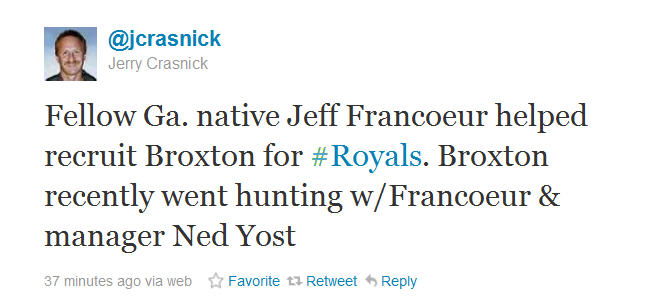 I was hoping the Mets would land Jonathan Broxton as a low-cost reclamation project for the back end of the bullpen, but the beefy right-hander would hardly be the first man to be lured in by Francoeur’s charming set of intangibles. One could only imagine the scene in those Georgia backwoods, Francoeur smiling maniacally with a rifle in one hand, a fresh kill in the other and a glimmer in his eye, convincing Broxton that this time he really has turned the corner and that if win-loss record was so important, well… you know.
They say free-agent relievers are the most dangerous game.
Broxton’s deal is reportedly worth $4 million for one year, hardly chump change but not unreasonable considering the way he dominated hitters from 2006 to 2009. Crasnick also tweeted that the Mets were among Broxton’s “most ardent pursuers,” which at least vaguely contradicts various vague reports from earlier in the hot-stove season. But I guess that’s all part of the game.
Anyway, there are still a handful of potential low-risk high-upside reliever types out there. Smart money says the Mets will land one eventually. Unless the Royals keep sending out Francoeur as an emissary. If that’s the case, we’re screwed.
I got a good email this morning from reader Hank, who is frustrated both by the Mets’ apparent inaction on the free-agent market this offseason and by the nagging insistence on “payroll flexibility” that keeps popping up in interviews with team brass. He suggests — perhaps accurately — that the term could be a euphemism for, well, complete payroll inflexibility: an utter lack of money to spend.
 I don’t know. There’s plenty more Mets stuff to talk about on the horizon this offseason, and plenty more time to hash out what it is they mean when they talk about payroll flexibility. But there really is something to the idea, regardless of if it’s a party-line thing the way they’re using it right now.
This offseason, C.J. Wilson is the best available free-agent pitcher. Some team that believes it’s one decent pitcher away from a world championship is going to sign C.J. Wilson, and that team will likely give Wilson way too much money. If that team’s hunch proves correct and Wilson helps it to the World Series, the proverbial (and actual) flag will fly forever, and the team can rationalize away the last couple of years of Wilson’s deal when he will likely prove a financial albatross.
But since the Mets appear to be more than a C.J. Wilson away from becoming a certain contender, they are better served building up their club with more reasonably priced players. Then, next winter or the following one or whenever they reach the point when they believe they are one C.J. Wilson away from securing a World Series berth, they can sign that offseason’s C.J. Wilson — and C.J. Wilsons come along practically every offseason — because they didn’t sign this offseason’s C.J. Wilson.
What Hank said in his email is correct: Teams (especially big-market teams) can build from within and spend on free agents. But since spending money on big-ticket free agents is one of the least cost-effective ways to improve a team, it should probably be the final piece of the process, not one of the first ones. Generally speaking, of course.
And I’d like to remind everyone of one very important point: It’s November 28th.
Come March we will have a better sense of how much money the Mets had to (or wanted to) spend this offseason, and whether the bluster about maintaining a payroll between $100 and $110 million was just that. But don’t confuse rumors — or the lack thereof — with anything terribly meaningful. It could just be that the Mets’ front-office is a bit tighter-lipped than some of its counterparts around baseball, shifting the media focus elsewhere.
Thus far this offseason, only a handful of players have actually found new teams on the open market. Using MLBTradeRumors’ ever-handy free-agent tracker, I put together the comprehensive list of players signed to Major League deals with new clubs:
Pitchers
Joe Nathan (Rangers, 2 years, $14.75 million)
Jonathan Papelbon (Phillies, 4 years, $50 million)
Catchers
Rod Barajas (Pirates, 1 year, $4 million)
Ryan Doumit (Twins, 1 year, $3 million)
Gerald Laird (Tigers, 1 year, $1 million)
Jose Molina (Rays, 1 year, $1.8 million)
Matt Treanor (Dodgers, 1 year, $1 million)
First basemen
Ol’ Jim Thome (Phillies, 1 year, $1.25 million)
Second basemen
Mark Ellis (Dodgers, 2 years, $8.75 million)
Jamey Carroll (Twins, 2 years, $6.75 million)
Shortstops
Clint Barmes (Pirates, 2 years, $10.5 million)
Outfielders
Mark Kotsay (Padres, 1 year, $1.25 million)
Look over that list. Not a rhetorical question: How many of those deals do you wish the Mets had made?
I could probably make an argument for a couple of the catchers. If you buy the recent pitch-framing research from Baseball Prospectus, Jose Molina in particular seems like a bargain at $1.8 million as a righty-hitting complement to Josh Thole.
Jamey Carroll’s still pretty useful: Gets on base a bunch, plays all over the field, once was an Expo. But he’ll be 38 on Opening Day and he required a two-year deal.
And there hasn’t been anything close to an obvious miss by the Mets, where the player and terms seemed to perfectly fit their (supposed) budget and needs but they let him slip away. Maybe that will happen, and then we can yell about it and say they were lying to us about the payroll figures and everything else. But right now it’s hard to kill the Mets for not spending money when a) it’s silly to spend money for the sake of spending money and b) pretty much no team has yet spent money.
 Tedquarters