What is Run Support Average and why is Johan Santana’s so high/so low?

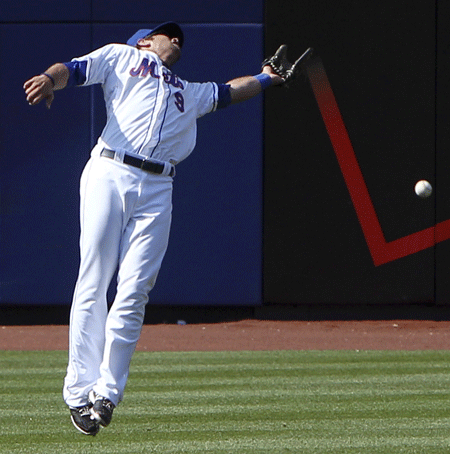
Was at the game last night and by the end we were talking about how Johan hasn’t had a single run scored for him while on the hill this year. So, I’m looking up through some stats this morning for run support and, according to ESPN, not only is he NOT the least run-supported pitcher in the bigs, he’s not even the least run-supported Santana—which goes to Ervin.

Am I just misreading this stat? How people be getting even less run support than the guy who has literally none?

– Bill, via email.

From the looks of it, ESPN’s “Run Support Average” is an oddly calculated stat. It appears to be:

Total runs scored by team in games started by pitcher / (Innings pitched by pitcher/9)

In other words, though the Mets have not yet scored a run with Santana on the mound, they’ve scored six total in the four games he has started. He has pitched 18 total innings in those four starts, or two full games’ worth of work.

So I guess the stat means to say that if Santana’s Run Support Average is 3.00, the Mets have provided him three runs per nine innings. Only it doesn’t seem to make much sense, since the Mets have scored those runs in (in Santana’s case) twice as many innings as he has actually pitched and, by coincidence, none of the ones in which he was actually pitching. Maybe there’s a logical explanation for calculating it that way — I’m hardly a math guy and my brain’s on short rest.

In any case, it’s a silly thing to worry about. Santana’s lack of run support is as well-documented as it is unlikely to continue. It is unfortunate for him that this season he has matched up with Tommy Hanson, Stephen Strasburg and Josh Johnson pitching well in the games he pitched well. Though it seems the “aces match up with aces” thing is mostly overblown, they do necessarily square off at the beginning of the year and, it seems like, often a few times in the first weeks when they’re on similar schedules.

But then Santana was near the bottom of the league in Run Support Average in both 2009 and 2010, so maybe this is a real thing. Maybe there’s something about hitting with Johan Santana pitching that makes hitters stop producing runs in those games. Maybe they get too tight or too loose or this lack-of-run-support problem is in their heads.

Or maybe this is something we think is a thing that turns out not to be a thing. We’re dealing with 58 total games here for Santana since the start of 2009 — early June if it were playing out in a season — and for most of that span the Mets just haven’t scored many runs at all. Recall that in 2009 and 2010 the Mets were near the bottom of the Majors in runs scored, and consider that several of the other guys who show up near the bottom of that Run Support Average list both years — Zack Greinke, Cliff Lee, Felix Hernandez — seem to be guys who spent at the front of rotations for teams with poor lineups.

The 2012 Mets do not appear short on offense, so I’d bet on them starting to score plenty of runs for Santana soon.
 

Twitter Q&A, part 2

Might I suggest asking Twitter for questions?

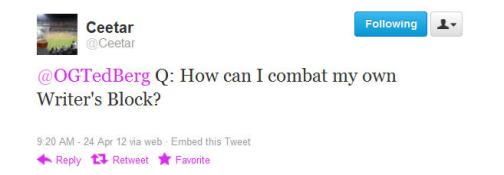
I’m probably not be the best person to ask about this, since my approach to writer’s block is about the same as my typical approach to physical pain, emotional distress and most other problems, and I’m not sure it’s always the most productive one: Power through.

With writing, and really any creative pursuit I’ve endeavored, it’s especially frustrating because I find it nearly impossible to know for sure which things will hit and which will miss. Presumably some of that’s on me, and obviously there’s a lot of randomness at play. But sometimes I’ll feel like I have almost nothing to say and struggle through a post, then people will seem to really enjoy it. And other times I’ll feel like everything’s really flowing and almost no one responds in any way. Totally emo. Are you there world? It’s me, Ted!

Anyway, that doesn’t matter. Point is, if you’re reading today and video stuff isn’t your thing, thanks for sticking out the last few days.

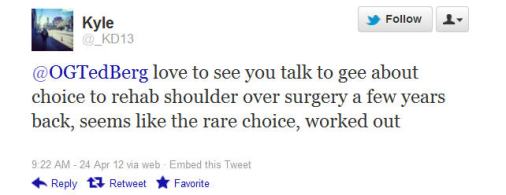
Man, I wish I were better qualified to talk about that. Truth is I don’t know exactly how rare a choice it is, nor all of what the rehab entailed, nor even that it was the best choice — who knows if Gee would be a better pitcher today if he went the surgical route? This Daily News article from last year suggests he still endures pain in the shoulder.

I can say with some confidence, though, that the human body is an amazing and mysterious thing. My wife and I took in Knuckleball! this weekend at the Tribeca Film Festival (which answers @dpecs‘ question), and the movie detailed R.A. Dickey’s lack of an ulnar collateral ligament and the way it cost him his first-round signing bonus out of college. Dickey explained how doctors said he shouldn’t be able to turn a doorknob without pain even though he had been throwing fastballs in the 90s.

I know it’s kind of an old story by now, but really… think about that! The guy threw fastballs in the 90s without one of the main things that’s supposed to be holding his elbow together. At 37, the guy still throws pitches in the mid-80s, and he still doesn’t have that thing. And for all we know there are five other Major Leaguers who don’t have UCLs either who just never posed for the wrong picture at the wrong time.

When I was diagnosed with M.S. in 2008, my doctor showed me MRI images that showed 10 small lesions on my brain, then said I had nothing to worry about because only about 50-percent of brain lesions affected people in any way. That freaked the hell out of me, because I’m good enough at math to know that 50 percent of 10 is five, and I didn’t want five lesions operating on my brain. So after a couple of weeks of fretting, I brought it up to the doctor. He explained that it ultimately didn’t matter at all — the lesions were there and likely would be forever, but even if some of them did have some small impact, the brain and body ultimately create new pathways and means of compensation, and neither I nor anyone else would ever be able to notice any difference.

You ever see those local news features about the people who lose their arm functions and learn how to do everything with their feet? We’re all kind of like that in various less-obvious ways. This sounds depressing but it’s actually the opposite: The longer you live the more crap you need to deal with, and you either figure out ways to deal with it or it deals with you.

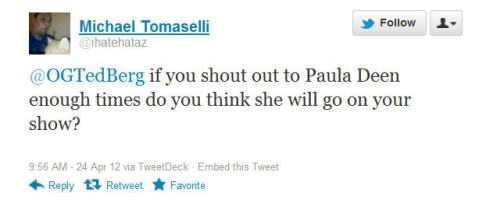
I do hope that, yes. Yo whatup Paula Deen? How great is butter? You want to come make a sandwich with me? Ladies’ choice.

Satchel Paige pitched three innings at “59”

Another notable number came up after Tuesday’s game, when the sports-information company STATS LLC pointed out that the Rockies had listed Moyer’s age incorrectly, and that he was, in fact, a day older than the team had reported. You can’t talk about old pitchers and age discrepancies, however, without paying tribute to the undisputed king of both categories: Leroy “Satchel” Paige, the Negro Leagues ace and baseball folk hero. Moyer’s win on Tuesday was impressive, but Paige has him beat on one score, at least, by a decade. On September 25, 1965, Paige pitched three credible innings of baseball for the Kansas City Athletics against the Red Sox at the decidedly incredible reported age of fifty-nine—making him the oldest player to ever appear in a major-league game. He faced ten batters, recorded a strikeout, gave up just one hit (a double to Carl Yastrzemski), and was replaced at the start of the fourth inning, leaving the field to an ovation from the nine thousand or so fans in the stands who’d come to watch the A’s finish out a losing season.

Ian Crouch, The New Yorker.

Everything about Satchel Paige is awesome. Every day that goes by without a biopic getting made is an opportunity lost. Check out Larry Tye’s biography of the man if you haven’t yet.

I’d cast Dave Chappelle in the movie myself, but it’s probably worth noting that I’d cast Dave Chappelle in pretty much everything. Via Alex Belth.


Worcester Tornadoes complete Jose Canseco

The Worcester Tornadoes of the independent Can-Am League signed Jose Canseco, meaning his amazing tweets will presumably soon take on a New England flavor (actually, it appears they already have).

The Tornadoes open with a weekend road series in Newark starting May 17, then play the Rockland Boulders in Pomona, N.Y. the next week, so New York-area baseball fans with an appreciation for spectacle and things Jose Canseco does (which is redundant) should have an opportunity to check this out in about a month’s time, assuming Canseco’s affiliation with the Tornadoes holds.

Incidentally, the Can Am League home run record belongs to Eddie Lantigua, whose baseball-reference page will break your heart. Lantigua has played 13 games above A-ball, all of them in Double-A, and spent parts of 16 seasons playing in Indy Leagues.

After a year off in 2010, the Puerto Rican-born Lantigua returned to the Can Am League in 2011 as part of the NYSL Federals, a squad formed to give the Can Am League an even number of teams which had no home stadium, went 15-78 in its season of exclusively road games, and which has since folded.

Dear everybody

On July 31, with the St. Louis Cardinals — the team with the best record in the National League — in town, the Dodgers announced a crowd of 44,543 on a day the stands appeared closer to half-empty at the 56,000-seat stadium. They also announced attendance of 47,877 for a game three days earlier against the Cincinnati Reds, but huge chunks of the right-field pavilion and the new luxury seats beyond third base were unoccupied, with blocks of empty seats sprinkled throughout each level of the stadium….

National League teams announced an actual turnstile count through 1992, MLB spokesman Rich Levin said. But the National League and American League have since consolidated business operations, and Major League Baseball defines attendance as “tickets sold,” not “tickets used.”

“It’s because of revenue sharing,” Levin said. “That’s what we use in our official count.”

Bill Shaikin, L.A. Times, Aug. 23, 2005.

Dear everybody,

Very often a baseball team announces an attendance for a game that seems way higher than the number of people who are actually at the game. I realize this is funny or strange or concerning to you, so you note it in your blog or newspaper column or talk-radio monologue. But for better or worse, Major League teams announce the paid attendance at games — the number of tickets sold, not the number of asses in seats — and have, I believe, for every game since 1992.

So if the paid attendance figure seems to have no bearing on the number of people actually in attendance at a ballgame, you can feel free to either dismiss it entirely, or note it and mention without snark that the figure represents tickets sold, as per standard baseball practice and not any conspiracy peculiar to that baseball team.

I know you’re not actually listening to me, everybody, but I wish you would because you just keep bringing up this same distinction between announced attendance and actual attendance like you’re the first person to ever notice it, when meanwhile Maury Brown wrote a whole thing last year explaining why it happens and how it’s actually worse in other sports.

Good day, and I look forward to seeing photographs of your cats.

Thanks,
Ted

Nuts remake the classics

In case you missed it in 2007 — and I’m assuming you did — that year’s version of the Modesto Nuts passed some of their downtime in the Rockies’ system by remaking scenes from classic baseball movies. Questionable casting choice on the guy playing Cerrano here, but the dude playing Harris not only seems to be the best actor in the bunch, but also appears to be Alan Johnson — one of 10 2007 Nuts to make the Majors so far.

Via Ted Burke.