Playing the international market

Over at Amazin’ Avenue, Steve Sypa kicks off a three-part series on potential Japanese imports to help the Mets with a look at shortstop Hiroyuki Nakajima. Though, as Sypa concludes, Nakajima doesn’t seem the most logical fit for the Mets’ offseason needs, the team needs to bring in productive players on the cheap and should be exploring every possible angle from which it might do so.

To that end, I nearly made a post yesterday suggesting the Mets bring back old friend Lastings Milledge, who finished third in the Japanese Central League in OPS in 2012. L Millz will turn 28 in April. He bats right-handed and he plays the outfield, so he would appear a nice match for the Mets. Unfortunately, the Tokyo Yakult Swallows hold an option on his contract for 2013, and given his offensive success there, I’d guess they pick it up.

But here’s a dude: Former Mariners and Reds outfielder Wladimir Balentien finished second in the Japanese Central League in OPS this season and led the league in home runs for the second straight year.

Balentien, a native of Curacao, turned 28 in July. He plays the outfield and hits for power from the right side. The first 511 at-bats of his big-league career didn’t go so well, but he was younger then, plus playing in an awful offensive environment in Seattle. And he’s got a career .283/.351/.535 line in Triple-A and as far as I can tell his contract in Japan should expire after the season.

Presumably the Mets wouldn’t be the only team interested in giving Balentien another shot after his success overseas, but they might be the team most desperate for outfield help. So there’s that.

Who is Major League Baseball’s most likely ocelot defender?

If you told me a baseball player was involved in a legal dispute over the protection of ocelot habitats, I’d — and this is prejudice, I know — assume he was one of Major League Baseball’s legions of avid hunters and decidedly not on the same side as the ocelots in court.

If you next told me he was indeed acting on behalf of the ocelots and told me to guess who it was, I’d probably start with Prince Fielder. That’s mostly based on appearances, since Fielder looks cuddly as anything and once almost deked me into hugging him. But we also know that Prince Fielder at least dabbled in vegetarianism for a while, plus he plays on a team named for another endangered cat.

I’d round out the top five most likely ocelot defenders as: Cole Hamels, Brian Wilson, Albert Pujols and Mariano Rivera. That’s not based on much, just educated guesswork.

Then, if I had to go through all thousand-something guys on every team’s 40-man roster and rank them in order of the likelihood with which I’d expect them to go to court on behalf of ocelot habitats, I imagine I’d put Josh Beckett right down near the bottom of the list.

But alas, Beckett’s the guy. It turns out said ocelot habitat happens to be on his 7,000-acre Texas ranch, and Beckett is suing a pipeline company for bulldozing in an area where he has observed ocelots. Which is kind of nuts, if you think about it, since there are believed to be only 50 ocelots left living in the entire United States and ocelots are nocturnal and known for “reclusive behavior.” What are the chances that Josh Beckett, of all people, has seen them, and what are the chances they happened to be in the same spot on Beckett’s 7,000-acre ranch that this pipeline company needs to bulldoze?

I vote “pretty good.” As much as we might want to vilify Beckett for his purported roles in various Red Sox clubhouse meltdowns in the past couple of years, I’m just going to go ahead and guess he purchased the ranch specifically because of his interest in ocelots and his knowledge of the area as a potential ocelot breeding ground.

Also of particular note: The linked article features the headline, “Pipeline work leads to an ocelot of legal woe.” Also, both Beckett and Nolan Ryan have won a deer-hunting contest called the “Muy Grande,” which is Spanish for “very large.”

Finally (language NSFW):

Via Deadspin.

Things to know about Max Scherzer

“He was born with them,” said Jan Scherzer, Max’s mother. “Then he was 4 months old. I looked down at my baby, and he had a blue and green eye. Very clearly. I have pictures and everything. I took him to the pediatrician shortly after that, and he said, `They may go back and forth. They may change again this year.’ As the year went on, the blue eye got bluer, and the green eye changed to brown.

“And it was amazing. That night, on Johnny Carson, the actress Jane Seymour was on. She had different-colored eyes. It was just such a coincidence. She was talking about all the flak she’d taken growing up. She’s a beautiful woman. She did OK. We always made a big deal to Max that he was special, that it wasn’t something wrong.”

In grade school, when Max drew a cat or dog or giraffe, he always chose dissimilar colors for their eyes. On parent-teacher night, Brad and Jan could immediately tell which drawing hanging on the wall was their son’s.

Jeff Passan, Kansas City Star, March 4, 2005.

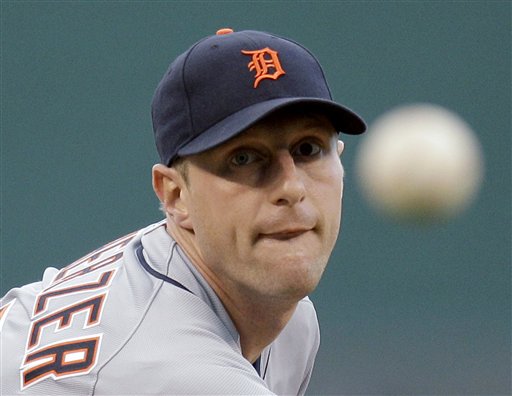
If you haven’t noticed by now you certainly will sometime early in tonight’s Game 4 matchup between the Yanks and Tigers: Max Scherzer, the Detroit right-hander aiming to end the Bombers’ season, has heterochromia iridum, a 1-in-500 genetic anomaly that produces two different colored eyes. As Passan’s article notes, it prompted a lot of teasing until he started establishing himself as a pro-caliber athlete, much in the way I assume the name “Keena Turner” did. When you’re striking out more than a batter an inning with a fastball you can dial up to the high 90s, this looks especially awesome:
But that’s hardly the only interesting thing about Scherzer. In college, at the behest of his economics-major younger brother, Scherzer became interested in baseball’s advanced metrics — a Brian Bannister with the stuff to do damage.

In a 2009 article for the Arizona Republic, Nick Piecoro described Scherzer’s understanding of the whims of batting average on balls in play, a knowledge that likely helped him through some adversity in 2012. In front of the Tigers’ LOLtastic defense, Scherzer yielded a .333 BABIP, second highest in the Majors — trailing only teammate Rick Porcello. It’s hard to imagine a Major Leaguer would ever go on record saying as much, but perhaps it’s no coincidence that Scherzer’s strikeout rate spiked and ground-ball percentage dipped the same year the Tigers shifted Miguel Cabrera to third and imported Prince Fielder to play first.

The article notes that Scherzer’s brother occasionally teases him via text message about becoming a four-win (above replacement-level) pitcher. This year, per Fangraphs, he was worth 4.6 wins. By baseball-reference’s version of the same stat, he was worth exactly 4.

It also seems worth noting that Scherzer came to the Tigers along with pitchers Phil Coke and Daniel Schlereth and center fielder Austin Jackson in a three-way trade that sent Curtis Granderson to the Yankees and Edwin Jackson and Ian Kennedy to the Diamondbacks before the 2010 season. By Fangraphs’ version of WAR, the Diamondbacks’ acquisitions have yielded them about 19.7 wins in the three seasons since — 7.2 of them from Daniel Hudson, acquired in a trade for Jackson in the middle of the 2010 season. Granderson has been worth 13.2 wins to the Yankees.

Scherzer, Jackson, Coke and Schlereth have combined to be worth 26.6 wins to the Tigers since the start of the 2010 season. In that time, they have made, in total, about the same amount of money Granderson did this season alone. And all of them are under team control through arbitration for at least the next two seasons.

Is being a fan psychologically unhealthy?

Phoebe Reilly at Vulture talks to some mental-health experts to investigate the psychological ramifications of fandom. Since it appears on a pop-culture blog, the story is tailored toward fans of pop culture, but obviously there’s a lot of implicit and explicit crossover with the sports world.

It’s an interesting read, but late in the post we learn that the psychiatrist most insistent that being a fan is psychologically unhealthy once actually became so hooked on Dexter that he had to give away his TV to avoid further temptation. So, without knowing the dude, I’d contend that there’s probably some underlying psychological unhealthiness to anyone with so little will power.

There’s a whole lot of chicken-and-eggery that’s ignored in the whole post, really. Does intense fandom make people psychologically unhealthy, or do unbalanced people take to fandom in unhealthy ways?

Plus, the basis of the argument that fandom is unhealthy, as presented in the article, seems to be that enjoying a television show or, say, baseball team is ultimately unsatisfying and “doesn’t return something specific to the individual.” And in my experience that’s just not true at all.

Hell, I’d even say the bulk of my learning since college has been borne of fandom, either of television or sports. Through baseball, I’ve learned a ton about statistics, about identifying randomness, about camaraderie, and about dealing with disappointment. The Wire taught me a hell of a lot about empathy. Lost encouraged me to read up on all sorts of odd references to modern and historical thinkers and their philosophies. Even if it’s rare a Mets season or a television series concludes in a wholly satisfying way, it’s rarer still that I come away from one feeling worse for having been through it.

Kate Upton likes guys who enjoy Taco Bell

The website Celebuzz spoke to two of Kate Upton’s relatives to confirm that the ubiquitous model is dating utterly awesome pitcher Justin Verlander.

If you follow Mark Sanchez’s dating life as closely as some of us do, you may recall that the Jets’ handsomest young quarterback was also once romantically linked to Ms. Upton.

So what does Kate Upton look for in a man? Well, I can only think of one common bond between Mark Sanchez and Justin Verlander: They both love Taco Bell.

Somewhere, Oliver Miller eagerly applies cologne.

Travis Snider live-tweets a sandwich adventure

Beyond having made arguably the best catch in Citi Field’s short history, Pirates outfielder Travis Snider frequently tweets his meals under the awesome handle @lunchboxhero45.

I’m not sure how I missed this, but Snider recently live-tweeted a trip to Primanti Brothers, the Pittsburgh-area sandwich establishment famous for piling french fries and cole slaw on their sandwiches. NotGraphs has the full story.

Aside from how much I appreciate Major League Baseball players sharing their awesome sandwich adventures with fans, Snider’s experience gives us all something to strive for. He presents his trip to the Pittsburgh landmark, if a bit tongue-in-cheekily, as a means of thanking Pirates fans for their support in his first season with the club. And it sort of rings true: What better way to show a city your gratitude than by dining with its people at one of its most popular local haunts?

There are probably a bunch of better ways, but still, what a life goal: To someday be so famous and appreciated that eating a sandwich someplace represents a legitimate gesture of acknowledgement for all that city gave you. “You’ve been a fine host, New Orleans, so I will eat this po’ boy in appreciation.”