
Wither the Phillies?

Optimistic Mets fans everywhere, this one included, spent all day Sunday considering the symbolic value of Ryan Howard’s caught-looking strikeout that ended the Phillies’ 2010 World Series hopes. “Just like Beltran,” we said, hoping Howard and the hated Phils would suffer the same fate Beltran and the Mets did after the 2006 NLCS.
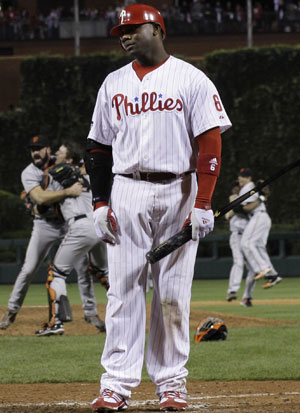
The Situations were far from identical, of course. The Phillies won the World Series in 2008 and got back there in 2009. Howard earned the love of the Philadelphia fanbase with three home runs in that series, and — though these things can turn quickly — probably will not soon suffer the same nonsensical and misdirected hostility from the fans and media that Beltran endured.

Many Mets fans tend to overrate the Phillies’ intangibles (underrating at the same time their very-tangibles). The Phillies have been the bad guys in the N.L. East for four seasons now, so we look at them like they’re 25 T-1000s, ignoring their humanity and trumpeting their apparent inability to be destroyed, citing their arrogance and their will and their remarkable capacity to overcome injuries.

But no team is invincible in a five- or seven-game series, and though Brian Wilson hardly cast the Phillies into a vat of molten steel, that 3-2 slider on the low-outside corner reminded everyone that the Phillies might not be so mighty after all, and inspired columns like this one and this one examining wounds in their mechanism that might not heal themselves instantly.

(OK, enough of that metaphor. </terminator2>, if you will.)

Truth is, the Phillies will still have Roy Halladay, Roy Oswalt and Cole Hamels at the front of their rotation next year, and a trio that good makes them unlikely to collapse completely. And if we — me — here at TedQuarters are unwilling to accept that Beltran and the Mets became magically unclutch and weak-willed upon the Wainwright curveball, we must recognize that the same will be true for the Phillies.

But since we’re in a celebratory mood, we can look down the road with rose-colored glasses on and find more important similarities between those Mets and these Phillies.

Those Mets locked up a ton of payroll in some longterm deals that rendered them financially inflexible. These Phillies already have $143 million spent for 2011 and and $89 million committed to seven players in 2012. Both clubs thinned their organizational ranks with a series of trades aimed to help at the Major League level. Injuries, you already know, took their toll on those Mets teams. Jimmy Rollins and Chase Utley, both on the long side of 30, both missed time with injury this year.

So though it’s probably silly to expect the Phillies to fall apart as dramatically as the Mets did in 2009, it is certainly reasonable to expect that they won’t be able to dominate the division much longer.

The Braves, I am concerned, could be a problem.

Frenchy Tracker update

Pretty poor job by the New York papers last night. Jeff Francoeur not only had a hit, but his trademark cannon-arm fired a costly error in the Yanks’ second-inning rally.

And yet we’re only treated to one Frenchy sider, courtesy of the Daily News. That puts the tally at eight, and it’s starting to look good for anyone who had the under on 20.

Shocked to read not a single recap of Francoeur’s stay in New York, with his old apartment and favorite restaurants and everything. Maybe those are forthcoming, or maybe — heaven forbid — the papers are actually going to focus on all the exciting real baseball stuff.

And if you’re the type of person who cares about these things — and I bet you are — Francoeur now has a grand total of 10 ALCS at-bats and two hits to only eight articles. This man needs a bigger stage.

A good question

Here’s my question: Do we really need right/left field umpires in the postseason?

I’m sure it’s confirmation bias or whatever, but I can’t think of a single instance when I’ve thought, “God, I’m glad we have that guy down the line.” But I can think of about 5 instances in which they’ve made blatantly terrible calls that were obvious to the naked eye (Maier, Phil Cuzzi last year, Berkman’s homer last night, etc).

What is the point?

– Ryan, comments section.

Good question. I wouldn’t be terribly surprised to learn that the presence outfield umpires for the playoffs and All-Star Game are some sort of make-good for a crappy travel schedule in the umpire’s union contract with Major League Baseball or something, because they really don’t seem to serve much productive purpose out there.

I believe it was Ron Darling on last night’s broadcast who pointed out that the right-field umpire actually had a worse perspective for Berkman’s non-homer than the umps at first and home, since he had to spin later to follow the ball’s flight and so had a tougher time seeing the ball tail foul.

And truth is, if no umpire at any level ever works the right- and left-field lines until he gets to the Major League postseason or All-Star Games, no one charged with the task is going at it with much practice. Sure, it doesn’t seem like a massively different skill set than some of the ones involved in umping the corner bases, but, you know, new angle, new perspective, different thing.

I kind of like the novelty of it, in the same way I like celebratory bunting on Opening Day, but it does seem a bit pointless. Especially if they’re not going to get calls right with any frequency.

How to demonstrate that you’re definitely ready for the Majors in 149 Triple-A at-bats

I stumbled onto Willie Mays’ Minor League numbers after that McCovey story led me to baseball-reference. Holy hell. Obviously small-sample size caveats apply, and Triple-A then wasn’t the same as Triple-A now, but, well, yeah. There was good stuff about this in Leo Durocher’s book, about Mays’ adjustment to the big leagues.

Excellent Willie McCovey article

“I don’t think anybody could have felt as bad as I did,” he said. “Not only did I have a whole team on my shoulders in that at-bat, I had a whole city. At the time, I just knew I’d be up in that situation again in the future and that then I was going to come through.”

Actually, McCovey was wrong. That Game 7 at-bat was the closest he came to being on a championship team. The Giants in the 1960s had five Hall of Famers — McCovey, Willie Mays, Orlando Cepeda, Juan Marichal and Gaylord Perry — but as McCovey recalled, “We always seemed to be one player away from winning it all.”

Karen Crouse, New York Times.

Good read from Crouse on McCovey, who still goes to the ballpark and works with Giants hitters regularly despite being mostly confined to a wheelchair by back and knee problems.

But the excerpted section made me think about the Mets, and not just because most things make me think of the Mets.

Did people write columns like this one about Willie McCovey? I’m not asking that rhetorically, either. Seriously — did Giants fans deem McCovey an unclutch loser and clamor for his trade? I wouldn’t be shocked to hear that they did, since the bizarre tendency to blame a team’s problems on its best player long predates David Wright.

Video shows umpires have been wrong for decades

Larry Granillo at wezen-ball has been beating the same drum I have about umpiring this season. He writes: “I feel like a broken record whenever I say that today’s umpiring is no
worse than yesterday’s (and is, perhaps, better), but I can’t help
myself. It’s just that, with today’s media and today’s technology, you
can’t get away from your mistakes.”