
!

The Savannah Sand Gnats are truly bringing the heat with a first-ever fire promotion at a minor league baseball game on Saturday, August 14 with Guinness World Record Holder, Ted Batchelor. After the Sand Gnats’ game against the Kannapolis Intimidators, which will begin at 6:05, and before the evening’s fireworks show, one lucky fan will light Batchelor on fire; he will then circle the bases at Historic Grayson Stadium.

Batchelor, 51, owns the Guinness World Record for the “Longest full-body burn without supplied oxygen” at 2 minutes, 57 seconds, set in Rome, Italy on February 25th, 2010. He and his crew also set the World Record for the “most people on fire simultaneously” at 17, on Pizak Farm in South Russell, OH, on September 20, 2009.

Savannah Sand Gnats press release.

Wow, OK. A lot of stuff here. First of all, apparently people should now be considered “lucky” to light one another on fire. Second, even though this guy is practically begging for a Darwin Award, he’s probably awesome.
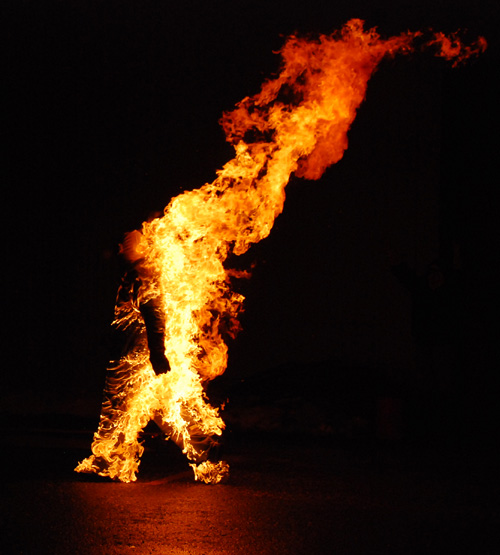
Guest poster/former roommate Ted Burke and I used to name worthy people named Ted to Team Ted, and banish people named Ted who we deemed unworthy to Team Melvin. Clearly Ted Batchelor makes Team Ted with flying colors. He appreciates fire.

Also — and excuse me if this is glib — I’m almost positive 17 is not the record for most people simultaneously on fire. Maybe it’s the record for most people simultaneously on fire on purpose, but I have a feeling the unfortunate women of the Triangle Shirtwaist factory would take issue with the benchmark.

And furthermore, good luck following “Dude running the bases while engulfed in flames,” Savannah-area pyrotechnics outfit. I have a feeling the fireworks show is going to be a bit of a letdown after they spark up Ted Batchelor.

Finally a visit to Mr. Batchelor’s website reveals that this is pretty much what he does for a living, and also this:

Ted Batchelor, a freshman radio-film major enjoys being dragged by trucks, setting himself on fire, sleeping in front of cars, eating glasses in bars and other unusual extracurricular activities.

Ahh… whatever you’re into, bro.

Hat tip to @mikexdavis for the tipoff.

Yu Darvish introduces “gyro-cutter,” Greek restaurant employees unimpressed

Yu Darvish unveiled a new pitch called the “gyro-cutter” in his All-Star appearance this year. According to the linked article, he had just shown it in practice on the 21st. Said Darvish: “it’s the first time I used it in a game. It’s one type of cut fastball. Just the trajectory is different from what we’ve had until now.”

Patrick Newman, NPBTracker.com.

Hat tip to Tommy Bennett for the link. Patrick’s got video of the pitch up on his site if you’re interested in its, ahh, gyrations. Obviously I’m no expert in the workings of the gyroball or Darvish’s new gyro-cutter, but it’s definitely cool that a 24-year-old who has been dominating the NPB for four seasons is inventing new pitches and honing his game.

I know Darvish has said he’d like to stay in Japan, and to some extent I think that’s pretty awesome. But on a selfish level I want to see this guy pitch more often and that’s not going to happen until if and when he comes stateside. Plus, you know, top competition and all that.

Meanwhile, this guy doesn’t see what’s so novel about a gyro-cutter:

On refs, dinosaurs, sandwiches and McGwires

Whoa, OK. Getting my head above water, sort of.

Anyway, I want to thank the guest posters who kept this site moving while I was away. And while I’m at it, I should respond to what they had to say.

(I believe there is still one guest post forthcoming, from a Ted bad at reading calendars.)

Here we go.

Tom Boorstein on officiating: Tom is not kidding. Outside of perhaps Brendon Desrochers, Tom cares more about sports officiating than anyone I’ve ever met. When Tom, Brendon and I worked in the same room at MLBAM, I would sometimes enter to find the two of them passionately discussing a call that had been made the previous night. I’d put my headphones on and get to work, and then 45 minutes later get up to go to the bathroom and they’d still be going. Unbelievable.

Anyway, I have a spotty history with officiating. As a freshman in college — in my younger, angrier days — I got kicked out of intramural football for punching a ref in the first game. I maintain that he completely deserved it and there was no way I was holding. But whatever.

My relationship with referees was only slightly less violent when I coached JV football years later. In my own high-school football days I generally avoided interaction with the refs, mostly because I didn’t want to draw any attention to myself since I was undoubtedly the dirtiest player on the field.

I umped Little League baseball games for a little extra cash while I was in high school. For some reason the kid assigned to be my partner was really into it and would actually show up with his own chest protector and beg to be the home-plate ump.

That meant I got to stand out between first and second base to take care of calls in the field, which rarely even happen in Little League. Basically I just got $15 to watch Little League games. One time the partner guy appealed to me on a check-swing. I didn’t have a particularly good angle and I wasn’t paying much attention, but I rung the kid up anyway because a) let’s move this game along, bro and b) how often was I going to get that opportunity?

Chris Wilcox on the triceratops travesty: I agree with nearly everything Chris says here. I mean, look, we know dinosaurs existed for real, but they mostly exist in our imaginations anyway. I want the triceratops to be pretty badass and its horns to be sharp and pointy. Not going to let science get in the way. Also, I mean, we’re kind of talking about semantics anyway. You’re telling me the triceratops is only a young torosaurus? Screw that. I’m maintaining that the torosaurus is just an old triceratops.

Incidentally, I feel its worth noting that our whole species has only been around for about 200,000 years, and dinosaurs dominated the earth for over 160 million years. Dinosaurs were around nearly a million times as long as homo sapiens have been. That’s nuts.

Eric Simon on National Ice Cream Sandwich Day: Eric did a great service to the world in alerting us all to National Ice Cream Sandwich Day, but he also touched upon an important topic I plan to cover in Saturday’s Sandwich of the Week post: What constitutes a sandwich? Mull that over while I do. I will attempt to reach some sort of comprehensive definition by the weekend.

Patrick Flood on the Army of McGwires: Hilarious and fascinating. So the McGwires would be good enough to be a really good baseball team, but not good enough to completely dominate? That seems to pass the smell test.

The further discussion in the comments section covers a lot of the ground I would have here, and sort of begs the question: Should the player best-suited to winning a clone tournament be considered the greatest player ever? Also, I’d be interested to see how different types of players would fare in clone tournaments.

Would 25 Ozzie Smiths prevent so many runs to make up for their lack of offense? How would 25 Joe Morgans fare if they had to be managed by another Joe Morgan? Would 25 A-Rods suffer because of terrible clubhouse chemistry, or the inability to create a 24+1 environment when every guy on the team is the +1?

Flood’s answer to my question really just opens us up to more questions. The only real way to solve all this is to get on with some cloning.

Roy Oswalt trade stuff

OK, looks like this deal is done, and also spun and analyzed in every which way. But for posterity, here’s some more:

The Phillies get Roy Oswalt and $11 million toward his salary. The Astros get J.A. (sometimes Jay) Happ and prospects Anthony Gose and Jonathan Villar. I’ll ignore for now that the Astros turned around and dealt Gose to the Blue Jays. I’m not really concerned with the Astros’ haul so much as with how the deal benefits the Phillies, since that more directly affects the Mets.

Oswalt is a better pitcher than Happ and so the Phillies are undoubtedly upgraded in the short term. And Oswalt will still be good next year. Though he has shown some signs of age, he has been among the better or best pitchers in the National League since he debuted in 2001 and has remained mostly healthy. He is a safe bet to be a productive member of a now extremely strong Phillies rotation in 2011.

Happ appears to have been a bit lucky to have so much success at the Major League level, but I think he’s gotten a bit of a rough shake from some analysts. Yes, he has far outperformed his FIP, tERA and xFIP in the bigs. But he did strike out more than a batter an inning (albeit while perpetually old for his level) in the Minors. If I had to guess, I’d assume his peripherals improve a bit with more experience, mitigating to some extent his regression. That’s if he can stay healthy, which is no sure thing.

All I know about the prospects is that both are very far off from the bigs and neither has done much so far in the Minors. Keith Law ranked Gose the Phillies’ fourth-best prospect before the season.

Everyone keeps calling the deal a massive win for the Phillies and it’s hard to argue that. But the bright side I’ll point out is this one: Though the Phillies will wind up paying below market value for Oswalt next season, they’re now on the hook for $143.728 million in 2011, according to Cots MLB Contracts.

I have no idea what the Phillies’ phinances are like, but that’s more than they’ve ever spent in a season before. They’re not set lose a whole lot of contributors — Jayson Werth is the only impending free agent that stands out — but they’ll have to fill out their roster somehow. And as Twitterer Chris Guzy points out, they’ve been trading a lot of prospects lately.

Maybe I’m desperate to find the bright side in this deal for Mets fans, but that money thing — I think that’s important. I write about sustainability for the Mets all the time, and unless the Phillies secretly have unlimited funds, the principles should be no different in the City of Brotherly Intentional Vomiting. They’ve got a whole lot of money committed to players on the long side of 30 and they’ve been very liberal about parting with prospects. They’ll likely still be good next year, but it’s not really a recipe for longterm success.

Something about at-bat music

Something about the Mets’ neat 4-0 victory this afternoon and the Fort Knox Five’s Insight got me thinking about at-bat music again.

It’s a topic I’ve touched on many times before and one I’ve been meaning to explore at greater lengths for a while.

I spoke to the guys who run the Citi Field p.a. a while back for the Baseball Show. They told me that their only qualification is that the section of the song be PG. Players can choose any section of a song — not just the intro, as I assumed earlier. Generally the player gets 10-15 seconds.

But what makes for good at-bat music? Well, a couple of things:

– Distinctive: This is most important, I think. A player’s at-bat music should be something that becomes inextricably linked with the player, and so it helps for the snippet to be memorable. When you hear that one specific horn riff from the David y Abraham song, you know that means Carlos Beltran’s coming up.

Generally, I think it’s best to choose a song people aren’t overwhelmingly familiar with. The backstory to Ike Davis’ choice of “Start Me Up” is a decent one and I don’t begrudge him the choice, but that’s such typical stadium fare that it’s almost hard to figure if Davis is coming up or if they’re just pumping Jock Jams for the hell of it.

There are exceptions, of course. The opening riff to Voodoo Chile worked great for Mike Piazza, and Rod Barajas’ use of Low Rider and California Love remains the most valuable thing about the Mets’ injured catcher. But none of those songs is standard for sports venues, so they can all be tied to the player by the fan.

In other words, familiarity isn’t necessarily advantageous. Distinctiveness is.

– Straightforward: As a relief pitcher, I would definitely, definitely pick something offbeat to get into my opponents’ heads. As a hitter, though, you don’t have that type of time. Ten seconds of some weird tune might raise a pitcher’s eyebrow, but it’s hardly going to get into his head. Just go for something good to get the fans into it. This is not the time for mindgames.

– Instrumental: Some guys go with songs with words, and for some guys that works. Wouldn’t be my choice. Then people get caught up in trying to figure out what you’re saying with the lyrics you’ve chosen. Make a statement with the music.

Incidentally, Mike Jacobs was using Eminem’s “We Made You” this season, and the first thing you heard whenever Jacobs walked to the plate was, “Jessica Simpson — sing the chorus!” That’s pitiful. You, Major League baseball player, want the first thing anyone to associate you with to be Jessica Simpson, and not because you’re dating her? I know Jessica Simpson didn’t even actually sing the chorus on that song, but that’s immaterial. Another wild swing-and-miss by Jacobs.

– With horns: Again, more of a personal thing. But horn sections make most things more awesome, and they provide a particular variety of fanfare for at-bat music. Trumpet your plate appearance with trumpet. And trombones and saxophones, too.

With vibraslap: Thaat one’s almost certainly just me. The vibraslap is the percussion instrument that goes, “byoyoyoyoyoing!” or something like that. It’s a hilarious noise and one I’ve always thought should get more airtime blasting through the PA systems of 50,000-seat stadiums. You may recognize the vibraslap from Nuthin’ But a G Thang or any number of songs by the band CAKE.

Anyway, I’m pretty certain my at-bat music starts at the 1:27 mark in this Ozomatli song:

I guess one thing that’s important to note is that in my at-bat music fantasy I’m an amazing hitter. So, you know, late in some game — one the manager mercifully gave me off because I’ve been carrying the team for so long — they call on me to pinch hit and then “bum bum chickachicka bum bum chickachicka…”

Here comes that funky, funky man again.