I’ve got the day off today I’m and heading to Long Island to hang out with my family. I’ll be back tomorrow with posts and stuff.
In honor of yesterday’s big news:

I’ve got the day off today I’m and heading to Long Island to hang out with my family. I’ll be back tomorrow with posts and stuff.
In honor of yesterday’s big news:
Popeye’s has created a new batch of fried chicken nuggets that feature a spoon-like curvature to them to make it easier to scoop up dipping sauce. This fast food innovation is dubbed “Dip’n Chick’n.”
This is a really good idea because I’ve often found that traditional sauce delivery methods are much too slow. You have to open up the sauce cup and dip your nugget in, and then you only get a light slathering of sauce. Now each nugget becomes its own sauce trough, allowing me to ladle on the flavor down my gullet with speed and alacrity.
– Ben Popken, Consumerist.com.
Oh hell yes. Your move, every other fast-food fried-chicken place.
 Scoop-shaped Tostitos make a hell of a lot of sense to me, but I had never before considered the need for scoop-shaped fried chicken.
The only trouble I ever have getting the appropriate amount of sauce on my chicken tenders is when the sauce comes in a container too narrow for the tender. Usually a situation like that can be rectified by dipping the chicken at a different angle, but before that happens I get so frustrated that I just clench the chicken tender in my fist and smash the little cup into oblivion.
Either way, though, you’d think it would be easier to alter the size of the sauce container than the shape of the chicken itself. But then you and I lack vision.
Via Corey.
On Sunday afternoon, Mr. Hurwitz tossed a few more crumbs to the “Arrested Development” faithful at a New Yorker Festival event that reunited him with the show’s ensemble cast, telling the audience that a movie was still in the works, along with a new set of television episodes that would serve as a prelude to the film….
Mr. Hurwitz continued: “We don’t completely own the property, there are business people involved and studios and that kind of thing. Just creatively, I have been working on the screenplay for a long time and found that as time went by, there was so much more to the story. In fact, where everyone’s been for five years became a big part of the story. So in working on the screenplay, I found even if I just gave five minutes per character to that back story, we were halfway through the movie before the characters got together.”
So, Mr. Hurwitz said, “We’re trying to do a limited-run series into the movie.” After a wave of excited applause died down, he continued, “We’re basically hoping to do nine or 10 episodes, with almost one character per episode.”
Man. I try not to let myself get too excited every time news comes out about a possible Arrested Development reunion for a couple of reasons: 1) There has been lots of talk but thus far precious little real action and 2) I’m a tad concerned that if the movie and new shows don’t live up to the first three seasons, they’ll color my impressions of the series as a whole.
But all that said, this is pretty amazing news. I especially like the idea of it returning as a short-run show created with an end-date in mind, so all the story arcs can be carefully scripted from the outset.
This site has long understood that sandwiches always taste better when someone else makes them. It turns out there’s science behind this:
When you make your own sandwich, you anticipate its taste as you’re working on it. And when you think of a particular food for a while, you become less hungry for it later. Researchers at Carnegie Mellon University, for example, found that imagining eating M&Ms makes you eat fewer of them. It’s a kind of specific satiation, just as most people find room for dessert when they couldn’t have another bite of their steak. The sandwich that another person prepares is not “preconsumed” in the same way.
Via Tommy Bennett.
But Mark Sanchez is the reason the Jets lost to the Ravens, 34-17. He was really dreadful, with three of his four turnovers returned for touchdowns and the other setting up a field goal.
– Gary Myers, N.Y. Daily News.
Sanchez did not play well. That’s true. He fumbled twice and made the terrible, desperate decision to try to force the ball to Santonio Holmes on what wound up a coffin-nailing interception and touchdown by Lardarius Webb.
But there’s just no way “Sanchez is the reason the Jets lost to the Ravens.” His gaffes all came thanks to awful, awful play from his offensive line. It’s easy to point the blame at the handsome, GQ-model of a quarterback when everything goes wrong, in part because no one was expecting much from Colin Baxter, Wayne Hunter and the Jets’ battered offensive line.
Think about it this way, though: If Sanchez and Joe Flacco changed places yesterday, and Sanchez helmed the Ravens’ offense instead of the Jets’ “offense,” which team would have come out on top? The Ravens, of course. Flacco made his share of bad throws and poor decisions, but had way more time with which to make them. Plus, the Jets’ inability to run the ball inside forced them to throw, which combined with their struggle to slow the Ravens’ pass rush to leave Sanchez looking like a three-legged (but still handsome) deer limping in Haloti Ngata’s crosshairs.
The Ravens have a strong defensive front, no doubt, and a series of schemes that confounded the Jets’ linemen. But none of the Jets’ front five — not even the usually great D’Brickashaw Ferguson — adjusted well enough to keep Sanchez from getting crushed on almost every passing play. And now that the line has been exposed as a glaring weakness, every defensive coordinator in the NFL should be thumping his chest over the opportunity to showcase his front seven and bolster his resume.
The small, personal upside to this is that it seems to have drawn into public consciousness the importance of center Nick Mangold to the Jets’ offense. As a former center, I’ve been barking Maddenisms for years about the value of a great blocker and strong communicator in the middle of a line only to be drowned out fantasy-guru types shouting about this quarterback’s arm strength and that runningback’s elusiveness. Truth is, if your line sucks so does your offense. That’s the story for the Jets right now.
Until Mangold gets healthy or the rest of the line makes some major improvements, Mark Sanchez will continue looking frightened and awful. Then when Mangold returns and the line play improves, we’ll hear all about the Sanchise Redemption and the Return of the Poise. And that will be welcome, because no one should look that bad on the field and this good off of it:

This one might be a little involved for a normal Sunday of focused football watching. But it is nonetheless bold. Also, because I now have about seven pounds of pulled pork, I haven’t eaten much else since I made it so I’m not sure I’ve had any other snacks of note.
This is a pulled-pork sandwich with pickles and peppers:
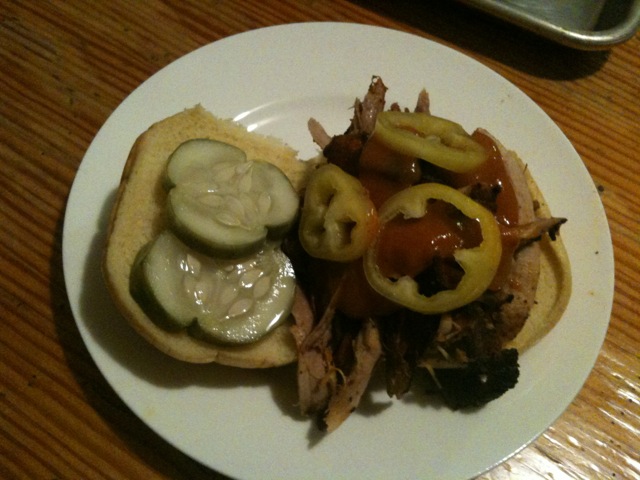
I’ve made pulled pork before, but I think I got a lot closer to perfection this time. I got a line on some awesome Duroc pork through our man Alex Belth. Here’s what you need:
A pork butt (or Boston butt), preferably awesome
Barbecue rub*
Yellow mustard
White vinegar
Cranberry juice
Butter
Sugar
Salt
Olive oil
Aluminum foil
Pickles
Peppers
Barbecue sauce
Potato rolls
A smoker, and whatever fuel and wood your smoker needs
*- I use a rub of my own devising based on a combination of suggestions I’ve seen in cookbooks. It consists of (in descending order of amount) paprika, black pepper, salt, chili powder, cumin, garlic powder, onion powder, and cayenne pepper. I don’t remember the exact proportions I used. Basically you can just open up your spice cabinet and start dumping a bunch of stuff in a bowl and it’ll probably be alright. Google “Barbecue rub” and you’ll find a ton of recipes. Just expect to use a lot of paprika.
Also: I have this hilarious meat syringe with which I injected the pork before smoking it. I don’t think it’s necessary. If you don’t have one of those, you won’t need the butter, sugar and salt and you can skip Step 2 below.
Remember to wash your hands and utensils thoroughly after they touch raw pork. I shouldn’t have to remind you of that but now you can’t sue me if you get trichinosis.
1) Roughly 4-8 hours before you want to start smoking, take the pork butt out of its bag. Pour vinegar over it, and work the vinegar into the pork with your hands a little. Coat the entire butt with a generous amount of yellow mustard. Liberally pour rub all over the butt — really cover that sucker because that rub’s going to be smoky and delicious in like 20 hours. Pat the rub onto the butt, giggling because of how often the recipe says “butt.” Then cover your butt and refrigerate.
2) About a half-hour before you smoke the butt (ha!), melt about a half a stick of butter in a small saucepan over low heat. Add 1/2 cup of cranberry juice, a tablespoon of salt and a tablespoon of sugar and stir until they’re dissolved. Let the mixture cool a bit, then inject it into the pork right before it goes on the smoker.
3) When the smoker is about 220-degrees Fahrenheit, put in the pork with the fatty side up. Find some way to entertain yourself because waiting for pork to smoke can be agonizing.
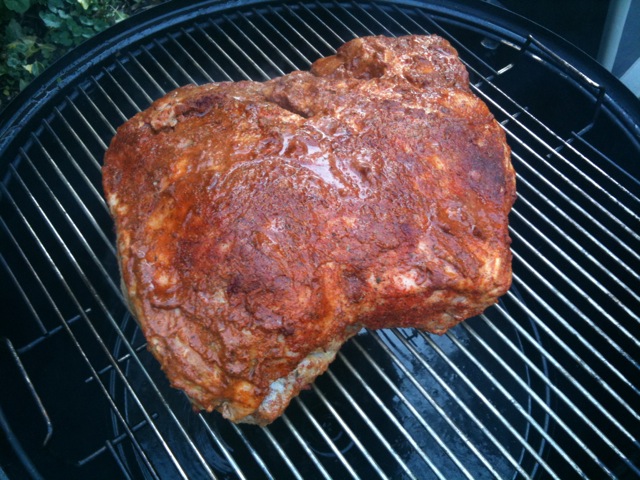
4) Combine about 2/3 a cup of cranberry juice and 1/3 a cup of olive oil in a bowl. Or if you don’t want extra dishes to clean, just drink a small bottle of cranberry juice down to the label and fill it back up with olive oil, like you did in high school when you made a brass monkey because you liked the Beastie Boys so much. Only do not drink the cranberry juice/olive oil mixture. Also: Do not drink brass monkeys. They’re gross.
5) Every now and then, check the thermometer on the smoker to make sure it’s around 220. If it’s not, do what you need to do to get it back there. Not a big deal if it goes above for a while or below for a while as long as the smoker’s between about 200 and 300 degrees.
6) After about four hours, lightly coat the pork with the cranberry juice/olive oil mixture. I use a spray bottle for this step, but you could use a barbecue mop or a silicone pastry brush if you don’t have that. If you don’t have any of those things, I don’t know, brother. You’re up the creek I guess.
7) When the pork’s internal temperature gets to about 165 degrees (mine took about eight hours to get there), pull it off the smoker and wrap it in aluminum foil. Put it back in the smoker for four more hours.
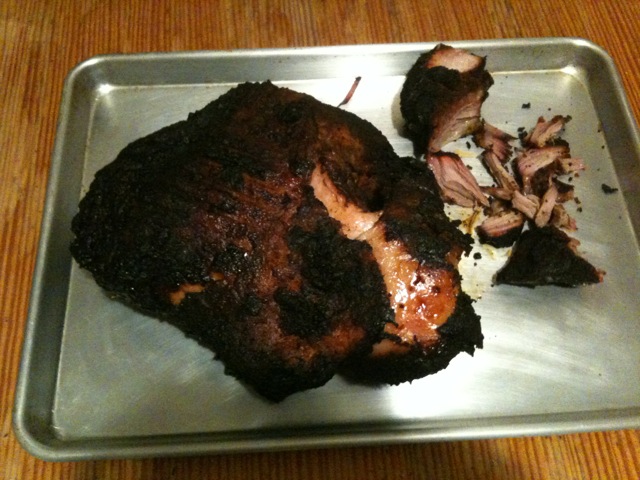
8) Remove the pork, unwrap it and let it cool for at least a half hour. It’s still going to be pretty damn hot inside, but by this point there’s just no way that’s going to stop you from turning the pork into a sandwich.
9) Grab a handful of pork and pull it off the butt, then pull it into smaller pieces. You want to get a good mix of the lighter, interior meat and the outside stuff with the rub on the edge. When you have enough for however many sandwiches you need, stop. You can deal with pulling the rest of the pork later.
10) Construct a sandwich with the pork, barbecue sauce, pickles and peppers on the potato roll. I used a Carolina-style mustard-based barbecue sauce, but I’m not the type to tell you any one barbecue sauce must be used with any one barbecue meat. I used Mariachi peppers because they’re what I have and they’re delicious. They’re spicy and sweet, so if you can find a pepper like that I’d recommend it.
11) Eat the sandwich while you try to think of other ways to use all the remaining pork.
This might have been the best sandwich I’ve ever constructed at home. The pork was smoky and juicy, the barbecue sauce sweet and tangy, the peppers crisp and spicy, and the pickles were pickles. Oh and the roll itself is soft and sweet, a perfect complement to all the stuff that’s going on here.
By using chicken skin for its texture and powerful flavor in all sorts of dishes, chefs are legitimizing what used to be a guilty pleasure, whether they call it gribenes, yakitori kawa or cracklings.
There is no more-committed evangelist than Sean Brock, executive chef of Husk and McCrady’s in Charleston, S.C. If it can be done in the kitchen, Mr. Brock has done it to chicken skin: He marinates it in buttermilk, then smokes and deep fries for a crunchy appetizer served with hot sauce and honey.
– Sarah DiGregorio, N.Y. Times.
OK, does anyone know where I can get my hands on some chicken skin without actually pulling the skin off chicken (and thus later having to cook and eat pathetically skin-free chicken)? Because smoked, deep-fried chicken skin with hot sauce and honey is practically begging to be a Bold Flavors Snack of the Week.
[poll id=”36″]
When we came into Spring Training, one of our main issues was to have a good approach at the plate — to work counts, to get ourselves in situations where we’ve got runners on base via the walks. And I think we did that. I think Dave [Hudgens’] insistence on it — I think the players bought into it as we kept going in to the season. And I look now at the end of the year and we had a lot of guys get on base. I think the approach is going to spread. I think it’ll go through the organization now due to that. To me that’s one of the keys to why we played as well as we did. We got ourselves on base a lot.
– Terry Collins, pre-game Wednesday.
For whatever reason last offseason I started charting the Mets’ “wasted at-bats,” their number of plate appearances by players finished the year with on-base percentages below .300. It’s not by any means a great way to assess an offense — just charting the team’s on-base percentage would be more useful — but it has become a great way to exemplify the improvements at the fringes of the roster brought on by the new regime in Flushing.
Last year, the Mets gave 1633 plate appearances to players with sub-.300 OBPs, by far the most in their division.
 This year, the Mets gave 185 plate appearances to players with sub-.300 OBPs.
Outside of the muscly Cardinals, every other team in the National League had at least one single player with a sub-.300 OBP amass at least 185 plate appearances. Several teams have multiple regulars giving away at-bats all the time.
The Mets finished second to those Cardinals in on-base percentage for the season. Despite their home field and general lack of power, they finished sixth in the National League in runs per game, behind three playoff teams and the park-aided Reds and Rockies. By adjusted OPS+, the Mets tied with the Brewers as the NL’s second-best offense.
Of course, nabobs will be quick to point out that the Mets finished 77-85, and maybe their strong on-base skills mean nothing because they can’t grit out clutch hits or something. But the Mets lost 85 games principally because they allowed the fourth-most runs per game in their league. The offense was absolutely not the problem.
Speaking of: Imagine what the Mets offense could have done if it stayed healthy and optimized all season long? What would have happened if the offense looked more or less like this all year long:
Reyes (143 OPS+)
Murphy (125)
Beltran (150)
Davis (123 career OPS+)
Wright (114)
Duda (136)
Pagan (93)
Thole (94)
This is assuming Davis would not have continued his torrid pace and Murphy could have lasted longer at second base than he ever has without getting injured, and it’s purely hypothetical. Injuries are inevitable, but if that lineup could have averaged 450 at-bats apiece, it would have given the Mets about 3600 at-bats’ worth of a 122 OPS+. If the reserves provided about a 90 OPS+ in the remaining 2000 at-bats, the team would have finished with an OPS+ of 111.
Again: This is all shoddy math that I’m endeavoring for my own entertainment. But if the Mets scored 4.43 runs per game with a 102 OPS+, they would score about 4.82 runs per game with the 111 total. Assuming the team could prevent runs at the same rate, using the Pythagorean expectation formula, that would make for about a .525 winning percentage. So, still not good enough to make the playoffs. But hey: better.
Amid the joyous news that we will not have to stomach Larry Jones in the playoffs, we may have missed the important subtext that we will indeed get to watch Albert Pujols.
Pujols’ streak of batting .300 with 30 home runs and 100 RBI ended this year when he hit .299 and drove in 99 runs. Of course, the .300-30-100 thing is really just a statistical novelty, and falling an RBI single short of that mark doesn’t mean Pujols is much less awesome.
After a rough start to the season, Pujols finished with a 150 OPS+ — not quite up to his career standard of 170 but still good for eighth best in the league. From June 1 through the end of the regular season, Pujols posted a .997 OPS. He has a 1.009 OPS in the postseason because he’s Albert Pujols.
The Cardinals’ NLDS matchup with the Phillies provides the stage for a possible playoff rematch between Pujols and Brad Lidge. For some inexplicable reason I can’t find video of Pujols’ 2005 NLCS home run off Lidge, which should be like the main thing on the Internet.
 Tedquarters