Real-life friend Lee passed along this link to io9.com’s thorough takedown of the recent press release boasting DNA evidence of Bigfoot’s existence. It’s worth a read, and it answers several of the questions I asked when posting the press release earlier this week. Specifically, the DNA was taken from — among other places — a blueberry bagel from a Michigan backyard known for Sasquatch sightings. Apparently Sasquatch love blueberry bagels.
And while you’re at it, click on some of the links then slide merrily down the Internet Bigfoot rabbithole. Or start here, if you want to cut out the middlemen. There are a lot of people online who have a lot to say about Bigfoot.
Still rooting for Bigfoot here, but I’m guessing any increase in recent Bigfoot sightings and accompanying Sasquatch science is something similar to what happened with the crop circles in England: Pranksters producing copycats and ultimately hysteria. That’s only slightly less fascinating than Bigfoot, though. And I’m still waiting on a satisfying explanation for cattle mutilation.
In case you somehow missed it, the latest from the Daily News says the Mets have offered David Wright a seven-year extension on top of his 2013 option for a total of around $140 million for the next eight seasons. If that’s true, it seems like a lot for a player who’ll be 38 at the conclusion of the deal.
If David Wright is a 5+ win player for most of his contract, he would be well worth any of the range of potential outcomes from ~$16-20 million annually, that have been kicked around the press. Not to put too fine a point on it, but Wright has been that player once in the last four years and three times in the last six.
One of the areas of volatility in Wright’s performance has been defensive, bouncing from -1.4 dWAR in 2010 to 2.1 dWAR in 2012, a swing of roughly 35 runs over full seasons of action….
Where the WAR graph of David Wright’s career resembled a roller coaster, his offensive production merely looks like a bumpy road. It is this, Wright’s relatively more consistent production offensively, that make a six, seven or even eight-year contract less scary.
Wright’s list of most similar batters on baseball-reference, for whatever that’s worth, paints a picture that can be interpreted in various lights. If you want to spy the beautiful woman, you could point to Carl Yastrzemski, Chipper Jones and George Brett, Hall of Famers who enjoyed years of success on the long side of 30. If you’re certain the image is an old hag, you could point to Eric Chavez, who has struggled with injuries and mustered barely more than season’s worth of mostly disappointing at-bats in the five years since he turned 30.
But, of course, both the beautiful woman and the old hag are there, so optimists and pessimists must both see how the deal could play out in a variety of ways. Plus, comps are just comps and Wright’s his own snowflake and we won’t really know whether the contract — assuming it’s for real, and should he sign it — is an overpay or adequate retribution for Wright’s services until those services are all rendered.
Consider also that contracts and the general baseball marketplace appear to be defying our expectations more and more these days (that’s a hunch of course; I have no way to measure it) as teams cash in on inflating TV deals. That all seems at least a bit tenuous, but really I have no idea how it’ll all play out and how it’ll ultimately impact player salaries.
It could be there’s a bubble that bursts, and in five or 10 or 20 or — pertinent here — eight years, players can’t expect as much money on the open market. Or, perhaps more likely, teams will figure more and better ways to reap our constant and desperate need for baseball and the salaries keep growing. Or maybe an asteroid destroys the earth in 2015 and none of this matters so much. Point is, eight years is a long way away, and a hell of a lot can happen to Wright, to the Mets, to baseball, to the economy and to everything in that time.
So, really, who knows? Today, without knowing many of the specific terms of the deal, eight years and $140 million for 30-year-old David Wright seems like at least a mild overpay, especially considering the Mets’ growing needs and finite resources. If the team’s financial situation doesn’t clear up soon, within a few seasons we could easily be lamenting the way they’re allotting so much of their payroll to a now-only-pretty-good David Wright.
Still, Wright — even at 30, at 31, 32, 33 and 34 — represents the Mets’ safest bet to be an elite offensive player, and they will need to score runs to win games. So maybe even beyond all the face-of-the-franchise stuff he’s worth a bit more to the Mets, with no obvious offensive stars on the horizon, than he would be to a team with lesser but still adequate replacement options in the clubhouse or on the farm.
Also, and most importantly, he’s David Wright. By definition, overpaying a guy means giving him more than he deserves, and on principle I don’t think teams should be rewarding players for past performances. But I’m not sure I can think of a baseball player I’d rather see overpaid than Wright, given all he’s put up with the last few seasons and how unspeakably cool he’s been about it throughout. Admitting as much forfeits my right to whine about the contract seven years from now, but that’s OK by me. These pages are not for decrying the best position player in Mets’ history.
I got unexpectedly busy this afternoon. I was going to write up something to recap Ty Cobb’s Wikipedia page, but really, you should just read the whole thing. Turns out Ty Cobb was crazy, in many of the ways you’ve already heard about but also several other ways as well.
The excerpt that led me there, via a former student turned Facebook friend:
After enduring several years of seeing his fame and notoriety usurped by Ruth, Cobb decided that he was going to show that swinging for the fences was no challenge for a top hitter. On May 5, 1925, he began a two-game hitting spree better than any even Ruth had unleashed. Sitting in the Tiger dugout, he told a reporter that, for the first time in his career, he was going to swing for the fences. That day, he went 6 for 6, with two singles, a double and three home runs.[73] The 16 total bases set a new AL record, which stood until May 8, 2012 when Josh Hamilton of the Texas Rangers hit four home runs and a double for a total of 18 bases.[74] The next day he had three more hits, two of which were home runs. The single his first time up gave him nine consecutive hits over three games. His five homers in two games tied the record set by Cap Anson of the old Chicago NL team in 1884.[73] Cobb wanted to show that he could hit home runs when he wanted, but simply chose not to do so. At the end of the series, the 38-year-old veteran superstar had gone 12 for 19 with 29 total bases and then went happily back to his usual bunting and hitting-and-running.
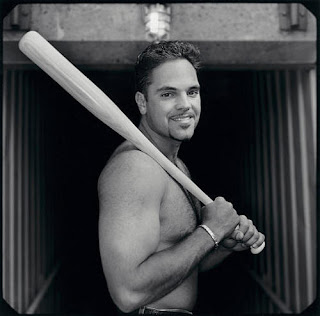
The BBWAA released the 2013 Hall of Fame ballot today. New to the list: Barry Bonds, Roger Clemens and Mike Piazza. Those players, you probably know, have been explicitly, legally, or at least vaguely linked to performance-enhancing drugs, and did outrageously impressive things on baseball fields during an era in which many players used performance-enhancing drugs.
All of them should make the Hall of Fame.
This debate seems likely to get furious and stupid in the coming weeks, and I’m not all that eager to participate further. Here’s what I wrote on the subject in 2009:
[T]here’s talk that four of the very best players of this or any era — Manny [Ramirez], Alex Rodriguez, Roger Clemens and Barry Bonds — should be excluded from the Hall of Fame. I like the Hall of Fame, and I fear if those men don’t make it in, the honor will someday seem like the Gold Glove Award or something, like some sort of pageant that bears little correlation to actual accomplishments within the game.
I know there are guys we think should or shouldn’t be in, but the Hall of Fame does a pretty good job of recognizing the achievements of the best players to ever play. We can get caught up in thinking it’s a pristine place, but its membership includes guys who doctored the ball and guys who popped pills, not to mention abject racists and legions of players who benefited from playing in a segregated game. The common thread is not integrity, but that each man enshrined was among the greatest players of his generation.
Yes, the pre-Manny steroid users did something wrong, but baseball did not adequately prevent them from doing it and so they got away with it. Yeah, that kind of sucks, but some of them managed to dominate a bunch of other guys who were doing exactly the same wrong thing, and unless those successes are somehow stricken from the record, the deserving should be honored for them. Bonds’ home runs all still count, right?
I’ve been singing thesame tune since. Essentially: I want to keep caring about the Hall of Fame, and if they shut out Bonds — indisputably one of the best players who has ever lived — then I will find it hard to keep caring about the Hall of Fame.
(I originally had the game embedded here, but it turns out it autoplays [hilarious] music every time you open the page and it got annoying. So go check it out elsewhere.)
For what it’s worth, I met Dikembe once when he came to speak at Georgetown my junior year. Seemed like an awesome dude. My roommate and I even posed for a photo with him, one of us in each of his outstretched arms. We had such big plans for the photo, too; we co-hosted a TV show on campus cable, and we hoped to blow it up to poster size and use it on our set. But I went to college before digital cameras, and the photo didn’t come out. It looks amazing in my mind though.
Did you know that Dikembe Mutumbo speaks nine languages?
This is something I’ve been thinking about for roughly 15 years, no joke. Why? “Triumph,” one of the Wu-Tang Clan’s most recognizable singles and (though not really my favorite) certainly among their most epic performances, ends with a seemingly random reference to Rod Strickland.
Strickland’s from New York, so maybe Raekwon was showing some civic pride. But it seemed funny to me that this otherwise ethereal song should end with a shoutout to a pretty good basketball player. And I’ve always wanted to figure out which athlete benefited from the highest ratio of mentions in rap songs to actual ability, but it’s not something I have the wherewithal to figure out.
A team of scientists can verify that their 5-year long DNA study, currently under peer-review, confirms the existence of a novel hominin hybrid species, commonly called “Bigfoot” or “Sasquatch,” living in North America. Researchers’ extensive DNA sequencing suggests that the legendary Sasquatch is a human relative that arose approximately 15,000 years ago as a hybrid cross of modern Homo sapiens with an unknown primate species.
The study was conducted by a team of experts in genetics, forensics, imaging and pathology, led by Dr. Melba S. Ketchum of Nacogdoches, TX. In response to recent interest in the study, Dr. Ketchum can confirm that her team has sequenced 3 complete Sasquatch nuclear genomes and determined the species is a human hybrid:
“Our study has sequenced 20 whole mitochondrial genomes and utilized next generation sequencing to obtain 3 whole nuclear genomes from purported Sasquatch samples. The genome sequencing shows that Sasquatch mtDNA is identical to modern Homo sapiens, but Sasquatch nuDNA is a novel, unknown hominin related to Homo sapiens and other primate species. Our data indicate that the North American Sasquatch is a hybrid species, the result of males of an unknown hominin species crossing with female Homo sapiens.
Color me skeptical. I’m not typically one to doubt scientific research, but I don’t know nearly enough about the validity of the specific science here to go all in on Bigfoot. For one thing: Where did they find Sasquatch DNA?
Obviously I’m rooting for Bigfoot to exist, but someone needs to make with the Sasquatch before I take back all the nasty things I’ve said about everyone involved in the production of Finding Bigfoot.
Also, if Sasquatch — which is apparently the plural of Sasquatch, not Sasquatches — actually exist and have managed to defy the best efforts of the Finding Bigfoot crew and just about everyone else for this long, they’re probably pretty smart and strongly prefer not to be messed with. So, you know, factor that in before you get searching.
When you live or work around Wrigley field, you probably think you’ve seen it all, but chances are you haven’t seen this: a pair of rather large coyotes hanging outside the ballpark looking for a snack.
Yikes. It looks like the coyotes are just sort of hanging out and enjoying themselves, completely oblivious to whether the Cubs are playing, so they’re not unlike most of the humans who show up at Wrigley.
Taco Bell letting customers drive ideas: OK, remember my vaguely paranoid post from July outlining my suspicion that someone in Taco Bell’s marketing department reads this blog? Remember how I pointed out that the dude whose story was featured in one of the first Doritos Locos Tacos commercials was a friend of loyal reader/commenter Catsmeat’s, and that the first “significant discovery event” on his video’s YouTube page was being embedded on TedQuarters? Check out this quote from Taco Bell Chief Marketing Officer Brian Niccol:
The way we thought about launching it was, What’s the story? We wouldn’t have sold 100 million Doritos Locos Tacos in ten weeks if all we did was say, It’s a new product and you’re going to love it because it’s now made with Doritos. We really listened in a different way for this program, to what people were tweeting and saying on Facebook. And that’s how we got our launch execution. We found out this kid drove 900 miles to Ohio get a hold of a DLT during the market testing, and it became inspiration for the commercial….
With the DLT we’ve proven to ourselves that if you can let go of some of the control, then good things can happen. And that’s changed things here at the office. Since the the DLT success, we’ve knocked down three conference rooms and created a new social-mobile listening room, where we’ve got the largest TV screens I’ve ever seen keeping track of what people are saying about our brand every day and everywhere.
Taco Bell has “the largest TV screens [Taco Bell CMO Brian Niccol has] ever seen keeping track of what people are saying” about Taco Bell online. Which means…. HELLO, PEOPLE OF TACO BELL! THANK YOU FOR READING TEDQUARTERS ON YOUR GIANT SCREEN! PLEASE INCORPORATE CRUNCHY RED STRIPS INTO MORE THINGS!
So, you know, my suspicions grow. I will be pretty miffed if Taco Bell rolls out the interactive design-your-own-menu-item interface I’ve been pitching since 2009 (and outlined again during my campaign for the job eventually given to Niccol) without at least giving me face-time in the commercials. I have experience!
Seriously, Taco Bell: It’s love. It’s all love. If you’re out there reading, know that I am a reasonably smart guy who spends a lot of time thinking about Taco Bell. We can make this work for both of us, I’m certain.
Denver-area Taco Bell apparently popular among hookers: There’s plenty to enjoy in Jenn Wohletz’s experiential column on trying the new Taco Bell menu items at a Taco Bell on East Colfax Ave. in Denver, but nothing quite jumps off the page to a Denver outsider like her note that at 7 p.m. the Taco Bell in question “was ringed with a circus of homeless people, hustlers and a couple of angry-looking hookers.”
I followed up with a Denver native and asked, “What do you know about the area around E. Colfax Ave. in Denver?” He replied, “Full of hookers.” So it seems to make sense that some of the more sensible hookers would find their way to the Taco Bell, since obviously hookers need to eat, too.
In my experience, there is little to no correlation between seediness and quality in Taco Bells. Some of the best and worst Taco Bells I’ve ever been to have been in the sketchiest places, and some of the best and worst have been in the nicest areas. Case by case thing.
Taco Bell makes glorious return to Sedalia, Mo.: I hate to profile here, but Sedalia Democrat columnist Travis McMullen looks like the type of dude who thinks critically about Taco Bell (and it takes one to know one). So when he expounds upon why the local Taco Bell developed a much more dedicated and vocal following than competing fast food locations in the area, I suggest we listen.

 And while you’re at it, click on some of the links then slide merrily down the Internet Bigfoot rabbithole. Or start here, if you want to cut out the middlemen. There are a lot of people online who have a lot to say about Bigfoot.
 Toby Hyde has more
 This debate seems likely to get furious and stupid in the coming weeks, and I’m not all that eager to participate further. Here’s what
  Obviously I’m rooting for Bigfoot to exist, but someone needs to make with the Sasquatch before I take back all the nasty things I’ve said about everyone involved in the production of Finding Bigfoot.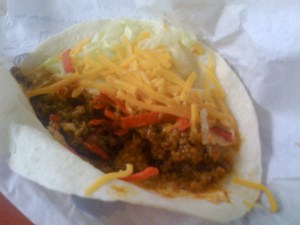
 Tedquarters