
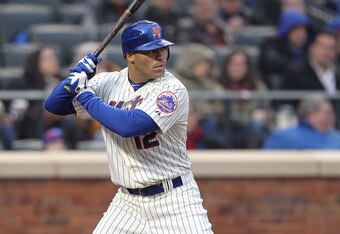
Signing Reyes: Not such a bad idea?

Anyway, Bill James found that players with young player skills tended, as a group, to age slightly better than their old player skills counterparts. The idea is that players with young player skills can adjust: as your speed goes, you can learn to be more selective and wait for pitches, driving them if they’re there or taking a walk if they’re not. On the other hand, if you already have old player skills, you can’t “learn” to be faster, so there are less things to compensate with as one ages and bats slow down.

There’s a lot of generalizations in the above paragraph, and it’s not a guarantee any of that happens with Jose Reyes, or any player with a certain skill set. But it is something to think about. He can learn to be more selective, something the Mets were already hoping he’d do this season.

Patrick Flood, PatrickFloodBlog.com.

Here’s the other thing: Reyes is 27, turning 28 in June. Mets fans all know that big long-term free-agent contracts often turn into albatrosses, but elite players rarely hit the open market at Reyes’ age.  Because the Mets rushed Reyes to the big leagues, he stands on the verge of free agency at a time in his life when many of his All-Star colleagues are still locked up under team control through arbitration for several more years.

As Flood says, we don’t know the exact details of the Mets’ financial situation. But we know the Mets will have a payroll, and in today’s baseball economy it sure seems like teams must be willing to overpay on the back end of contracts to get elite production on the front end.

Carlos Beltran’s contract is a good example: Since he is a right-fielder now and an injury liability, on the open market he would get nothing like the $18.5 million he’ll make this year. But since Beltran played as more or less the best center fielder in baseball from 2006 to 2008, he earned all the money the Mets will pay him (no matter what anyone says).

If Reyes requires a massive six- or seven-year deal, as seems probable, whatever team that signs him will likely be getting a short return on his chunk of the payroll by the time he’s a 34-year-old in 2017. But Reyes in his prime, healthy and playing every day is worth an absolute ton. If the Mets are confident he can do that for the next three or four years, they should be willing to shoulder the financial obligation for the final years of the contract.

The Mets, like all baseball teams, need to invest money in their club to win games and bring in more money (to then, ideally, pour back into the club). Yes, it’s best if a team can constantly churn out young, cost-controlled players to contribute at the big-league level. But it’s unreasonable to expect any prospect to turn out as good as Reyes, and a big reason you want those cost-controlled guys is to provide the type of financial flexibility to lock up elite players like Reyes when they do come around.

I wrote this in February:

There’s no obvious answer, but to me the best solution seems like exactly the opposite of what Heyman says the Mets are doing. If the team determines early in the season that Reyes is again capable of getting on base at a 35-percent clip, it can work to lock him up long enough before he hits the open market to maintain some part of the discount afforded by his last two underwhelming seasons. There’s more risk that way, of course (he could get injured or revert to being a leadoff hitter with a .321 OBP).

Everything we’ve heard still suggests neither the Mets nor Reyes’ agents seem eager to negotiate a new deal during the season, but often everything we hear is nonsense. The Mets might be smart to put in a call — if they haven’t already — to Reyes’ representatives to talk about the possibility of extending his contract today.

Yes, Reyes stands to make a ton of money if he hits the open market. He’d also, presumably, make a ton of money on a contract extension, and every day he plays without one he risks an injury that could cost him millions. Obviously he and his agents understand all this. So perhaps there’s a deal to be made. Reyes would get a boatload of money and the ability to enjoy baseball like he does without being forced to endure endless speculation about his future. The Mets would demonstrate to fans an ability to invest in winning (assuming they have one) and get several years of an awesome shortstop.
Guest post: All-knowing Twitter funnyguy

I have a busy morning today so I’m turning this Mets-Dodgers preview over to a popular and very well-informed Twitter comedian. I’m not a huge fan of this guy’s stuff really, but he’s got like a billion followers so maybe you’ll enjoy it.

The Dodgers head to Citi Field tonight to face the Mets, and the way these two clubs are going, it’ll be the first time Ramen noodles have ever been served in the owner’s box! I mean these guys should be glad those luxury-suite couches are so cushy, because they might be able to scrounge up some extra quarters.

Mets owner Fred Wilpon won’t pass up the opportunity to see his beloved Dodgers in action, meaning he’ll have to cancel his original plans for the weekend: Trying to sell Carlos Beltran on Antiques Roadshow! GET IT BECAUSE HE’S OLD!

This is the first time the Dodgers will face the Mets since being taken over by the commissioner’s office, but the Mets have been secretly run by Bud Selig for years. And what’s more, Selig has urged both clubs to part ways with the accounting firm they both use: MC Hammer and Associates!

Worse yet for these teams, due to their financial woes they’re not only forcing 83-year-old Dodgers broadcaster Vin Scully to travel east for the series, but making him serve on the grounds crew as well. Why? So I can make this joke: If it rains, he’ll have to pull out the… wait for it… wait for it… TARP!

Of course, things aren’t all bad for the Mets these days. Reports say they’re close to selling part of the team to hedge-fund manager Steve Cohen. The joke’s on Cohen, too: He doesn’t know the part they’re selling him is Oliver Perez. WHO CARES THAT HE’S NOT ON THE TEAM ANYMORE IT WORKS BECAUSE HE’S SO BAD AT PITCHING DO NOT DOUBT ME I HAVE 40,000 FOLLOWERS!

Dodgers owner Frank McCourt seemed a bit put off by the coin-operated visitors’ batting cages and the three-card monty games that have replaced the Jumbotron cap shuffle, but said he is confident the Dodgers will remain financially solvent.

“As long as we employ Fernando Valenzuela, we’re too big to fail,” he said.

“Take me wife,” he added. “Please.”

Hate to say I told you so

I don’t like to go back through the archives to dig up stuff I was right about because more often than not I find stuff I was wrong about. But here’s what I wrote on February 11:

So is this how it’s going to be now? We’re just going to start speculating that every single rich person with even vague ties to baseball or New York might purchase the Mets?…

There are a ton of extremely rich people who aren’t celebrity rich people, meaning that there are prospective buyers beyond Bloomberg and Mark Cuban and James Dolan and Derek Jeter and whoever else. It might not make for an interesting story if some hedge-fund manager from Chappaqua that no one outside the financial world has ever heard of emerges as a candidate to buy all or part of the team, but I can’t imagine it makes much of a difference to the Wilpons or, for that matter, to the Mets in the long run.

Today, the Post is reporting that the leading candidate to buy the Mets is indeed some hedge-fund billionaire that I’ve never heard of. Only he’s from Greenwich, not Chappaqua.

Keep in mind the Post also reports stuff like “Jerry Manuel is suffocating from the silence above him” and “The Mets are prepared to name Luis Hernandez starting second baseman” and “Bat Boy Lives!” so we should probably take this with several grains of salt.

More krod

In case you missed this afternoon’s game, you should know that Francisco Rodriguez again loaded the bases without allowing a run in the ninth inning. He somehow raised his WHIP to 1.875 while lowering his ERA to 1.35.

This is some Crazy Schmit.

Speaking of crazy: Mike Pelfrey likely quieted some of that incessant talk today, going 7 2/3 strong innings, yielding a bunch of weakly hit groundballs, even striking out five guys.

Oh, and Carlos Beltran is unspeakably awesome.

Lede of the year?

A West Virginia man claims he was high on “bath salts” when he allegedly stabbed a neighbor’s goat to death while wearing women’s underwear.

Michael Sheridan, N.Y. Daily News.

Man… sucks most for the goat, of course. Sucks second most for the 4-year-old who owned the goat as a pet (follow-up: People have pet goats?). Sucks third most for the West Virginia goat-murderer, who probably has some pretty serious issues if he’s getting high on bath salts and murdering goats while wearing women’s underwear.

Roster stuff

Angel Pagan is set to come off the Disabled List on Saturday, meaning the Mets will have to make a roster move. This is a good thing. Something probably needs to change.

Chin-Lung Hu, Scott Hairston and Willie Harris — the three bench players who have been with the club all season — have a combined .184/.264/.289 line in 114 at-bats. So far, Mets pitchers have a slightly higher OPS than Mets pinch hitters on the season.

I’m going to repeat that for emphasis: Mets pitchers have a better OPS than Mets pinch-hitters.

Hairston, the primary right-handed bench bat, has a .405 OPS against lefties. Harris, the primary left-handed bench bat, has a .540 OPS against righties.

I guess what I’m saying is the Mets’ bench could use a shakeup. Or a shakedown. Something.

Let’s think about this: If you were only concerned with providing Terry Collins the very best 25-man roster and not at all worried about keeping young players regularly on the field, how would you put together the Mets’ bench, using only in-house options?

Figure the backup catcher would stay the same. A platoon of Josh Thole and Ronny Paulino appears to be the team’s best option behind the plate.

So you need guys who can capably back up all the other positions, and ideally a good righty bat and a good lefty bat.

I get that you need a guy that can back up shortstop, and finding one isn’t easy. But you know how many innings Chin-Lung Hu has played at shortstop this season? One. He came in to relieve Jose Reyes in the bottom of the eighth when the Mets were down 10-0 in Philadelphia on April 29. (The Mets actually scored three runs in the top of the ninth that evening, but Hu struck out to end the game. No bottom of the ninth was necessary. I was out eating a burrito while it all went down; it was delicious.)

Knocking wood extremely hard right now: Jose Reyes has played all but one inning at shortstop for the Mets in 2011. Considering that, would it be so terrible to call Justin Turner the backup shortstop? Turner played 22 games at shortstop in Triple-A last year. He can’t boast Hu’s range in the field, but given the amount of workload, you’ve got to figure Turner is up to the task. And when Reyes needs a day off, the Mets could use Turner at short on a day fly-ball machine Chris Young is starting.

The only hiccup there, I suppose, is that when Turner starts against a tough left-hander, the Mets can’t take him out of the game for a pinch-hitter lest they have no one to back up shortstop if they need to pull Reyes. But then how often are they going to want to pull Reyes? And if they’re forced to take Reyes out, they’ve probably got bigger problems than finding an emergency shortstop for a couple innings late in a game.

Now if we’re still talking fantasy-world best-roster stuff, you’d probably want Kirk Nieuwenhuis and Lucas Duda on the bench. Neither has done much to show he can be a solid Major League pinch-hitter yet, but they both hit left-handed with power and have hit righties very well in Triple-A. Because there are so many more righty relievers than lefty ones (obviously), ideally a team would have more lefties than righties on the bench.

You do need a righty bat though, and a case could be made for Hairston. Though he’s off to a brutal start, he’s not terribly old and he has hit lefties well in the past. Plus he appears apt to back up center field, no small feat.

Of course, carrying a bench of Paulino/Thole, Turner, Duda, Nieuwenhuis and Hairston would give a team three backup outfielders and only one backup infielder, not a great balance. Righty-hitting Nick Evans is off to a slow start in Triple-A, but he could replace Hairston and play the corner infield (and outfield) spots.

But that’s just an exercise. Young players should be given regular playing time, and Nieuwenhuis in particular needs to be in an everyday lineup.

But Duda and Evans are both 25, getting up past prospect age. Duda, as a lefty bat with way more power than Willie Harris, seems particularly apt to help the big club. Could Terry Collins get him enough playing time to justify keeping him around?

Harris certainly hasn’t been wanting for playing time, and though that’s mostly due to the injuries to Pagan and Jason Bay, a) there are always injuries and b) if Duda becomes the primary lefty bat off the bench and backup in left, right and at first, you have to figure there are 200+ at-bats for him somewhere. How much more valuable is playing every day in Triple-A than sporadic play in the Majors for a 25-year-old?

I don’t know. Just thinking out loud here. The Mets’ bench has been really bad, is all.

Early wins

By the way, at what point is it not early…

Matt Cerrone, MetsBlog.com.

I hate to defer to Mike and the Mad Dog on anything, but I always go with Memorial Day as the benchmark for when to start looking at baseball records and stats as things that might be actually happening and not just merely the whims of small sample size.

And yeah, two months of baseball isn’t really a very big sample size in the grand scheme of things either, especially when you’re talking about a player’s stats. But by then everyone’s so sick of qualifying everything that we all have to sort of agree to just talk about stuff as if it might be really happening and not as if there’s no way it lasts.

Anyway, the Mets still have 23 games to play before it stops being early.


More Beato stuff, briefly

When news broke yesterday that Pedro Beato was bound for the disabled list, many Mets fans and members of the media came out with woe-is-mes, here-we-go-agains and talk that the team is irrevocably cursed.

Here’s the thing though: The Mets have actually been (knock wood) reasonably healthy this season. After the events of 2009, we’re so jaded by injuries that we seem to assume the Mets are the only team that has them. But every team has them.

By this list, in fact, there are eight other teams with four players on the Disabled List and ten teams with more than four players on (or bound for) the Disabled List.

It seems like the team’s new front office has a quick trigger for placing players on the shelf, which should be welcome after the Omar Minaya Era. Both Beato and Angel Pagan said they didn’t think they needed the full 15 days and suggested that at a different point in the season they might have remained with the club. Sandy Alderson likely does not want to saddle Terry Collins with a short roster, although… well, I’ll get to that in another post soon.

Pedro Beato to DL

Well that sucks. Again, probably better than trying to force him to pitch through it or giving him a couple of days off and rushing him back. Beato told SNY’s Matt Dunn that he was examined today and Dr. David Altcheck said he should be good in a week but that they’re taking 15 days as a precaution.

The bright side, I suppose, is we get to see if Mike O’Connor might make for a better lefty option than Tim Byrdak.

On clutchitude, briefly

Can we all finally agree that “clutch” is a made up thing like ghosts and dinosaurs? #whithercarleverett?

@ajdelb, via Twitter.

This Tweet came in response to something I wrote about David Wright the Unclutch doubling to lead off the bottom of the ninth with the game tied yesterday.

What the Tweeter in question is referring to, you may know, is that all the evidence we can gather so far discredits the idea that certain baseball players are inherently more “clutch” than others.

Because of a few particular moments, Derek Jeter is labeled clutch, and since he has that label we confirmation-bias the hell out of every hit he gets in a big spot. David Wright is labeled, by some, to be unclutch, and so many choose to overlook hits like the last night’s ninth-inning double.

I am preaching to the choir on this one, I think. But some quick info for those for whom this is new: The amazing website baseball-reference.com charts players’ stats in low-, medium- and high-leverage situations. They define leverage index as such:

Within a game, there are plays that are more pivotal than others. We attempt to quantify these plays with a stat called leverage index (LI). LI looks at the possible changes in win probability in a give situation and situations where dramatic swings in win probability are possible (runner on second late in a tie game) have higher LI’s than situations where there can be no large change in win probability (late innings of a 12-run blowout).

Across his career, David Wright can boast a stellar .303/.382/.514 batting line. In 954 plate appearances in high-leverage situations — the ones most important to the outcome of the game — he has a very similar .316/.388/.523 line.

Derek Jeter’s career line is .313/.384/.450. In high-leverage situations, it’s .315/.396/.428.

Click around baseball-reference.com and you’ll find that most players, with enough exposure to all situations, turn out to hit pretty much the same in clutch situations as they do in all others. It makes sense, too: If a player could willfully become better in certain spots, why would he not opt to be better in all spots? If the pressure in late-game situations compels him to focus harder and succeed more often, why is the pressure of playing televised professional baseball in front of thousands of screaming fans insufficient at all other times?

And that’s kind of the thing. A lot of people use this evidence to say that no player is clutch, but I think actually all players are clutch. To make the Major Leagues, you need to shoulder an enormous amount of pressure because baseball is, at its core, a game that demands individual success in the center of attention.

Plenty of people come up to bat with the game on the line in Little League, can’t handle the gravity of the situation, panic, strike out and cry. But they don’t make the bigs.

Certainly, players likely endure stretches when the game does get to their head, when they do “press” in big spots, when they do fail. But one of the mental requirements of Major League play is the ability to move past failure, since in baseball, as you know, that is inevitable.

So players wind up hitting about as well in clutch situations as they do in all others.