
The Florida Marlins’ new ballpark is right off I-95. Currently known as Miami Ballpark, it sits a few miles north of downtown Miami and about a dozen miles south of their current home, Sun Life Stadium nee Land Shark Stadium nee Dolphins Stadium nee Dolphin Stadium nee Pro Player Stadium nee Joe Robbie Stadium.
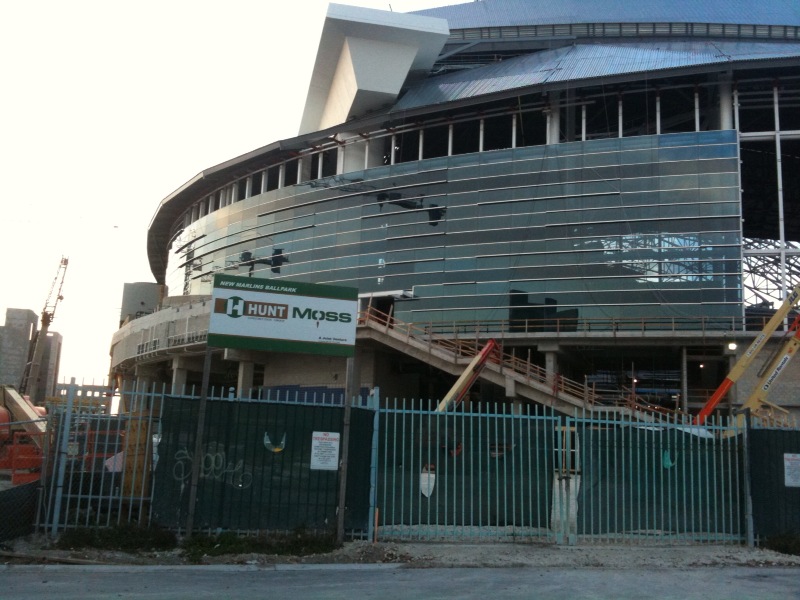 The new place is at the old Orange Bowl site, nestled into a residential neighborhood called Little Havana. One side faces 7th St, a local thoroughfare: pharmacies, gas stations, barber shops, nail salons.
The ballpark in progress is taking shape, a massive oval of glass and off-white concrete. It makes no effort toward nostalgia; parts of it look at least vaguely like a UFO, the massive supports for the retractable roof bracketing one side like some sort of fueling dock.
Around back, a chain-link fence separates the construction site from blocks and blocks of single and multi-family homes. A few — nearest the huge concrete parking garages — are boarded up or decorated with “FOR RENT” signs.
Most aren’t. The neighborhood shows all the familiar signs of people being people: Cars and bicycles, barbecues smoking on front patios, televisions glowing in windows. From a driveway, a remote control car speeds out into the street, kicking up dirt and gravel.
Six kids, ranging in age from about six to 12, play around a neon orange construction pylon separating the part of the street that’s still paved from the part that has been dug up. One boy holds an orange-painted stake, another drags some sort of thin metal bracket, scraping and rattling against the pavement. Up against the fence, construction junk deemed unworthy for play sits on a pile of rubble, alongside, for some reason, abandoned shoes.
By my count, there are 11 old shoes strewn among the detritus — only four total that are paired. Two pairs of shoes and seven strays. They are of all sorts and sizes: sneakers, pumps, loafers, sandals, Crocs.
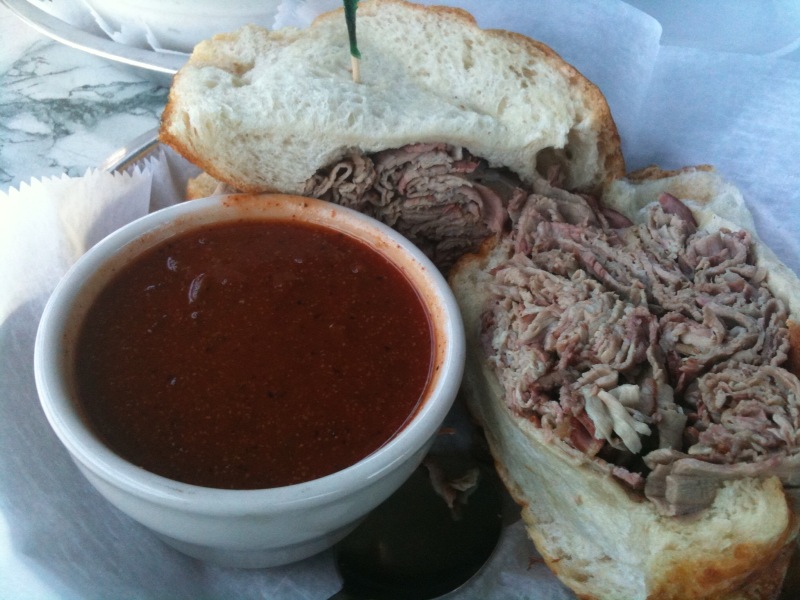
A few blocks away, Morro Castle serves delicious Fritas Cubanas – a Cuban-style seasoned hamburger buried in crisp shoestring potatoes. The waitress speaks only Spanish, communicating with some customers (including this one) in a universal language of finger-points, gestures and smiles. A couple of teenagers in Miami Heat t-shirts rattle off their orders in Spanish, then converse in English.
Many baseball fans seem convinced that Major League Baseball just won’t work in South Florida. We say the Marlins have “no fans,” even though the Marlins – like all teams – decidedly do have fans. “No fans” is a quick way of saying they can’t boast a fanbase the size of the Mets’ or Yankees’ or Phillies’ or Red Sox’, but sit in the crowd at Sun Life and you’ll hear plenty passionate cheers and jeers, celebrating Hanley Ramirez for his hitting or excoriating him for his defense.
The current stadium is among baseball’s worst. A bland, mid-80s construction, it is surrounded by parking lots, far from the city, among expanses of strip malls. Its dimensions and sightlines are clearly built for football; many seats do not properly face the action. It can boast decent wings and an arepa stand. They play baseball there so the place cannot be unpleasant, but it adds little to the experience.
I’ve hardly been following the particulars of the new ballpark’s construction, but I assume it came with all the inevitable complaints, counter-complaints, ill will and taxes. I can’t say what the park means to the people of Miami and in the neighborhood or what it’ll do to traffic and local business. But it’s hard to imagine the upgrade won’t ultimately be good for the team.
The Marlins have a great (if relatively short) history, good players locked up under team control for a long time, and a front office that appears to know what it’s doing. They play in a big market where baseball is popular. Next year, they’ll have a new baseball-only ballpark in a residential neighborhood way closer to the city’s center.
Of course, owner Jeffrey Loria has been accused of pocketing revenue-sharing money and misleading the public about the team’s funds. But if a new stream of cash from ticket sales and advertising can increase the Marlins’ operating budget, they will become more competitive financially with the heavyweights in their division.
That might not sound pleasant to Mets fans, but it’s probably a good thing in the long run. Better stadiums make for better road trips, and better competition makes for better games.


 The situation: The Mudville nine are down 4-2 with two out in the ninth inning. Against all odds, a pair of terrible hitters — Flynn and Johnny Blake — reach base, bringing up the team’s best slugger, Casey. He strikes out on three pitches.
 Tedquarters