Daily News gossip poll consistently hilarious

You know, I promised myself I was going to cut back on the straight-up newspaper trolling. But I’m really busy today and the Daily News gossip poll is like an alley-oop pass. They’re usually embedded in the related articles online, but they run the results in isolation in the Gatecrasher section in the print edition. And the questions will be stuff that really shouldn’t be left up for polls, like, “Should (Celebrity A) and (Celebrity B) have gotten a divorce?”

Anyway, today’s is true to form. Apparently someone named Joel Madden, who is married to Lionel Richie’s daughter Nicole, Tweeted that his wife spends too much money on pillows. Now the Daily News wants to know if he was overreacting, if he’s completely right, or if he should be keeping their private affairs off Twitter.

Turns out 64% of Daily News readers believe no one should be spending $3,000 on pillows. But I don’t care about Daily News readers (besides myself, of course). I care about you! So I’ve put the same poll here — with a few more choices — to see what TedQuarters Nation thinks about Joel Madden’s decision to Tweet about Nicole Richie’s decision to spend $3,000 on pillows.

[poll id=”18″]

That last one is a shout-out to some SNY.tv editors. For a very long time, whenever we ran a homepage poll involving the Knicks, that was the last answer. It usually won.

New York Post Fear Index

Turns out I missed a lot in the papers while I was in Port St. Lucie. And if you read the New York Post, you must think this is a pretty terrifying time to be a Mets fan. Let’s look at some of the things the Post would have us fear and rate them by how scary they actually are, on a scale of 1-10.

I should note that there’s plenty to fear in all the other papers and on just about every blog, too. I was going to do a general Mets Fear Index, but I started out at the Post’s Mets page and realized it had all the material I needed. So here’s what we’re afraid of:

Carlos Beltran’s knee problems: There’s a lot about this on the Post, and rightfully so. Beltran’s arthritic knees, we know, have hampered his last two seasons and slowed his preparation for this one. This is something legitimately worth fearing. The only mitigating factor is that, in Scott Hairston, Lucas Duda and Nick Evans, the Mets have a reasonable amount of depth at the position, something new for the organization. Fear factor: 9 out of 10.

Oliver Perez is still here: I’ve said this before: Barring a rash of injuries, Oliver Perez is not going to make the Mets. Every word spilled on the subject — on this site included — is a word wasted. I will not mention Oliver Perez again until either he is officially cut or it is March 31 and he is still on the roster. Fear factor: 1 out of 10.

Jose Reyes is the new Carmelo Anthony: Get this: Because Jose Reyes is not as good as Rickey Henderson, the greatest leadoff hitter of all time, then there’s no chance Sandy Alderson will want Jose Reyes back. The fact that Reyes plays shortstop only gets a single parenthetical mention in this column. I’ll amount there’s a solid chance Reyes won’t be back next year, but, without quoting nebulous “executives,” I’d put it at way less than 95 percent. Fear factor: 4 out of 10.

OH MY GOD WE’RE HAVING A FIRE… sale: I will never hear the term “fire sale” again without thinking of Tobias Funke. Evacuate all of the schoolchildren! That said, I don’t know a lot about business and I don’t have a ton of inside information or anything about the Wilpons’ pending lawsuit and their finances. I’m not eager to get too deep into this, lest I sound like a shill. But everything I understand suggests that most of the media coverage — and basically all the sports-media coverage — entirely fails to grasp any of the nuance involved. Here, the thesis — citing more “executives” — is: We know the Mets have money problems, so we should expect them to cut salary down to the $70 million small-market team range. Seems like the brushstrokes are too broad. Also, my understanding is the whole point of seeking another part-owner is so the Mets’ finances are not impacted by the Wilpons’ troubles.  Fear factor: 3 out of 10.

From the Wikipedia: The Great Auk

Originally posted March 18, 2010.

I like nature as much as the next guy, but I’m not generally one to get all broken up about extinct animals because, you know, survival of the fittest and all. But I do always wonder what those extinct animals would have tasted like.

The subject of today’s From the Wikipedia was almost certainly delicious. In fact, it was partly our ancestors’ ravenous consumption of the species that led to its demise, because our forefathers lacked the foresight to leave even a few of them behind for us to breed and subsequently barbecue.

From the Wikipedia: The Great Auk.

The Great Auk was a species of flightless bird that lived on islands off eastern Canada, Greenland, Iceland, Norway, Ireland, and Great Britain up until the 19th century. It stood about 30-33 inches high and vaguely resembled a penguin. Under its down, it had a thick layer of fat, which served the dual purpose of protecting it from the cold Northern air and preventing its meat from drying up when cooked over an open fire.

Besides its deliciousness, the Great Auk’s most notable characteristic, by far, was its naivete. For some stupid reason, it was not afraid of humans, even though it clearly should have been.

In fact, on a 1622 expedition to Funk Island — which is not nearly as awesome a place as it sounds — a British crew was able to drive the succulent poultry right up the gangplanks and onto their boat. Sir Richard Whitbourne described it, “as if God had made the innocency of so poore a creature to become such an admirable instrument for the sustenation of man.

But man, being man, was obviously not an admirable instrument for the sustenation of so poore a creature.

Hint to animals: Fear humans or figure out how to make humans fear you. Otherwise, you’ll endure species-wide humiliations like the ones that eventually spelled the demise of the Great Auk.

As long ago as 2000 B.C., someone was buried in Newfoundland wearing a coat made of 200 Great Auk skins with the heads left on for decoration. The Great Auk jacket was the O.G. mink coat.

The Beothuk people of Newfoundland made pudding out of Great Auk eggs. (It should be noted, here, that the last surviving Beothuk died about 15 years before the last Great Auk, so the Great Auk had the last laugh in that storied rivalry.)

But more than anything, it is the treatment of the last few Great Auks that underscores humanity’s lack thereof.

By the turn of the 19th century, after centuries of being hunted for its meat, eggs and down feathers, the Great Auk was nearly extinct, and in 1794 it became illegal to kill Great Auks in England.

That didn’t stop the 75-year-old Scotsman who caught the last Great Auk ever seen in the British Isles, though. He tied the bird up for three days then beat it to death with a stick. Why? Because he thought it was a witch, obviously.

The last remaining colony of about 50 Great Auks lived on an island inaccessible to humans until 1830, when the island submerged and they were forced to move to another island that was barely accessible to humans.

Just accessible enough, it turned out, for preservationists — I kid you not — to kill the remaining birds for displaying their skins and eggs in museums.

In July, 1844, the last pair of Great Auks sat incubating an egg, still somehow not fearing humans even though humans had killed all the other Great Auks. Three humans approached and the two Great Auks just sat there on the egg, so two of the humans strangled the Great Auks while the third smashed their egg with his boot.

That was all for the Great Auk.

Tale of the Tape: R.A. Dickey vs. my freshman-year R.A.

Originally posted Aug. 20, 2010.

I know you’ve been wondering how they stack up, so here it is: A tale of the tape measuring Robert Alan Dickey against Jacques, the friendly resident advisor on the fourth floor of the New South Dormitory at Georgetown University in the 1999-2000 academic year.

R.A. Dickey Jacques the R.A.
Headwear Mets cap Bucket hat
Enjoys reading Yes Yes
Beard Yes Varying
Weapon of choice Knuckleball Student-conduct citations
Widely appreciated facial gesture Makes hilarious face while throwing Looks the other way while you’ve got a backpack that’s obviously filled with beer
Dislikes Being pulled from a game early due to injury Hall sports
Willingness to let you play Bond on his N64 Unknown Frequent
Skills Controlling knuckleballs at multiple speeds, fielding position, flummoxing opposing hitters Playing various musical instruments, pulling off tie-dye, maintaining an interesting tumblr
Fun fact 


Has no ulnar collateral ligament Introduced me to coffee milk

#BLOCKED!

Originally posted Aug. 10, 2010.

I banned my first commenter today. Pretty exciting stuff.

A few people suggested I do so a while back, but I resisted for a number of reasons. I welcome feedback and enjoy seeing comments on my work — a luxury I was never really afforded on the SNY.tv columns — so I intentionally made it as easy as possible for people to comment when I started up this blog. I’m not out to muzzle anybody, even straight-up trolls.

Plus I have a reasonably thick skin and I like giving people an open forum, so I figured if some banned MetsBlog commenter believes he has unlocked the dark secrets to the SNY.tv empire, you know what, go to town in my comments section, bro.

But for some reason, the allegation that my post earlier this afternoon was “hacky” bothered me. I imagine, if pressed, Ryan would say that the Mets absolutely must go out and get Cliff Lee and insist that my post was a Wilpon-driven effort to excuse them from doing so.

Problem is, I honestly think signing Cliff Lee — a 32-year-old pitcher — to a lengthy and expensive deal is a bad idea regardless of it the Mets can afford it and no matter how awesome Lee is right now.

Look: Maybe by now you realize this, but I’m a contrarian by nature. When everyone’s all puppydogs and daffodils about the Mets, I present skepticism. When everyone’s gloomy, I provide some optimism. It’s not a conscious thing, it’s just the way I am. I have no idea why. I went to a stuffy college and became something of a hippie. If I went to a hippie college I probably would’ve started tucking my shirt in.

So this morning’s post — and I really shouldn’t even bother defending it — aimed merely to provide some perspective given all the doom-and-gloom around the blogosphere about the Mets’ payroll stuff. Ryan’s assertion that it was something other than that finally got to me.

When I first started subbing — for some reason my old jobs keep coming up here lately — the teachers I was replacing would always provide a big stack of worksheets to give out to students. I know other subs would yell at kids and force ’em to sit quietly and do their assignment, but that wasn’t my style — I just wasn’t nearly that invested in it.

So my approach was to hand out the worksheets and be forthright: I’d tell students that I didn’t really care if they did them or didn’t, but that I had instructions to collect them at the end of the class. And I’d say, “Look: I’m not here to get you in trouble and I imagine you’re not here to get me in trouble, so everybody just be cool.”

With high schoolers, it worked almost every time. They would sit, usually chatting quietly but rarely getting out of control, and at the end of the period a bunch of them would hand in their worksheets and the rest, I guess, would explain it to their teachers later.

With middle schoolers, the approach failed miserably. Middle schoolers are bastards. They cannot be reasoned with and they are incapable of just being cool. They would yell and throw things and choke each other and then I’d have to yell back and write them up.

My approach to comments on this blog has always been similar: Everybody just be cool. And it has worked. Everybody is cool. There are active discussions and interesting arguments and everyone keeps the tone respectful. It’s great and I am hugely appreciative.

But Ryan had the maturity level of the middle schoolers. And I grew at least a little concerned that some would confuse him with the O.G. commenter Ryan, one of the brightest and funniest people who comments on this blog.

So everybody else, continue being cool. And you’re welcome to doubt my motivations all you want, no matter how often I insist I am being open and honest. Just do it in some productive fashion, or try to add at least a little bit of humor or originality to the mix.

Except you, Ryan, you don’t have that option. You’re banned. Farewell. I will miss your pageviews.

“At no point in your rambling, incoherent response were you even close to anything that could be considered a rational thought. Everyone in this room is now dumber for having listened to it. I award you no points, and may God have mercy on your soul.”

The Mets’ lineup as half-full

Originally posted Dec. 21, 2010.

Over at MetsBlog today, Matt Cerrone took issue with Ben Shpigel’s assertion that the Mets, “in all likelihood,” would not contend in 2011. I can’t fault Shpigel for the prediction — the Mets, as we all know, are coming off two sub-.500 seasons, have made few roster moves, and will start the year without Johan Santana in their rotation.

But as Matt points out, unpredictable things happen in baseball all the time. I didn’t talk to Cerrone about the post, but if I had to guess I would assume it was at least in part motivated by the sense of fatalism that seems to be growing in Mets fans, especially since the Phillies signed Cliff Lee. There’s nothing wrong with making predictions and taking stabs at what will likely happen, as Shpigel does. Writing off any team entirely before the season even starts is silly.

For what it’s worth, last winter I listed both the Reds and the Padres as “unlikely to contend” in my National League preview for the Maple Street Press Mets Annual. Captain Hindsight can look back now and identify the ways in which both clubs were primed to compete, but at the time it hardly seemed I was taking controversial positions.

Anyway, on to the point. If we’re talking optimistically and trying to figure out the things that reasonably could happen to launch the Mets into contention, I’ll point out that the Mets might have a very good offense next season.

Fangraphs currently lists two 2011 projections for most players — Bill James’ version, and their crowdsourced fan projections. In most cases, the two are reasonably similar. Because I’m trying to see the cup half-full for the sake of this post, I took the better of the two projections for everyone slated to be in the Mets’ lineup and plugged them into David Pinto’s lineup analysis tool.

I even gave Josh Thole a bit of a boost, figuring Ronny Paulino will take some at-bats away against tough lefties. Since Thole was projected at a .358 OBP and a .378 slugging by the fans, I unscientifically bumped those numbers up to .360 and .415, seeing as Paulino has a lifetime .390 OBP and .490 slugging against lefties. I’m painting in broad strokes here.

I plugged in Daniel Murphy for second base, which assumes he can capably man the position. His Bill James projection seemed so optimistic that I didn’t bother adjusting it for any sort of platoon. James’ system projects Murph to post a .339 OBP and .455 slugging in 2011, which would put him among the top handful of second basemen offensively.

Anyway, with a lineup of Jose Reyes, Angel Pagan, David Wright, Carlos Beltran, Jason Bay, Ike Davis, Murphy and Thole/Paulino all performing up to the most optimistic of reasonable projections, the Mets would score just short of five runs per game (4.959, to be exact) according to the tool.

That’s nearly a full run per game better than the Mets scored last season. It would have made them the NL’s top offensive club in 2010.

Obviously the system is not perfect for a variety of reasons. For one, it assumes all players play 162 games at their positions, which clearly won’t happen. There’s a dropoff when you start plugging in bench players for the starters, and even in full health every team needs to plug in bench players with some frequency.

But even despite the team’s impotent offense last year, I don’t think it’s crazy to expect the Mets to score a lot of runs next season. There’s no obvious gaping hole in the lineup, and amazing things can happen when you replace out machines with capable Major Leaguers. Subbing in Jeff Francoeur’s 2010 Mets line for Beltran and Rod Barajas’ for Thole/Paulino would cost the team about a half-run per game, per the tool. (Pinto’s script fails to factor in smiles and leadership.)

If the Mets could only prevent runs as well as they did last year, using the Pythagorean win expectancy formula with that lineup projection, they’d finish with right around 100 wins. So that, well, that’d be cool.

Problem is, it’s just not that likely to happen. The Mets enjoyed very good pitching last year, but they also had a healthy Santana throw 199 innings. Jon Niese and R.A. Dickey, two of the three starters penned in for the 2011 rotation, experienced lasting big-league success for the very first time in 2010. And throwing Murphy in at second base could have repercussions for the defense.

The Mets lineup, as currently constituted, probably won’t score 800 runs. But it will probably be pretty good. That is what we can hold onto until April. That and the knowledge that lots of crazy things happen in baseball.

I’d say neither of those things makes the Mets likely to contend in 2011, but together they should be enough for us to recognize that it’s not downright impossible for the Mets to contend in 2011.

Jose Reyes working, me leaving

Then Hudgens provided an addendum to his assessment. The art of hitting relies on harnessed aggression, the ability to sift between balls and strikes, punishing mistakes and accepting walks when available. Discretion is necessary.

The Mets’ general manager, Sandy Alderson, builds franchises with on-base percentage and power in mind. Hudgens believes this. Reyes, 27, understands it as he heads into free agency. He hopes to bounce back from a .321 OBP season, his lowest mark in the past five seasons and about 30 points lower than the pace he set from 2006 to 2008.

Which is why Hudgens adds this about Reyes and his attack-mode at the plate: “We just have to make sure he’s getting good balls to hit.”

Andy McCullough, Newark Star-Ledger.

Excellent work from McCullough, using plate-discipline stats in an accessible way to track Reyes’ pursuit of a better on-base percentage in 2011. McCullough, incidentally, is also the subject of a good interview in the Amazin’ Avenue Annual, discussing, among other things, life on the Mets’ beat.

I’m on my way back to New York as we speak. I’ll be back here in Port St. Lucie at the end of the month to catch the last couple of games then the first series in Miami. I will add this: As much fun as I had covering Spring Training these two weeks — and I had a ton of fun — it gave me a much greater appreciation for what the beat writers do. I like traveling, but two weeks away from home is pretty close to as much as I can handle. Those guys are here for almost all of Spring Training, then get to recover by spending half their days on the road for the next six months. I suppose you get used to it, but that has got to be exhausting.

I’m setting up some re-runs for this afternoon. It seems the Spring Training exposure has brought a good crop of new readers to this site, so I’m digging up some posts from the past that will, I hope, help everyone know what to expect around here when I’m not spending every day around the Mets. I do try to keep pretty close tabs on the Mets all year round and don’t plan to change that, but there’s a good deal of other nonsense here as well.

One of the posts, incidentally, will be the one I made after banning my first commenter. I included that not because I want to further call out Ryan the very angry conspiracy theorist Mets fan, but because it contains some general guidelines for commenting on this site.

The Extra 2%

In sizing up the possibility of inking Longoria to a multi-year contract, Friedman seized on the practices he developed in his private equity days. When investing in a company, he had to assess not only that firm’s operations but also the quality and risk tolerance of management, the current trends within its industry, and the state of the broader economy. Likewise with a potential Longoria deal, Friedman had to consider a lot more than the quality of the player. The success of the Crawford contract and similar deals across baseball offered a sound precedent. The Rays’ revenue streams—outside of the estimated $70 million to $80 million a year they would pocket in revenue shared via MLB Advanced Media and other league-wide ventures, as well as from richer teams—remained tight. And then there was the matter of Longoria’s agent.

Paul Cohen, an agent for Los Angeles-based TWC Sports whose client list included Yankees second baseman Robinson Cano, Braves pitcher Tim Hudson, and Rockies shortstop Troy Tulowitzki, also repped Tulowitzki’s former Long Beach State teammate Longoria. After tearing up Double A for most of the 2007 season, Longoria’s numbers tailed off slightly in Triple A as he hit .269/.398/.490 with 29 strikeouts in 31 games. Cohen had just locked down a six-year, $31 million contract for Tulowitzki—the biggest contract of all time for a player with one-plus seasons of major league service time—with a $15 million club option at the end. Would his other high-profile Long Beach State Dirtbag client, Baseball America’s number-two prospect for 2008, be willing to consider an even longer deal, coming off zero seasons of service time?

Jonah Keri, the Extra 2%. Via GQ.

GQ magazine presents an excerpt from Keri’s new book, which hits shelves today. It charts the way the Rays’ front office used Wall Street techniques to build a winner, and seems likely to become a must-read for baseball nerds. This excerpt lacks a heavy-handed locksmith analogy though.

On closers, one more time

But there is one way the Mets could keep Rodriguez from finishing 55 games while plausibly arguing it is for baseball reasons. They could essentially redefine the role of a closer, from a pitcher who is used almost exclusively in save situations to one that is used in the most important situations in a game.

Bases loaded in a tie game in the seventh inning? Bring in the closer. Clinging to a one-run lead with the heart of the Phillies’ order due up in the eighth? Bring in the closer. And if Rodriguez’s pitch count is too high by the ninth inning? Bring in someone else.

It’s a radical idea, but not a novel one. Sabermetricians have long argued that by making closers ninth-inning specialists, teams fail to maximize their potential value. The key word is leverage, which measures the relative importance of each situation on a game’s outcome.

Brian Costa, Wall Street Journal.

I’ve beaten this drum about a million times and Costa absolutely nails it here, so there’s really little to add. I think he may be off in his use of Leverage Index — he writes that 19 pitchers came into games in on-average higher-leverage situations than Rodriguez, and I’m not sure that’s the case. I will cop to not being that comfortable with LI stats, but it says here that gmLI is the pitcher’s average LI when he enters the game. And Rodriguez actually had the top gmLI on the Mets last year.

But I could be wrong, and it doesn’t matter anyway. Costa’s point is that a team’s best reliever should be used in the most important situations, and no one could argue that coming in with the bases empty and a three-run lead in the ninth is a tighter spot than bases loaded with no outs in a tie game in the seventh. Too often, managers use their closers in — and only in — save situations, and managing to a powerfully flawed stat just doesn’t make a lot of sense.
I will again cite this tremendous Forbes research from 2007. It says:

Those veteran closers making millions can thank Tony LaRussa, who ushered in the era of hyper-specialization as manager of the Oakland A’s in 1988. That year, LaRussa decided that his best reliever, Dennis Eckersley, would be used strictly to protect ninth-inning leads. Other clubs soon followed suit, and top relievers found themselves racking up more saves (the biggest stat driving their paychecks) while pitching fewer innings.

Yet in the 20 seasons since LaRussa’s brainstorm, teams holding late leads have won at about the same rate they did in the 20 seasons before. Since 1988, teams leading after eight innings have won at a .951 clip, according to Baseball-Reference.com and STATS Inc., compared to .948 from 1968 to 1987. That adds up to less than one win per season per team.

To be fair, relievers do seem to appreciate defined roles, which makes sense. Anyone would prefer to know what he’ll be asked to do at work that day before he shows up at the office. But perhaps Collins, with the help of the Mets’ front office, can come up with some sort of newly defined role, or — dare I suggest — tell every reliever that his role is defined as: “guy who gets people out when we ask him to.”

Sandwich of the (last) Week

Today is my last full day in Port St. Lucie. I will miss the weather here and the opportunity to watch baseball stuff all day and then talk to baseball players about it. I won’t miss the awful Florida radio stations — I really should have brought CDs — or the food options.

A couple of people recommended Florida eateries to me that I hoped to get to this week, but all of them were at least a half hour away. If you are an insider at Roadfood.com (as I am), you could see that site’s map of interesting places to eat in Florida. And you would notice that there is precious little south of Titusville and north of West Palm Beach. I’m certain there are actually good options about if I knew where to look, but Port St. Lucie lacks New York’s ridiculous network of food blogs to point me in the right direction. I’ll say that the beef patty I had at Jerk City was delicious, as Jamaican beef patties almost always are.

Anyway, I fear I won’t have all that much to say about the following sandwich. But here we go.

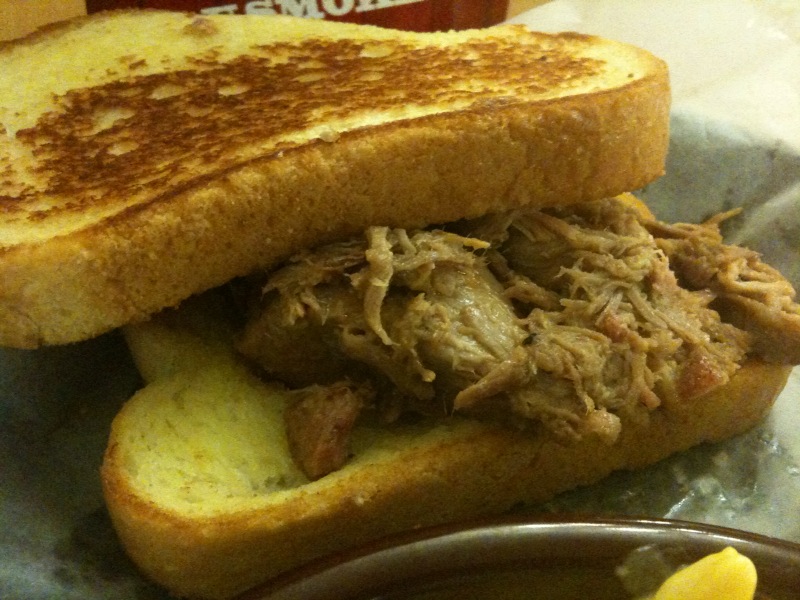
The sandwich: Pulled pork from Sonny’s Bar-B-Q, various locations in basically every Deep-South state (including Florida, which I know some people don’t consider the South despite the disturbing number of confederate-flag bumper stickers).

The construction: Pulled pork on garlic toast.

Important background information: I’m so glad that barbecue, as a cuisine, has blown up. I remember when a Famous Dave’s opened near my hometown, my dad and I went nuts over it because we had only limited exposure to barbecue. Now, snob that I am, I scoff at Famous Dave’s. It’s Blue Smoke or Dinosaur or Hill Country or Georgia’s or Smoke Joint (the best I’ve had in the city, for what it’s worth). Or I smoke it myself.

I realized Sonny’s was a decent-sized chain, and I definitely think barbecue is the type of thing that is best when homespun. But I figured a barbecue chain with locations throughout the South (and exclusively in the South) couldn’t be all that bad, even if there was no distinct smoke smell emanating from the restaurant.

What it looks like:

How it tastes: Not bad. The pork didn’t really have any identifiable smoke flavor, but it was pretty tasty. Really porky-tasting pork, if that makes sense, like a pork chop pulled into tiny bits. It’s not a terrible flavor; pork, as you may know, is delicious.

The garlic toast didn’t taste much like garlic, really. It primarily tasted like heavily buttered toast, which is also very good. It was greasy enough that I had concerns it wouldn’t hold up over the length of my sandwich-eating experience, but it was cut thick enough to withstand the weight of the pork and the grease of the butter.

Yeah, I suppose the best way to describe the first couple of bites is to say they tasted like butter and pork, and unsurprisingly good combination, since butter goes with basically everything and pork is amazing. But buttered pork can get old pretty quick, so I started experimenting with the four bottles of barbecue sauce on the table: Mild, Sweet, Sizzlin’, and Sizzlin’ Sweet.

None of the four was exactly what I was looking for to complement the flavors. The Mild didn’t provide enough taste, the Sweet and Sizzlin’ Sweet were both a little too sweet, and the Sizzlin’ was a little too vinegary without a ton of heat, and itself not quite sweet enough. Sorry if I’m the princess-and-the-pea with barbecue sauce, but these things are important. I wound up eating most of the sandwich with a good but not great combination of Sizzlin’ and Sizzlin’ Sweet.

From there on out it was better, but nothing like what my now-refined barbecue palate has come to expect, and not even way better than a sandwich made with the pre-packaged barbecue pulled pork you can buy in the supermarket. I probably should have tried to get pickles and cole slaw on there even though that was not on the menu (they offered cole slaw as a side, though).

What it’s worth: This is the good part: For $6.99 you got the sandwich, a side and a soft drink. I got macaroni and cheese. It was a pretty hefty amount of food for little more than you’d pay at a fast-food place.

How it rates: 65 out of 100. It did the job and I enjoyed it, but I’m more likely to try someplace else when I return to Port St. Lucie.

Speaking of: I’m returning to Port St. Lucie at the end of the month. I’ll be here for the last couple of Spring Training games then drive south for the opening series against the Marlins. I figure there’ll be no shortage of sandwich options in Miami.