This

The idea that New York would be especially bad for someone with Social Anxiety Disorder seems to me completely unfounded. Depression and anxiety are internal matters; they may be triggered to a greater or lesser extent by external factors, but an otherwise healthy isn’t likely to become clinically depressed because New York features a lot of media attention, while S.A.D. is a disorder precisely because its feelings of anxiety are not reflective of reality. Greinke might find New York stressful or he might not, might like it or not, but it’s unlikely that external factors would determine his mental health. I know plenty of people who deal with anxiety and depression and who find New York much easier to thrive in than their smaller hometowns.

Besides — though this may less true among athletes and sports fans than in the city’s larger culture — few places on earth are more accepting of psychiatry. Not to turn this post into a Woody Allen riff, but our shrink per capita ratio is off the charts, and New Yorkers talk about their therapists about as frequently as they discuss the weather (granted my view is probably a little warped from working in publishing and journalism, where psychotherapy is essentially mandatory).

Emma Span, Bronx Banter.

Great points abound. Thanks to reports in the Daily News and elsewhere, I was operating under the assumption that Greinke wanted no part of pitching in New York. As Emma points out, that might very well be true, but it’s unfair for us to assume it’s the case just because he has suffered from social anxiety disorder.

#BlameTheAlmighty

I PRAISE YOU 24/7!!!!!! AND THIS HOW YOU DO ME!!!!! YOU EXPECT ME TO LEARN FROM THIS??? HOW???!!! ILL NEVER FORGET THIS!! EVER!!! THX THO…

Bills reciever Stevie Johnson, via Twitter.

You’ve probably seen Johnson’s postgame Tweet by now and have read all about how he lashed out at higher powers after a dropped touchdown pass. And odds are you enjoyed a good chuckle.

Twitter is a strange and funny place. Reporters use it to break news, some people try to convey reasonably complex opinions in 140 characters, and some — this guy, say — mostly use it to make jokes and solicit restaurant recommendations.

But most people — or maybe just most people I follow — seem to use it primarily as some sort of emotional sounding board, sort of an open IM to the world of their instantaneous reactions to the news the reporters just broke or whatever just happened on their TVs. And 140 characters are plenty for that.

And with more and more athletes signing on to Twitter, fans (and journalists, for that matter) gain a type of access to players that I’m not sure ever before existed. We are presented emotion unfiltered by newspapers and the postgame cliche fomalities, and insight into players’ lives outside their sport. A few feeds are obviously operated by publicists. Of the others, some turn out to be interesting. Others not so much.

Regardless, as I learn more about a player — even if it’s just the way he consciously chooses to portray himself to the world — I find that a funny thing happens: I feel like I actually know them, and because when push comes to shove I generally like the people I know, I start rooting for them in a different way than I would a guy whom I’d just seen in a few boring postgame interviews or read quotes from in a newspaper.

C.J. Wilson comes out to start a World Series game, I don’t just think, “hey here’s a lefty who converted from reliever to starter and had a pretty good season,” I think, “oh hey, it’s @str8edgeracer! I have a pretty decent sense of what this dude’s about, and even though we don’t have a ton of overlapping interests outside of baseball, I hope he succeeds because he seems like a decent dude.” Except I don’t really think it out in words like that; that would be weird.

I know now that Mark Sanchez, Dustin Keller and Nick Mangold like to rip on each other, and that Keller and especially Mangold make plenty of time to interact with fans (Sanchez, presumably, is busy eating Taco Bell, and that’s cool too). I know that Marlins first baseman Logan Morrison is a legitimately hilarious dude, and that Blue Jays outfielder Travis Snider — a man of my own heart — uses the handle @lunchboxhero45 and almost exclusively Tweets about food.

And now I know that Stevie Johnson is a bit of a bugout, prone to meet adversity with overreaction and vaguely existential meltdowns. I know people like that. And hey, we’re all human — his outburst only makes me like him more. Hell, I’ve spent plenty of time myself irrationally wondering if I were being punished for something. I feel you, Stevie Johnson.

So I fear that when the public at large reacts the way it did to Johnson’s freakout — ranging from mockery to sanctimony, but an undoubtedly loud response — we risk forcing athletes to become as guarded in this forum as they are in others. That’s a shame, because candid ballplayers interacting with fans in a public forum benefits all parties involved.

And look: I realize that Johnson’s outburst is indeed funny, and that the public overreacting to, well, public overreaction is pretty much inevitable, so I’m pretty much tilting at windmills here. Plus obviously an absurd tirade is a very different use of Twitter than Sanchez and Keller trading embarrassing photos, and that an athlete using the site responsibly will face no criticism.

I just worry that as more teams’ brass and media-relations types see the response to Johnson’s meltdown, “responsibly” will come to mean “blandly.” And that stinks, because I really like hearing about all the ridiculous things Travis Snider is eating.

Ollie as lefty specialist?

That leaves the bullpen devoid of an experienced lefty, unless … dare we say it? OK, here goes.

The Mets should make Oliver Perez a lefty specialist next season. Or at least bring him to spring training with the hope that he earns the job, along with maybe Pat Misch (who might be needed at the back of the rotation). They should not — and, because Sandy Alderson and his men are rational types, probably will not — release him this winter to appease a bloodthirsty public.

Andy Martino, N.Y. Daily News.

Many of Martino’s points in the article are reasonable — especially the excerpted one about how there’s no sense cutting Perez without giving him the chance to succeed (or fail) in Spring Training. They’re paying him whether they cut him now, they cut him in March or they keep him on the team all season.

But citing batting average as evidence that Perez is effective against lefty hitters is silly. Yes, he held them to a .214 average in a tiny sample in 2010. He also yielded a miserable .411 on-base percentage because, as we know, he doesn’t often throw the ball over the plate.

That’s a tiny sample, though. Of course, it’s hard to find a reasonable-sized sample because Perez’s career stats don’t really reflect the type of pitcher he has been for the last two seasons. Perez faced lefties 91 times in 2009 and was legitimately effective, holding them to a .200/.278/.313 line.

Across his career, Perez has yielded a decent but hardly Felicianoesque .691 OPS to lefty hitters. As a point of reference, Feliciano’s career OPS against for lefties is .580. Scott Downs’ is .631. J.C. Romero’s is .603. Randy Choate’s is .598.

Martino’s article includes quotes from a scout that suggests Perez drop his arm angle to be better against lefties, so maybe there’s hope that with an adjustment he can become an effective specialist.

I’m skeptical, though. Even when Ollie’s pitching well he’s wild, a terrible quality if you’re coming into games with runners on base. And does anyone — anyone — like the idea of Perez coming into a close game to face Ryan Howard in the 7th inning?

And while Martino suggests there “are no obvious substitutes” for Feliciano or Hisanori Takahashi in the farm system, I’m not certain that’s true. Well, I guess I should say I’m almost certain they are not substitutes for Feliciano and Takahashi because both of those guys were great for the Mets. But I’m not certain Ollie Perez is the best internal option.

Skinny lefty Mike O’Connor pitched to a 2.67 ERA in 70 1/3 innings in relief for Triple-A Buffalo in 2010 while holding lefties to a .289 on-base percentage.

The Mets put out a press release yesterday to say they re-signed him. If you’re into conspiracy theories you might assume that means they see O’Connor in some Major League role next year, since Val Pascucci’s return did not merit a press release. Of course, O’Connor — whom you might remember from one excellent start against the Mets in early 2006 — did not fare any better than Perez against lefties in his Major League stint, and also proved pretty wild. But he’s got a full year working out of a Triple-A bullpen under his belt and always exhibited excellent control in the Minors, unlike Perez.

Further, Buffalo southpaw Adam Pettyjohn pitched mostly out of the bullpen for the first time in his career in 2010, and though he yielded a 4.94 ERA, he did manage to hold lefties to a .313 on-base percentage. He seems like a less impressive candidate for the Major League bullpen than O’Connor, but if the competition’s Oliver Perez, then, well, you know.

So while the Mets absolutely should consider Perez for any role they feel he can capably handle — including a lefty-specialist job — I’m skeptical that he really could perform any better in the job than other options in the system, or, for that matter, a bunch of guys who might be on the scrap heap. Just because he’s better against lefties than he is against righties does not mean he’s actually good against lefties.

Only because the Grog and Tankard came up in the comments section yesterday

My brother died on the first Tuesday of my senior year of college. Three days later, I got an email from the guy who played the bass in the Moo Shoo Porkestra, the band we had started up the previous semester,  with the subject line “EMERGENCY PORK NEWS.”

He wrote to inform me and the rest of the band that he had secured a gig at a local bar called the Grog and Tankard. Problem was, the only open spot in the schedule — at least according to the booking guy — was the upcoming Tuesday, so he needed to know if I could make it back to D.C. from New York by then.

It stands, to this day, as the nicest thing anyone has ever done for me.

We didn’t realize then that the Grog and Tankard almost certainly would have been able to book us a few weeks later. We didn’t know that the place kind of sucked, and that every kid in the greater D.C. area with a band played his first gig there because the bar would basically take anybody. We couldn’t recognize it as some weird, stubborn hemorrhoid weathering the ointment of gentrification, along with the strip club next door.

We just knew it was a real, authentic, beer-serving bar, and everyone in the band wanted badly to play a legitimate off-campus show.

There was nothing left to do in New York but sit and stew and curse everything and feel generally numb. I made it back to D.C. by Monday, just in time to practice the handful of songs we knew and figure out how to extend them out long enough to fill the two-hour slot we were charged with playing.

Because the bar sold Bud Light cans for $1.50 with only a $5 cover and was lax with ID scans, we drew about 150 people. We played our loose brand of funk for two hours. About 90 minutes deep, my lower lip split open and I played the remaining half hour with blood dripping down my chin from under my trombone mouthpiece. No one in the dancing, drunken crowd seemed all too grossed out.

When we finished, the bar’s owner took us into the tiny, fluorescent-lit linoleum glorified mop closet where we stashed our instrument cases and handed me a stack of cash. He called us “the next Chicago” — presumably only because we featured horns — and asked us to play a regular gig there on Thursdays.

We thought it was because of our talent, chemistry, stage presence, everything. We didn’t know yet that he mostly cared about the crowd we amassed — as seemingly all venue-owners do. We were floating.

My brother was dead only a week and I was suppressing all sorts of awful emotions I wouldn’t fully face until over a year later. But I was so damn happy. We thought that somehow, despite our lack of original material and constructive rehearsal, we were on the cusp of making it.

We played there every Thursday for the next six months. Crowds — especially when they’re half-full of drunken college girls — attract crowds. We made friends with the strange older men who started showing up and lurking in the back. From the stage, we stared in amazement when the strippers from next door would come in for a drink and dance with their clothes on. One time one of them flashed us. It was amazing.

We learned a bunch of new covers and eventually wrote a few new originals. On Halloween we dressed up as the Beatles and played our version of Abbey Road in its entirety. We met legitimate fans — people we didn’t know who actually seemed to like our music.

For six months we ignored the crappiness of the sound system and made due with the tiny stage. We suffered through the ever-present stench of vomit, knowing that we were often directly responsible. We made money, something we never could have imagined happening when we first started jamming the previous winter.

Eventually we started booking other gigs in better venues in hipper locations with even better drink specials, and the allure of the Grog and Tankard grew stale. We cut ties with the owner and played our final show there in February, in front of a small crowd that braved one of the worst blizzards D.C. had ever seen. We closed with our version of “Burning Down the House” and no shortage of pelvic-thrusting college-aged bravado.

I should remember my senior year in college as one of the worst times of my life. I lost my best friend and hero, and I threw myself into a whirlwind of activity because it was the best way I could figure to prevent my mind from straying in hellish directions.

But I think about it now and I struggle to conjure up all the loneliness and anger.

The lasting image I have of that year is looking out at a boozy orgy of dancing college kids in that narrow space, my friend Dan cozying up to whatever girl he would inevitably take home, sketchy Herb singing along to our shamefully rendered James Brown covers, and my roommate making a beeline for the toilet because he drank too much. And of course, I remember the camaraderie the band fostered with all those nights playing together in suboptimal conditions, something I had been searching for since high-school football, and something that could never replace but made a pretty respectable stand-in for brotherhood.

It was awesome.

Exit, stage lefty

Since returning from the East in 2006, Perpetual Pedro has pitched in 408 of the Mets’ 810 games — 50.3%, or more than half. This means that if you have watched any single Mets game in the past five years, there is a better chance than not that you saw Pedro Feliciano pitch in it. Since the beginning of 2009, only David Wright, Luis Castillo, Angel Pagan, and Jeff Francoeur — position players — have played in more games for the Mets than the lefty specialist. If you’ve been a serious Mets fan in the fairly recent past, Pedro Feliciano has become a bigger part of your life than you may have realized. He has represented quiet stability for a relatively unstable organization, and he is probably leaving just as things are becoming stable.

The Mets not having Pedro Feliciano is going to be like those observation tower fly saucers disappearing. He’s just a situational lefty, and they’re just awkward pieces of Robert Moses’ sixties. Everything will function pretty much the same without them. But the first time Ryan Howard comes to the plate against the 2011 Mets in the seventh inning, it’s going to feel really weird.

Patrick Flood, PatrickFloodBlog.com.

Flood nails it here. It’s inarguably a good thing for the Mets that Pedro Feliciano declined arbitration today — with the front office now saying it will pay above slot for draft picks, the delicious sandwich-round pick is more valuable than a slightly overpaid lefty specialist. But it’s still going to feel really weird to watch so many Mets games without Pedro Feliciano in them.

At a game I was covering during the 2009 season (before it went to hell), the Mets called on Feliciano to face Howard and Ibanez with a runner on and no outs with a one-run lead in the eighth inning. He got Howard to ground into a double play and Ibanez to tap out weakly. Took him four pitches.

I waited in the Citi Field clubhouse to talk to him about it after the game, because I thought maybe he’d have something interesting to say about the inning, even if I didn’t have anything particularly interesting to ask.

Instead, he was just all, “yup, that’s my job — I get lefties out.” So I tried to follow up and ask him if he got especially excited to face a lefty like Howard, and he was like, “nah, not really, just gettin’ lefties out.”

It was awesome. And it made it seem really weird when he campaigned to be the “crossover” 8th-inning guy in the offseason.

Anyway, good luck to Perpetual Pedro wherever he lands. And good luck to Paul DePodesta with that sandwich-round pick. I suggest muffuletta. High upside.

Chris Young stuff

Depending on what report you read, the Mets are either interested in former Padres pitcher Chris Young or taking him out to a celebratory dinner while the ink dries on his contract, presumably also providing him a jolly ribbing, in the tradition of rival Ivy League alumni.

In terms of height and education, the 6-foot-10 Princeton grad is in the upper echelon of Major League pitchers, and, for that matter, humans.
In terms of likely ability to impact a Major League club in 2011, Young’s stature is not nearly so impressive.

Though Young was a very good pitcher when he was last fully healthy, he has not been fully healthy since 2007. Labrum surgery ended his 2009 campaign in June, and he missed most of the 2010 season with a strain in the same shoulder. He did return in September to pitch well in three short starts, but even then his average fastball velocity hovered somewhere in the R.A. Dickey territory, and he wasn’t throwing knuckleballs.

So there are quite a few red flags for Young.

But all that said, if Young weren’t coming off two straight years with shoulder problems and hadn’t suffered a massive decline in velocity, the Mets probably wouldn’t be pursuing him. Remember that the team is strapped for cash and that Javier Vazquez — himself of the declining velocity, and of the 80 ERA+ in 2010 — just got $7 million from the Marlins.

We don’t know the cost of Young’s contract yet, or if there will even be one, but assuming it is small, his signing is exactly the type the Mets must make this offseason. He represents a very low-risk pickup with a potentially high reward, however unlikely. With a couple more like him and a good deal of luck, perhaps they can cobble together a decent pitching staff on a discount.

And I have to hope that this front office — more than the last one — does its due diligence on players before and after inking them to deals. It may be that the Mets executives or their scouts know something about Young or saw something in his late-season starts that makes his recovery more likely than it seems on paper.

The McRib vs. actual ribs

A few people have asked that I write up the McRib while it’s on its current limited-time-only run at McDonald’s. I finally had one on Sunday.

I theorized before I did that the McRib might not seem so impressive this time around. The way I figured, the last time I ate a McRib I probably didn’t have nearly as much experience with “real” barbecue food as I do now. I really only began to understand the great joys of wood-fired meat in college — a time for expanding horizons, no doubt — thanks to the excellent work of a place called Rockland’s right up the street from the bar where the Moo Shoo Porkestra played weekly. I mention my band only so you can better understand my lifelong dedication to pork (and also, maybe, because I’m still proud of the name).

Since then, barbecue has become pervasive in New York, with numerous delicious purveyors available. Hill Country and Blue Smoke are my favorite, for what it’s worth.

Anyway, I speculated that my familiarity with barbecue would render the McRib less exciting, and that the only reason the McRib appealed to me — and many others — in the past was that it was the only limited exposure people in the northern half of this country ever had to barbecue-style food.

What I failed to consider, though, is that eating at fancy and/or “authentic” Mexican places has never made Taco Bell any less delicious, since I recognize it’s a totally different thing.

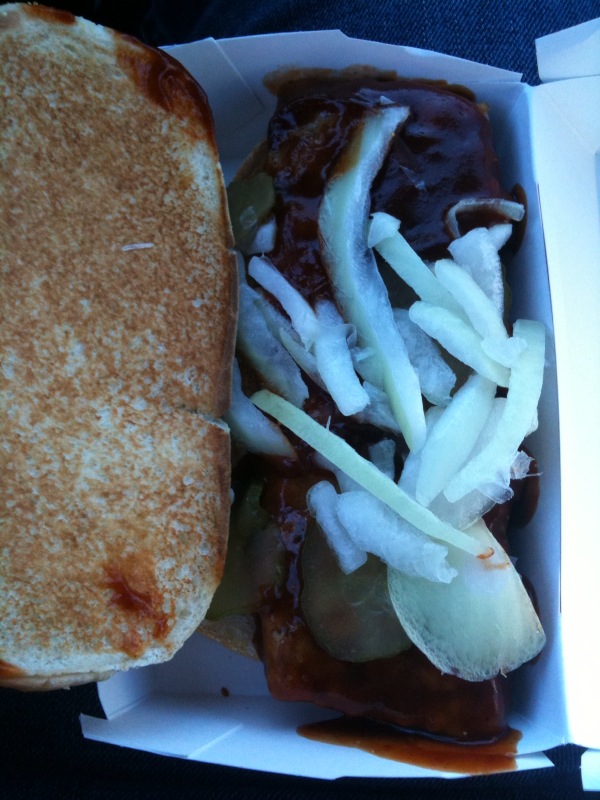
Maybe I’m nuts or my memory is failing me, but the McRib seemed a bit different than I remember it. I seem to recall the meat itself appearing a bit stranger, almost reconstituted in that odd McNugget fashion, where this just appeared to be ground pork with some seasoning in there. Also, it doesn’t appear as if McDonald’s went as far in its hilarious attempt to shape the meat like actual ribs. And I definitely don’t remember there being this many onions, though I may have ordered it sans onions in the past:

I’m not a big onion guy so I knocked a couple of those puppies off before I bit in. I also took time to carefully redistribute the pickles, since they were all piled up on one side of the sandwich.

As for the taste: Not bad. There’s a ton of sauce on there and the sauce is extremely sweet, so that was a little overwhelming. But it’s not a bad flavor, and the pork is at least edible, plus pickles are delicious and the bun tastes like grilled McDonald’s, a good thing.

Straight-up, though, I’d rather have their cheeseburger. When I go to McDonald’s, it’s never because I want a burger or a pork sandwich or pancakes, it’s because I want McDonald’s. The taste, though still good, is pretty distinct from what the food is actually supposed to be. It tastes like McDonald’s. And to me, that flavor is best transmitted through a cheeseburger and fries.

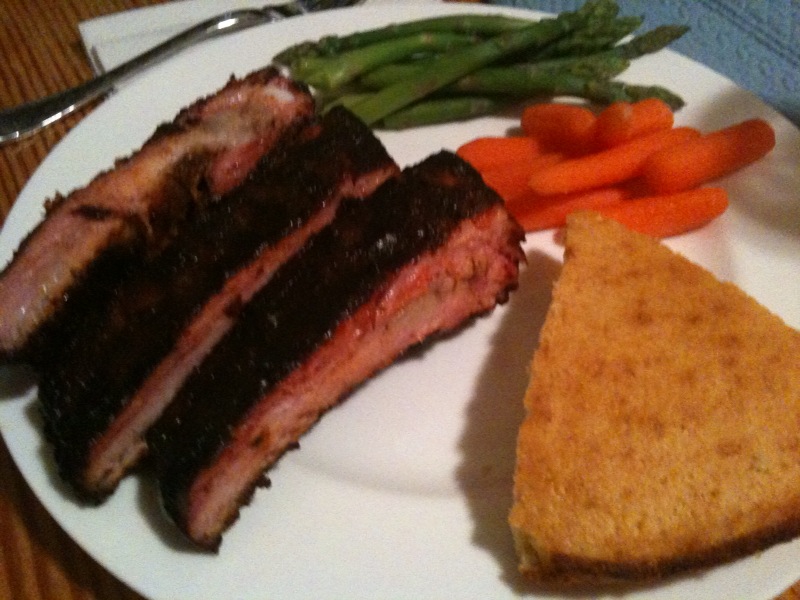
Anyway, because I happened to eat the McRib on the same day I smoked and ate actual pork spare ribs, I figured I’d run down a little tale of the tape for y’all. First, here’s what the spare ribs looked like:

And how they stack up to the McRib:

Actual ribs The McRib
Cost per serving Roughly $5 $2.89
Time investment required Six hours, including prep and cook time Three minutes, if you happen to be driving by McDonald’s
Presentation On plate with vegetables and cornbread Cardboard box
Smells like Hickory smoke McDonald’s
Pork shape St. Louis cut ribs Simulated ribs
Pork quality Fall-off-the-bone tender and moist Vague
Pork flavor Lots of it Vague
Sauce flavor Sweet and tangy with a tad too much vinegar Slightly tangy and candy sweet
Sauce prevalence Thin, sticky glaze over the ribs Goo everywhere
With pickles? No Yes
Bread pairing Cornbread my wife made Sort of a stretched-out hamburger bun
Edible while driving? Not at all With great concentration
Napkins required Multiple paper towels Leg of jeans

Javier Vazquez stuff

With a 2010 salary of $11.5 million, Javier Vazquez qualified as a major disappointment this last season with the Yankees. However, the free agent didn’t have to wait too long to find a new home, as the 34-year-old righty starting pitcher has signed a one-year contract with the Marlins.

The contract will be worth $7 million, and comes with a full no-trade clause. It also has a built-in clause that the Marlins can’t offer Vazquez arbitration after the year, which will help to make him more desirable next winter. Vazquez is signing with Florida in large part so he can re-establish some of the value he lost with New York.

Jeff Sullivan, SBNation.com.

OK, a couple of interesting things here. For one, I was hoping the Mets might make a run at Vazquez. Just based on the back of his baseball card alone he looks like a solid candidate to bounce back — last season was his first real clunker in years, plus he’s perpetually healthy. Also, pitching in the National League East — and in a pitcher’s park — would likely help him.

As Eric Simon pointed out, though, Vazquez’s average fastball velocity took a pretty steep hit last season, falling from 91.1 MPH in 2009 to 88.7. That’s a bit unnerving.

If Vazquez returns to anywhere near his 2009 form — or even his less-spectacular 2008 form — he should be worth way beyond the $7 million the Marlins will pay him. Pitchers that can reliably throw over 200 decent innings do not grow on trees.

But that he cost so much should be at least marginally interesting to Mets fans, since starting pitching seems like the team’s most obvious place for an upgrade this offseason. The innings-eater types — Vazquez, Jon Garland, Ted Lilly, Jake Westbrook, Hiroki Kuroda — have been flying off the shelves this offseason, and not exactly at discount prices.

If the reports about the Mets’ very-limited payroll flexibility are true, then it seems entirely possible they’ll be priced out of the mid-level starting pitcher market and enter 2011 without another reliable starter on the staff. By my count, the only non-Cliff Lee free agent starters who have proven capable of racking up lots of innings over the past few years are Carl Pavano, Kevin Millwood, Dave Bush and Braden Looper.

None of those options is particularly inspiring, for a variety of reasons. (Of course, for the same reasons, none besides Pavano seems likely to command that much money.) Perhaps one slips through the cracks and is available at a big discount later in the winter, but at this point, none seems like a big enough upgrade over Pat Misch and Dillon Gee to be worth paying him nearly all of the Mets’ offseason resources.

Right now, it appears as if the Mets’ best option will be to pick up a couple of upside guys coming off injuries. Joe Janish put together a good list of candidates at Mets Today over the weekend. At first look, lefties Jeremy Bonderman and Chris Capuano seem like decent options, though obviously the cost and the Mets’ scouting assessments are paramount.

The other part of Vazquez’s contract that’s of interest to Mets fans — and all fans, really — is the no-arbitration clause. That was presumably included so that if Vazquez does bounce back and becomes a Type A free agent next offseason, whatever team signs him next will not be forced to surrender a first-round pick to the Marlins. Carlos Beltran’s contract includes the same clause.

It stands to reason that the clause is a byproduct of the league-wide emphasis on the draft, and if that type of contract becomes a trend it will ultimately benefit a big-market club like the Mets. Since the Mets are likely to be big spenders again in the not-too-distant future, they will stand to gain from being able to pursue free agents without risking first-round draft picks.

Sandwich of the Week

Busy weekend, very late Sandwich of the Week this week. My apologies. Here we go:

The sandwich: Pork schnitzel sandwich from Schnitzel and Things. It’s a food truck so it has no permanent location; I caught up with the Schnitzel truck on 52nd and Lexington.

The construction: Breaded pork schnitzel with lettuce, tomato and spicy sriracha mayo on a ciabatta roll.

Important background information: I wonder what happens next with the food-truck thing. As I’ve written here before, I’m not sure it’s the fleeting fad so many assume it is — though I suspect food trucks’ popularity does have something to do with the economy and everything. But I imagine it has more to do with the Internet, and smart people figuring out how to use the Internet to communicate where they’re selling their delicious food.

Truth is, food from food trucks is not appreciably cheaper than food from the myriad corporate gourmet deli places all over Midtown, it’s just way more interesting. And as someone who eats a lot of take-out lunches, I’d way rather walk an extra block to find something special — especially if it’s an option I don’t always have — than settle for some bland chicken-and-rice affair from someplace I pass every day. And based on the massive line outside the Schnitzel Truck the day I went, I’m not the only person who feels that way.

So the way I see it, food trucks could continue to provide unique food to hungry people in Manhattan and we enjoy some sort of food-truck Renaissance, ultimately reaching critical mass when there are delicious and exciting food options on practically every corner, rotating throughout the week.

Or — and this is what I fear — corporate types take note of the current trend and figure out a way to make more money out of food trucks than any single enterprise could. This, I imagine, would lead to pervasive identical trucks and rob the consumer of one of the most enjoyable aspects of the individual food truck: its novelty.

In any case, I’m going to keep enjoying our ability to find delicious and unusual food on the street as long as it lasts.

What it looks like:

How it tastes: F@#$ing amazing.

The breaded, fried pork — the schnitzel — is clearly the centerpiece of the sandwich. Shocking, I know. But somehow the breaded, fried pork actually tasted better than I expected, which is amazing considering the expectations I hold for any breaded, fried meat product.

The meat is pounded thin and tender and the breading is light, crispy and flavorful. Oh, and there’s a ton of schnitzel on the schnitzel sandwich. So much that when I opened the thing up, I thought, “OK, the reasonable thing to do would be to cut this in two and save half for dinner.” Then when I bit into it, I thought, “OK, well clearly I have to eat more than half, but I’ll try to save a little for a late-day snack.” And then after that, I have no idea what I thought because the pork was so overwhelming that I could concentrate on nothing but enjoying the pork.

The rest of the stuff on the sandwich is probably good, too, but it’s a little like trying to assess the mid-90s Bulls who were not Michael Jordan. The sriracha mayo is like Scottie Pippen. I’m pretty sure it was also really good, but it was hard to tell if it helped make the schnitzel taste more awesome or if it just itself tasted more awesome because it played with the schnitzel.

The ciabatta bread was like Dennis Rodman, in that I felt certain it could be an important foundational piece to many good sandwiches but I couldn’t be sure it was good enough to make a sandwich great all on its own. I mean, it was really good at what it did — a nice flaky crust, soft and chewy on the inside — but obviously it’s bread and so it can’t really carry a sandwich. Like Rodman, it was doing the important stuff to make the other parts of the sandwich look great, but it wasn’t itself much of a point-scorer. Also — little-known fact — this particular ciabatta hero roll also enjoyed a brief whirlwind marriage to Carmen Electra.

The lettuce and tomato were like Luc Longley and Steve Kerr because they were also there.

Clearly this metaphor sucks, but the point is that the schnitzel is a transcendent sandwich superstar likely to make any ingredients around it seem awesome. This certainly wasn’t the fanciest or most intricately constructed sandwich I’ve had, but the quality was good enough to push it into the Hall of Fame.

What it’s worth: It cost $8 and about a half-mile walk. Then it cost me the second half of my workday, because I fell into a solid food coma after I finished it.

How it rates: 91 out of 100. A deserving Hall of Famer.

Good Mets prospects list

Hat tip to Joe Budd at Amazin’ Avenue for pointing out this Mets’ Top 20 prospects list from poster Chris in Ga at MetsGeek.

It’s clearly a well-researched list and a good read for Mets fans like myself that might not be so familiar with some of the Mets’ younger prospects.

For prospects lists like this one, I’ve learned not to pick nits with specific designations — who’s No.3 and who’s No. 7 — because creating a list like this one requires a ton of educated guesswork and because there are so many factors that can affect a player’s development. Really, I like reading this stuff for the information more than the rankings.

But I do have one quibble with the methodology here, though: He ranks a bunch of pitchers who haven’t shown much in the Minors over Mark Cohoon, a lefty who, at 21, acquitted himself nicely in Double-A after a midseason jump from Savannah.

I recognize that Cohoon’s raw stuff is not as impressive as that of the pitchers who made the list, but since pitching prospects are so fickle, I would generally opt for results and durability at upper Minor League levels over high ceilings and projectability.

Kyle Allen and Eric Goeddel might have more impressive arms, but Cohoon is the one who rocked a 4:1 K:BB ratio while staying healthy enough to throw 161 1/3 innings across two levels in 2010. Maybe he has a lower ceiling, but I’d guess he has a much higher floor.

I’ll add that I’m biased toward Cohoon because I’ve spoken with him a couple of times and he seemed like an extremely bright guy who’s very dedicated to his craft. Granted, perhaps the same is true of all the dudes who made the list. Either way, it strikes me that it’s worth something.