
What are sabermetrics?

A few years ago, I painted the interior walls of an apartment with a friend. Neither of us had ever endeavored a paint job of that magnitude before, but we figured it wasn’t exactly rocket science — tape the moldings, paint the walls.

The actual painting part wasn’t terrible, but taping all the edges turned out to be a huge pain in the ass. We spent at least as much time taping as we did painting, and the project took us about twice as long as we expected.

Just before we finished, the cable guy came. He complimented our paint job, and asked if we had taped up all the moldings. We said that we had, and he informed us to the existence of paint edgers, an inexpensive tool that paints the edges of walls without the need for all that tape.

We cursed ourselves for not doing more research and cursed fate (and probably Cablevision) for sending the cable guy so late in our process, but at no point did we curse the paint edger.

That’s why it’s a bit weird to me, as I sort through all the reactions to Sandy Alderson’s introductory press conference at Citi Field on Friday, that so many people seemed to get so riled up about sabermetrics.

For one thing, I don’t even know what “sabermetrics” means. I know it involves baseball and statistics, and I know that lots of people seem willing to speak or write on behalf of all so-called sabermetricians. But which stats define sabermetrics? It’s not batting average; we know that. Is it on-base percentage, or is that still too basic? It strikes me as strange that we should need a fancy term for those who recognize the merits of hitters that get on base often.

My understanding has always been that the numbers we throw under the umbrella of sabermetrics are those that aim to give us a more precise understanding of a player’s value than the so-called traditional ones on the back of a baseball card, and that “sabermetrics” itself refers to the pursuit of those more precise metrics.

The book Moneyball, contrary to widespread belief, was not just about sabermetrics. It was about a cash-strapped baseball team identifying an inefficiency in the market and taking advantage of it. Running a successful business.

So I get a bit confused when I see debate over when Alderson first started using sabermetrics, like he at some point flipped on a light switch to enact sabermetrics, and from there his team was a sabermetric team. I’m pretty sure it doesn’t work like that. All stats are just tools, and every team uses stats, among other tools, to evaluate players.

That’s all. No real point in getting frustrated about it. Some teams use the tape and some teams use the edger, and probably most teams use both depending on the circumstances, and everyone’s got an opinion on which option works better. The point is there’s no real good reason to get upset and say, “f@#$ you, it’s tape!” or to be all, “yield to the dominance of the edger!” because it’s really silly to get so worked up over tools.

If you hope Sandy Alderson uses sabermetrics and Moneyball to run the Mets, then great. If you hope he doesn’t, that’s fine too. Both of those words are just big sweeping labels assigned to reasonably simple concepts, and if you want to use them or not use them to describe what Alderson does as Mets GM, you know, whatever.

All I care is that he seems dedicated to running the team the right way, and appears apt to do so.
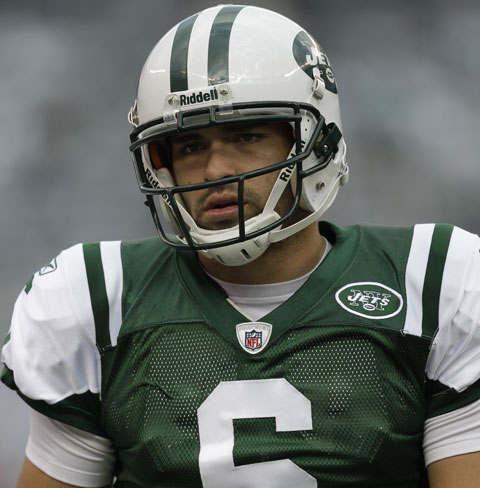
And that happened

I spent a good portion of my drive home yesterday wondering if the current Jets could be the best team I’ve ever rooted for. I realized that I’ve never actually followed a championship team, since I was too young to recognize the gravity of 1986. The Mets won the NL Championship in 2000 and Georgetown made the Final Four in 2007, and that’s pretty much the closest any of my teams have come.

So I got to fantasizing about the Jets making the Super Bowl, and thinking about how awesome that would be and all that. I rushed home to catch the game, and then, well, then that happened.

Maybe I jinxed the Jets’ offense, or, way more likely, maybe they just had a bad game. More to follow when I talk with Brian Bassett later. For now, here’s sad Mark Sanchez:

Where I was this morning

Originally published May 13, 2010.

OK, so I chew stuff sometimes. Usually it’s a pen or a straw, but any small plastic object will do. It’s hardly a chronic habit, but I’d say about once a day I stumble upon something that appears chewable, and next thing I know I’m chomping away for about a half hour.

I realize it’s kind of gross, and Freud might have a field day with it. But I maintain that it’s not the jamming things in my mouth that I enjoy so much as the sensation of chewing itself. For some reason, I enjoy the feeling of working my jaw muscles.

For about 20 years, nearly every woman in my life has nagged me to quit the habit, insisting I’ll someday choke. My mom, my sister, various teachers, and now my wife.

Last night, while walking home from the train station, I started chewing the cap of a Poland Spring bottle. No idea why; it wasn’t something I did consciously. It rarely is. Next thing I knew — and this has never happened before — I swallowed the thing.

I didn’t choke, thankfully. I had chewed the cap into something akin to a football shape, and I guess that ergonomically tailored it to slide right down my throat. But though I could breathe and I wasn’t in any pain, I had a bottle cap inside me, so my wife convinced me I should probably go to the hospital.

I spent most of my next 10 waking hours being shuffled around the emergency room. By my count, all the consulting and poking and attempts at extracting the thing required eight nurses and five doctors. And every single one reminded me how stupid it is to stick plastic objects in my mouth, and told me that my mouth should only be for edible things.

Thanks. Because, you know, I thought I was supposed to swallow bottle caps, and I’m not humiliated enough without your help. It was the medical equivalent of booing David Wright after he slams his helmet down in frustration; they were just reinforcing an emotion I already came to on my own.

Anyway, apparently they would normally just let something like that pass through the system, but because I’m special for a variety of reasons, they gave me an endoscopy this morning to try to fish that sucker out. They couldn’t, and so now I have to hope it leaves my body via, ahh, more traditional means. Sorry for the imagery.

The best and most ridiculous part of the whole thing was the aftercare print-out from the hospital. Turns out the standard form for “swallowed foreign objects” is addressed to the parents of an infant or small child, and describes how it’s somewhat normal for children under the age of 5 to swallow parts of toys and small household items. Nothing in there about 29-year-olds doing the same thing.

I called my parents and read it to them. They had a good laugh, but they were unwilling to follow the suggested procedure for monitoring when it exits.

My mom, doing her mom thing, used the incident to argue that I should stop chewing on plastic stuff. I recognize she’s probably right, but from a statistical standpoint, she doesn’t have a very strong argument. I’ve probably chewed some 10,000 small plastic objects in my life, and never swallowed one before. What’re the odds it happens again?

I guess it only takes one time when I’m not as lucky, though. I should probably invest in some gum.

(Slams head against desk)

Originally published Nov. 13, 2009.

Mike Silva of NY Baseball Digest spoke to a “high-ranking official with one of the 30 big-league clubs” about the concepts stated in the book Moneyball (sort of), and the executive said this:

Moneyball geniuses have flopped like DePodesta, Ricciardi, and even the infamous Billy Beane whose exploits have all lacked a World Series trophy. It is all a tool to be used by the uninitiated. I’ll take a good scout and player development people anytime; the statistics are very secondary. How do you account a .220 hitter for being the hero of the World Series or a guy who hits three home runs a year wins the pennant clincher with a home run?

With all due respect to this high-ranking official, this high-ranking official is a dunce.

I do not pretend to have “all the answers,” as Silva suggests many sabermetricians do. I have far more questions than answers, and I’ve never said otherwise.

I know this for sure, though: If you don’t understand why a .220 hitter could be the hero of the World Series or a guy who hits three home runs a year can win the pennant-clincher with a home run, you do not deserve to be a high-ranking official with one of the 30 big-league clubs.

And to him, I’d ask the same question so frequently lobbed at sabermetricians from sanctimonious and misguided old-school baseball minds:

Do you even watch the game?

Or are you suggesting to me that a seeing-eye single is somehow the product of a player’s skill or will? Are you saying that a hard-struck line drive hit right at the shortstop is bad form, not bad luck? Do you really mean to tell me that some .220 hitter — some guy who can’t hit better than .220 in the regular season — can actually magically make himself a better player when it counts more? Good lord, if someone had the ability to make himself a better player when it counted, why wouldn’t he do it all the time? Is there somehow really not enough pressure in a regular-season for that .220 hitter to morph into Albert Pujols? And in that case, wouldn’t he be the exact type of player you’d label a headcase and eschew from baseball?

It’s random. It’s a random game and a random world and randomness pervades everything. Sometimes things don’t need explanations. They just happen, especially in extremely small sample sizes.

I really don’t even want to fight this battle anymore. I recognize that some people will never agree, and they’ll just think A-Rod magically became clutch this year after being unclutch for three postseasons and clutch in the two before those. I mean, hey, it’s the magic of Kate Hudson!

But I bring it up here because it’s scares the crap out of me that people like the guy Silva quotes — who not only demonstrates a fundamental misunderstanding of what Moneyball was really about, but also a fundamental misunderstanding of the way baseball actually works, not to mention a fundamental misunderstanding of the rules of standard written English — are in positions to make decisions for the baseball teams we all love. It’s a pitch-perfect justification of what I wrote about yesterday, asserting that people in Major League front-offices screw things up all the time.

And holy crap, no one ever said that book was about canning every scout and letting calculators make decisions. It wasn’t called Numbersball. It was about exploiting market inefficiency, and just because Beane hasn’t done a good job of it over the past few years doesn’t mean GAGLWEJHRKJ^@#$. I’m done.

“Dadadadadadadada.” – Marcel Duchamp.

From the Wikipedia: The finger

Originally published Feb. 1, 2010, a day dedicated to Rex Ryan’s middle finger.

Hilariously, the finger — as in the middle finger, the bird, the flip-off — has its own Wikipedia page. And it’s your day, the finger.

From the Wikipedia: The finger.

You already knew that the finger is an obscene gesture created by showing the back of the hand while extending only the middle finger upwards, and that it often connotes the phrase, “up yours.”

What you probably didn’t know is that the tradition dates back to ancient Greece, and was known as — no joke — digitus impudicus, or “impudent finger” in Roman times.

The Wikipedia speculates that the use of the finger started as a threat, since the middle finger was an archer’s bow-plucking finger, and so extending the middle finger was really just the middle-ages version of the Gilbert Arenas trigger-thumb.

The entry also includes a rundown of similarly obscene hand gestures in other cultures, which is a handy thing to know if you’re traveling. For example, DO NOT flash the two-finger, back of the hand V-sign to people in most other English-speaking countries, because they do not think it means “peace.” This means you, Justin Bieber.

What the Wikipedia does not include, unfortunately, is a list of popular middle-finger delivery styles.

So I’ll provide a few on my own. If anyone wants to add these to the Wikipedia, you know, go to town.

1.) The “Right Here, Buddy”: This is the method Rex Ryan chose, and probably the most widely used variety of the middle finger. It is by nature dismissive, as if to suggest that the provider has something to lord over its recipient. In Ryan’s case, it almost certainly came in response to some heckling, as if to say, “I got your fat joke right here, buddy. I just coached a team to the AFC Championship, and I’m about to eat more bacon than you can possibly conceive.”

2.) The Maniacal Double: This is my favorite, especially while driving. I think in New York the finger gets bandied about so liberally that it almost loses its meaning, so I like to bring it back by adding a little flair. Next time someone cuts you off or does some bad-driving move that prompts your road rage, drive up next to them, widen your eyes as far as they’ll go, and wave both middle fingers around in the air at them. The driver will almost certainly be terrified enough to think twice next time he or she is about to do something stupid and/or dangerous on the road.

NOTE: It is crucial that your tires be properly aligned before you attempt the Maniacal Double. And yes, I know that it is hypocritical to respond to a dangerous or dumb instance of driving with something at least as dangerous and dumb. But wait ’til you see the look on that guy’s face.

3.) The Clever Guy: This category includes all middle-finger techniques popular in late elementary school, including holding up the index, middle and ring fingers and instructing recipients to “read between the lines” and pretending your hand has a little crank attached to it and using your off hand to ratchet up the middle finger. These methods were hilarious in elementary school, but have lost their luster with time. Avoid these methods.

4.) The Emphatic Thrust-Bird: OK, I just made that name up (which I guess makes sense, since I’m making all these up). But sometimes you really, really need to give someone the finger, and you’re concerned that the regular old finger just isn’t strong enough. That’s what this is for. It’s actually a combination of two-to-three obscene gestures, depending on your definition of obscenity, and it really drives home how emphatically you want to let the recipient know how you feel.

Here’s what you do: Keep both feet planted with your weight distributed evenly and knees slightly bent. With your left hand, slap your right bicep as you swing your right hand up, simultaneously extending your middle finger. This combines the classic French bras d’honneur — recognizable from Spaceballs, of course — with the time-honored middle finger. As you’re doing it, ever so slightly thrust your pelvis forward. That’ll show ’em.

Did you hear about Pat?

Originally published July 16, 2010.

Thanks to this job, I’ve had some satisfying and enlightening conversations with baseball players, and a bunch of pretty boring ones, too. But I’ve never had a conversation with any player more awkward than the one I shared with Ike Davis after the cameras stopped rolling on this interview a couple of weeks back.

Davis seems like a real nice dude, but I wound up lying to him. And I think I bummed him out, too.

Some background: On the Friday before Independence Day, a well-built guy around 25 and a pair of pretty young women in tank tops sat down across the aisle from me on the Metro-North train.

“Did you hear about Pat?” the guy asked the girls.

“No,” one responded.

“He got cut from his Independent League team. Like not even a real, affiliated Minor League team this time; he got cut from this, like, semi-pro team he was on.”

“Oh my God, that sucks… Have you talked to him?”

“Nah,” he said. “I called him when he got cut by Seattle, but he never called me back. I don’t think he –“

“How’d you find out?”

“My dad just told me. He sent me this thing, from their website — from the team’s website — that said he’d been released.”

“So what’s he gonna do?”

“I don’t know… I guess, I mean, they say it takes 12-to-14 months to recover from that surgery, but if he can’t throw his pitches… his career… I don’t know.”

Their conversation changed course and drifted away from baseball, so I stopped paying attention. I’m hardly a serial eavesdropper, plus I was using my phone to search for information about some pitcher named Pat who had been cut by an Indy League team that day. I don’t know why I was so eager to know.

The only Pat I could find who had pitched in the Mariners’ system anytime recently was a guy named Patrick Ryan, who was indeed now pitching in Indy ball. But Ryan’s stats with the Bridgeport Bluefish were excellent and I couldn’t find anything on the team’s site suggesting he had been cut. Plus Ryan was from Illinois, so it seemed unlikely he’d have a trio of old friends riding Metro-North on a Friday afternoon.

But since I was already at the Bridgeport website, I clicked the only story that had been published that day, a press release about the acquisition of a catcher named Tom Pennino. The last sentence said this:

The Bridgeport Bluefish have also activated pitcher Luis Arroyo from the disabled list and, to make room on the roster, have released pitcher Pat Bresnahan.

Oof. Bresnahan was not the guy I was looking for, but he was clearly the guy in question. Indeed, further searching revealed he was born in Connecticut, had Tommy John surgery in April 2009 after a few seasons in the Pirates’ system, then got cut from the Mariners’ extended Spring Training camp this year.

The Bluefish signed him on June 25 and cut him on July 1. Sorry, dude, we know you just got here, but we’ve got to make room for 36-year-old Minor League lifer Luis Arroyo on the roster. You’re not allowed to play alongside Wily Mo Pena anymore. Not if you can’t get the ball over the plate.

And sure, you’ve got family and friends and even the families of friends tracking your career, and we know they all probably said you were headed for the Majors back when you were dominating Little League, but well, that’s not really our problem. Luis Arroyo’s got family and friends, too. Thanks for playing.

I noticed that Bresnahan played with Ike Davis at Arizona State, so for some silly reason I asked Davis about him after that interview. He smiled and said, “Oh yeah, Pat! How do you know him?”

I said Pat Bresnahan was a friend of friends, that I didn’t know the guy but I knew some people who did. That’s how I lied to Ike Davis. Then I told him that Bresnahan had just been cut by the Bridgeport Bluefish, a little over a year after Tommy John surgery. That’s how I bummed Ike Davis out. Terrible. Davis has been around the professional game more than most guys his age and certainly knows the way it goes, but his whole body language changed: his shoulders slumped and his head tilted downward.

Like I said, it was awkward. So then, mutually sensing that awkwardness, Davis and I started feeding each other half-hearted optimism.

“I mean, a lot of times guys come back even stronger from that surgery,” I said. “It just takes time.”

“Oh yeah, I’m sure he’ll be back to throwing his mid-90s heat in no time,” said Davis. “If I know Pat, he’ll catch on somewhere.”

Maybe he will. And look: I wouldn’t know Bresnahan if he punched me in the face, and I doubt he wants or needs my pity. The guy got a $200K signing bonus from the Pirates, plus the opportunity to play baseball professionally for several years. I’ll never get either of those things. Maybe Pat Bresnahan has no regrets, understands the way it shook out for him, and is perfectly satisfied with the spoils of his baseball career. What the hell do I know?

I caught part of the Triple-A All-Star Game on MLB Network on Wednesday. During the game, a 30-year-old catcher in the Pirates’ system, Erik Kratz, got the call to the Major Leagues for the first time. When asked about his initial reaction to the news in an interview just moments later, he choked back tears and said he just wanted to call his wife. It was a stunning, heartwarming, beautiful moment.

But it strikes me as funny or strange or at least too often left unvoiced that for every feel-good story, every Kratz or Jesus Feliciano or Dirk Hayhurst who toils in Minor League obscurity and finally gets the call — and heck, every Ike Davis who flies through the Minors, too — there are hundreds of men who commit their youths to the game, and who shoulder the massive expectations of friends, teammates, relatives and entire towns, only to be reduced eventually to a single line in an Indy-ball team’s press release and a crestfallen did-you-hear-about-Pat.

The sandwich that made me love sandwiches

Originally published June 30, 2010.

I got a desperate text message from my old friend Charlie yesterday. It said this:

Buscos is no longer. RIP Full Bird, you will be missed.

My heart and mind raced. I furiously began texting him back, peppering him with questions about what happened. He didn’t know. He just knew it was gone. Busco’s is gone.

Busco’s was not the best deli in Rockville Centre, N.Y. Not even close. That honor belonged to E&W, right across the street, or my former employer DeBono’s, a bit off the beaten path.

But Busco’s boasted something none of the others could. The Full Bird. Her majesty.

There’s nothing particularly notable about a chicken cutlet hero with bacon and american cheese. Hell, something similar is on the specials board at every deli in America.

Busco’s did theirs particularly well, though. The proportions were great, and they sliced up the chicken cutlets into thin strips and piled them on the bread, maximizing delicious surface area and minimizing the all the inherent problems prompted by oddly shaped chicken cutlets. Every bite of every full bird had chicken, bacon and cheese on it. That’s important. Sandwich uniformity should not be underrated.

And the Full Bird is notable because it was the first of its kind in Rockville Centre, or at least the first I became familiar with. Before high school, my friends and I ate at Taco Bell and the McDonald’s Express. We were middle schoolers, so we didn’t have much money.

But in my first few weeks of football practice in high school, an older guy named Nick De Luca — a Mets fan, I know, so maybe he’s reading somewhere. Whatup De Luca? — took me to Busco’s and introduced me to the Full Bird.

Holy lord. I had eaten sandwiches before, of course, but usually the type we made at home on Pepperidge Farm bread with cold cuts from the supermarket. Not like this. This was a sandwich to make you love sandwiches. It was the sandwich that made me love sandwiches.

Football practice is an exhausting thing, and something that works up an appetite that can only be sated by piles of fried protein. We ate a whole lot of Full Birds those days. I never really gained any weight from them because we were exercising so much, but I realize now that I probably shaved about five years off my life with all the cholesterol. Whatever. Totally worth it.

And I would be remiss if I eulogized Busco’s without mentioning its best-ever employee. Busco’s was a true local place, the type where you recognized all the guys behind the counter. There was the mustache guy who I think was the owner, and that guy Pete who went to school with my brother, plus the older brother of that kid Jimmy from my Little League team.

And then there was Pat Greenfield. I should note that when I reminisce here about people from Rockville Centre I usually use made-up names so no future employer Googles them and ends up here to find me poking fun of them. But Nick De Luca and Pat Greenfield are real. These men deserve to be celebrated.

Greenfield was nothing short of the most legendary deli man in town history. A hero of heroes. When I went into the trade myself years later, I emulated Pat Greenfield. He was a hulking guy and I think a stud pitcher on the high-school baseball team a few years earlier. He wasn’t much one for conversation. He just made sandwiches.

But oh, how he made them. Oh, oh, oh. It’s not just about the amount of meat, though Greenfield gave you a ton. It’s about the proportion. The right mix of meat, cheese, bacon and dressing. And Greenfield — I don’t know if he studied or trained or just had an innate knack for it — he was the master. People in line would let other, less savvy customers cut ahead so they could get a Greenfield sandwich. Worth the wait.

Sometimes, when bragging about my own impressive abilities as a deli man, I claim this story for myself. But that’s a lie. It’s part of the Greenfield legend:

One time, my dad and I were waiting on line for sandwiches at Busco’s. Full Birds, no doubt. Greenfield was behind the counter working on someone else’s. He spun around to ask the person if she wanted tomatoes on it, but in so doing, he lifted up the sandwich and presented it to the crowd. And it was beautiful. It sparkled in the flourescent light, that signature Greenfield mix of ingredients.

There are people who are paid to dress up food for advertising photo shoots, and I can guarantee none of them has ever created a sandwich that looked like that one. It was perfect. It epitomized what sandwiches should look like. The crowd gasped. Seriously. A deli full of hungry, chatty customers fell silent at the sight of Greenfield’s hero.

Now Busco’s is no more, and Greenfield has gone off to who knows where. Hopefully he’s making sandwiches somewhere. He doesn’t know me, but maybe he’ll find this and agree to come to my house to make me some sandwiches.

That’s all I got. This is a sad day.

UPDATE, 8:05 p.m.: Just got a call from Charlie with an update. He called the nearby deli rumored to be taking over the Busco’s location, and it turns out commenter/Watson elementary school alum BHorn is right — Busco’s is taking over that deli, and not the other way around.

So Busco’s will be moving one town away, but the girl who answered the phone assured Charlie that the Full Bird would soon be added to the menu. As Charlie put it, “Like a beautiful bacon-filled Phoenix rising from the ashes.”

Long live The Full Bird.

I’ve also since been informed that Pat Greenfield is indeed still making tremendous sandwiches, just now at the aforementioned E&W Deli across the street. And someone else pointed out that this post will ultimately be sent to him and he’ll inevitably read it. Which is a bit awkward since, like I said, he has no idea who I am. But thanks for the sandwiches, dude. Your efforts are appreciated.

Ahhhhhhh…

Originally published June 3, 2010.

In his second consecutive column about Oliver Perez, Mike Lupica tells us not to get “overly worked up” about Oliver Perez. But that’s, well, whatever. That’s not what disgusted me about the column. Check out this part:

And we can all go ’round and ’round the mulberry bush about how [Perez’s contract] is the worst Mets contract this side of Beltran’s.

Ahhhhhhhhhhhhh…

Ahhhhhhhhhhhhhhhhhhhhh…

Excuse me? All due respect, sir, but what the f@#$ are you talking about? Did you really just suggest that the three-year, $36 million contract handed to Oliver Perez — a guy who has posted a 6.62 ERA since inking the deal — is not as bad as the hefty one the Mets gave Carlos Beltran before the 2005 season? Is that what you’re saying? Because it really sounds like that’s what you’re saying.

And that’s ridiculous.

Look: I know everyone wants to get in their potshots at Scott Boras, because god forbid an agent be excellent at getting his players tons of money. And since Beltran’s hurt now it’s not as if his contract is a steal. But did you somehow forget the production he provided the team from 2006-2008, when he was one of the very best players in the Major Leagues on both sides of the ball?

Even if you’re on Team Phillips, that galumphing horde of ingrates unappreciative of greatness, you must recognize the difference between paying $12 million a year for Ollie Perez, a guy actively hurting his team, and paying even up to $18.5 million a year for Beltran, a guy actively hurting, but a guy who has only helped the Mets when healthy.

Wait, hold on, we have stats for this. Spreadsheets from our nerdery. Fangraphs converts WAR to a dollar scale to evaluate what a player should make in free agency. Over the course of his contract, even with his injuries, Beltran has already been worth $101.5 million to the Mets. That’s not including any value he might provide this year if and when he returns, or next year when he’s still under contract. So the Mets have already gotten nearly a full return on the $119 million they committed to Beltran before 2005, at least according to that stat.

Perez has been worth -$5.5 million since the start of 2009. Negative 5.5 million. Oliver Perez has been costing the Mets wins since they signed that deal. He cost them wins by pitching terribly, and now he is costing them wins by occupying a roster spot he doesn’t deserve. Oliver Perez should be paying the Mets for the right to pitch awfully, like some sort of absurd and masochistic vanity pursuit — the type you can afford when you’re earning $12 million a year for no reason in particular.

Whatever. Whatever. I’ve made no secret of the fact that I love watching Carlos Beltran play baseball, and so I am, as always, hopelessly biased. Maybe Mike Lupica falls in line with the Joe Benignos of the world, those that are sure Beltran hates baseball, and that he’s a lousy player who hasn’t brought the Mets championships and struck out looking one time to end an NLCS in which he hit three home runs.

Here’s what I know: I remember standing in the scrum of reporters around Beltran on the last Friday night of the 2007 season, after Beltran homered but the Mets lost to the Marlins and the team finally fell out of first place. Beltran faced the crowd and said all the right things, a bunch of words that couldn’t in any way convey the shock and horror on his face. With apologies to Tom Glavine, the dude looked devastated.

And I remember a night late in the 2008 season, when the Mets’ bullpen tried to blow Pedro Martinez’s last start with the team but Beltran wouldn’t let them, lining a walkoff single with two outs in the bottom of the ninth. Before that game, Beltran had told reporters that he learned to stay measured during the ups and downs of that strange season, but that his wife took the late-season losses hard. Then after the game, someone asked him how the missus would feel about the win. He paused for a moment, then burst into a mile-wide smile.

“It’s gonna be a good night,” he said.

You can tell me Beltran isn’t a winner, doesn’t care about baseball and isn’t worth is salary, but I just won’t believe you. And you can bombard me with conspiracy theories about his knee surgery and slow recovery, but I’ll remain skeptical. I have no idea what went down this winter in the he-said, they-said drama, but at this point, based on empirical evidence, I trust Beltran’s baseball instincts more than I do those of the Mets’ front office.

And if he’s only in it for himself and slowly working to come back so he can play for his contract, answer me this: Why the hell did he come back last September, with the team out of the race, with his bone-on-bone knee issue and everything else? I don’t know, but I think maybe Carlos Beltran really, really likes baseball. Or maybe it seizes him in some way I could never understand without being that good at something.

The Flaming Lips:

Tell everybody waiting for Superman
That they should try to hold on as best they can.
He hasn’t dropped them, forgot them or anything
It’s just too heavy for Superman too lift.

From the Wikipedia: Birdhouses

Originally published on Nov. 7, 2009.

Don’t ask why. From the Wikipedia: Birdhouses.

The Wikipedia’s birdhouse, or “nest box” entry, contains frighteningly little information about birdhouses. Basically, all it confirms is that they exist, and they are houses made for birds.

So I’ll go ahead and assume they were invented in the Bavarian Alps by that region’s 18th century middle-school shop teachers.

Birdhouses are currently most sought-after by the American old, and maintain some popularity among birds.

Moreover, birdhouses are one of the most presumptuous human inventions.

“Hey, bird. I know you and your feathered ancestors have been perfectly fine on your own since the late Jurassic, but I figured there’s no way you could build yourself a home as nice as this one. Eh? Eh? We people have a fine sense of aesthetics, don’t we? See, it looks just like my house! Now you can live like a real person!”

And furthermore, birdhouses are another indication of how stupid birds are. If someone you didn’t even know — especially from a species that totally dominates yours — just set up houses for you at random, would you move in without a whole lot of suspicion? It seems way more likely it would be a trap, or haunted or something.

But birds don’t think that way, even though humans eat bird eggs for breakfast. Birds are just all, “hey, this seems like a good enough place to set up camp. I mean, look at how cute the roof is!”

They’re lucky that, in this case, the humans responsible usually have good intentions. But man, birds really have a lot of growing up to do.

Reruns

I’m taking the day off work and heading out of town, and in all the excitement about Sandy Alderson I neglected to line up anyone for guest posts.

So in lieu of that, I’m going to roll out some past posts that I liked or you seemed to like or people told me they liked. Reruns, if you will.

I realize this is a particularly narcissistic thing to do, but hey, the site’s called TedQuarters. Fueled by narcissism.

Also, I hate to grovel, but if you want to use this opportunity to tell your friends, loved ones, and everyone you meet about this site, that’d be cool.

Obviously I appreciate all the readers that make their way here now, but the more traffic I get, the more opportunities I’ll have to do stuff to benefit this site. And considering the narcissism and everything, I’m a pretty terrible self-promoter. So if you want to help out with that, you know, sweet.

In either case, enjoy some posts you may have missed from the first year of TedQuarters. Sandwich of the Week will come as scheduled tomorrow and I’ll be back on Monday.