Quotes from the Times

Have we heard the last (truly memorable) word from Hollywood?

Probably not, but it’s been a while since the movies had everybody parroting a great line.

Like, say, “Go ahead, make my day.” That was from “Sudden Impact,” written by Joseph Stinson and others, more than 27 years ago.

Sticky movie lines were everywhere as recently as the 1990s. But they appear to be evaporating from a film world in which the memorable one-liner — a brilliant epigram, a quirky mantra, a moment in a bottle — is in danger of becoming a lost art.

Michael Cieply, New York Times.

For what it’s worth, I don’t really buy it. I think — as a couple of the experts in the story suggest — it probably takes time for the transcendent and lasting movies quotes to separate from the mire. Saying that we simply don’t make quotable movies anymore strikes me as senseless nostalgia.

I will offer this, though: There are some reasonable explanations, if it’s the case that movies are no longer as universally quotable. For one, Hollywood studios now rely on foreign box offices for 68% of ticket sales, creating more pressure to make blockbuster movies that will succeed in translation and so perhaps less emphasis on dialogue.

Plus — and I think more importantly — the era filled with supposedly unquotable movies covered in the article has seen the rise of great TV.

Thanks to more competition among satellite and cable providers, we have more channel options. There is undeniably better and bigger-budget programming on those channels, and HDTV technology allows us to enjoy that programming in quality that rivals or betters the cinema from the comfort and convenience of our living rooms.

And when I think about it, while I really don’t quote a ton of movies from the last few years, I quote The Wire, The Office, Park and Recreation and Arrested Development almost constantly.

Hat tip to Jonah Keri for the link.

A good question

Here’s my question: Do we really need right/left field umpires in the postseason?

I’m sure it’s confirmation bias or whatever, but I can’t think of a single instance when I’ve thought, “God, I’m glad we have that guy down the line.” But I can think of about 5 instances in which they’ve made blatantly terrible calls that were obvious to the naked eye (Maier, Phil Cuzzi last year, Berkman’s homer last night, etc).

What is the point?

– Ryan, comments section.

Good question. I wouldn’t be terribly surprised to learn that the presence outfield umpires for the playoffs and All-Star Game are some sort of make-good for a crappy travel schedule in the umpire’s union contract with Major League Baseball or something, because they really don’t seem to serve much productive purpose out there.

I believe it was Ron Darling on last night’s broadcast who pointed out that the right-field umpire actually had a worse perspective for Berkman’s non-homer than the umps at first and home, since he had to spin later to follow the ball’s flight and so had a tougher time seeing the ball tail foul.

And truth is, if no umpire at any level ever works the right- and left-field lines until he gets to the Major League postseason or All-Star Games, no one charged with the task is going at it with much practice. Sure, it doesn’t seem like a massively different skill set than some of the ones involved in umping the corner bases, but, you know, new angle, new perspective, different thing.

I kind of like the novelty of it, in the same way I like celebratory bunting on Opening Day, but it does seem a bit pointless. Especially if they’re not going to get calls right with any frequency.

What we think of when we think of Yankee fans

I think the major reason I no longer harbor any particular distaste toward the Yankees — besides a general preference for underdogs — is that I’m no longer in high school and so no longer need to regularly interact with people like this guy:

The Yankee fans I deal with now tend to be people more like Alex Belth, a guy reasonable enough to recognize that he is lucky to root for a team with the resources to contend every year, who does so without the obnoxious sense of entitlement too frequently demonstrated by people like the fellow seen here.

I know plenty of Yankee fans like that and I suspect they might actually make up more of the actual fanbase than we assume; we merely associate Yankee fandom with people like this guy because of confirmation bias, and because they express their allegiance in a much more vocal and detestable fashion than the Yankee fans smart enough to realize that not everyone gets to root for a perpetual winner.

That GIF (taken from Scratchbomb) is mesmerizing. I could watch this guy for hours.

Join Toby Hyde for a drink, see me with a haircut

I got a haircut today. And for the first time in recent memory, I might actually go two weekdays without shooting some web video or another, so your first opportunity to see my haircut will very likely be at the Village Pourhouse at 64 3rd Ave. in Manhattan tomorrow evening around 5 p.m. as I join Toby Hyde to drink and watch baseball.

I know that must have you on the edge of your seats, so one spoiler: It looks almost exactly the same, just shorter.

But how much shorter!?

Seriously though, come hang out. There’ll be booze and big TVs showing baseball. See if you can corner Toby because he has a lot of interesting things to say about a lot of interesting topics. I mostly will just stare blankly at one of the screens, nursing my drink, chewing my straw.

Excellent Willie McCovey article

“I don’t think anybody could have felt as bad as I did,” he said. “Not only did I have a whole team on my shoulders in that at-bat, I had a whole city. At the time, I just knew I’d be up in that situation again in the future and that then I was going to come through.”

Actually, McCovey was wrong. That Game 7 at-bat was the closest he came to being on a championship team. The Giants in the 1960s had five Hall of Famers — McCovey, Willie Mays, Orlando Cepeda, Juan Marichal and Gaylord Perry — but as McCovey recalled, “We always seemed to be one player away from winning it all.”

Karen Crouse, New York Times.

Good read from Crouse on McCovey, who still goes to the ballpark and works with Giants hitters regularly despite being mostly confined to a wheelchair by back and knee problems.

But the excerpted section made me think about the Mets, and not just because most things make me think of the Mets.

Did people write columns like this one about Willie McCovey? I’m not asking that rhetorically, either. Seriously — did Giants fans deem McCovey an unclutch loser and clamor for his trade? I wouldn’t be shocked to hear that they did, since the bizarre tendency to blame a team’s problems on its best player long predates David Wright.

The O.G. Earl of Sandwich

Starch grains found on 30,000-year-old grinding stones suggest that prehistoric man may have dined on an early form of flat bread, contrary to his popular image as primarily a meat-eater.

The findings, published in the Proceedings of the National Academy of Sciences (PNAS) journal on Monday, indicate that Palaeolithic Europeans ground down plant roots similar to potatoes to make flour, which was later whisked into dough.

Reuters.

Of course he did. Of course he did. C’mon. And though it’s not stated in the article, I can personally guarantee you that, with enough digging, archaeologists will uncover evidence that prehistoric man wrapped his meat in that prehistoric bread.

You think prehistoric man, our forefather, was smart enough to hunt and gather and reproduce successfully — spawning our whole society here — and didn’t recognize the importance and deliciousness of the prehistoric sandwich? Not a chance.

I’ve made this point before: Survey humanity. Just about every culture wraps some sort of protein in some sort of starch. We call it a sandwich and credit it to John Montagu, the Fourth Earl of Sandwich, but that’s a cultural and semantic distinction, and one that vaguely discredits the fine work done by visionaries like Hillel the Elder.

The desire to package meat in bread is baked — pardon the pun — into our very constitution. When scientists eventually sequence the entire human genome, perhaps they’ll discover the section that makes us enjoy sandwiches so thoroughly.

I surmise that prehistoric man probably bit into some meat one day and said, “Damn, this meat is delicious, but I really wish there were some sort of crusty, flaky, milder-tasting starch-based food product to accompany and surround it, creating a synergistic relationship in terms of both flavor and convenience,” then went out and created bread.

Except he probably didn’t say it exactly like that. Did prehistoric man have language? Who has got time to look up a thing like that at a moment like this? The important thing is bully to that guy for obviously desiring something that didn’t even exist yet, though I imagine bread and bread-like products would have been invented one way or the other, because, like I said, desiring burritos is clearly an invariable aspect of the human condition.

Cliff Lee stuff, part seven billion

Cliff Lee was spectacular last night. As advertised, really. Master of puppets, pulling strings, twisting minds, smashing dreams, the whole thing.

It’s awesome to watch, especially when it happens on a big stage against an excellent Yankee lineup. But it still doesn’t mean the Mets should pursue Lee this offseason.

I’ve long held that signing Lee to a long-term, big-money deal would ultimately do the Mets more harm than good, seeing as he’s a 32-year-old pitcher likely to require a contract that takes him deep into his 30s. In the comments section here recently, though, Metropolyglot made a good point that made me briefly reconsider my position:

Lee is the best free agent pitcher available for quite awhile. Look around the league — teams have made a habit of locking up young elite pitchers (Jimenez, J. Johnson, Lincecum, Hernandez, Price). Furthermore, they’re all more or less signed to team-friendly deals. The only reasonable get is probably Zack Greinke and that’s not until 2013. If you’re serious about contending in 2012, you have to sign Cliff Lee, or prepare to rape the farm system.

It’s a reasonable thing to consider, especially with rumors spreading that Greinke wants a trade but no part of big-market baseball and word coming down that Yu Darvish is staying in Japan for now.

But I still say signing Lee — at least to the type of deal he’s expected to get — would amount to a mistake for a team with finite resources. The odds just seem so long that he’ll be worth anything like the type of money he’ll be earning three and four years into the new contract.

That means, like Metropolyglot suggests, that the Mets likely won’t be finding an ace on the open market for a reasonable cost anytime soon. To that I say a couple of things:

First, who knows what happens from here? It’s easy and reasonable to look around the league at all the great pitchers, see that they’re mostly locked up and conclude that the Mets will never have a great pitcher, but things change in weird ways all the time in baseball. Hell, look at Lee’s emergence in the 2008 season. Or, for a perhaps more reasonable, less miraculous-seeming example, look at the way Dan Haren became available at the deadline this year.

Second — and something that comes up here a lot — there’s no hard and fast rule that you need a true, branded ace to contend. Don’t get me wrong: It helps. Having great players is an excellent step toward having a great team. But a strong, deep pitching staff combined with a potent lineup can make a pennant run too. Plus there’s enough regular fluctuation in baseball that if you have a few good, healthy pitchers in your rotation there’s some reasonable chance one can pitch like an ace over the course of 32 games.

And the best way to find an ace is still to develop one. Right now Jenrry Mejia appears to be the Mets’ best shot at one — and that’s at least a couple of years down the road. Plus I suppose there’s some chance Jon Niese goes all Cliff Lee and turns into an ace.

But investing in scouting, overslot draft picks and international free agents would go a long way to assuring that the Mets find a frontline starter eventually, or at least the right pieces to trade for one.

Do you like beer?

If so, come hang out at the Village Pourhouse at 64 3rd Ave. in Manhattan on Wednesday to join me and Toby Hyde as we watch playoff baseball and enjoy beverages.

And even if you don’t like beer, come down anyway. It’s a reasonably accessible location and there are a ton of huge TVs.

Toby says he’ll be there by 4 p.m. for the start of the Yankee game. I’ll likely join him around 5 or so because I have work and stuff, and I imagine I’ll be there at least until the second game stops being interesting.

On the downside, it kind of sounds like “booger”

I have another managerial candidate for you: Tim Bogar. Here are his records from ’04-’07 in his four years as a Minor League manager; 41-26, 82-57, 87-55, 80-62. Finished first every season and was manger of the year three times. And that is the Astros and the Indians affiliates so not like he was managing all stars. Throw in the fact that he spent the last two years on the Red Sox staff and started his playing career as a Met and you got a candidate, no?

Paul, via email.

Well there’s an interesting name. I liked Bogar when he was with the Mets, and I remember watching when he went 4-for-5 with two doubles and two home runs, the second of which was an inside-the-parker on which he injured his wrist, ending his season. I’ve always found it a little funny that Bogar probably would have been more lauded for that performance had he stopped at first on one of the doubles and stopped at third on the final home run, and would have reaped the added benefit of remaining uninjured to continue his rookie campaign.

Bogar interviewed for the Blue Jays’ manager position but is reportedly no longer a candidate for the job in Toronto. Like Paul wrote, he had a lot of success in the Minors. He earned league manager-of-the-year nods in three of his four seasons and was named the Eastern League’s “Best Manager Prospect” by Baseball America in 2006.

Bogar joined the Rays in 2008 in an interesting role: He served both as a coach and as a liaison between the scouting department and the club. He became Boston’s first-base coach before the 2009 campaign.

Obviously the next GM is the more pressing and more important hire, and I don’t know much about Bogar’s demeanor. But he seems to have a plenty lengthy resume, the existing Met connection and ties to a couple of well-run teams. So I think a good call by Paul.

Pork!

I smoked a pork butt yesterday to make pulled pork. I expected it would take about 8-10 hours, but it wound up taking 13. In the middle, when I realized I wasn’t going to have my home-smoked pulled pork ready in time for a reasonable dinner hour, I walked a couple blocks to my local pizza place for a calzone to tide me over.

When I left, I caught the smell of delicious smoky barbecue and wondered if someone else in my neighborhood was also wood-firing some meat on a Sunday afternoon. But as I approached my house, I realized that I was the source — the smell of hickory and pecan smoke from my backyard was blanketing at least a four-block radius, I just didn’t smell it on my way to the pizza place because my nostrils had grown accustomed to it. Amazing. I should get some sort of civic honor.

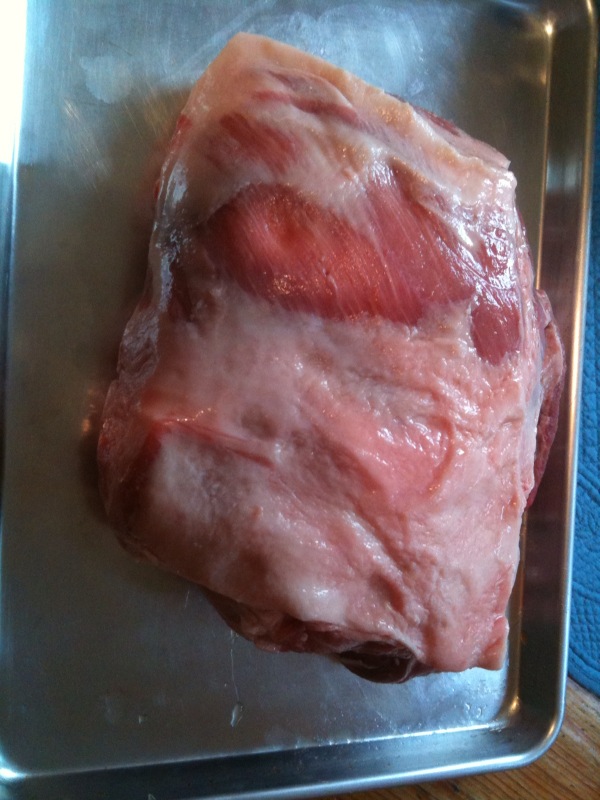
Anyway, turns out the hardest part of smoking a pork butt is finding a suitable pork butt. All the instructions I could find pertained to bone-in pork butt (pause, as they say), but Stew Leonard’s — the place I could find near me selling pork butt — only had the deboned variety. (Also, no vinegar in the whole damn store.) Plus it looks like the butcher cut off a little fat from the top that might have been better left on there:

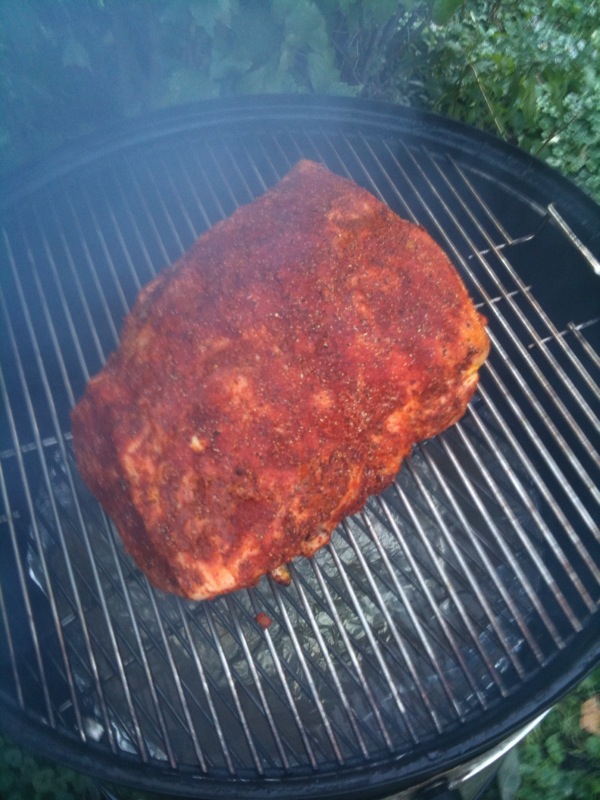
From there, it’s not terribly hard. Just a bit time consuming. Cover the butt in yellow mustard and spice rub. The mustard helps seal in the juices and gives the rub something to stick to, forming a nice crust when it’s all finished. The rub seals in the juices too, I believe, plus adds a little spice. I wanted the pork to be versatile — I knew there’d be enough of it that I’d ultimately use it in a variety of meals — so I didn’t want to go overboard with flavor in the rub. It was mostly paprika, salt and pepper, then a little bit of a lot of other stuff from the pantry.

Once that’s done, onto the smoker:

I used a mix of hickory and pecan woods. Hickory is sort of the gold-standard, bacony-smelling (I guess technically bacon is hickory-smelling, but whatever) barbecue wood, but I found with baby-back ribs that the flavor could be a bit overpowering. So I cut it with pecan here because pecan smells a bit like hickory and because it’s what I had.

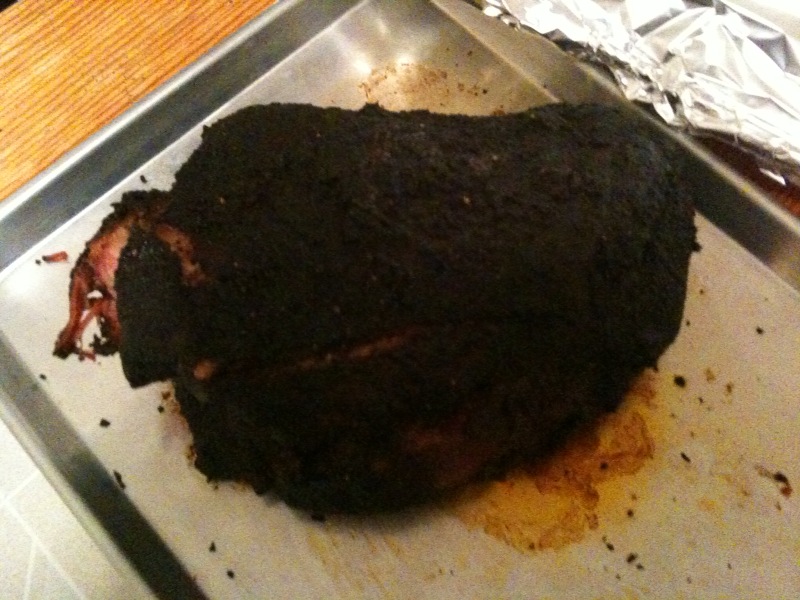
I mopped it with a mix of cranberry juice, olive oil and spice rub a couple times toward the end, to moisten the outside parts and give the crust a little sweetness, a tip I took from a book by Gary Wiviott. But mostly, you just have to do whatever you need to do to the fire to maintain a steady smoke and low heat — around 250-degrees Fahrenheit — until the pork is between 190- and 200-degrees inside, at which point it sort of starts falling apart on its own. Doesn’t look all that appealing, really:

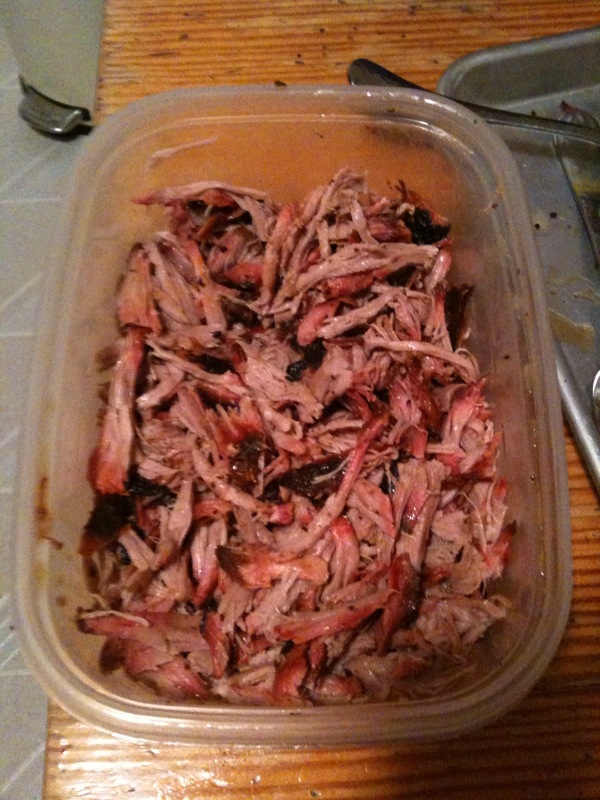
Next comes the really tedious part. Take that 8.5-pound pork butt and pull it into tiny bits:

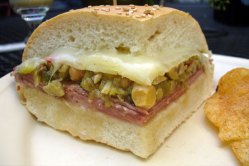
Then, at 10 p.m., after you’ve been futzing with the fire all day, while you still reek of smoke, with spice rub still under your fingernails, enjoy your damn sandwich already. More on that later in the week.