Some Mets GM stuff

On The Happy Recap radio show last night, we talked a little about the known candidates for the Mets’ GM job and which one I’d choose if I were in position to make that decision. I waffled and hedged like I always do, and stuck to my stance that I really have no idea. But I said something about personality that doesn’t jive with anything I normally write here, so I think I should probably clarify:

I don’t know any of the men interviewing to run the Mets, but I would like to know that whoever gets hired is confident enough to ignore the inevitable onslaught of nonsense he or she will face at some point in the near future.

It has always seemed as if the Mets are run by people conscious of public perception. Omar Minaya, as I mentioned on the show, talked about how he heard from Mets fans about addressing the bullpen whenever he went to get bagels in the winter of 2008.

That’s just a quote, a joke Minaya made to make the J.J. Putz acquisition seem like a no-brainer.

But it would be nice if the Mets could find a general manager cocky enough to turn to the guy on the bagel line — or the guy on the radio, or the guy writing for the newspaper, or the guy who owns the team — and say, “Bro, I appreciate the feedback, but I know a hell of a lot about how to build a baseball team, and I’ve got things under control.”

In other words, while I think the bluster about the particulars of the New York market is normally little more than the New York media overemphasizing the impact of the New York media, in this one instance I think it’s important the Mets hire someone they feel can withstand the pressure to compete immediately, shoulder the comparisons to the winning team across town, and exercise the requisite patience to turn the Mets into a successful, sustainable franchise.

Does that mean anything at all? I don’t know. Theoretically all of the candidates have reached the top of their profession, and that type of climbing usually requires a good deal of confidence.

The Mets have a nice crop of halfway decent young players and, in the right hands, I suspect it won’t be as hard as many think to turn the club around. But it’s going to take some time, and in the interim there are going to be a whole lot of airwaves and newspapers and blogs to fill, and so every move the new GM makes and doesn’t make is going to meet with a hell of a lot of criticism.

And so, basically, the Mets need to hire someone who won’t care.

Sandwich of the Week

Last week, I mentioned how Russ from work keeps criticizing me for seemingly rating every sandwich in the 80s or above. I gave Russ a piece of my mind on Thursday, because, as a spreadsheet jockey, he should understand selection bias.

Now that I’m only discussing one sandwich a week, I’m not reviewing every sandwich I eat in a week. So it’s a pretty safe bet I’m writing about the most notable sandwich I ate in the week, which usually means the best sandwich. Are you coming here to read about the crappy knockoff sandwiches I get from the soulless Midtown food bar places around my office? I certainly hope not, because I’m not writing about them.

So here’s another excellent sandwich, the best I ate this week. Bite me, Russ.

The sandwich: Bacon and Cheddar Burger, Bill’s Bar and Burger, two locations in Manhattan, one that happens to be  directly across the street from my office.

The construction: What it sounds like: A burger with bacon and cheddar cheese on a sesame-seed bun.

I added ketchup from the table, as seen in the photo below, but once I dipped my fry in the little accompanying cup of ketchup, I realized my mistake. The fries at Bill’s Bar and Burger apparently come with the very hot sauce/ketchup hybrid I speculated about last week, which presumably would have been great on the burger. They were excellent and so was the condiment, but this isn’t French Fry of the Week so let’s move on.

Important background information: I have been eagerly awaiting the opening of Bill’s Bar and Burger for months. As I’ve discussed, Midtown is something of a wasteland for good, economical eating, though if you use the Internet and your legs you can get by pretty well. Still, Bill’s is right across the street and promised to be a welcome alternative to Heartland Brewery for the occasional midday pow-wow.

Also, while under construction, Bill’s had wrappers on the windows with a bunch of reviews printed on them. One of them read something along the lines of, “Bill’s renewed my faith in burgers.”

Sorry, bad review. I’m sorry, but if you ever lose faith in burgers I just do not trust you to review food. I mean, have you even been to a Five Guys, bro? How could you lose faith in burgers?

What it looks like:
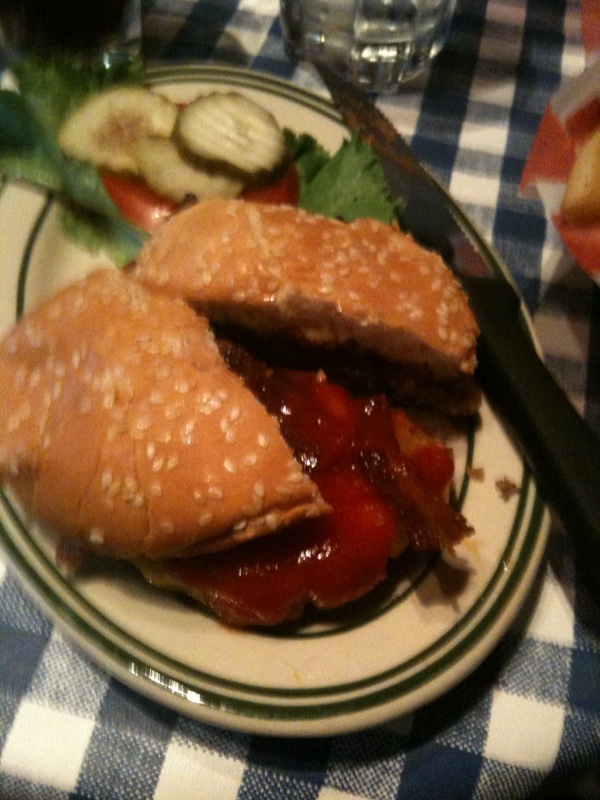
(Note that the burger does not come cut in half; that’s something I did on my own. I find that having corners from which to begin eating makes the whole process both neater and more enjoyable.)

How it tastes: Great. Like I said, I had high hopes for this burger, and it at least met my expectations.

I think one thing people miss a lot when making burgers at home is that you want meat with a high fat content. Big-time rookie mistake. Back in college, I used to buy ground beef that was like 93-percent lean, thinking that was the way to get high-quality, meaty tasting burgers. Silly college-aged me didn’t realize that higher fat content makes the burgers juicy and delicious, which is probably why silly college-aged me wound up spending way more time driving 15 miles into Virginia to one of the original Five Guys than barbecuing on our back porch.

Judging by all the meatjuice pouring out of every bite of Bill’s burger, I’d guess this thing had to be at least in the 20-percent fat range, right in the optimal zone there. Delicious, flavorful meat. Quality stuff.

Also, it had cheese and bacon on it. The bacon, in particular, was notable because Bill’s did it the right way: crispy as all get-out. I don’t need to tell you what good bacon adds to a good burger. I mean I assume I don’t. If you don’t know about that by now, I don’t know what you’re doing reading this blog and not eating a bacon cheeseburger.

Alex Belth and I discussed on Friday the way the standards for burgers have risen in the last five-to-ten years. I’ll maintain that it’s less about a fleeting trend and more about competition stemming from the Internet exposing hungry people to a better array of options, but it’s a good point either way. The standard (and still tasty, don’t get me wrong) diner cheeseburger now seems only replacement-level. In college we used to drive a 20 minutes to get to Five Guys, back when there were only a couple of them, and now they’re practically ubiquitous (except in Westchester, frustratingly enough). This is a good thing.

What it’s worth: Bill’s is a sit-down place, which means you’re going to have to tip your waiter and maybe buy a drink, plus the burgers don’t come with fries so if you’re looking to get starchy with it it’ll be an extra four bucks. But the bacon and cheddar burger only costs $7.50, which is a pretty good deal for Midtown. It’s not a particularly huge burger, but that’s probably a good thing if you’re eating in the middle of your workday because then you’re not asleep at your desk by 3 p.m.

How it rates: I want to reserve the right to hold off on rating Bill’s bacon and cheddar burger for a couple of reasons. For one, burgers are something I take very seriously, perhaps moreso than any other sandwich. And after one sampling, I sense Bill’s might be an upper-echelon burger, but I don’t want to overrate it based on only one experience. Second, I defy Russ from work — who will sometimes go weeks eating the same sandwich every day — to eat this or any other burger from Bill’s and tell me it doesn’t deserve at least an 85. It’s right across the street, Russ.

In which I try to sort out game theory

Something about this post at The Book Blog didn’t sit right with me, but because I never studied economics and don’t know anything about game theory I figured I’d run it by TedQuarters resident maverick economist and former roommate extraordinaire Ted Burke.

He also struggled to grasp what MGL was trying to get at when he writes:

If batters and pitchers adjust their approaches according to what the other has done in the past during a game, then one or the other is NOT performing (in terms of their approach/strategy) optimally!  Game theory tells us that.

Baseball is a game of adjustments only in terms of learning – a player improving upon his skills and strategy and learning new things about his opponent.  It should NOT be about the kind of adjustments during a game that you hear from commentators all the time.

My gripe was that, though certainly it makes sense that a player should rely on the largest sample he has  to determine an opponent’s tendencies, there are myriad minor in-game factors that might impact those tendencies (most obviously the pitches a pitcher has the best feel for on any given day) and so it seems reasonable that an opponent should be adjusting to the in-game sample.

Ted Burke’s issues ran a bit deeper, and were perhaps more semantic. Our conversation went like this (apologies in advance for the cheapshot at Jersey drivers):

Burke: He’s assuming that a Nash Equilibrium exists for this situation, which pretty clearly isn’t the case.

Berg: You’re assuming that I have any idea what a Nash Equilibrium is.

Burke: It’s a nerd name for a concept you fully understand as a sports fan and human in society. In a situation where multiple parties each have to make a choice or series of choices, its Nash Equilibrium is the outcome where each party made the right choice for them given the choices of the other parties.

Say the two of us are driving on two different roads and we’re approaching the intersection of the two. Your road has the green light, and my road has a red light. We each have a choice to make: stop at the intersection or continue through it. We’re both licensed drivers, so we have certain expectations about how other licensed drivers will behave in this situation. You figure that if you keep going through that intersection, there’s a slim chance that I will plow into you, but there’s a much greater chance that you’ll pass through the intersection safely.

If you stop at the green light, you eliminate the chance of getting smashed by me, but you realize that doing so will almost certainly result in you being rear-ended by the truck behind you. So you choose the safer expected outcome and drive through the intersection. Similarly, I know that stopping at the red light carries a very small possibility that I will be rear-ended, but there’s a much greater chance that I’ll smash into another car if I attempt to drive through the intersection. So I choose to stop on red. Our paths cross safely, like two handsome ships passing in the night.

So every time we get in that situation, I stop and you keep driving. That’s the Nash Equilibrium.

Berg: And you’re saying that doesn’t exist in baseball (or in some parts of Jersey).

Burke: There are plenty of situations in baseball that have a Nash Equilibrium, but this isn’t one of them. Actually, if there were a Nash Equilibrium in this situation, the game of baseball wouldn’t be nearly as interesting as it is. One primary reason for throwing different pitches at different speeds in different locations is to prevent the batter from knowing if, when, and where to swing. In that sense, game theory would fit perfectly with the adjustment process the announcers described.

If the Yankees are swinging aggressively at first pitches, Pavano would want to start at-bats with a breaking ball or something out of the zone, which would in-turn lead to the Yankees choosing to be more patient, which leads to Pavano throwing fastballs over the plate on first pitches. And the cycle repeats itself.

Berg: It seems like his point is based on the fact that the Yankees should know going into the game that Pavano is going to throw fastballs over the plate and should base their expectations on those tendencies.

Burke: But if Pavano went through the whole game throwing first-pitch strikes and the Yankees spent the whole game swinging at them, the Twins would have to be idiots.

Game theory tracks the decisions people make over time to maximize their own utility. It would never suggest that the Twins continue making a decision that’s getting them pounded when a simple “adjustment” would at least give them a chance of not getting pounded.

Berg: Yeah, which is a big part of why it made no sense to me.

Burke: What the announcers were describing is basically the essence of game theory.

On switching allegiances

I have therefore started to move away from the Mets as a fan and have started to look into some other sites and other teams. When I buy a DVD-player from Panasonic and it’s terrible and breaks down, I don’t keep buying Panasonic DVD players. If I get a crappy sandwich from a restaurant and every time I go there the sandwiches stay crappy no matter what I order, guess what, I stop frequenting that restaurant. These players love to say “baseball is a business.” Owners couch their talk in business-speak all the time – “Best product on the field!?” If they want to treat it like a business, fine. I’m starting to feel like I’d be better served by putting my time and devotion and emotions in a team that knows how to reward that dedication.

Shamik, comments section yesterday.

Whoa, whoa, whoa, first things first, Shamik: Other teams we’ll discuss in a sec, but other sites, no way. Keep it locked on TedQuarters. You can skip the Mets stuff and just read about Taco Bell and dinosaurs or whatever.

As for the first part, I think Shamik’s comment raises an interesting discussion for a number of reasons. For one, I’m with him on being turned off by the business-speak thing. That comes down to a big-time divide between the rational and irrational minds, I think. We all recognize that sports teams are, in fact, businesses, but I don’t think anyone hopes to hear their teams’ owners speak about them as such, referring to the product on the field and the customers in the seats and everything.

But my public-relations quibbles aside, I don’t think I could ever actually stop pulling for the Mets, even if at times I’ve felt like I wanted to. Remember that I said I’d quit if they traded for Jeff Francoeur, then they did and I stuck around like a shmo. Perhaps moving away would make it possible — transplanted New Yorker Tim Marchman has discussed how he finally stopped caring about the Mets last year — but I fear it might be too deeply ingrained in me to change allegiances now, and I don’t think I ever want to know baseball without a rooting interest.

I could imagine taking up a second team if I moved elsewhere. When my wife was applying to medical schools a couple years back I gave her pretty simple qualifications for places I was willing to live: Anyplace with a Major League team except Philadelphia.

I argued that case based on my career, but really I just wanted to know I’d be able to get to big-league baseball games when necessary. And though I harbored some small bit of excitement that we might move somewhere with a team that actually won something every so often, I knew all along I’d really still be rooting for the Mets from wherever we went.

I think it’s the rational vs. irrational thing again though. I can recognize that, as a fan, I owe the Mets nothing and should be free to change sides if I so choose. But in my gut it doesn’t work like that, and — though I certainly don’t begrudge him the decision — I wonder if Shamik would (or will) actually find the transition as easy as switching from Panasonic to Sony.

Dispatches from the TedQuarters San Francisco desk

I never caught up with TedQuarters San Francisco correspondent and frequently frustrated Giants fan Dailey McDailey upon the Giants’ playoff berth, and it’s a Friday and, to use his words, nothing clever is coming to mind. So here’s that.

TedQuarters: I never formally followed up with you, the TedQuarters San Francisco correspondent, about the Giants’ playoff appearance.

Dailey McDailey: Well, I’m still here, and I’m wearing my awesome Hawaiian shirt.

TQ: Recall that last we left off, you were cursing Brian Sabean for the Fred Lewis thing. And now the Giants are in the playoffs.

DM: And the Giants are still one outfielder short, since Aaron Rowand and Nate Schierholtz are on the roster. But Pat Burrell’s resurgence is the sort of thing that usually doesn’t happen for the old guys the Giants sign.

TQ: So Sabean and crew have gotten a bit lucky?

DM: In the roster construction department? Well, yes. Andres Torres, Aubrey Huff, and Juan Uribe have all been surprisingly good. And usually good teams don’t get surprised by how good they are.

On the flip side, Pablo Sandoval can’t hit on the road anymore, and hits into double plays at a Pierzynskian rate. But that’s four positive surprises to one negative. Thus, division championship.

TQ: Plus there’s the whole Buster Posey thing, which probably goes down as positive surprise, all told.

DM: I’m not very surprised by it to tell you the truth. I didn’t think he’d have this much home run power as a rookie, but other than that, he’s the player everyone told us he was when the Giants drafted him.

TQ: Yeah but I think you put way too much stock in all the animal sacrifices you’ve performed at the feet of your Buster Posey statue.

DM: On the advice of my attorney, I’m not going to respond to that

TQ: All their pitchers had pretty good years, too. Lincecum was sub-Lincecum-like, but Jonathan Sanchez put it together and they got good work out of Bumgarner,

DM: Yeah, most teams would love to be able to build their own staff from within like the Giants have, but for all his faults Sabean has always had an eye for pitching talent, and Dave Righetti seems to know how to turn that talent into a consistently good rotation.

TQ: So are you less inclined to [deleted for decency] Brian Sabean’s face right now?

DM: No. As good as this team is, it could have been much better with sound roster management starting, I don’t know, seven years ago.

This was always my problem during the Bonds years. You get no credit for winning 90 games when you start with the best player in baseball history. You have to use the other 24 spots to win 105 games. Also, winning 90 games starting with the four best 20-something pitchers in the league is not an accomplishment as much as an inevitability

TQ: Well that’s an overstatement but we’ll let it slide because you’re obviously amped up about your Gigantes. What of Bruce Bochy?

DM: Ever since Bengie Molina got traded away, he’s made all the right moves as far as I’m concerned. Especially in September, when the outfield was a jumbled mess, he deftly used Burrell and Guillen early to score runs, and then subbed in Ross and Schierholtz for defense late.

TQ: Did he look as awesome in person last night as he did on TV before I fell asleep?

DM: Awesomer? He had it all working.

TQ: Anything else you’d like to add for the TedQuarters faithful?

DM: Nothing clever is coming to mind.

TQ: Well, you had a late night.

Umpiring stuff

Calling balls and strikes is not easy. Some umpires are better than others, of course. Major League hitters appear to have a better eye of for the strike zone than umpires do, and that’s a problem. As much as Bronx Cheer likes to defend umpires, sometimes it can’t. Wendelstedt had a terrible game on Thursday. Baseball has made great strides in cracking down on the strike zone, but it needs to do more. The Twins, not the umpires, probably lost the game Thursday night, but the uncertainty in that statement reflects a problem.

By isolating the discussion on the 1-2 pitch to Berkman, the media do themselves and the larger point a disservice. The controversy is not about that one missed pitch. Any umpire can miss one pitch. The problem lies in Wendelstedt’s terrible strike zone all night. He called a pitch right down the middle a ball. Jeff Passan has a good, if Twins-slanted, takedown. A strike zone that bad cannot happen in a playoff game.

Tom Boorstein, SNY.tv.

Boorstein is, as he explained here, as big a fan, follower and defender of sports officials as anyone I’ve ever met. It’s pretty weird. But it appears the umpiring and instant replay discussion is going to keep coming up until some sort of clear resolution is reached, and clear resolutions have never been the forte of Bud Selig’s office. So Tom’s a pretty good guy to go to for this stuff since he’s been following umpiring since way before it was cool.

It strikes me — pardon the pun — that ball-and-strikes duties are the aspect of umpiring that could most easily be replaced by computers or a robot, and it wouldn’t even require cutting back the number of umpires since you’d still need a guy standing there to make calls at home plate and rule on hit batsmen and checked swings, etc.

Probably not something that will happen soon or be implemented without hiccups. And I’m not even sure it’s something that should happen; I really haven’t thought it all the way through.

But Major League Baseball has to find a way to diminish umpire error if it’s affecting the strike zone so much that it impacts the outcome of games. Yes, the human element is part of the game and all that. But no one’s arguing that the players be replaced by machines (although Transformers baseball would be pretty awesome to watch). It’s just about making baseball more fair for the humans competing in it.

Also — and Tom doesn’t get at this, but I’ve discussed it before — I’m shocked by how many people seem certain that umpiring has gotten worse and how few consider that umpiring may have been equally bad forever and we’ve only recently come into new technologies that allow us to more thoroughly and frequently judge the way the game is called.

Now we watch games in high definition with a dozen super-slow-mo replay angles. We see for certain when umpires are wrong on calls we might have shrugged off as questionable or close just a few years ago.

Do you even watch the games?

“You got me confused with a man who repeats himself.” – Omar Little.

There was nothing in my post here about “grit” and perception that I felt I misstated and so there’s no good reason to revisit it besides the one irksome assertion, in the comments section, that I do not watch the games.

I don’t mention that now to defend myself against that ridiculous charge, but rather to turn it around on anyone who ever brings the same criticism against me or anybody else making the argument I made yesterday:
Do you even watch the games? Do you see how unbelievably f@#$ing good these guys are at baseball? Do you really believe that Carlos Beltran just coasted to the Major League level on sheer physical ability, then became one of the very best baseball players in the world without really giving a damn? Do you really think it works like that?

(It is, of course, massively ironic that Beltran the lightning-rod is again thrown in the middle of this discussion. Unclutch Carlos Beltran of the 1.302 career postseason OPS. Soft, selfish Beltran who fights his way back from a bone-on-bone knee condition to play in meaningless games. Apathetic Beltran who has a special Carlos Beltran practice machine written into his contract.)

And look: No one’s saying ballplayers aren’t human. Of course they are. But they’re humans who managed to stomach years of awful Minor League living, countless long bus rides, and endless hours of practice, often very far from home. It’s so much easier to give up at some stop along the way than it is to make the Major Leagues.

In other words, I guess, all Major Leaguers have a hell of a lot of grit. And all our armchair psychology and body-language expertise doesn’t provide a fair shake to guys who have worked their asses off to reach the Major League level.

Sure, there are moments when players don’t hustle. Isolated incidents. But no player lasts in the Majors without hustling because remaining at the big-league level requires perpetual hustle.

And you might say that it’s not black-and-white. Maybe the guys on the Mets have some of those qualities, but the Phillies have more of them: more attitude or swagger or grit or whatever talk-radio buzzword we’re using to describe the same silly thing.

But those are things we notice and appreciate in winning teams, partly because players inevitably behave certain ways when they’re winning and mostly because we seek out and identify those things in a team once we know that they are winners.

Ask Mets fans over 30 to name the grittiest team they can think of and they will almost universally tell you it’s the hard-fighting, hard-partying Mets of the late 1980s.

But recall that the 1986 Mets fielded an incredibly deep and potent lineup and got over 200 strong innings apiece from their top four starters. Then they won the World Series in part because Bob Stanley threw a wild pitch and the ball got by Buckner.

How gritty would that team be if Stanley’s pitch stayed true? And all that swagger earned those same Mets no rings in 1987 or 1988. A little less luck in October ’86 and we’d probably be pointing to all the same qualities we now revere — the fighting, the attitude, the off-field nonsense — as the distractions that prevented a massively talented team from ever winning it all.

Once again, the beast is only us. It is often our nature to create these narratives to help explain complicated things, and in sports they are likely perpetuated by the need to fill columns, blog posts and airtime.

But in this particular case it is baffling, or at least frustrating, because far too often the stories we develop only cloud a much simpler and more elegant truth: Good baseball teams win more games than bad ones. Maybe not necessarily in a seven-game series or in the five-game sets we’re watching now, but almost always in a full 162-game season.

The Phillies didn’t do this to the Mets; the Mets did this to the Mets. Carlos Beltran, David Wright and Jose Reyes are not losers, they’re just too often playing on shallow rosters filled with subpar players. Get a hold of yourselves. Fatalism fixes nothing. Good management does.

They call him ‘Large Game Jimmy’

I’m curious how this is going to work out. Shields has always had good peripherals, but his ERA has been higher than his FIP and xFIP for his entire career. Things like fly ball to home run rate and BABIP are subjected to a lot of randomness, but that randomness is sometimes overstated. They’re not TOTALLY random. It’s not a complete fluke that his ERA has been higher than his other numbers would suggest.

At the very least, I find it interesting that a major league team is not only willing to look past the surface numbers, but openly admits to doing so. So if you’re into that whole revenge of the nerds thing, i suppose you might want to root for the Rays and Big Game James tonight.

Patrick Flood, Exile on 126th St.

Like Patrick said, it’s pretty great that Maddon is willing to explain that he’s pitching Shields this afternoon because of defense-independent pitching statistics when he could easily say, “oh, well of course we’re going with Shields here, he’s ‘Big Game James,'” and meet with a lot less resistance from the majority of fans and the media.

All that said, I struggle a little bit with xFIP, as I’ve mentioned here on a few occasions. I have no doubt it’s a useful tool and that most pitchers’ HR/FB rate eventually, with a large enough sample, should normalize somewhere near the league average.

But if I could wonder if perhaps Johan Santana was reliably yielding weak fly-ball contact this season when his xFIP was way above his ERA, I must allow that there’s a chance Shields consistently yields stronger-than-average fly-ball contact.

I’m probably fighting a strawman here because I don’t think anyone who really thought it through would pretend xFIP is the be-all end-all of pitching statistics, but do I see it sometimes bandied about like gospel, and I suspect there’s still a lot more work to be done in divorcing the pitcher on the mound from the defense behind him and the randomness inherent in the sport.

All that said, I’m still rooting for the Rays. Obviously.

Stories/things I have no interest in going anywhere near: Brett Favre’s junk

So sounds like Deadspin is going to produce some naked photos of Brett Favre tomorrow, which should at least clear up once and for all if he’s just like a little kid out there.

I reserve the right to continue making stupid and/or tasteless jokes about the matter, but the only embarrassing picture of Brett Favre I’m really interested in seeing is the reaction shot after his fourth interception on Monday night.

Not a lot of big breaking news here. Professional athletes (and many other people) cheat on their significant others? Shocker. Brett Favre’s a big, fat liar and a manipulator of media types? Nothing new there, either. Even Brett Favre’s passes at women get intercepted? Hey-oh.

Bah

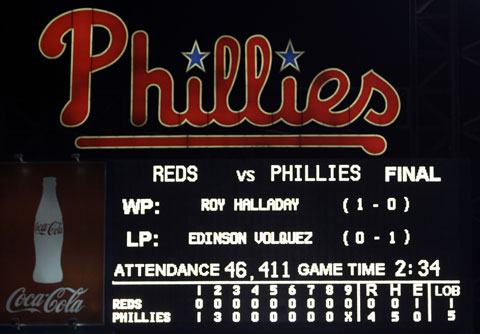
If you’re a Mets fan trying to squeeze some small, pathetic measure of solace out of Roy Halladay’s no-hitter, I offer you this: The Phillies’ win significantly increases the chances Halladay will pitch again this October, which increases the already-high likelihood he will surpass his career-high single-season innings total of 266, set back in his Cy Young season in 2003. And Halladay struggled with shoulder problems for a large portion of the 2004 season, and he was only 27 then.

But to so much as consider that right now would be tantamount to wishing misfortune, ineffectiveness or injury down the road on a great pitcher in the immediate wake of a historic accomplishment.

If you read this site with any frequency you know I love spectacle, and I like Halladay as a pitcher — laundry aside — because I appreciate excellence in all of its forms.

But I hate the Phillies so much that every part of my soul wanted Brandon Phillips to beat out that dribbler last night. I just couldn’t stand the thought of the Phillies fans I know getting even more to brag about, and spending a night out vomiting on children in celebration.

Still, we got to watch something special, and though it’s great for Halladay, it amounts to only one win for the Phillies. So here’s hoping Bronson Arroyo makes sweet music tomorrow night and Sunday the Reds’ hitters roll up on Cole Hamels like a bunch of werewolves on a sparkly vampire, or something.

Pardon me if that reference is heavy-handed; I don’t read the Twilight books, as Hamels does.