Gag order will not prevent Daily News’ from sexy, druggy coverage of Clemens trial

Like a loose manhole cover above a steamy city sewer, there may be a weak spot in the gag order a federal judge applied in the government’s prosecution of Roger Clemens, who pleaded not guilty last week to charges he lied to Congress in 2008.

A gusher of sex and drugs stories about the famed pitcher could erupt from a civil lawsuit filed by his former trainer, Brian McNamee, in the Brooklyn courtroom of U.S. District Court Judge Sterling Johnson, starting Wednesday.

Teri Thompson and Nathaniel Vinton, N.Y. Daily News.

So no actual juicy news here, but let’s recap: “Loose,” “steamy,” “gag,” “gusher,” “sex,” “drugs,” “erupt,” and, of course, “manhole.”

The future’s so bright, I gotta wear transition lenses

OK, so this point is more easily made after Dillon Gee’s nice outing last night, but it’s less about any one game and more about reiterating something I’ve been saying for a long time: I don’t think the Mets are in as bad shape as we all think when we’re crying ourselves to sleep at night.

I wrote about this at length in February. For the first time in recent memory, the Mets actually have a crop of young players that appear to be decent and near-ready to be cost-controlled Major League contributors. Not necessarily stars, mind you, just guys.

I’ve been railing for years about how the team mismanages and overspends at the margins of its roster, and here — and I’m not saying this is on purpose, mind you — we see the makings of a low-cost complementary unit that might actually offer the team some youth, upside and flexibility.

The Mets currently have Ike Davis, Josh Thole, Ruben Tejada, Lucas Duda, Nick Evans, Jonathon Niese, Jenrry Mejia and Gee on the Major League roster and contributing in some fashion. All are under 25.

Not all those players will develop into Major League regulars, of course. Some won’t even be Major Leaguers. But all have at least something promising about them — some more than others, naturally — and so at least some of them will likely be a part of the next good Mets team, assuming the next front-office regime puts together a good team.

And that’s the thing: I don’t aim to defend the Mets here. The Mets are a poorly run operation that seems to have stumbled into a crop of decent young players. I have no idea if they intentionally chose not to trade any prospects the past couple of seasons or just couldn’t get their act together to do so, but either way, they mishandled Mejia and even Evans this season.

All I’m trying to get at is that there might actually be something good brewing here, we’re just having trouble seeing it because we’re so bitter about everything that’s happened with this club over the past few years. Things can turn around quick when a team has a good core of young players — look at the Padres.

It might take the Mets a while to get unburied from all the bad contracts, and who knows what else might be done to screw it all up. Plus I’m not saying the young players alone — even with David Wright, Jose Reyes, Mike Pelfrey and the other locked-in elements of the Mets — are nearly enough to guarantee a winner. They’re just elements of a winner is all, and elements that could allow them to go out and acquire the big name players without having to commit millions of dollars — and hundreds of at-bats — to the Marlon Andersons and Alex Coras of the world.

Q&A with Grady Phelan, bat inventor

When I walked into the visitors’ clubhouse on Saturday, Ike Davis and Josh Thole were examining one of Thole’s new angled-knob bats. Thole told me it was designed to protect against hamate-bone injuries, and I pointed out that Thole choked up anyway and was an odd choice to be debuting the new bat design.

During warmups the next day, several Mets passed one of the bats around, fascinated both by the oddly shaped knob and the bat’s finish.

I snapped a picture of it a few hours before Mike Hessman used it on his pinch-hit double on Sunday, becoming the first Major League player to do so. The inventor of the angled knob, Grady Phelan, made his way here and was willing to answer a few questions about how the idea came about and how the bat works.

Ted Berg: First off, how’d you get into the bat-design business?

Grady Phelan: My youngest son, Brian, and I have a summer ritual of fungoing hickory nuts out of our backyard -– it’s great practice and makes for a fun afternoon. While we were hitting these green nuts into the woods the bat I was swinging slipped from my hands nearly hitting Brian. The knob had been digging into the palm of my hand, had left a nice bruise in my hand (similar to what you get from your first time in the cages every spring). That’s when I realized that the knob probably caused my grip to fail. I started to do research on thrown bats, hand injuries, anatomy and even started to experiment with bat designs to eliminate the problem.

TB: So did you just get on a lathe and start crafting? I think even if I came up with a good idea for a better bat knob I wouldn’t know where to go from there.

GP: I didn’t get a lathe at first. I had a local custom wood turner make a five or six bats that I could carve my designs into. It’s one thing to buy a lathe and try to turn a bat, it’s quite another to find quality ash and Maple that can actually be used to hit baseballs with.

TB: And how did you finally settle on a design? How did you test the bats out, get feedback? And what are you using to produce them now?

GP: I worked through an endless series of designs, testing in the cages with my son and refining each iteration. While I was doing that I also started researching patents on baseball bats to see what was out there. I did a lot of homework on rules that govern bat shapes for MLB and NCAA to ensure I didn’t create something that would be illegal. My thinking at the time was if I was going to do all this work I might as well try to protect my idea, so I submitted a patent application and then started testing the bats with players. The patent was issued this past June.

I’m fortunate to know some college baseball coaches in the St. Louis area and they let me bring my bats to practice for the players to try. After each session in the cages I had them fill out a survey on the bats.

I’m currently working with Rock Bats, an MLB-certified bat company, to produce bats with my angled-knob design. It’s owned by the wood scientist who developed the MLB specifications for maple bats, Roland Hernandez. So not only is the wood these bats are made of the best, the performance of the bat in the players hands is designed to give them their best swing.

TB: You mentioned in the comments that the bats give players “quicker hands, stronger swings, better plate coverage and reduced incidence of injury.” Is that the conclusion from those surveys, or is there more evidence pointing toward that? And do those benefits come just from the ergonomic design of the knob, or is there more to it?

GP: The test results from the batting cages indicated players felt a number of performance improvements. Players said they could extend the bat better with more ease and control, they said they felt like they had quicker hands and that their swing felt smoother. As the data came in showing consistent responses from players at all levels, I began to think I had come across something new –- something every other bat maker had overlooked.

The wife of a good friend is a professional hand therapist and university teacher –- I showed her the bats, told her my theories and explained my findings. Soon after that meeting I found myself in the physical therapy labs at Washington University School of Medicine, using digital pressure sensors to test the knob pressure on the hands of my bat and a standard MLB bat. The tests consistently showed a roughly 20% decrease in pressure to the base hand from the knob with my bat.

So in fact, the ergonomics of the knob reduces the pressure to the base hand allowing a more natural and powerful swing to occur. Standard knobs cause what I call “The Speed Bump Effect”, at the point of contact with the ball the batter rolls his hands over the knob –- it’s this pressure point that causes broken hamate bones, thrown bats and weak swings.

I believe batters have become accustomed the negative forces of the knob in their base hand and their natural swing suffers because of it.

TB: I know that in addition to the knob, one of the things that seems to fascinate a lot of the Mets about Thole’s new bat is the finish, which is a bit rougher and harder than you usually see on Major League bats. Do you know anything about that, or is that all Rock Bats? Were you at all involved in the process of getting them to Thole, and are any other Major Leaguers currently using them or testing them out?

GP: Rock Bats developed the proprietary Diamond Barrel finish on the bat that has the Mets talking –- it’s impressive technology and Rock Bats is the innovator on that one. It is all about developing technologies that players want to use.

I got the bats to Josh in a round-about way. It goes back a few years when new neighbors moved in across the street. Their son and ours play baseball so we’re always talking baseball. His cousin, Josh Thole got drafted by the Mets, began playing Single-A ball and the connection was made. I sent Josh some bats over the years and he used them in batting practice. Now, I can’t take credit for his batting skills, but it is interesting that players who have used my angled knob bats have had the highest batting average on their teams at one point or another.

You can’t just give someone bats to use in an MLB game, they need to be made by certified bat makers, which Rock Bats is. I met Roland early this past spring and we hit it off (pardon the pun). We made the bats, I let Josh know I would meet him in Chicago with the bats. So my son Brian and my wife drove to Chicago with the bats in the car and met Josh outside the clubhouse before the game.

Other players using these Rock Bats are Cory Hart and Prince Fielder. The response to the angled knob and the finish has been surprising. I actually didn’t think anyone would use the bats right away. I was guessing it would take a few days in the cages for someone to get comfortable with it. And as you know, Mike Hessman is the first MLB player to ever use an angled knob bat in a game and he got a double with it.

TB: Thanks so much, Grady.

You can check out Grady’s website here or follow him on Twitter here.

Second City sleuthing

When the team-dispatched fan photographers make their way around Citi Field, it seems like most Mets fans no-thanks them away or, at best, muster up a halfhearted smirk and shove the claim card in their pockets to be discarded later.

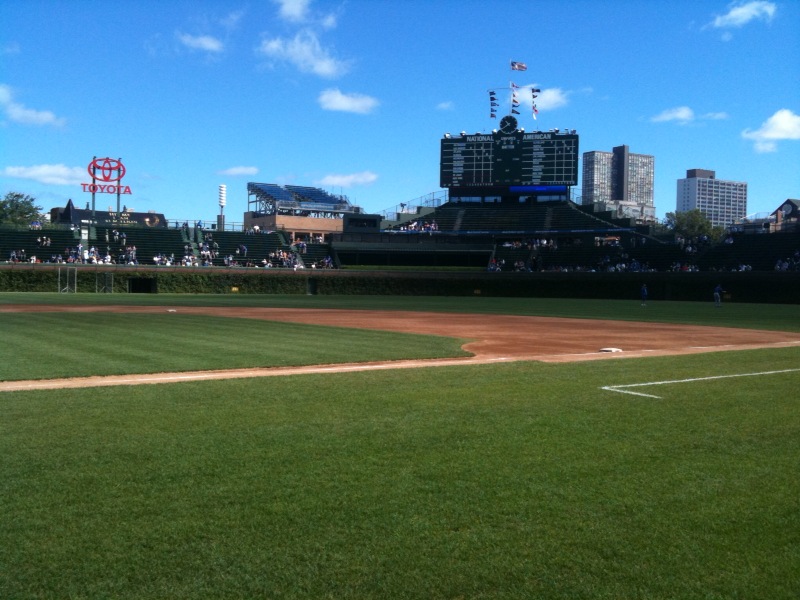
Not so at Wrigley Field. Not this weekend, anyway. Cubs fans stand and pose their best Facebook poses, arms around each others’ shoulders, faces locked in mile-wide smiles prepped to withstand digital shutter delays. When the photographer walks away, they examine the card and file it in a wallet or handbag, then cheerfully turn their attention back to crappy, meaningless September baseball.

Everyone told me about how Cubs games almost always sell out even when the team sucks, and how the fans almost never boo, though they haven’t seen a champion in over a century. So I went to Chicago hoping to learn something, trying to take from the Second City some lesson I could bring home about patience or eternal optimism, to find out what it is about those people that allowed them to tolerate a terrible team for such a long time. An ambitious goal obviously, but Chicago is built on the maxim, “Make no little plans.”

For a day, I considered that perhaps the Wrigley crowd was like an audience full of Tyler Durdens, nihilists enjoying baseball games for the sake of baseball games, in isolation, absent of hope. Remember that in Fight Club, Durden maintained that true freedom came only after you hit rock bottom. I thought maybe all these Cubs fans stopped dreaming years ago and could come out to Wrigley to drink and watch, unencumbered by the desperation that claws at fans of the 29 other teams. Maybe they don’t need any validation; maybe they just want to see baseball.

But I’m not sure that’s it.

Many of the people I asked maintained that Cubs games — or at least these particular Cubs games — are more a social event then a sporting one. The park is the attraction, and all the day games draw the carefree, playing hooky. The loudest cheers we heard all weekend came for the successful completion of a stadium wave on Sunday. After that, the most raucous applause came for a guy who made a nice play on a foul ball, and the only jeers were aimed at a fan slow to throw a Met’s home run ball back onto the field of play. Fans rooting for fans.

I came to Chicago under the impression that Cubs were the drunken, epithet-spewing cretins that so flummoxed Milton Bradley, the racists that buy the terrible t-shirts I saw selling on the street outside, the angry mob that looked ready to murder Steve Bartman. But the people I encountered were attractive, bubbly, happy to be there. Maybe some were buzzed, some even tipsy. But none appeared bitter, downtrodden, angry or even the slightest been concerned that the Cubs idled in fifth place in the N.L. East.

I suspected the bleachers held some answers so I tried to make my way there. I wasn’t allowed. Turns out the “all” in “All-Access Press Pass” does not include the bleacher section at Wrigley. I asked everyone I could to find out how I could get in, but I was denied at every stop. They said the bleachers were for fans only.

So I have no idea what goes on there. Maybe it’s more of the same, the smiling Facebook set with their cheery singalongs. Or maybe those are the real Cubs fans, and they’re all just too drunk or too sad, too terrorized by bad baseball to summon the strength to boo their team so late in a lost season.

And I realize that’s probably the big thing, that trying to measure Cubs fans when their team is out of the race in September is unfair or impossible, that it would be a whole different story if the team was actually playing for something.

But then again, it’s not like that happens that often.

On Sunday night, before I left the city, I went up to the observation deck on the 94th floor of the John Hancock Center. I looked out from that skyscraper at all the others, behemoths tapering swiftly into the endless suburban twinkle. And I wondered how people could stand in the shadows of such accomplishments and still stand for this, how a place with the hubris to erect so many stories on so much land could stomach so much losing.

I have a feeling it’s something that would take a whole lot more than a weekend to understand.

Way down there

It’s been a lost season for Oliver Perez, as Mets fans know, but Perez may try to make up for his extended spells of inactivity this season by pitching in winter ball in his native Mexico for the Culiacan Tomatillos.

Anthony McCarron, N.Y. Daily News.

I may have mentioned here before how badly I want to go see Mexican League baseball. I was prepping to go in December, 2008, actually, but my plans fell through for a variety of reasons.

And now Ollie Perez is going to pitch there this winter? Yeah, sign me up for that. I don’t know how feasible it’s really going to be, of course, but the draw of baseball and Mexican food is a powerful one.

One note, though: The Wikipedia page for Culiacan says the team there is not called the Tomatillos, no matter how awesome it would be to have a team named after everyone’s favorite green-salsa ingredient. They’re actually the Tomateros, or Tomato Growers.

SkyMall goes meta

I’m back home, firing up the barbecue for Labor Day. I’ll have a bit more on Chicago tomorrow, but for now, wrap your heads around this item from SkyMall:

That’s right: In the midst of a catalog filled with elegantly photographed products nobody needs, a product nobody needs for elegantly photographing stuff which you can then sell on your own. Start your very own SkyMall! Or just take nice portraits of your favorite lamp and football, as seen here.

And you’ll note, of course, that those photos of the photo studios are very obviously themselves taken in photo studios. And in that studio holding the studio, just beyond the frame, there are probably lights that look just like those prop lights, lighting the lights in the studio for the studio.

Sandwich of the Week: Windy City style

I long ago said my piece about cheesesteaks. This thing is clearly Chitown’s answer to that sandwich, only, as you’ll see, there’s more to it than that. But there’s a baseball game going on so let’s cut the nonsense and get at it.

The sandwich: “The Regular Al” from Al’s Beef, several locations in Chicago.

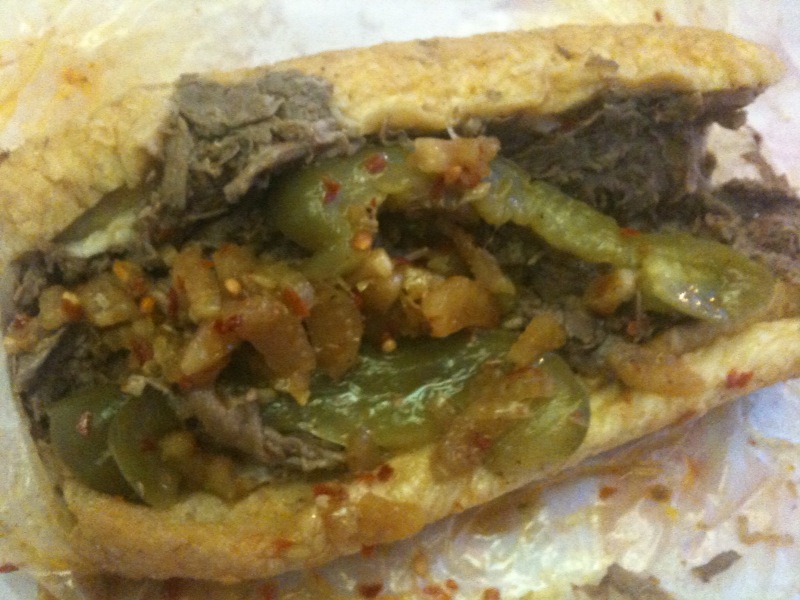
The construction: Thinly sliced, Italian-seasoned beef on a soft Italian hero roll with giardiniera — a spicy pepper relish — provolone and sweet peppers, all dipped in the gravy in which the beef was stewing. Marinara was listed on the menu board and I ordered one “with everything” because I didn’t know how else to play it, but if I got red sauce on mine it wasn’t enough to notice.

Important background information: I can’t figure out why Chicago has such tall buildings. Manhattan makes perfect sense — it couldn’t spread out anymore, so it went up. In Chicago, you walk past these huge skyscrapers, and then like right down the block there’s adequate parking and restaurants with drive-thru windows and gas stations. What’s that about? Based on the map and its proximity to our hotel, Al’s Beef should have been a hole in the wall in a row of stores. But it stood alone, with a parking lot and some outdoor tables and a drive-thru. Right in the middle of a city with all these massive, massive buildings.

I mean, don’t get me wrong: I’m for it. If I had my druthers, I’d replace my tiny house with a 110-story superstructure in the middle of suburban Westchester just for the sake of awesomeism. But often building codes and market forces prevent people from doing stuff like that, and it seems weird to just keep going skyward when there’s ample parking about and all. I don’t know. I still have a lot to learn about Chicago. One sandwich at a time.

What it looks like:

How it tastes: Good. Spicy. Beefy. Like oregano.

It’s definitely an improvement on the regularly Philadelphia cheesesteak. I need to make that much clear. The seasoning of the beef might be a little heavy on the oregano, even, but it’s tasty nonetheless, and there’s way more going on here than just cheese and meat. Not that there’s anything wrong with cheese and meat but those are lilies appropriate for gilding. Actually to be perfectly honest, the cheese kind of got lost in the mix. But whatever, the rest of the mix was good enough to make up for the lack of cheese flavor. Unlike Philly’s offering, where the cheese flavor is the only flavor.

The giardiniera is great — a nice spicy peppery kick to go with the sweetness from the roasted peppers. And dipping the whole thing in the gravy worked well to keep the whole thing juicy. I was concerned that it would make the bread soggy and the sandwich mushy and hard to handle, but it withstood the pressure somehow. Just a wet-tish sandwich is all. And a good one.

But I’ll say it was lacking a certain depth of flavor I wanted to put the thing over the top into true sandwich magnificence. I think “spicy oregano bomb” is a fine treat, it’s just not something I’m nominating to the sandwich Hall of Fame anytime soon. I added a little ketchup, which sweetened the affair and helped a bit, but it was not enough to make anything explode with awesomeness in my mouth like previous sandwiches I have loved.

I will add, though, that for a sandwich that appears so unhealthy, I found the Regular Al surprisingly digestible. Cerrone and I walked the mile back to our hotel after eating, and I didn’t at all endure the greasy feeling I normally expect after eating a giant beefy sandwich. So good for you, Al. I think that signifies quality ingredients. Or maybe I’ve just developed an iron stomach.

What it’s worth: I can’t remember exactly what I paid for the Regular Al, which is as good a way as any to know it was real inexpensive. Like $6 maybe? Plus we walked about a mile there and back, like I said, but that seemed as good a way as any to explore the city and wasn’t much of an investment. So it was absolutely worth that, and I’d probably recommend checking it out if you’re in Chicago. Actually, if you asked me for advice — and I hope you might on these matters — I’d tell you to get an Italian beef sandwich from Al’s instead of bothering with the whole deep-dish pizza and the hours of investment that go into it.

Oh because that’s the other thing! We walked right up to the counter and ordered at Al’s, even though it’s supposedly over 70 years old, famous, and a bunch of magazines say it serves one of the best sandwiches in America. It is a terrifying indictment of humanity that the line wraps around the block at Pat’s King of Steaks in Philly, where they treat you like crap and serve you overpriced Steak-Um with Cheez Whiz, and there was no wait at all at Al’s.

The rating: 84 out of 100. A very good, but not exceptional sandwich. At times I thought it might be more, at times I thought it might be less, but it was definitely an above average sandwich that has been putting in solid work in the Second City for a long time now. The Ryan Dempster of sandwiches.

Cool

Somehow I never knew about this; I didn’t see them yesterday or the last time I came to Wrigley a few years ago, but the Cubs have a live Dixieland band that walks around the stadium during the game.

Fittingly enough, they’re called the Cubs Band. They feature a cornet, a clarinet, a tuba, a trombone, and a banjo, and they’re pretty sweet.
I have long, long held that the Mets — and most baseball teams — should have some sort of live musical act inside the stadium during games. The Hammond organ is obviously a nice start, but I’m open to all sorts of ideas.

I think it would be particularly badass, for example, if a dominant reliever kept a string quartet on hand to play his entrance song. I’ve written about this before: The Hannibal Lecter approach to closer music. I’ve priced that out with my friend Ben, an orchestra conductor, and he says the cost to keep four top-flight musicians on hand for that type of work for 81 home games a season would be peanuts compared to player salaries. A good reliever could easily get it written into his contract.

But I’m open to most things. A top-flight college basketball pep band would be fine if it played funky arrangements of decent songs. Not like a lame, b-rate pep band, I mean like one of the awesome ones that outshines the basketball team itself. Just filling up a whole section of Citi Field with joyful noise and all that. And absolutely no “25 or 6 to 4” or “Carry on My Wayward Sun.” It’s time to retire those to the rafters.

A funk band up on the bridge to the Pepsi Porch. Delta Blues in the Delta club. Metal in the Acela restaurant. Anything would be better than trying to get me to sing Sweet Caroline or Rickrolling the entire stadium.

One of the dudes from the Cubs Band told me they’ve been playing together since 1982 and they’re at every game. Cool.

Also, fun fact: I could almost entirely outfit a band like the Cubs band with instruments I have in my house (or at my parents’ house). The only one I don’t have is a tuba, which is ironic because it’s one of the few I can play capably. I really need to practice that banjo.

On Chicago’s so-called “pizza”

We’ve all heard Judge Potter Stewart’s famous quote about porno so I won’t bother recounting it here. And if that man can subjectively, definitively identify pornography, so I can with pizza.

Matt Cerrone says that pizza is anything that stacks sauce, cheese, and, optionally, toppings on top of dough and calls itself “pizza.” Matt Cerrone lies. I’ve encountered plenty of things that vaguely fit that description call themselves pizza that are certainly not pizza, and probably at least one thing that calls itself something else that I might classify as a type of pizza — Flammekueche in Strasbourg, France.

So what’s the best way to know what is pizza and what isn’t? There’s only one way to be certain: Ask me. I know. Just trust me on this one, and be willing to defer to my pizza judgment.

If you eat something and you think it might be pizza, bring it to me. I will let you know.

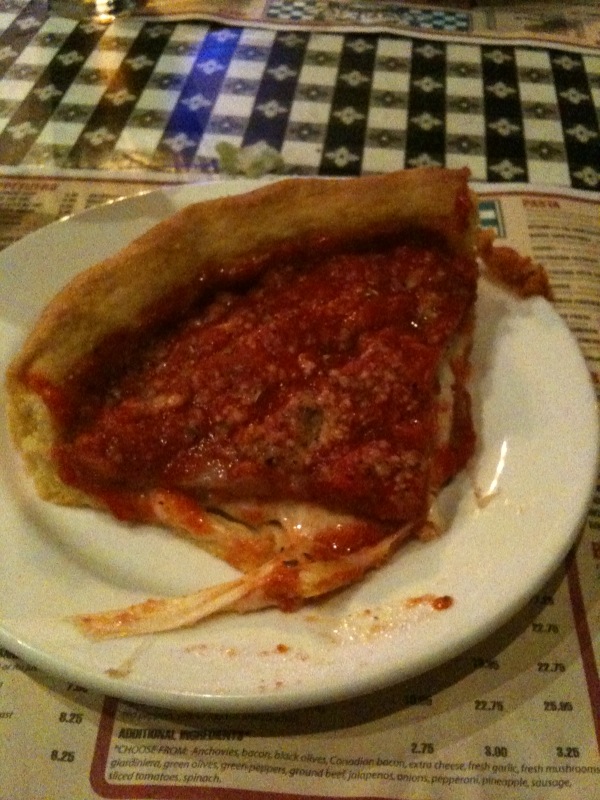
But I can tell you this much right now. What I ate last night at Gino’s East here in Chicago was not pizza:

Which is not to say it wasn’t delicious, mind you. Because it was. I mean, hell, it featured sweet, delicious tomato sauce, a big, whole sausage patty and some scant mozzarella cheese on a cornmeal crust. Cornmeal! I mean it was like a giant pizza made on cornbread. And cornbread is awesome.

But note that I said it was like a giant pizza made on cornbread. Because pizza is not like this. This was like some sort of cake with pizza-related substances on top. Actually, this was like an actual pie of pizza things. Not a pizza pie, because that’s what we call real pizza. This was a pie inspired by pizza. Tasty, don’t get me wrong. I can’t stress that enough.

It was good last night and it was good again when I had the leftovers this morning for breakfast. But at no point along the way was it something I’d call pizza. If you blindfolded me and fed me it, I’d be all, “thanks for this delicious treat,” but not, “thanks for shoving that pizza in my mouth.”

The other thing is it takes 45 minutes to prepare. That’s nuts. I was fine with it because the waiter at Gino’s East told us it was going to take that long and we understood, but I can’t think of anything in New York you wait 45 minutes for once you’ve ordered it. One time when I was six, my mom and I waited 45 minutes at Friendly’s because the waitress forgot about us. But that’s pretty much it. There’s got to be a better system, especially at a place with as much traffic as Gino’s East had last night.

Chicagoans really just sign up to wait 45 minutes for pizza every time they order it? That means if they get it delivered it has to take at least an hour, right? That’s lunacy. Reminds me of an old Mitch Hedberg joke:  “I like baked potatoes. I don’t have a microwave oven, and it takes forever to bake a potato in a conventional oven.  Sometimes I’ll just throw one in there, even if I don’t want one, because by the time it’s done, who knows?”

But then these people still come out to the park every day even though their baseball team hasn’t won in a damn century, so maybe this city has a patience a lifelong New Yorker can’t understand.

Finally, I regret to inform you that Sandwich of the Week will be delayed until tomorrow or Monday for this week, depending on my schedule here in Chicago. Busy here. I meant to find a sandwich last night but we figured it would be a good time to get the eating of the “pizza” out of the way.