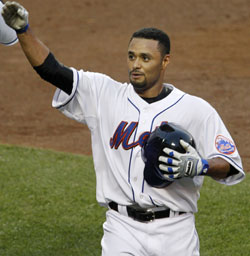
Reasonable speculation

After hitting six bombs in 45 games in AA, Duda has eight in 21 in AAA. He’s hitting a combined .300/.406/.582 for the year and .329/.395/.750 in 21 games in AAA. Three of his eight homers have come against lefties against whom he’s hitting .200/.286/.640 compared to .392/.448/.804 versus righties.

Toby Hyde, MetsMinorLeagueBlog.com.

I don’t want to bandy about unfounded rumors, but I believe it’s entirely reasonable to start speculating that Mets farmhand Lucas Duda has sold his soul to Satan for home-run power or is otherwise benefiting from a recent foray into the dark arts.

Duda’s previous career high was 11 home runs in St. Lucie in 2008. He averaged about one home run for every 46 at-bats in his first three Minor League seasons, but has stepped it up to about one per every 17 at-bats this season, including a downright Ruthian 1/9.5 rate since his promotion to Triple-A.

Will Duda keep that up? No. Not unless he really entered a contract with Lucifer. But the outburst has to at least earn him consideration as something more than organizational roster filler. By most accounts he’s a pretty terrible fielder in the outfield, and he’d be redundant on the big-league club with Chris Carter already in tow. But he’s probably a better option than Mike Jacobs to get a call if the Mets need left-handed pop in a pinch.

Some stuff about Jon Niese

The start was an important one because it was Niese’s second of the season against the Reds. (He gave up four runs in a no-decision on May 5.) A young pitcher like Niese may be able to befuddle hitters the first time around, but the second time, they lose the advantage that comes with their unfamiliarity.

Thomas Kaplan, New York Times.

This is a point I hear made pretty frequently, and one I’ve definitely considered here numerous times. But I wonder if it’s true. Is there any evidence to back up the claim that a pitcher does better against his opponents the first time he faces them?

Also, even if there is, I’d have to guess it is at least partly attributable to the same logic that explains the beginner’s luck fallacy. The notion of “beginner’s luck” exists because people who win when they first start gambling are more likely to keep gambling, since they’ve been rewarded. If they lost from the outset, they’re more likely to leave the casino. When they win from the start, they stay long enough for the odds to catch up to them, and so when they see someone else win early they say, “aww, beginner’s luck.”

If a young pitcher gets rocked by an opponent in his first start against them, there’s a pretty good chance he’s getting rocked by lots of opponents and he’s not going to last in the Majors long enough to make a second start against any team. If he succeeds his first go-round, he’ll get more chances, and so more opportunities to fail. I’m pretty sure that’s a big factor in the Verducci Effect and “sophomore jinx,” too — no one’s looking for regression from pitchers who sucked in the first place.

Anyway, that’s just something I’m thinking of and has nothing to do with Jon Niese. At least not yet, I guess.

Niese lost last night and got tagged for a couple homers, but he struck out eight guys while walking only one in 7 2/3 innings. That’s excellent.

In fact, Niese’s 2.61 K:BB ratio is the best among Mets starters this year. He’s inducing 49.5% groundballs. Straight up, the kid is good.

People always seem to talk about him as, at best, a middle-of-the-rotation innings eater. But considering his strong start to his career and very good Minor League peripherals, I don’t think it’s unreasonable to expect a little more than that. He could certainly struggle with a little more exposure, like the quote above suggests, but there’s no evidence that he’s been unduly lucky in his rookie campaign.

Niese has been one of the least heralded reasons for the Mets’ success this year, I think. If he keeps this up, though, that will change. With Jason Heyward hurt and Stephen Strasburg’s innings set to be limited, Niese may contend for NL Rookie of the Year.

All sorts of stuff I didn’t previously know about squirrels

Yet researchers who study gray squirrels argue that their subject is far more compelling than most people realize, and that behind the squirrel’s success lies a phenomenal elasticity of body, brain and behavior. Squirrels can leap a span 10 times the length of their body, roughly double what the best human long jumper can manage. They can rotate their ankles 180 degrees, and so keep a grip while climbing no matter which way they’re facing. Squirrels can learn by watching others — cross-phyletically, if need be. In their book “Squirrels: The Animal Answer Guide,” Richard W. Thorington Jr. and Katie Ferrell of the Smithsonian Institution described the safe-pedestrian approach of a gray squirrel eager to traverse a busy avenue near the White House. The squirrel waited on the grass near a crosswalk until people began to cross the street, said the authors, “and then it crossed the street behind them.”

In the acuity of their visual system, the sensitivity and deftness with which they can manipulate objects, their sociability, chattiness and willingness to deceive, squirrels turn out to be surprisingly similar to primates. They nest communally as multigenerational, matrilineal clans, and at the end of a hard day’s forage, they greet each other with a mutual nuzzling of cheek and lip glands that looks decidedly like a kiss. Dr. Koprowski said that when he was growing up in Cleveland, squirrels were the only wild mammals to which he was exposed. “When I got to college, I thought I’d study polar bears or mountain lions,” he said. “Luckily I ended up doing my master’s and Ph.D. on squirrels instead.”

Natalie Angier, New York Times.

My wife and I were talking about this not too long ago: I have lived among squirrels my entire life, and yet I have no idea where they sleep. Turns out they “nest communally as multigenerational, matrilineal clans,” which is impressive and ominous but doesn’t really clarify where they’re actually sleeping. Holes in trees? If so, how do they hollow them out to fit their whole squirrel clan in there? Does that kill the tree?

The Times article is pretty fascinating. Turns out squirrels also trick each other when hiding their nuts. They bury them and rebury them to avoid nut theft, because squirrels are super paranoid.

It’s a neat trick squirrels have pulled. How many other rodents live among us that we don’t actively try to destroy? I mean, sure, sometimes some squirrels will overstep their bounds and find a way to burrow in your attic crawlspace and then, you know, chain of animal command and all. Humans are unmistakably the king of the suburbs.

But no one ever puts down squirrel poison or squirrel traps like they do for rats or mice. Really, there’s no other non-domesticated mammal as large and ubiquitous that we so willingly share a habitat with. We fear raccoons and possums disgust us, but squirrels bear no similar stigma. And why? Is it just because squirrels are better looking than rats? Less likely to spread the plague? Less invasive?

And though we don’t seek to rid our yards of woodchucks or chipmunks or any other rodent that doesn’t look to invade our homes or ravage our gardens, they’re not nearly as present and prevalent as the squirrel. So I recommend being a little more suspicious of squirrels. Those little bastards are up to something.

David Wright: Suddenly not crazy anymore

Wright’s got a lot of Derek Jeter in him, on and off the field, and part of that means he’s not going to reveal very much about himself, for better or for worse…

Wright fielded questions yesterday about his remarkable turnaround at the plate without offering any real insight into how he did it.

“I don’t know if you can really put your finger on it,” he said, and then, in typical Wright fashion, proceeded to link it more to the way the team is playing than himself.

It was admirable, and Jeter would have been proud, but it does leave you wanting more. Did he have demons to fight on balls up and in? Did he have doubts about getting back to the form that has made him an All-Star again? Did all the strikeouts make him crazy?

No, no, and no, said Wright.

John Harper, N.Y. Daily News.

I don’t have a direct link to Harper’s column. It was in the early edition of the paper and is not online. It’s almost entirely based on conjecture, but to Harper’s credit, I don’t think it’s unreasonable to speculate about the lingering effects of last year’s beaning on Wright early this season.

The most interesting quote in the column is Wright saying, “I don’t care about the strikeouts.” That’s cool, because neither do I. Since this year’s uptick hasn’t prevented him from producing as well as he ever has in the Majors (especially when you adjust for the park), and since even when Wright seemed to be striking out every other at-bat he was still maintaining a respectable on-base percentage, they’re just not that big a deal. Wright will probably finish this season with a career-high strikeout total. It won’t have stopped him from being awesome.

And that’s the thing I think everyone needs to keep in mind when we spend so much time analyzing Wright psychologically and in every other which way. Wright’s going to slump again, he’s going to strike out in some big spots again and he’s going  to get booed again. It’s just part of it. That’s just baseball; these things happen.

But Wright will always come back to being awesome. Wright is a great, great baseball player, probably the best position player the Mets have ever had. It’s not fair (or safe) to call him a Hall of Famer yet, but there’s no doubt he’s on that trajectory. And players of that caliber simply do not roll over in the face of adversity. All the different things that made David Wright this great in the first place will keep him great moving forward.

And since inevitably Wright’s psyche will be assessed from armchairs the next time he struggles — and that will suck — it only seems fair to share a feel-good story about the man while he’s going well. Corny fodder for Wright’s loyal admirers among us:

While the Mets were taking batting practice yesterday, I waited outside their clubhouse with our video producer and intern, prepping to interview Ike Davis for the Baseball Show. Every person that passed commented on the sweltering heat. Players walked by soaked in sweat, looking a bit wilted, conserving energy.

Then came Wright, bouncing down the hall, no worse for the wear. Alongside him was a kid, about 8, wearing a “Make-A-Wish” t-shirt and a Mets hat. The kid looked a bit overwhelmed. Wright looked positively giddy.

“Here’s our indoor batting cage, and here’s our video room,” Wright said, sounding himself like an excited 8-year-old showing his friend his parents’ new home or something. “You wanna see our clubhouse?”

They emerged a few minutes later and proceeded toward the dugout. “You wanna meet some of the players?” Wright asked as they walked down the hall, away from where we were standing. “You know a lot of the players? Who’s your favorite player?”

The kid mumbled something inaudible.

“Well you have to say that,” we heard Wright say before they moved out of our earshot. “Because I’m walking with you!”

We were the only media anywhere close, and no cameras were rolling.

Pwnage

There needs to be a word for what Johan Santana did to the Reds tonight. Considering all the frivolities we keep track of in baseball, there should be an isolated stat for pitchers who throw complete game shutouts in which they also hit a home run. Shut ’em out, hit one out.

I know Jason Jennings did it against the Mets in his Major League debut because I was there. (Incidentally, there was a rain delay in the game and we moved down to the first row behind home plate and wound up taking advantage of an unbelievable opportunity to heckle Steve Phillips point blank.)

According to the Mets’ game notes, the only other Met to accomplish the feat was Pete Falcone in 1981. (For what it’s worth, that game featured both Mark Davis and Sparky Lyle pitching for the Phillies. Davis started the game, but the duo represent 22% of pitchers who have won the Cy Young Award as relievers.)

I assume Babe Ruth did it at least once.

Anyway, what’s important is that we come up with some formal way of documenting whenever a pitcher single-handedly dominates his opponent like Santana did tonight. What could that be called? A pwn? A Little League Shutout, since the feat happens all the time at that level?

Or what about “a Newk,” in honor of Dodgers great Don Newcombe, one of the best power-hitting pitchers of all time? By my count Newcombe only did it once himself, but he was a pioneer, plus he has spent his retirement working with ballplayers with substance-abuse issues. Seems like a good enough dude to commemorate.

Plus the name works perfectly as a noun or a verb. Johan Santana hopes to compile more Newks in his career. Johan Santana Newked the Reds tonight.

Hmm… on second thought, maybe “Newking the Reds” sounds a little too Cold War-oriented for a baseball frivolity. I’m open to suggestions.

For once, a kid fleeces a card shop and everyone complains

Back in 1990, in a baseball card shop just a few Chicago suburbs over from where I grew up, a 13-year-old named Bryan Wrzesinski bought one of the iconic 1968 Nolan Ryan/Jerry Koosman Topps rookies for $12.

Twelve bucks was a whopping sum for us early teen types back then, but Wrzesinski knew it was a wise investment and couldn’t get his wallet out fast enough. The card was normally valued at $1,200, but a card shop worker who didn’t know very much about baseball cards put a decimal point in a spot where there shouldn’t have been one when pricing it.

‘Duk, Big League Stew.

‘Duk does a great job recapping a story from 1990 that I entirely missed at the time, despite being in the prime of my baseball-card collecting career. Turns out Chicago-area human interest stories didn’t really get to Long Island back before anyone knew about the Internet.

Anyway, it’s a good one and worth a read. I mention it here for a couple reasons:

1) I have the card in question. Inherited it from my brother. Sadly, it’s not worth $1,200 or whatever it should be worth now because there’s a pinhole in Jerry Koosman’s head. No idea how that happened, but it has been there as long as I’ve known the card. We didn’t do nearly enough to protect the condition of our baseball cards back in the day.

Luckily, I guess, it doesn’t really matter since I have no intention of ever selling off my baseball cards anyway. They’ll stay in storage at my parents’ house where they belong.

2) My brother and I pulled a pretty similar stunt, only on a much smaller scale. Our parents dragged us to an antique shop upstate once, and we found the lady in the store selling her son’s old cards based on a price guide from 1979. I don’t think anything we bought back then is really worth all that much now, but we stocked up, thinking we were savvy as all get-out for taking advantage of an old woman.

Josh Thole stuff

Josh Thole has been with the Major League Mets for nearly two weeks now, but has averaged less than a plate appearance per day in that time. He has made the most of the scant chances he has had, going 5-for-10 with a double and a walk. And in his two starts behind the plate, Thole failed to single-handedly destroy the Mets’ pitching with his purported inability to call games: He has a 3.00 catcher’s ERA over the tiny sample.

It would be reasonable to question why Thole is with the Mets at all since he’s a 23-year-old catcher that, by almost all accounts, needs more experience behind the plate. But who knows? Maybe the knowledge he can gain studying under old hands like Rod Barajas and Henry Blanco is more advanced than what he’d pick up playing everyday in Triple-A.

I can’t say, nor can I reasonably contend that Thole should be up in the Majors for a team with playoff aspirations and several banged-up regulars who aren’t catchers.

What I can argue, though, is that if Thole’s going to be with the big club, he should probably play more. Predictably, Barajas’ ridiculous run of early-season heroics ran up just as soon as everyone remembered how he swings at everything. His OPS has plummeted to an eminently Barajasian .730 thanks to his .502 rate since June 1. Henry Blanco has been great — and especially outstanding defensively — but it would be a lot to ask his 38-year-old body to hold up under more frequent play.

No one is accusing Thole of being the next Mike Piazza, but he can hit a bit. After a brutal start to the season in Triple-A, he posted a .410 OBP in May and June before his call-up. Though he lacks home-run power, it’s not unreasonable to suggest Thole is a better hitter than Barajas right now. He’s certainly more likely to get on-base. And he hits left-handed, which could add to the righty-heavy lineup a bit of that balance that Jerry Manuel loves so dearly.

The only things that should prevent Thole from playing more often are difficult ones to measure: Leadership, game-calling, defense behind the plate.

I don’t doubt that they’re important; Mets pitchers have been praising Barajas and Blanco all season for their approaches to opposing hitters. I just wonder how much they’re worth compared to an extra 50 points of OBP. In other words, does Barajas’ superior ability to handle pitchers overwhelm Thole’s superior ability to get on base?

Again, I can’t say. The Mets apparently think so.

My guess is that, barring another injury somewhere, Thole will be the odd man out once Carlos Beltran returns. But it wouldn’t kill the Mets to give him a few more chances to prove himself worthy of a Major League spot before that happens. If it turns out he can handle the job behind the plate, he’s another free offensive upgrade for the stretch run.

Salfino: Follow the money trail

But this is a business. So follow the money. Forbes said it best, through Interbrand (a company whose business is valuing brands like the one James wants to become). The bottom line: James should expect to make $983 million if he signs with the Knicks and finishes his career here — that’s $284 million more than second-place Cleveland. (Cleveland beats Chicago because Michael Jordan already owns Chicago, so winning a title there is worth far less than winning one in New York or even Cleveland.)…

But the biggest reason why it’s the best basketball decision for James to come to New York is Curry — the secret weapon. He comes off the books after this year. So he can be traded at any point to a team seeking future cap relief or let go in June to create more cap room for next year’s free-agent class. New York would have almost enough for another max contract. Most importantly, he protects James from a change in the collective bargaining agreement that creates a hard cap. James knows that the Knicks will go over the cap if nothing changes. But only the Knicks from among all his suitors can also stay within the cap to get a third big player (or fourth if you count Danilo Gallinari).

Michael Salfino, SNY.tv.

The NBA free agency hype has grown so monstrous that I’ve sort of stopped paying attention, but Mike makes the most comprehensive case I’ve yet seen for why LeBron James should and will end up a Knick.

Also, it’s hilarious that anyone besides Isiah Thomas and Greenburgh-area fast food restaurants might consider Eddy Curry “the secret weapon,” but it’s a good point.

And furthermore, the Greenburgh area could use a lot more variety in its fast food restaurants. McDonald’s, Wendy’s and Burger King? What is this, 1989?

Time to look elsewhere?

MLB source hears #twins have offered OF Aaron Hicks (1st rnd, 08, 900 minor lg OPS) and top C prospect Wilson Ramos for C.Lee.

Jeff Fletcher of AOL Fanhouse, per Twitter.

By rule, I’m skeptical about all trade rumors. But if there’s any truth to this report, you can probably forget about Lee joining the Mets.

Going by Baseball America‘s preseason ranking, the Mets don’t have a prospect in their system as promising as Hicks, who ranked #19 overall. The Mets’ top guy on that list, Jenrry Mejia, ranked #56 — only two spots ahead of Ramos, who has been reported as the object of the Mariners’ affection in talks with the Twins.

The Mets could certainly match or better that deal if it came down to it, but the cost is probably too high for a rental player. And a negotiating window for Lee, as I’ve discussed, should not be considered added value to any deal for the pitcher.

A no-doubter

Adding a five-time All-Star to the roster seems like a no-brainer as a recipe for success, certain to help a team get to another level. But for Mets manager Jerry Manuel, the expected addition of Carlos Beltran next week in San Francisco after the All-Star break comes with this potential backlash: How can he keep his entire outfield corps happy and productive?

“It will be a tough thing,” Manuel said about seamlessly integrating Beltran and divvying up playing time. “I think a lot will depend on them. It gets now to the point of you have to perform to kind of be out there. I think that’s where we are.

“We’ll sit down and talk with them and let them know what’s to come. We’ll try to map it out for them so they don’t come to the ballpark not knowing whether they’re going to play or not. I’m going to try to give them an advance schedule as to what I anticipate the lineup to be.”

Adam Rubin, ESPN New York.

For a while it looked like Angel Pagan’s oblique injury might linger and render this entire conversation moot, but the 2010 Mets’ best outfielder has five hits including two doubles and a homer in his last two games, so it appears Pagan is healthy.

Mets fans have come to expect the worst from the team and its manager when decisions like this one come up. After all, it’s the same club that started Gary Matthews Jr. and Mike Jacobs on Opening Day.

But I’m going to take “you have to perform to kind of be out there” as a glimmer of hope.

This may be inconceivable to many Mets fans and beat reporters, but Jeff Francoeur should lose the most playing time when Carlos Beltran returns. It’s a no-doubter. Shouldn’t even be up for debate.

“You have to perform to kind of be out there,” like Jerry says, and Francoeur has not performed. Not at nearly the same level as Angel Pagan or even the long-befunked Jason Bay.

Francoeur himself said that Manuel’s decision should be difficult because none of the Mets’ current outfielders is “flat-out sucking.” That’s a relative term, I suppose. Francoeur is not flat-out sucking compared to how your average man on the street might suck if tossed into the rigors of Major League play. I could not post a .711 OPS at any level of professional baseball.

But every other starting Major League right fielder can better that rate, and that’s the issue. Among the men who man his position, Francoeur is dead last in OPS. He’s second to last in OBP, last in wOBA and third to last in WAR.

And why shouldn’t Francoeur, a Major League veteran, be given more leeway? Because these numbers are precisely in line with the ones he has posted across his career. This is Jeff Francoeur.

Flashes of awesomeness like the one he had to start the season or his three-week stretch starting in late May are nothing new; they were enough to enchant the Braves into giving him everyday playing time for four seasons. But Francoeur still hasn’t mastered the strike zone, so he is forever prone to the lengthy droughts that have hampered his 2010.

Angel Pagan has been great this season. Straight-up great. Jason Bay hasn’t been himself, but he has still performed a whole lot better than Francoeur. So — and the joke could very well be on me — I’m going to go ahead and assume that when Jerry Manuel speaks about “performance,” he also understands what that means. Pagan and Bay have far outperformed Francoeur. And Carlos Beltran is really, really good.

There should still be playing time for Frenchy, no doubt. With Fernando Tatis on the disabled list, the Mets will need a primary right-handed pinch-hitter. Plus Francoeur has always torched lefties, so he should spell Pagan against tougher ones. And Beltran will need plenty of rest days for his achy knee.

It just shouldn’t come down to an even split for Pagan and Francoeur or equal shares for everyone or anything like that. The Mets’ outfielders have not performed equally.