Important poll
Reply

The very first thing that statistical analysis shows us is there is a whole lot of randomness involved in every single baseball outcome. Predictions based on statistics are merely suggesting the most likely outcome. Not even Colin Wyers of Baseball Prospectus is so soulless as to not appreciate when something unlikely and random occurs during baseball. If anything, a basic understanding of statistical likelihood, enhances one’s enjoyment of short hops, fielding flubs and unexpected performances.
And this is why Mike Fiers is the most enjoyable story in baseball right now.
– Dustin Parkes, Getting Blanked.
Good read from Parkes on Fiers, the Brewers’ 27-year-old rookie sensation. I especially like the excerpted part because it reiterates something I’ve argued many times before: Understanding baseball’s probabilities fosters a greater appreciation for both the unlikeliest and likeliest outcomes. It’s beautiful when Jeff Francoeur plays like a superstar for a few months and then it’s beautiful when he regresses to his career norms. Baseball is the best.
As for Fiers: Certainly no one could have predicted this level of success in his first go around the big leagues, but his Minor League stats were pretty good. He was old for every level, but his career Minor League strikeout-to-walk ratio is over 4 and he seemed to suppress hits pretty effectively. Maybe his stuff doesn’t look like a typical Major Leaguer’s, but then maybe there’s some selection bias there.
I’ll never not be entertained by old-timey baseball stuff.
 From the Wikipedia: Pud Galvin
James Francis Galvin was born on Christmas day of 1856 in St. Louis, Missouri. He grew up in an Irish neighborhood called Kerry Patch and trained as a steamfitter, but by the age of 18 he was pitching for the St. Louis Brown Stockings in the National Association, playing something similar to modern baseball but featuring almost no offense. No one on the 1875 Brown Stockings sported an OPS over .550 besides Lip Pike, who was utterly awesome for his time.
According to this Wikipedia-endorsed bio (from which I’m getting most of this information), Galvin was “uneducated and unrefined,” and as a teenager he exclusively wore flannel shirts and ate with his hands. That sounds a lot like me as a teenager, but I thought I was pretty refined.
Galvin played independent ball in 1876, then played one year for Buffalo of the International Association in 1877, then surfaced in the Majors for good as a 22-year-old when the Buffalo Bisons joined the National League in 1879. Galvin purportedly earned the nickname “Pud” because he made hitters look like pudding. Known as a gentleman, he was also called “Gentle Jeems.” And for his durability (detailed in the next paragraph), the 5-8, 190-pound Galvin was called “The Little Steam Engine.”
From 1879-1884, Galvin averaged 504 innings a season, starting nearly 70 percent of Buffalo’s games in that stretch and throwing 317 complete games, culminating in back-to-back years of more than 600 innings and 70 complete games in 1883 and 1884. He was pretty good, too, notching a 114 ERA+ and a 4.62 strikeout to walk ratio over his first six seasons as a full-time Major Leaguer. At one point he started 22 straight games and completed all of them. Galvin’s 1884 campaign, in which he went 46-29 with a 1.99 ERA over 636 1/3 innings, produced the highest single-season pitcher WAR in baseball history, though Galvin was so atrocious with the bat that his offense cost his team about 1.9 wins.
In Buffalo, Galvin became lifelong friends with fellow mustache man and future president Grover Cleveland.
A lot of this isn’t from the Wikipedia, by the way. Feel free to add it.
Another thing that’s not on the Wikipedia is that Galvin and most of his teammates probably sucked, at least by contemporary standards. The game was obviously massively different then — there was no pitcher’s mound yet, for one thing, plus the distance from the mound to home plate changed multiple times during Galvin’s career, Galvin never saw the need for a curveball, and he threw underhand. But take a look at the work Patrick Flood put together here. If fielding percentage is a decent indicator of the level of play, the way it increased over 100 points from 1871 to 1901 suggests the game was rapidly (and not surprisingly) developing and improving, presumably due to increased exposure and a broader talent pool, plus more time to figure out what the hell to do on a baseball field.
Which brings me to an important question, and something I think about pretty frequently: At what level could Galvin and his teammates from 1884 reasonably compete today if they could time-travel here and have modern equipment (but not modern training, since that throws everything off)? The league’s .899 fielding percentage, if we’re using that method, suggests the level wasn’t any better than a typical high school league today. Obviously the fielding stats are subject to the whims of subjective scoring and shoddy groundskeeping, but then so is high-school ball.
In other words, if I crewed up with some bros to form a competent but by no means good amateur team of adults in 2012, how far back in time would we have to travel to be able to compete with Major Leaguers? I bet it’s sometime around the 1880s, or maybe a little later if my friend Bill comes. Bill can throw really hard.
Back to Galvin: He was traded to the Pittsburgh Alleghenys in 1885 and ate innings for them until 1889. That season, incidentally, Galvin openly used the Brown-Séquard elixir, a supposed performance-enhancer made by draining monkey testicles. At the time, the Washington Post reported:
If there still be doubting Thomases who concede no virtue of the elixir, they are respectfully referred to Galvin’s record in yesterday’s Boston-Pittsburgh game. It is the best proof yet furnished of the value of the discovery.
In 1890, Galvin left the National League for the uncreatively but somewhat deliciously named Pittsburgh Burghers. The Burghers played in the newly formed Players’ League, which was presumably named after the football pool Lenny Dykstra keeps asking you to join. The Players’ League was formed by the Brotherhood of Professional Base-Ball Players over a spat with the National League owners, but it folded after one season and ultimately hurt the players’ standing, as it led to the demise of the American Association and more leverage for National League owners.
Galvin returned to the NL’s Pittsburgh franchise in 1891, the first year in which it was called the Pirates. He was traded to the Browns midway through the 1892 , but suffered a leg injury in a collision with Cap Anson and retired later that year. He attempted to hang on as an umpire in 1893, but did not take criticism well.
Galvin died broke and fat in Pittsburgh in 1902 after several failed business ventures. To date and for the foreseeable future, he ranks second in innings pitched and complete games in Major League history. He was the first pitcher to win 300 games, the first to throw a no-hitter on the road, and presumably the first to advocate monkey testosterone.
But with Bay inching closer to the Citi Field exit, here’s what likely happens next. He finishes this season in his new part-time role and then returns for spring training next year (for those screaming trade, don’t waste your breath).
At that point, Bay will have roughly a month to prove he can be a productive piece in the Mets’ lineup. That should provide Bay the opportunity to show he can do more than slap grounders to the left side of the infield or strike out, his signature contributions of the past two seasons.
But if that trend continues, and there appears to be no bottom to Bay’s spiral, the solution is unavoidable. He’ll have to be released before Opening Day, with the Mets picking up the remaining $19 million on his tab — $16 million salary, $3 million buyout of his 2014 option.
That sounds spot-on to me. Much was made yesterday of Sandy Alderson saying that the team would not eat Jason Bay’s contract, but what would anyone expect him to say? “Yeah, actually I’m quite sick of seeing him ground out weakly to the shortstop and can’t wait to cut him loose, $19 million be damned.”
Alderson keeps it tight, as he should. Here’s what I said in June:
The Mets will and should give Bay every chance to make good on his contract. Since it hasn’t happened yet and the injuries are piling up, it doesn’t seem likely to happen. And this front office doesn’t seem prone to carrying players that can’t pull their weight just because they’re paying them. I’d guess Bay comes to Spring Training, we read a couple stories about how he’s in the best shape of his life, and the Mets keep him around while the roster picture clears up. If no one gets hurt and he isn’t 2009 (or even 2010) Jason Bay again, they cut him loose late or send him packing in a Gary Matthews Jr.-style deal, provided he’s willing to waive his no-trade clause.
I’m sticking to that story. I’ll add that I expect some segment of the Mets’ fanbase to fret like hell over the possibility of Bay making the team out of the gate in 2013 over some better or younger player, just as some did in 2010 with Oliver Perez and Luis Castillo. Unless Scott Hairston leaves in free agency and the Mets can’t find any other righty- or switch-hitting outfielder who’s anything close to a Major Leaguer or Bay shows up to camp magically and legitimately rejuvenated, it’s hard to see how he fits on a big-league roster.
I know a lot of you don’t follow Georgetown basketball and its alumni the way I do. But if you pay any attention to college or NBA basketball and you don’t love Roy Hibbert, you’re doing something wrong.
If you’re unfamiliar, the 7-foot-2 Hibbert entered Georgetown as a gangly freshman in 2004, unable to do a single push-up and useful on the court mostly just for his height. But he bulked up in the weight room and developed into a good passer and a surprisingly good shooter, well-suited to the modified Princeton offense the Hoyas run. By his junior year, he was a first team All Big East player and helped the Hoyas to a Final Four run. Then he passed up a potential lottery-pick payoff to return for his senior year because he promised his mother he would graduate.
Across four years in the NBA, Hibbert has again improved from very-tall guy to good player, pacing the Pacers in rebounds and blocks the last two seasons and earning his first All-Star nod this year. You may know him from his excellent cameos in Parks and Recreation. He also does stuff like this, which prompted this post.
And he did this in one of the most exciting regular-season sporting events I’ve ever seen. This was the first three-pointer Hibbert ever attempted in his college career:
No one is happier than I am that I’ve carved out some weird and awesome niche as a Mets and sandwich writer. And I am so very grateful that a non-zero number of human people want to read what I have to say about the Mets and sandwiches that I’m driven to do the best damn job I can covering this beat, especially when that entails eating sandwiches at Mets games. So I hoped to eat the first Original Filet Mignon Steak Sandwich served at Citi Field.
I failed. When I got to the new Pat LaFrieda stand in Citi’s center-field concession area on the Field Level concourse shortly after 5 p.m. on Tuesday, there were somehow already a few people ahead of me on line. I suspect most if not all of them were Mets employees, so I can vaguely lay claim to eating the first Original Filet Mignon Steak Sandwich served to a civilian at Citi Field. But typically everyone who doesn’t work at SNY blurs the line between the network and the Mets so it’s not even worth making the case. Whatever. I ate one of the first Original Filet Mignon Steak Sandwiches served at Citi Field. It looked like this:

Maybe it’s not much to look at, but on that sandwich are three nearly burger-sized pieces of steak from famed meat purveyor Pat LaFrieda, who is the only person I’m aware of that can accurately be described as a “famed meat purveyor.” The guy provides meat to many of the best burger places in New York and the stand at Citi Field represents his first foray into retail.
The sandwich is prepared on a hot, flat grill. The woman behind it laid down the three pieces of steak and some caramelized onions, then spread slices of Monterey Jack cheese on top of the onions to melt. When the steak was ready, the man next to her distributed the pieces evenly on a split french-bread hero, shoveled on a layer of melted cheese and onions, then added a scoop of something the press release described as “secret au jus.”
The Original Filet Mignon Steak Sandwich costs $15, steep for a sandwich even inside a ballpark. But the thing is delicious.
Fun fact: Before I started writing about sandwiches, I was way pickier about the ingredients that go on my sandwich. If I were ordering this with no plans to review it, I’d have asked for no onions, as onions — especially slithery sauteed onions — typically turn me off.
But I have found in this pursuit that a great sandwich can make me understand and appreciate an ingredient I previously did not. That’s what happened here: the onions and the oniony au jus add a lot of flavor, a wealth of sweetness that complements the steak and cheese and is absolutely essential to the sandwich as a whole.
The steak is so good. When I watched the woman prepare the sandwich I worried the unsliced pieces of filet mignon — way larger than you normally see on steak sandwiches — would prove difficult to chew through in a single bite of sandwich. Fret not: It’s prepared rare, and it’s so tender it bites almost like a burger. I tried my best not to be biased by the brand and to assess the meat on its own merits, but within two bites I was thinking, “damn, this Pat LaFrieda dude is the f—ing balls.” To boot, it’s got a pleasant black peppery seasoning that gives the sandwich a touch of spice.
The cheese feels like more of a binding element to affix the onions to the steak than anything else, but the creaminess it added was certainly welcome. And the bread was fresh and sturdy, toasty and crunchy on the outside but soft with au jus on the inside.
It’s a hell of a sandwich, on the same tier with the Shake Shack burger and Blue Smoke pulled pork in what has to be the greatest sandwich ballpark in all the land. My only quibbles with it are that there might have been a touch too much of the onion flavor (even necessary as it was), that it’s a bit messy for ballpark fare, and that it’s $15.
Here’s why I suck at this: While I was wolfing it down over one of the standing picnic tables out in center field, a guy in a chef’s jacket approached me and introduced himself as an Executive Chef at Citi Field. He noticed that I was eating the sandwich and wanted to know if I had any feedback.
Seems like a great networking opportunity just fell in my lap, no? I knew I should tell this guy that I actually write about Citi Field food all the time and try to strike up a conversation, and maybe he could become a valuable source or at least hook me up with free food. But I’m awful and awkward at networking and self-promotion, plus I was too focused on enjoying the sandwich to think about much else, so I panicked and said, “uhhhhhhh, the meat is really good!”
It is, though.
Reports all over the Internet have it that the long-awaited fourth season of Arrested Development will begin filming today and will debut on Netflix all on the same day sometime in early 2013.
Needless to say, I probably won’t be going to work that day. The first three seasons of Arrested Development stand as the best thing that has ever been on TV. And yeah, I’ve seen all of The Wire and Breaking Bad and most of The Sopranos and plenty of All in the Family and several episodes of Bethenny Ever After*.
Still, as this once-ridiculous pipedream moves closer to reality, I find myself growing more concerned that the new season of Arrested Development will not meet the standards of the first three and will thus sully the show’s near-perfect record. Even if the new shows are only half as good as the old ones they’ll still be worth watching, though.
Also, apparently Michael Cera now looks a lot like Beck:

*- This is not actually true. But I assume it is high art.
The downside to life is that it comes with a neverending onslaught of nonsense and senselessness, tragedy and inconvenience, violence and frustration and sickness and stupidity, plagues and pains and problems that bubble and fester and grow as we lurch toward our one true outcome. The upside is Led Zeppelin.
My gripe for today is mundane: I need to get an MRI every few months, and I hate MRIs. It seems, ironically, that they are in my case perfectly tailored to upsetting the symptoms of the condition they’re being used to monitor, as the tense quarters and frequent vibrations seem to freak out my neck, back and arms.
A few years ago, the MRI that ultimately diagnosed my M.S. rendered my entire left arm spasmodic and numb for a couple of hours. Too stupid or prideful to say anything to the people at the MRI place, I had to untuck my shirt and leave the place with my pants belted on but unbuttoned and unzipped because I could not control my left arm enough to fasten either. I staggered in shock to the Columbus Circle mall and sat at a table in the Borders on the second floor until it passed, terrified. It sucked, needless to say.
You know what doesn’t suck? That’s right: Led Zeppelin. At the MRI place today, for the first time, they offered headphones and asked me what type of music I like. I asked what my options were, and they said it was Pandora so I could pick whatever I wanted.
I’m not a huge Zeppelin guy or anything. I only own one of their albums, plus a CD full of their hits that I downloaded my freshman year of college during peak-Napster. But I recognize that they’re awesome, and under pressure of the waiting technicians I didn’t want to pick anything too obscure or too pretentious so I just blurted out, “Zeppelin. Led Zeppelin.” So they played Zeppelin, and Cream and Pink Floyd and the Rolling Stones, and it was hard to imagine anyplace I’d rather be than crammed inside the MRI tube. When George Thorogood came on I thought about squeezing the little emergency button for help, but I stuck it out.
How can music possibly be so awesome? How does it exert so much power over our moods? Is there anything else so abstract that we appreciate so regularly? To what evolutionary advantage did we become emotionally susceptible to series of percussive and pitched sounds strung together?
Who cares?
Last week I looked at all the age-27 and younger position players who have suited up for the Mets this year to try to assess what we’ve learned about them in 2012 and how it bodes for their futures with the club. Here’s the sequel to that post: The pitchers.
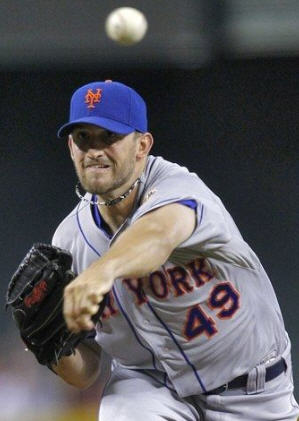 Jonathon Niese: With a contract extension inked early in the season, Niese obviously has a part in the Mets’ future. The young lefty — still only 25 and with over 500 Major League innings on his resume — has pitched like a credible middle-of-the-rotation starter so far this year. Niese faded after July in 2010 and 2011, so the next couple of months could go a long way toward determining whether that’s a pattern or a coincidence. With a solid ground-ball rate and strong rate stats, Niese has pitched to his peripherals with a 3.72 ERA in the first four-plus months of 2012, benefiting from a career-low batting average on balls in play but suffering a bit from a career-high home run per fly ball rate. Both should normalize a bit, but as long as Niese stays healthy and keeps pitching the way he has there should be no doubt of his status in the Mets’ rotation moving forward.
Dillon Gee: Gee had kind of a weird year. The second-year starter struck out way more batters, walked way fewer and yielded more groundballs than he did in his rookie campaign, but the results didn’t quite follow. If he’s done for 2012 after surgery to correct a blood clot in his shoulder, he finishes with an unspectacular 4.10 ERA but a 3.69 FIP and a 3.53 xFIP. Gee’s high strikeout rate was more in line with his Triple-A numbers from 2010, so perhaps, if he returns healthy in 2013, the improvement is sustainable. It allowed him to average nearly an inning more per start in 2012 than he did in 2011 and makes Gee look like a valuable member of a big-league staff. Whether he’s in the Mets’ rotation come Opening Day 2013 should depend entirely on his recovery.
Bobby Parnell: My friend Ripps, a true SABR if there ever was one, sent me this text message a couple nights ago: “It feels like Bobby Parnell should be better than he is but it seems like he is much worse than he is.” I couldn’t put it better myself. Parnell’s blazing fastball and now-nasty-looking curveball have made him by far the Mets’ best reliever this year: He has the best strikeout to walk rate and best ERA of anyone who has been in the bullpen for the bulk of year — faint praise, for sure. Parnell’s few high-profile meltdowns and his unfortunate association with the rest of the Mets’ relief corps have clouded what should be a partly sunny outlook: This will be his third straight season as a capable Major League reliever, and he gets a lot of ground balls, strikes out more than a batter an inning, and doesn’t walk too many. He’s 27 so it seems unlikely he’ll get much better, but he’s under team control through 2016 and good enough that he should be an important part of a Major League bullpen as long as he’s healthy. But it does seem like he’s worse than that, for whatever reason.
Jeremy Hefner: No one outside the Hefner household appears to get too excited about Jeremy Hefner starts, and Hefner himself admitted he wasn’t as good as Johan Santana earlier this week — true, but a surprisingly humble statement from a Major Leaguer. Hefner’s only 26, though, and his 5.04 ERA in 50 innings with the Major League club masks solid peripherals and a strong part-season at Triple-A Buffalo. He throws strikes, which is more than many can say. His lack of strikeout stuff means he’ll likely have to rely on weak contact and a good defense behind him, which could get him in trouble on occasion. But he seems well-suited to the role given to Miguel Batista at this season’s outset: A long reliever and spot starter for the big-league Mets. Hefner’s got options remaining so he could ride the Buffalo shuttle if there’s a roster crunch next season, but he’s good enough to keep around.
Matt Harvey: Even after Sunday’s shaky start, it looks like Harvey will have to pitch his way out of the Mets’ 2013 rotation. Though Harvey hasn’t pitched very deep in games so far at the big-league level, he has shown the stuff to overpower Major League hitters and struck out 23 of them in his first 16 1/3 innings at the level. He’s still a bit wild — walking 3.9 batters per nine both at Triple-A Buffalo and so far in the Majors — but Harvey’s health and performance this season bode well for his future. He looks fit to at least join Niese and Gee as solid young starters in the Mets’ rotation next year with a reasonable shot to be better than both.
Elvin Ramirez: Elvin Ramirez has thrown 12 1/3 Major League innings this year, and though I watch nearly every pitch of every game I can hardly remember any of them. They’ve been pretty forgettable, as Ramirez, who has been wild throughout his Minor League career, has walked more than he’s whiffed in the bigs. That’s not good, and though Ramirez mounted a 1.99 ERA in 40 2/3 innings at Double-A and Triple-A this year, the walks prevent him from looking like a dependable Major League reliever. He’s only 24, so Ramirez still has time, but counting on him to be a part of the 2013 bullpen seems foolish until it’s clear he’s made some improvement or adjustment.
Josh Edgin: Edgin was also pretty wild in the Minors, but he appeared to improve across the season and into his first 12 Major League innings. Sort of by default, Edgin has emerged as one of the Mets’ best late-inning options in the very early part of his big-league career. He’s lefty and he throws hard, which means he likely has a long big-league future. Unless the Mets go crazy for bullpen arms in free agency — and perhaps even if they do — Edgin should be penciled in for the team’s 2013 bullpen. If he performs anything like he has in his first month in his next two, write over that pencil in ink.
Chris Schwinden: If you’re only aware of Schwinden’s three woeful Major League outings in 2012, you don’t know a quarter of the story. After being DFA’d by the Mets in late May, he was claimed by the Blue Jays. He made one start for their Triple-A team, then was waived again and claimed by the Indians. He made three starts for their Triple-A Columbus squad, then was DFA’d in late June. He got picked up by the Yankees, made one start for their Triple-A team before being DFA’d again and picked up by the Mets, the only organization he had known before his whirlwind tour of the highest Minor League level. Schwinden has actually been great in Buffalo this season, boasting a strikeout to walk ratio over three and a 2.19 ERA in 78 innings. His 2012 transaction ledger suggests he can have value to a Major League team as a spot starter or fill-in member of the rotation, but also that teams see him as expendable when rosters get crowded. I’m rooting for him, for what it’s worth.
Pedro Beato: Beato’s seven sporadic outings with the big club in 2012 did not go well, but he’ll be back. He has a 1.97 ERA in Triple-A this year with a 0.906 WHIP, and he’s still got the arm that everyone raved about when the Mets grabbed him in the Rule 5 draft before 2011. Bullpen arms are fickle. Beato could pitch well for a few years in the future and someday earn a “closer” label somewhere and hang around the Majors for years. Or he could prove a Manny Acosta type, good enough to dominate Triple-A and pitch well in spurts at the big-league level. Either way, if he’s around and healthy come February he should compete for a role in the Mets’ 2013 bullpen.
Robert Carson: Carson’s got youth, handedness, arm strength and roster status on his side, but he looked pretty hittable in Double-A and in his insignificantly brief Major League stints this year. His first go-round in Triple-A has gone well over a very short sample, but oddly Carson has had more success against righties than lefties. Lefty relievers often seem to emerge in their mid-to-late 20s, so it’s way too soon to rule out a successful big-league career for Carson. But it’s also way too soon to expect one.
In sum, and despite this season’s bullpen atrocities, the future of Mets pitching looks better than it did last year at this time. If Gee returns to form, the Mets should enter 2013 with at least a solid pitching staff. R.A. Dickey looks like a lock for the front of it, with Niese and Harvey somewhere behind him, and Johan Santana and Gee inked in if they’re healthy. Plus, in Parnell, Hefner, Edgin and Beato they’ve got youngish arms with varying degrees of promise that should vie for bullpen roles. And, in Zack Wheeler, Jenrry Mejia and Jeurys Familia, the Mets have three talented 22-year-old pitchers in Triple-A.
But don’t think about trades. The cliches are true: There’s no such thing as too much pitching and there’s no such thing as a pitching prospect. The best way to build a great staff is to compile as many good pitchers as possible and hope some of them stay healthy. The Mets now appear to have a deep crop of good or potentially good pitchers. Let’s hope some of them stay healthy.
Philadelphia style.
The sandwich: The 50/50 from Jake’s Sandwich Board on South 12th St. in Philly, recommended by Twitter multiple times over.
The construction: Slow-roasted pulled pork, bacon, house sriracha spread and provolone cheese on a sesame-seed hoagie.
Important background information: Jake’s sandwich board features a slew of awesome-sounding sandwiches. I picked the 50/50 because of a sign near the front calling it the Sandwich of the Year in some newspaper or magazine’s poll, and because the two guys ahead of me on line both also ordered 50/50s so it seemed like the thing to get.
Jake’s, which opened in 2010, also offers a ridiculous eating challenge that seems aimed directly at getting the establishment on Man vs. Food. If you can eat a two-foot, three-pound sandwich, four soft pretzels, a box of Tasty Kakes, 24 peanut chews and a large cherry soda in 45 minutes, it’s all free and you get your photo on the wall. If you fail, as almost everyone does, you still get your photo on the wall but with a big stamp on it that says “FAILED.”
When I sat down to await my sandwich, the guys at the next table over were in the midst of a discussion of Jake’s wall of fame and shame. “I don’t see him on here,” one guy said.
“Well, his doctor told him he had to stop,” said another.
What it looks like:

How it tastes: Decadent. Delicious, but spectacularly decadent.
The pulled pork is so tender it hardly gives when you bite it, allowing your jaw to tear through a whole lot of pork in very little time. The meat itself has a pleasant pork flavor with a soft, black-peppery kick, which combines with the “house sriracha spread” — which looks and tastes a hell of a lot like sriracha and mayo mixed — to give the thing an indistinct back-of-the-mouth heat that never quite bites or cuts but is present throughout.
Bacon is bacon, and it’s well-prepared — thin-sliced but layered thickly, crunchy but not overcooked, still oozing grease from its recesses. The provolone cheese is piled on top and I caught myself wishing at times during the first half of the sandwich that they had found a way to better distribute it throughout. By the second half, it melted onto the pork and provided a nice sharp flavor and some creaminess on the other side of the sriracha spread.
The bread was soft, but it wilted in the center under the considerable grease of the ingredients on top. But I’m not sure it’s fair to fault the bread. A yellowish, translucent grease spilled out the back of the sandwich starting with the first bite and pooled up in the wax paper below, ultimately catching some thicker splashes of bright pink sriracha spread to create an ominous, psychedelic lava lamp of grease in the dish.
In my head I could hear the guy at the next table again. “His doctor told him he had to stop.” But I looked at that guy and he was midway through some massive and awesome-looking sandwich. And I looked down at the remaining quarter of mine, wondering what my own doctor would say — almost certainly: “stop!” — then picked it up and polished it off.
I suspect the sandwich is called the 50/50 because it’s even money it’ll kill you. Wouldn’t be the worst way to go out.
What it’s worth: It cost only $8, which is a pretty great deal. It’s obvious every ingredient in there is quality, and if you had more will power than me you could probably make two meals out of it.
How it rates: 77 out of 100. On taste and texture alone it’s a borderline Hall of Famer, but it’s docked points for the associated grease and guilt.
 Tedquarters