Staten Island renting goats

On a sweltering afternoon on Staten Island, the New York City parks department unveiled its latest weapon in the war on phragmites, an invasive weed that chokes the shoreline: goats. Twenty Anglo-Nubians, to be exact. With names like Mozart, Haydn and Van Goat, and with floppy ears and plaintive bleats, they did not seem fearsome. But on Thursday they were already munching inexorably through the long pale leaves in the first phase of a wetland restoration at what will soon be Freshkills Park.

Known for their unending, indiscriminate appetites, the goats are being rented by the city for the next six weeks from a farmer in the Hudson Valley. Parks officials are counting on the goats to clear the phragmites across two acres of wetlands that will eventually be cultivated with native grasses like spartina and black needle rush. The hope is that the goats will weaken the phragmites, setting the stage for another series of assaults on their stubborn rhizomes — applying herbicide, scarifying the earth and laying down sand….

“I’m not a big fan of goats,” said Bernd Blossey, an associate professor of natural resources at Cornell University.

Lisa Foderaro, N.Y. Times.

Unlike natural-resources professor Bernd Blossey, I am a big fan of goats. Look at this goat:

Here’s something you might not know about goats: In addition to being obviously awesome and hilarious, goats are one of the domestic species that most quickly adapts to feral life. The Wikipedia says that among domestic animals, only cats can revert to the wild as swiftly as goats. In fact, that goat photo you see above is a feral goat in Aruba. Australia, apparently, has a big-time feral goat problem.

So while I mean no offense to Staten Islanders here, and while in principle the idea to turn that massive Staten Island landfill into something called Freshkills Park seems like a noble one, I’m definitely, definitely rooting for a mishap wherein several of the goats get loose, then live off the fat of the garbage, mate, and ultimately wrest Staten Island from the hands of the Wu-Tang Clan.

The Garbage Goats of Staten Island, running loose on the street, butting heads with locals, eating up prized shrubberies, saying “meh.”

Also, Van Goat is the best name for a goat.

Shadow hero

It was Edgardo Alfonzo that got me.
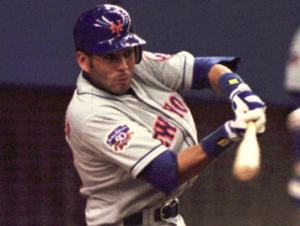
During the Mets’ All-Time Team event Sunday night –- the one that airs tonight at 7 p.m. on SNY, I should say -– Gary Cohen called Alfonzo the team’s “shadow hero,” the guy who always seemed to draw the walk that set up the big hit or drive in the tying run that led to the winning run in the comeback.

And in fact, at the preceding reception and all others I’ve attended like it, most Mets heroes of yesteryear hold court among gleeful fans, smile for photos, point at each other fraternally and generally carry on with the type of understandable bravado developed from a post-baseball life spent encircled by admirers harping on their every word. But Alfonzo, the best second baseman in Mets’ history and an important part of what Sports Illustrated deemed “The Best Infield Ever” — he of over 1,500 hits and an .891 career postseason OPS and countless great games and big moments in orange and blue — seems content to stand or sit in some corner, nursing a drink and picking from the passed hors d’oeuvres like my wife and I do at work-friend weddings where we hardly know anyone.

Thinking about that — and thinking about Alfonzo — got me choked up on my short walk home from the event. I even shed a couple of tears on 89th St., my first since Shea Stadium closed in 2008.

Alfonzo’s only the medium, of course. Most memories don’t come neatly packaged or sharply edited like the baseball highlights shown at Sunday’s event, and there’s no archive we can rely on to summon them when we need them — no play or pause or rewind buttons on our consciousness. And considering Alfonzo, trying to recall his playing days and wondering what it was (and is) about him that pushes him to the margins at these things, inevitably brought back a flood of mostly indistinct memories of my late brother.

Somewhere in my head there’s Chris looking at the roster sometime in the summer of 1995, noticing for the first time that there’s a player on the Mets younger than him and lamenting his fading chances of ever making the Majors. And there’s his voice on the phone from someplace in Texas, providing a recap in exhaustive detail of the dizzy-bat race that won him the broken bat with which Edgardo’s brother Edgar struck his 999th career Minor League hit -– Chris delighting at once in his dizzy-bat victory, the coincidental nature of the prize, and the remarkable fact that Edgardo Alfonzo had a brother named Edgar. And then for just a moment I can see, in crystal-clear high definition, my brother’s grinning face under a Mets hat and backed by the blue seats at Shea, saying, “Fonzie!”

It’s the fleeting feeling of what he was like, and what it was like to hang out with him and b.s. about baseball with him, and it’s the best feeling. And then, when I can’t get it back, it’s the worst.

People say the holidays are the toughest time for missing lost loved ones, but that’s not the case for me. For me it’s right around now, in the crushing New York summer, when school is out and network sitcoms are on hiatus and there’s not much to mark the passing of time besides the steady crawl and awesome enormity of baseball’s regular season. I want to call my brother and talk about it but I can’t.

Then I see Fonzie in the corner and I feel compelled to grab him, hug him, pull him to the center of the room and say, “this guy, here! Does no one here remember how awesome he was? He was our favorite!”

But it would be weird, and it wouldn’t change a damn thing. It thrills me to see Alfonzo in the spotlight at events like Sunday’s because he deserves it, and because it seems like some odd form of validation for my brother’s appreciation of Alfonzo from his rookie year. Then I cry on the walk home because of the awful irony, because no recognition or highlight reel or ceremony can draw my own hero from the shadow for more than a moment.

The Mets, you know, annually seek meaningful games in September. The phrase gets bandied about a bunch, in seriousness and silliness. Naturally, it refers on face to games that impact the pennant race. But really, is any baseball game meaningful? Or is every baseball game meaningful, in May of ’95 and September of ’99 and August of ’03 and in the sticky summer heat at Citi Field last night?

What is any baseball player or baseball itself but a shadow hero behind our appreciation of beauty and greatness and chance, our understanding of joy and community and brotherhood and love? And why would anyone aspire to more?

N.Y. Times food critic reviews Doritos Locos Taco

William Grimes writes, “The meat filling just lay there like ballast, but the lettuce was fresh and crisp and the grated Cheddar had an assertive tang. In other words, for what it is, the Doritos Locos taco is pretty good.”

Here’s my thing: I’m casting a broad net here, and Grimes typically writes good, accessible stuff for the Times, but I think this and all other “serious” food criticism about Taco Bell would strongly benefit from a little background about the author’s history with Mexican-inspired fast food. In other words, when was the last time Grimes ate Taco Bell?

Because it strikes me that any food critic who hasn’t been to a Taco Bell since his teenage years — and has since, perhaps, come to judge the place — would be struck upon first bite by how delicious the food is and assume that Taco Bell is doing something new and different. But meanwhile Taco Bell has been awesome all along.

Which is to say: Hey New York Times, call me if you ever need a Taco Bell review in the future. I’ve got you covered. Trust me, I’ve done my research.

Link via Brad Z.

Foul play suspected in Bieber-Putz episode

OK, I know what some of you are thinking. This story has gone from “charming, oddball coincidence” to “too good to be true.” It was one thing that Putz just happened to pull a random and precious Bieber autographed card from some boxes that Panini employees just happened to hand one of his Twitter-happy teammates. But now, instead of giving his girls the card, Putz is taking them to a Bieber concert that just happens to kick off a tour starting … in Phoenix, where perhaps the whole Putz clan could meet Justin Bieber and get another autograph.

We are to believe that these are just a series of coincidences? Somebody might have gotten played.

David Brown, Big League Stew.

My headline initially called it the “Putz-Bieber episode” but I figured the “Bieber-Putz episode” would be much better for search engine traffic.

From the Wikipedia: Fan death

This one comes via Devon Edwards. If you stumble upon a strange or interesting or funny or suspiciously exhaustive Wikipedia page, please send it my way.

From the Wikipedia: Fan death.

Fan death, here, refers to “the widely held belief in South Korea that an electric fan left running overnight in a closed room can cause the death of those inside” and not the Vancouver-based synthpop band Fan Death.

According to the Wikipedia, fear of fan death runs so deep in South Korea that electric fans sold there are often equipped with sleep timers that consumers are urged to use for safety. As recently as 2006, the government-funded Korea Consumer Protection Board published a report citing fan death as one of South Korea’s top five most common summer seasonal accidents, claiming that 20 cases of fan (or air-conditioner) death were reported between 2003 and 2005. In fact, per Snopes.com, South Korea’s leading fan manufacturer even prints a warning label on its fans that reads, “This product may cause suffocation or hypothermia.”

About that: It doesn’t. Fans don’t kill people; people kill people. Also, heart and lung disease and old age and drug addiction kill people. Dr. Lee Yoon-song, a professor at Seoul National University’s medical school, has performed autopsies on several of the supposed victims of fan death and found that most of them “already had some sort of disease.” As he explained:

Korean reporters are constantly writing inaccurate articles about death by fan, describing these deaths as being caused by the fan. That’s why it seems that fan deaths only happen in Korea, when in reality these types of deaths are quite rare. They should have reported the victim’s original defects such as heart or lung disease, which are the main cause of death in these cases.

The Wikipedia page features a bunch of other doctors saying similar things. Essentially, fans can not cause death by hypothermia because fans don’t actually lower the temperature of the rooms they’re in and because someone doomed to death in his sleep from hypothermia would most likely wake up long before that happened from the cold and go find another blanket. And fans can not cause death by asphyxiation because they don’t change the constitution of the air in the room and very few non-astronauts sleep in airtight chambers anyway.

Most likely, it seems, South Korea has on its hands one of the greatest and most widespread cases of confirmation bias in recent history, perpetuated, apparently, by the media. People die in their sleep all the time everywhere, for a variety of reasons. When it happens in South Korea with a fan or an air conditioner running, someone inevitably says, “oh no! Another fan death.”

The Wikipedia isn’t clear on this, but I assume many or most South Koreans today realize that fans don’t actually kill people and that the urban legend lives on as an old wives tale and/or a force of habit. This is, after all, the contemporary culture that has provided the world, among other things, delicious food, hundreds of awesome and crazy-ass horror films, a growing appreciation for food bloggers, Shin-Soo Choo and my car.

Plus, every time I swallow gum I consider how it’s going to stay in my intestines for seven years even though I know that’s not true, and I try to give myself time between eating and swimming and I nod knowingly when someone mentions that we only use 10 percent of our brains.

Which is to say that people — or me and maybe some South Koreans, at least — have a weird way of continuing to act like they believe something even long after they stop believing something. In South Korea, it so happens that some people think fans left running in the night will kill you. I, for one, need the white noise.

Oh, where did the urban legend come from? No one’s entirely sure, but some believe it was spread by the government during a time of high energy prices in the 70s. If that’s the case, all blood from fan death is on the South Korean government’s hands. Luckily there isn’t any, because fans still don’t kill people.

The R.A. Dickey phenomenon

Around 3:30 p.m. on June 1st — a few hours before Johan Santana threw the first no-hitter in Mets’ history — I stood on the warning track in foul ground at Citi Field, just toward the right-field side of the first base, milling about. I knew Carlos Beltran, in his first trip back to Flushing since his departure last July, would address the media at some point, and because the producer who usually keeps me in the loop on these things had that day off, I didn’t know when. So I took that and the lack of other pressing responsibilities as an excuse to stand near the Mets’ dugout and see what I could see.

There was Josh Thole, returning to the club after a stint on the disabled list for a concussion, assuring a couple of stray media that he felt great. There was Elvin Ramirez, visiting the stadium for the first time as a member of a Major League club, introducing himself to teammates, getting acclimated. There was Ruben Tejada, running and skipping and hopping on the outfield grass for Terry Collins and Ray Ramirez.

And there was Dickey.

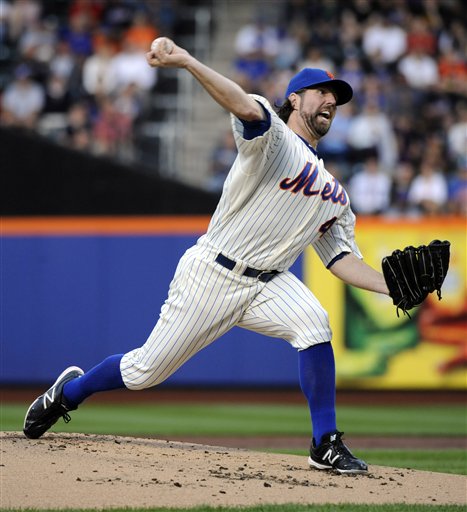
At some point, R.A. Dickey and Mike Nickeas took to deep right field where Dickey long-tossed knuckleballs to the enthusiastic catcher. In front of a cadre of smiling coaches, Dickey’s throws fluttered and danced and darted and dove and cut and sliced, sometimes all on one toss. Some appeared to freeze in mid-air before plummeting — Wile E. Coyote off the cliff. Some looked like they somehow actually shot upwards in flight, as if propelled by some second force after Dickey’s fingertips.

From a distance, all except the reserved Dickey appeared delighted. It was delightful. Even knowing what I do about knuckleballs, I found myself subconsciously searching the air for strings, evidence of fraud. How could this possibly just be air currents? How could a baseball move that way? How could anything?

For a lifelong baseball fan like myself, the best thing among many great things about this job is the up-close appreciation it gives me of just how phenomenally good Major League Baseball players are at playing baseball. And now R.A. Dickey, the league’s only knuckleballer, is performing as its very best pitcher. Even his off-day workouts are something spectacular to watch.

This guy, Dickey, who endured sexual abuse as a child, who starred with his fastball in college despite his lack of an ulnar collateral ligament, who lost his first-round signing bonus but made a go of it anyway, who once considered suicide, who abandoned conventional pitching in 2005, who loves Star Wars and Hemingway and appreciates Havarti cheese, now leads the Majors in wins, ERA, strikeouts, WHIP, and complete games.

It’s a series of odd angles and seemingly impossible turns crazy enough to make his knuckleball look mundane. What’s happening now, every fifth day in 2012, is something special. Enjoy this.

Taco Bell Tuesday

Happy Taco Bell Tuesday everyone!

An entertaining Reddit thread yesterday sparked some discussion around the Internet: What wine pairs best with a Crunchwrap Supreme?

I’m all for the coming of the Franchise Wars and the long-awaited elevation of Taco Bell to haute cuisine, obviously, but I’m ill-fit to weigh in on this one. I’m not a big drinker and when I do drink, I rarely drink wine. Sometimes I’ll partake to be social, and people will start talking about the earthy bouquet and such, but it always just sort of tastes like wine to me. Some wines go down smoother than others, I’ll amount, but outside of a few choice bourbons, I find most alcoholic beverages primarily a means to an end.

(For that matter: I have no taste for craft beer either. For some reason there’s a huge overlap between baseball-blogger types and craft-beer enthusiasts, enough so that people hear you blog about baseball and just sort of assume you’ve got all sorts of considered opinions about craft beer. I like the beers that taste the least like beer. And if I’m at a bar where I can’t readily identify any of the available beers, I’m lost. I usually point to something someone else is drinking that looks light and say, “I’ll have that one.”)

All that said, I suspect Taco Bell pairs best with a cold 40-ounce of Olde English 800, or at least it sure seemed to back in the days when I more regularly enjoyed malt liquor and late-night Taco Bell. And I don’t think my appreciation for Taco Bell then had much to do with the flavor combinations and the way the Olde E sat on the palate. That predated the existence of the Crunchwrap Supreme, though.

The good news is that if you are a wine drinker and do hope to sit down with a Crunchwrap Supreme and a well-paired glass, wine-guy Gary Vaynerchuk has you covered:

In more pressing news, Taco Bell is testing two new versions of the Doritos Locos Taco: the long-anticipated Cool Ranch and the heretofore unheard-of-by-me Flamas flavor. FoodBeast has tried them both.

The Flamas flavor is apparently a combination of hot chili and citrus, which would sound way better to me if I hadn’t recently sampled a bag of Chile-Limon Doritos Dynamita while in Phoenix. Dynamita apparently means traditional Doritos rolled up into a taquito shape, vaguely resembling dynamite*. Unfortunately, the flavor sucked. It tasted like nuclear fallout soaked in artificial lime flavor. I don’t know for sure that Flamas is the same, but since the combination sounds suspiciously similar, I will proceed with skepticism when the flavor comes to my local Taco Bell.

The Cool Ranch sounds a lot more intriguing. I don’t see how the flavor will overcome the saltiness and dryness issues that plagues the Nacho Cheese version of the Doritos Locos Tacos, but since everyone knows Cool Ranch Doritos are better than Nacho Cheese Doritos, it looks to be an upgrade over the original. Plus I suspect the flavor, tangy as it is, is less redundant with the seasoned beef stuff.

I’d also be down for checking out that Sweet and Spicy Thai Chili Doritos as a Doritos Locos Taco, for what it’s worth. Asian-inspired/Mexican-inspired fusion. Are you listening, Taco Bell? It’s me, Ted.

*- You may remember that the term “taco” is believed to come from Mexican mining communities, named after a form of dynamite.