In case you haven’t heard: Jamie Moyer is incredibly old

Real facts about 49-year-old Jamie Moyer have overtaken fake facts about Chuck Norris as the Internet’s darling, but this one is particularly awesome.

Still, it’d be cool to see it contextualized. Is that the record? What pitcher has faced the highest percentage of all hitters in Major League history? It’d seem to favor guys with long careers in the contemporary baseball era, since there are more teams now and thus more hitters to face, plus more guys switching leagues more frequently and Interleague Play.

Per the baseball-reference play index, only Javier Vazquez and Livan Hernandez have thrown more innings than Moyer since Interleague Play started in 1997, but Moyer got a 10-year jump on both of them so it’s pretty safe to say he faced more hitters. Greg Maddux started in 1986, like Moyer did, and finished with nearly 1000 more innings pitched than Moyer has thrown to date. But Maddux pitched his whole career in the National League, which probably hurts him.

The only candidates who could rival Moyer in percentage of all-time Major League hitters faced are probably Randy Johnson and Roger Clemens, both of whom started in the late 80s, lasted through the late aughts, threw more total innings than Moyer has so far, and spent time in both leagues. Johnson pitched about an even number of innings in the NL and the AL, so he he seems most likely of all. But then obviously his career didn’t span the length that Moyer’s has.

Anyone I’m missing? I’m assuming the sheer difference in innings means longtime relievers like Darren Oliver and Arthur Rhodes can’t come close to Moyer or the other starters. But if anyone knows a better way to figure this out, I’m all ears.

Also, the one Jamie Moyer old-man stat I can’t get past is this one: Moyer made three starts against the 1986 Mets. He went 1-0 with a 3.74 ERA in 21 2/3 innings.

Supreme Court Justice breaks from mind-numbing legalese to take misguided cheap shot at Mets

Truth be told, the answer to the general question “What does ‘not an’ mean?” is “It depends”: The meaning of the phrase turns on its context. . . . “Not an” sometimes means “not any,” in the way Novo claims. If your spouse tells you he is late because he “did not take a cab,” you will infer that he took no cab at all (but took the bus instead). If your child admits that she “did not read a book all summer,” you will surmise that she did not read any book (but went to the movies a lot). And if a sports-fan friend bemoans that “the New York Mets do not have a chance of winning the World Series,” you will gather that the team has no chance whatsoever (because they have no hitting). But now stop a moment. Suppose your spouse tells you that he got lost because he “did not make a turn.” You would understand that he failed to make a particular turn, not that he drove from the outset in a straight line. Suppose your child explains her mediocre grade on a college exam by saying that she “did not read an assigned text.” You would infer that she failed to read a specific book, not that she read nothing at all on the syllabus. And suppose a lawyer friend laments that in her last trial, she “did not prove an element of the offense.” You would grasp that she is speaking not of all the elements, but of a particular one. The examples could go on and on, but the point is simple enough: When it comes to the meaning of “not an,” context matters.

Supreme Court Justice Elena Kagan, Caraco Pharm. Labs. Ltd. v. Novo Nordisk.

OK, first of all this is like the dumbest f@#$ing thing I have ever read. And I get that half of you are lawyers and there’s probably some legal reason why the distinctions in possible implied meanings of “not an” needs to be detailed in such thorough fashion, but c’mon. This case really made it to the Supreme Court without anyone hashing that out? There’s no legal precedent she can cite that covers how sometimes “not an” means not any and sometimes it means not one specific thing? This is what Supreme Court Justices do?

Second, after she gives two perfectly apt examples of what she’s talking about, she throws in a totally unnecessary joke about the Mets. And I’m all for lightening the mood at Supreme Court proceedings, but, again: c’mon. Stale, and too easy. Jokes about the Mets for people who can’t make lawyer jokes are like lawyer jokes for everyone else.

Moreover, Kagan’s a Mets fan, so you’d hope she’d have a little better sense of what she was talking about. DOES THE SUPREME COURT NOT CARE ABOUT ACCURACY ANYMORE? Hitting is the one thing the Mets do have!

If she said “the team has no chance whatsoever (because they [sic] have first basemen at four positions, shaky starting pitching and play in a tough division),” then she’d get a pass, a frustrated but reasonable fan airing her grievances wherever she finds a platform. But no. Supreme Court Justice Elena Kagan thinks the Mets can’t hit even though the Mets can hit. And I’m just going to go ahead and assume she retires to her quarters to call WFAN to demand the Mets trade David Wright.

Let’s hope The People vs. Carlos Beltran never goes to the highest federal court because I suspect Kagan’s going to rule on the wrong side of that one.

Via Bill.

A glimmer of hope

From Ryan via Ezra Klein comes and IBIS World report of the 10 fastest-growing industries in the United States. Some make sense, some are kind of silly, others are kind of depressing, one of them both speaks well and bodes well for all of us:

McIlhenny, you may know, is the Major Industry Player responsible for Tabasco products. Reckitt Benckiser, it turns out, is responsible for a bunch of household cleaning products, French’s mustard and — relevant here — Frank’s Red Hot.

The report suggests the hot sauce industry “has heated up” due to:

demographic consumption trends, immigration and international demand from Canada, the United Kingdom and Japan. As Americans’ palates have become more diverse, hot sauce has earned tenure on the dinner table. Demand from supermarkets and grocery stores has reflected the change in consumer taste, and food retailers are dedicating more shelf space to ethnic cuisine…. Hot sauce production isn’t expected to burn out any time soon.

Good case for serial commas in that excerpt. The way it is, it sounds like the increase in hot sauce consumption is in part due to a bunch of Canadian, British and Japanese people moving here and enjoying tons of hot sauce. And hey, maybe that happens. Who could blame them really?

I, for one, would welcome an economy based on hot sauce and self-tanner. Everything and everybody would have a delightful orange hue. And our stomachs will be strong inside and out, from all the spicy food and pilates. Maybe the future doesn’t suck so hard after all.

For what it’s worth, I’m currently keeping four hot sauces at TedQuarters: Frank’s, sriracha, Cholula, and the one I made myself. Also, I found it way easier to mention my love of Cholula on this site before they became an SNY sponsor, but it really is good.


Mets to infuriate fanbase with tribute to once-loved player

The Mets are apparently planning a video tribute to Jose Reyes upon his return to Citi Field on April 24, and people aren’t happy about it.

Personally, I’m finding it difficult to get too worked up one way or the other. Maybe it’s because the Mets are 7-3 and Ruben Tejada’s leading the league in doubles. Maybe it’s because I try not to get too upset over frivolities.

I get that it’s weird to pay tribute to a guy who just skipped town to take more money to play for a rival, but at the same time I’d way rather watch video highlights from Reyes’ time with the Mets than whatever else they’re showing on the video board, entertaining though the 800-Flowers Kiss Cam may be. You guys remember that Jose Reyes was awesome at baseball for the Mets, right?

[poll id=”105″]


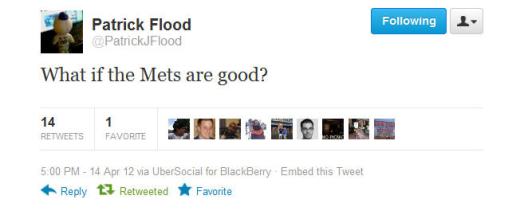
What if the Mets are good?

Ten games into the 2012 campaign, the Mets are 7-3. It’s the time of the season when tiny samples drive our irrational baseball-fan minds to crazy and wonderful places, no matter how often we remind ourselves that many ultimately crappy teams have started better or that 10 games into 2010 Jeff Francoeur had a .535 on-base percentage. And the backlash to the small-sample frenzy — in which I frequently participate — is often so obnoxious and vigorous that it seems unnecessarily grouchy at a time when many fans just want to enjoy their fantasies while they last.
So let’s look at it this way: These 7-3 Mets are the same team that entered the season to low expectations, sure, but those seven wins are banked. The gambler’s fallacy would suggest that the Mets are now more likely to endure a rough stretch after starting the season hot, but rolling three sixes in row doesn’t make the fourth any less likely.

Which is to say that if the Mets perform exactly like the 74.5-win team foreseen by Vegas from here on out — that is, they play to a .460 winning percentage starting now — they win 70 of their remaining 152 games (actually 69.9, but I’m rounding up) and finish the season 77-85. So still not great, but hey, the over.

If the Mets can just muster .500 ball for the rest of the season — you can probably do this math yourself — they finish 83-79 and stay on the fringes of contention until late in the year, and a lot of breathless haters full of authoritative preseason predictions have a lot of explaining to do.

And if these 2012 Mets can somehow manage just one more 7-3 stretch like this one at any point in the season while playing precisely .500 ball for the rest of it, they’re an 85-win team — good enough for postseason play in two of the past 10 seasons in the National League if the new two-Wild Card system were in place.

Maybe that’s a small payoff for what still seems something of a longshot, but then the on-the-field part of the Mets’ early success and our first exposure to their feared division rivals help it seem at least conceivable.

This is where our imaginations run wild: With the Phillies relying on old, injured players and burying their prospects behind veterans like a vintage late-aughts Mets team and the Braves and Nats peppering their offenses with out-machines, the Mets’ lineup appears to rival the Marlins’ for the division’s deepest. The Mets’ defense doesn’t look great, with some lousy defenders and some guys out of position, but the Marlins and Nationals have some lousy defenders and some guys out of position, too. And the Braves have Chipper Jones, Dan Uggla and Freddie Freeman starting in the same infield. (The Phillies’ defense is good.)

The Phillies clearly have the division’s best pitching staff. The Mets… well, they don’t. But they have a constitution some of their competitors lack, with two starters that seem safe bets to throw around 200 innings, two that have stayed mostly healthy for the past two years, one that is Johan Santana, and a nice blend of ceilings and floors at the high levels of their Minor League system.

That’s squinting at the 7-3 team and seeing the best, of course. And it’s the inevitable fallout of a hot start: What once seemed very unlikely now seems just unlikely.

And naturally, it’s that pesky way small fragments of seasons can mess with our heads. All of this could fall apart at any time.

But every day David Wright keeps hitting provides more evidence he could enjoy a rebound season, every double Ruben Tejada lashes in the gap suggests he’ll hit more of them, every game Kirk Nieuwenhuis plays like a Major Leaguer makes it more likely he is one, and every Santana start without incident means another.

It’s 10 games, less than 1/16th of the season, and precious little evidence with which to make any bold declarations about the rest of the Mets’ 2012 season. But little evidence is evidence nonetheless, and most of what we have so far is good.

So that’s cool.

 

Just curious

This is a silly hypothetical, but say you were managing the Mets in a single-elimination relegation game — the very existence of the franchise depends on winning this one baseball game and for some reason you’re calling the shots, high-pressure stuff. Andres Torres is healthy and Kirk Nieuwenhuis was sent back down to Triple-A, so you’re basically working with the Mets’ Opening Day roster. Oh, and Lucas Duda already told you that it’s really important to him to play right field, so if you want his bat in the lineup he has got to be there.

Your opponent has a good but not spectacular rookie right-hander set to start. No one on your team has faced him before.

Who’s playing left?

[poll id=”104″]

Everyone high-five your local third baseman

As of Saturday morning, it looked as if David Wright was heading to the disabled list with a broken pinkie and the Mets were going to shift Daniel Murphy to third base in his absence. That would mean, if you agree with the editorial thrust of this site, two items of bad news very early in a Mets season otherwise rife with unfamiliar positivity.

But then Wright, who couldn’t even grip a bat on Friday, showed up Saturday all like, “nah, I’m good,” and required exactly one pitch from Vance Worley to show the world he wasn’t kidding.

Wright is, at 29, the team’s all-time leader in offensive WAR and total bases. He is second in batting average, third in OPS, second in runs scored, second in RBI, third in hits and fourth in home runs.

Whenever Wright leaves, he will depart either arguably or definitely the best position player in Mets’ history. And he’s the type of dude who plays through broken backs and broken pinkies — the guy who, according to Terry Collins, was eager to pinch-run last week when he couldn’t do anything else with his swollen finger bandaged up. And he turns the other cheek when the owner of the team rips him in the New Yorker, and says nothing when the club opens up a park that seems expressly designed to sap him of his extra-base power.

Wright set an absurdly high standard in 2007 and 2008, failed to match it despite solid seasons in 2009 and 2010, then endured an injury-riddled and merely OK 2011.

But, though every small-sample-size caveat applies, Wright’s season-opening hot stretch provides the dwindling legion of Mets fans still rooting for the Face of the Franchise with some hope he can return (or has already returned!) to being the MVP-caliber player he was a few years ago.

And I could try to draw all sorts of big-picture conclusions about what that would mean for Wright’s rumored contract-extension talks and the team’s chances in 2012, but it all really boils down to this: That would be cool.

Sandwich? of the Week

The candidate: Mami Arepa from Arepas Cafe, 33-07 36th Ave. in Astoria.

The construction: Venezuelan roast pork, shredded white cheese and avocado in an arepa.

Arguments for sandwich-hood: Meat and cheese in bread-type stuff. The bread-type stuff is on both sides of the meat and cheese, and it’s clearly made to be eaten with the hands. Though it’s called an arepa, the focus is obviously on the stuff inside over the stuff outside.

Arguments against: It’s called an arepa, not a sandwich. Ho hum. There’s only one bread-thing (the arepa), it is made from cornmeal, and it’s sort of a pancake/muffin hybrid, and not very bready.

How it tastes: Unsauced, it was good. The wedge of the arepa made proper ingredient distribution difficult, so the first few bites were mostly cheese and avocado and the last few were almost entirely pork. None of those ingredients stood out, but they were all tasty: The pork lightly seasoned and pleasantly chewy, the cheese salty and creamy, the avocado smooth and, well, also creamy.

Before the waiter brought the arepas, though, he put two sauces on the table: A green sauce and an orange sauce. The green sauce tasted garlicky and a little like my prized pio pio stuff, though a touch heavier on the mayo and lighter on the spice. The orange sauce had a jelly-like consistency, with some sweetness and a ton of heat.

In conjunction and carefully applied to the arepa, they made the thing delicious — not just because the sauces tasted good, but because they amplified the stuff inside. I never really understand how this works, but somehow with a little bit of spice, pork tastes porkier, cheese cheesier, everything. There’s probably a life lesson in there but it’s Friday at 5 p.m.

For a few bites, when the sauce is working and all I’m taking down all three ingredients, this is borderline hall-of-fame level stuff. The arepa itself is a perfect vehicle for the melange of flavors inside, too: It’s griddled to crispiness on the outside and holds up under saucy duress giving it almost a panini-like effect, but then it’s got a thin, mealy, soft inside like a johnnycake.

But due to the aforementioned uneven distribution that seems intrinsic to this medium, those bites were fleeting. The rest was still really good though.

What it’s worth: If I recall correctly, around seven bucks. And it’s definitely a meal, though not a huge one.

The verdict: A sandwich. If a gyro’s a sandwich this one’s a no-doubter.


Murphy should play second

We talked about this on the podcast some but I wanted to hash it out here for those who don’t listen. And this post could be rendered useless as soon as this afternoon if the Mets determine that David Wright can play through his pinkie fracture. But if Wright needs a stint on the disabled list, Terry Collins should not move Daniel Murphy to third base in Wright’s absence, as he has suggested.

I write this realizing that Murphy has not looked good at second in most of the season’s first six games, and that keeping him there and using Ronny Cedeno or Justin Turner at third would mean playing two infielders at relatively unfamiliar positions when simply switching them would make both more comfortable and save the team runs in the short term.

And if the Mets were six games into a season in which they looked likely to compete for a division title or Wild Card berth, where they should be scrapping for wins every game, the move would make sense. But this is not that type of year, and if the team was content to open the season with Murphy at second, six games should not be enough evidence to change anyone’s mind.

Collins’ job is to make the most of the guys he has, so any inclination on his part to move Murphy to third makes sense. But since Wright’s injury does not seem to be (wood knocked, fingers crossed) a long-term thing, the Mets will need to find someplace to play Murphy when Wright returns. That most likely means a return to second base for Murph, only with a couple weeks away from the position and perhaps — for whatever it’s worth — some doubts about his team’s confidence in his ability to handle the position.

Even if it means sacrificing some runs in the short term, the Mets should make it clear to Murphy that he’s their second baseman no matter what happens. That means keeping him there while Wright’s out and using Turner or calling up Zach Lutz to play third, understanding that while it may not be the best thing for the Mets’ chances on April 13, it is almost certainly best for their chances in August, and in 2013.