Something to consider while you watch Eli Manning

Earlier this week, Mike Salfino at SNY Why Guys pointed out that Mark Sanchez and Eli Manning had identical QB ratings after their first three seasons in the NFL. Then, Chris Matassino added that Giants backup David Carr was only a touch better than the pair.

Sanchez stunk for long stretches of this season, but Eli stunk for parts of his early career too and now looks like one of the best quarterbacks in the NFL. I think the most important thing to remember is that a quarterback’s performance — and stats, of course — is massively impacted by the play of his teammates and the schemes in which he plays.

It’s not entirely sensible to defend Sanchez for the way he played this year, but given the woefulness all around him on the offense, it’s also probably not fair to cite this season as evidence for why he’ll never be a successful NFL quarterback.


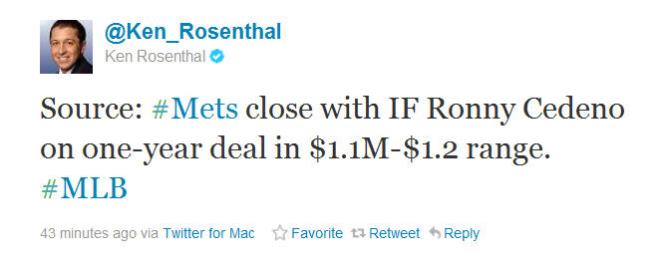
And we’re talking about the Mets’ last bench spot on Jan. 9

The Mets bench now looks something like this:

C — Mike Nickeas
IF — Ronny Cedeno
IF — Justin Turner
OF — Scott Hairston
OF — ?

As it stands right now, Mike Baxter seems likely to edge out Josh Satin for that fifth spot, if only because Baxter’s lefthanded-batting-ness and outfielder-ness fit better on the righthanded-hitting heavy bench.

Patrick Flood, PatrickFloodBlog.com.

Yikes — doesn’t look so pretty when you spell it all out like that. Each guy is defensible in his role, but outside of Hairston there’s really not a lot of offensive might there. Turner can get on base a bit, which is useful.

But like Patrick points out, they’re all right-handed. And given the way Terry Collins relies on platoon matchups with his pinch-hitters, expect to see a left-handed hitter given that fifth spot, and expect that left-handed hitter to get hell of a lot of opportunities off the bench.

After the Hairston signing last week, some discussion surfaced over whether the Mets should or should not (and would or would not) re-sign Willie Harris, but if they’re going to carry Cedeno and Turner, there’s no real solid case for adding Harris to the roster. With two backup infielders in the fold, Harris’ defensive versatility becomes less valuable, and it can’t be that hard to find a better hitting lefty bat on the cheap.

Based on the Mets’ needs, they’ll likely be looking to fill that last spot with a guy who can hit left-handed and play at least a vaguely passable center field, depending on how comfortable they are with Hairston as the backup in center. Looking at the remaining free agents, it doesn’t seem like there are a lot of guys in their price range likely to do either of those things way better than Mike Baxter. Plus Baxter brings the additional upside of being 27 and under team control, so if he succeeds in the role he could fill it for a while.

Of course, a lot can still happen between now and Opening Day, and something almost always does.

Food for thought

Jon from Brooklyn baseball brought up an interesting discussion at the bar on Saturday night. Say instead of separate sports with distinct teams, the professional sporting ranks were operated like his summer camp, where kids were split into teams at the beginning of summer and had to compete against each other (always in the same teams) in a variety of sports.

For the purposes of debate, narrow it down to the four “majors” in the US: football, baseball, basketball and hockey. So say for some reason the NFL, MLB, NBA and NHL (and all international leagues) crumble, and you’re named a GM in the new all-encompassing super-league. The ping-pong balls fall your way and you get the top overall draft pick. Who do you take?

Lebron James seems like the obvious call, but a) we have no idea if he can ice skate or hit a baseball and b) then you’d have to have him on your team. Also, how valuable are the most specialized skills — pitching, for example — when they only pertain to 1/4 of the activities?

Oh, and I guess you’re going to have to split that up somehow. Let’s say these teams play four football games, 40 baseball games, 20 basketball games and 20 hockey games — essentially 1/4 of each league’s season — but they’re weighted so that the outcomes in each sport count evenly. So the schedule’d be something like: Baseball, basketball, baseball, hockey, baseball, basketball, baseball, hockey, baseball, football, baseball, basketball, baseball, hockey, baseball, basketball, baseball, hockey, baseball, basketball, hockey. Repeat.

Current players only, or else we all want Bo Jackson.

Mets close to signing Ronny Cedeno for some reason

Yeah?

I guess that would mean the Mets feel Cedeno is that much more valuable than Omar Quintanilla at the minimum, and hey — maybe he is. Cedeno can’t hit, but he seems to be a pretty good defender at shortstop and second base. UZR has him a tick above average at short for the last three years, for whatever that’s worth, and Dave the Pirates fan from my baseball game in Brooklyn references Ronny Cedeno whenever anyone makes a nice play on the infield. (Dave’s a pretty astute baseball guy so that probably carries similar weight to UZR.)

Get up for the Ronny Cedeno show. Suck it, Jack Wilson.

I should’ve slept more last night.

A plea for bacon at Shake Shack

Drew Magary at Deadspin wonders why Shake Shack does not offer bacon. Language predictably NSFW.

It’s a valid question. Readers of this site must know how I feel about bacon, what with the way I write about bacon like once a week and talk about it in nearly every podcast and even smoked my own bacon that one time. But oddly, I’ve never finished a Shake Shack burger and thought, “man, I really wish that had bacon.”

I’ve certainly wished bacon was available at Shake Shack while looking at the menu board, because immediately when I see a list of burgers my instinct is to scroll down until I see mention of bacon. But everything about the Shackburger feels so perfect when I’m eating it that I never want anything additional that might throw off its delicate balance of awesomeness.

For what it’s worth — and to demonstrate my commitment to bacon cheeseburgers, lest it be doubted — I remember the first time I ever ate a bacon cheeseburger. I was nine years old and eating at the Friendly’s in Manchester, Vermont with my family.

I often ordered bacon cheeseburgers before then. I really liked bacon and I really liked cheeseburgers, but my nine-year-old mind couldn’t process the idea that they might taste good in conjunction, so I’d pull the bacon off the cheeseburger and eat it as a delicious little appetizer. This particular time in Vermont, my brother noticed me pulling the bacon off and convinced me to try the cheeseburger with the bacon in place, and then… well, holy f@#$ing s@#$, that’s synergy.

The Friendly’s is still there, though I think it has been remodeled by now. I even remember where in the Friendly’s we were sitting that evening and how every member of my family was oriented at the table when it happened. Sort of a pivotal moment, you guys.

Sandwich of the Week?

A new take on an old feature, in part inspired by a conversation I had with Scanwiches creator Jon Chonko before our Q&A session a couple weeks ago. It turned out Jon and I had different definitions of what constituted a “sandwich,” and though I tried, I could not express what I thought made a sandwich a sandwich. I operate with a relatively liberal definition of the term, but I rely mostly on the ol’ Potter Stewart “I know it when I see it” instinct.

Anyway, since I fear much of the sandwich writing on this site is growing stagnant, and since I never intended the sandwich reviews to be mistaken for legitimate food-criticism so much as food appreciation and investigation, I figured I’d endeavor something a bit different in 2012: Eating and discussing various sandwichy foods and determining whether they are in fact sandwiches to work toward a distinct definition of the term.

A lofty, perhaps unobtainable and entirely semantic goal, I realize. But the truth is, nearly every man on my father’s side of my family besides me has been an architect or an engineer (the two exceptions are SCUBA divers, incidentally), and while the math part of those fields failed me, the appreciation for them did not. I suspect my sandwich-making success while employed at the deli came thanks in part to those engineering instincts, what with the sense of proportion and structure necessary to conceive and construct great sandwiches.

So I hope spending more time thinking about the way sandwiches are built — and the way non-sandwiches are built — can provide me further insight into how to build great sandwiches, which I will then also probably detail here because really I just don’t lead that interesting a life.

There’ll still be traditional TedQuarters sandwich reviews when appropriate, of course.

The candidate: K roll from Buddha BBeeQ, 2nd Ave. between 91st and 92nd in Manhattan.
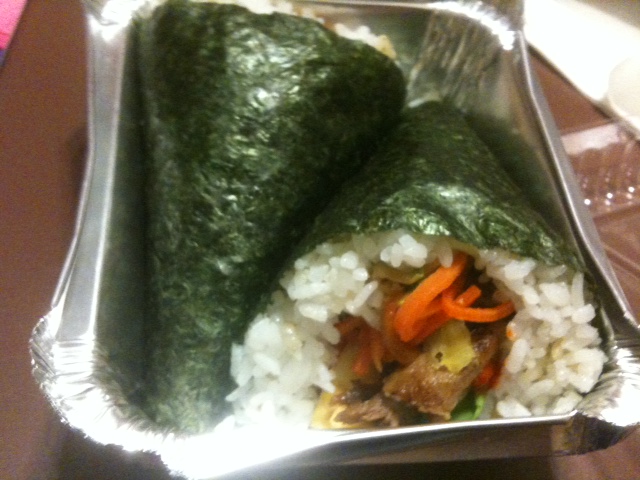
The construction: Large piece of nori (seaweed) wrapped into a cone shape, stuffed with a layer of rice, marinated and grilled Korean beef, and assorted vegetables. I ordered mine “spicy,” which meant there was some thickish red hot sauce in there.

Arguments for sandwich-hood: The K Roll features meat (and vegetables) wrapped in starch and it can be eaten with the hands without too much mess.

Counter-arguments: With or without fish in there it’s pretty clearly sushi, and if you’re extending the definition of “sandwich” to include all sushi that can be picked up with the fingers, you’re heading down a foggy road on a dark night.

How it tastes: Kind of confusing, honestly. I like sushi, and I love the flavor that every Korean beef has that I still can’t put my finger on (seriously, can someone tell me what this flavor is?). But the K Roll takes some getting used to, because the seaweed on the outside brings you to the ocean and hands you a fishing pole, and then you reel in a cow and some pickled vegetables.

The beef tasted good and the proportion of beef to vegetables seemed about right, and it had about the right amount of spice to keep things interesting without getting out of hand.

But the texture seemed off: It required a lot of nori to keep the K Roll intact, so the outside layer was a bit chewier and filmier than I’d hoped. The Wikipedia entry for sushi stresses that temaki rolls — this style — should be eaten immediately after its prepared so the nori doesn’t lose its crispness. I took this home before eating it, so maybe that’s on me. Still, I only live a few blocks away.

There was also a lot of rice here, which works fine with sushi when you’re dipping it in soy sauce and wasabi and in burritos when it gets all mixed up with delicious burrito-stuff, but it made parts of the K Roll kind of dry. They included a packet of soy sauce with the order, so I shot that into the second roll, which made the rice wetter and the whole thing saltier and soy saucier and thus more delicious.

On the whole, pretty good, but not nearly the best thing I’ve had from Buddha BBeeQ, which has so far proven to be one of the better and more interesting takeout places in my new neighborhood.

What it’s worth: The K Roll cost $8. It’s a little small to be a full dinner for a hungry person. Probably the type of thing you want to order with an appetizer, or to share if you’re into the family-style thing. You can figure that stuff out though, you’re smart.

The verdict: Not a sandwich. Still a perfectly pleasant item of food, but I’d say that the nori/rice wrap is not close enough to bread to make this a sandwich. They’re too prevalent a part of the eating experience here, whereas I feel on a sandwich the bread is in most cases a complement to the ingredients contained therein (hence “a turkey sandwich on whole wheat” and not “a whole wheat sandwich with turkey”).

Again: Just because something isn’t a sandwich doesn’t mean it’s not good. Many of my favorite foods are not sandwiches. But since I’m now, as of today, in the business of figuring out what is and what is not a sandwich, we start with the determination that the K Roll decidedly is not.

Mets hire CRG Partners, Internet explodes

A source familiar with the situation has said that the Mets have hired CRG Partners — the turnaround consultants that handled the Rangers’ bankruptcy sale — and that a team sale with or without bankruptcy is on the table. The Mets have confirmed the hiring, stating that they have “engaged CRG Partners to provide services in connection with financial reporting and budgeting processes.”

Hiring turnaround consultants doesn’t necessarily mean that the team is specifically preparing for bankruptcy and a sale — consultants like these are brought in to figure out how a struggling business can become profitable — but it further underscores the Mets’ moribund financial situation. Also, a turnaround company typically gets only a modest fee if it comes in and merely makes recommendations; it has a considerable economic incentive to push for a huge sale when a sizable commission is in the offing.

Eno Sarris, AmazinAvenue.com.

So there’s that. The Mets confirmed their association with CRG about an hour after Eno published the story, lest you think all my skepticism regarding anonymous sources should fly out the window when the source speaks through someone whose work I clearly appreciate and link all the time — Sarris’ frequent and shameless blasting of Ruben Tejada notwithstanding.

By 6 a.m. this morning, I saw people suggesting the story was being overhyped and/or overblown, but I’d urge anyone thinking as much to read Eno’s original report. I think it’s being subjected to some undue criticism precisely because he took care to qualify everything and make sure he distinguished the facts from his speculation.

I’ll add only that the news shouldn’t really be all that surprising: It’s not exactly a secret that the Mets and their owners are in some pretty serious financial straits, so it makes a hell of a lot of sense for them to be engaging consultants experienced in those matters.