
Five new ideas for zombie shows

With the ratings success of The Walking Dead, it seems inevitable that some other TV network will soon present its own spin on a zombie-based show. Here are some ideas for that. I happen to work at a TV network and I’ve tried to pitch some of the bigwigs around here on a few of these, but no dice. Apparently they don’t fit with SNY’s “brand.”

Working titles only:

The Flu: An airborne infection turns nearly everyone on the planet into mindless, vicious cannibals. Unlike many zombies, they have some instinct toward self-preservation and they can feed on other zombies, so they spread out rather than move in packs. That makes life tricky for Rod, a biologist working to determine why he is immune to infection, seeking fellow survivors, and searching for a cure.

Zombie Hunter: After a weapons collector and mixed-martial-arts expert loses the only woman he has ever loved to a horde of 28 Days Later-style fast, raging zombies, he becomes convinced he is the last living human left on earth. Luckily, he is Jason Statham, and vengeance against the zombie masses provides all the motivation he needs to go on living. Hardcore action with a philosophical bent. OPTIONAL: His friend Norm MacDonald also survives, and doesn’t help much with the zombie-killing but spends a whole lot of time talking about how great it is.

Croatoan: Hey, whatever happened at Roanoke Colony anyway? There are a variety of theories: Maybe the colonists integrated with the local tribes, or got lost at sea or starved to death. Or maybe they slowly fell victim to a New World virus that killed half their settlement only to see them rise again as lurching, brain-hungry zombies. The survivors bicker over how to handle the reanimated remains of their loved ones, dividing the settlement in an escalating saga of man vs. man vs. ex-man. They all die in the finale. Or maybe there’s a twist ending, and it turns out we’re all descended from zombies. Or it was only a snow globe.

True Brains: Thanks to new, mass-produced synthetic version of human flesh, a bunch of sexy, brooding zombies and the capricious but also very sexy humans upon whom they once feasted can finally live in harmony. OR CAN THEY?

Night of the Comet, the TV show: Did anyone see that movie Night of the Comet? It was sweet. This would be that, but a TV show.

OTHER IDEAS: Who Dat Zombie?; Everybody Loves Zombie Raymond.

Wendy movin’ on up

Wendy’s could soon surpass Burger King as the nation’s second-largest fast-food burger chain under a strategy that focuses on premium foods and restaurant makeovers, according to an analyst report released Tuesday….

The debut of contemporary prototype restaurants along with a continued focus on food quality are giving Wendy’s the edge it needs to bump Burger King from its No. 2 spot, Kalinowski said during a phone interview Tuesday….

In his report, Kalinowski said he expects Wendy’s to increase sales if it continues to revamp stores with modern fixtures, fireplaces and flat-screen TVs.

Nancy Luna, OC Register.

I’m going to keep choosing Wendy’s over Burger King regardless of where it ranks among fast-food chains, just like I’m going to keep listening to Dark Side of the Moon over Back in Black even if the latter is more popular. But good for the fine people of Wendy’s if and when they do surpass Burger King. They have the superior product; they deserve the recognition. It’s a shame that Dave Thomas never lived to see the day.

The whole article is worth a read if you’re interested in terms like “limited-service hamburger sector,” but obviously the most intriguing part is this talk of the “contemporary prototype” Wendy’s restaurants with flat-screens and fireplaces. Has anyone seen one yet?

Check out what they look like:

Reconstituted Meat

This feature, for the uninitiated, aims to satisfy our cravings for hot-stove information while recognizing it is for the most part nutritionally devoid. Today’s rumors three:

Teams are “kicking the tires” on Alfonso Soriano: First, note that Ken Rosenthal, who presents this information courtesy “a major league source,” gives us “kicking the tires” in quotes. I don’t know what to make of that. Does that mean it’s a direct quote from the source? Is it Rosenthal’s literary interpretation of making the little air-quotes with his fingers?
More importantly, when teams kick the tires on Alfonso Soriano, what do they expect will come out? Normally you hear of tires being kicked on frequently injured reclamation-project types, the Chris Youngs of the world. And maybe in those cases, all kidding aside, the term means only that the team is doing its due diligence: investigating all the necessary medical records, consulting doctors, and talking to kinesiologists, phrenologists and any other experts that might provide insight on whether the player will hold up for a full Major League season.

Soriano has had a series of minor injuries with the Cubs, but he played 137 games in 2011 and 147 in 2010. His issue isn’t health: It’s that he’s not very good. So unless a team thinks kicking his tires is going to shock him into walking more and becoming immune to the effects of time, he’s probably not going to be very valuable to anyone even if the Cubs do pick up a hefty chunk of his remaining contract.

A better way to put it might be that many teams are looking at the tires on Alfonso Soriano, and seeing that the treads are worn down and the sidewalls are scratched up and the tires probably were never as good as everyone said to begin with. Smart money says the Cubs would be pretty happy to get rid of him and any portion of his contract they can salvage, so maybe he does get moved. But he’s probably an emergency donut tire on a good team at this point.

The Marlins told C.J. Wilson they want him in their starting rotation: Man, the Marlins say a lot of things, don’t they? Lips grow loose after boozy nights of stone-crab claws and frozen cocktails in Miami Beach. Not for C.J. Wilson, of course: He’s str8-edge. But maybe Jeffrey Loria or some other member of the Marlins’ brass is one of those I-seriously-love-you-guys type of drinkers who doesn’t know when to shut up. “No, really, bro… whatever it takes. $160 million? Carl Crawford money? Anything, bro. Seriously, bro, I want you in our starting rotation, like, RIGHT NOW!”

And then the next morning: Oh man my head hurts, what the hell did I tell C.J. Wilson last night? I somehow forgot I operate the team that has never spent more than $60 million on payroll. Actually I think I’ve already blown our entire 2012 budget on stone-crab claws.

The last hot-stove rumor is actually an anti-rumor. But it’s so definitively worded that I thought it worth noting here. If you’re trafficking in rumors, it makes sense to qualify almost everything you write to cover your ass for when you’re wrong. So it’s refreshing to see something like this published on Dejan Kovacevic’s blog for the Pittsburgh Tribune-Review:

Let me skip past the newspaper-ese and spell this out a different way: If you just had the conversation I just had, you wouldn’t give another second of thought to [Andrew] McCutchen being traded.

Hat tip to MLBTradeRumors.com for various links. But I assume you’re already reading MLBTradeRumors.com.

Oh well if that’s the case…

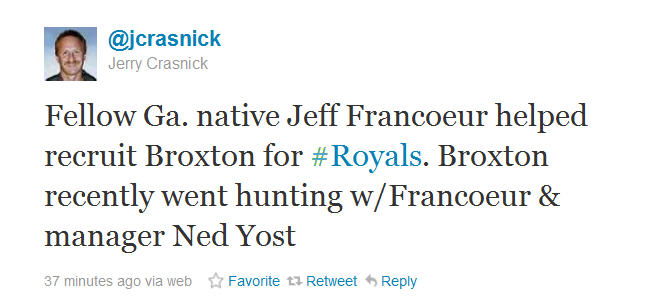
I was hoping the Mets would land Jonathan Broxton as a low-cost reclamation project for the back end of the bullpen, but the beefy right-hander would hardly be the first man to be lured in by Francoeur’s charming set of intangibles. One could only imagine the scene in those Georgia backwoods, Francoeur smiling maniacally with a rifle in one hand, a fresh kill in the other and a glimmer in his eye, convincing Broxton that this time he really has turned the corner and that if win-loss record was so important, well… you know.

They say free-agent relievers are the most dangerous game.

Broxton’s deal is reportedly worth $4 million for one year, hardly chump change but not unreasonable considering the way he dominated hitters from 2006 to 2009. Crasnick also tweeted that the Mets were among Broxton’s “most ardent pursuers,” which at least vaguely contradicts various vague reports from earlier in the hot-stove season. But I guess that’s all part of the game.

Anyway, there are still a handful of potential low-risk high-upside reliever types out there. Smart money says the Mets will land one eventually. Unless the Royals keep sending out Francoeur as an emissary. If that’s the case, we’re screwed.

Self-awareness fail

I reached Lucchino briefly in his office this morning. He said he couldn’t talk to me. He said there would be no announcement today.

I followed that up with, ‘‘Do you have any comment on how indecisive this makes you guys look?’’

‘‘Goodbye, Dan,’’ he answered. ‘‘Nice to talk to you.’’

Click.

Dial tone.

Dan Shaughnessy, Boston Globe.

I suspect Larry Lucchino was lying, and that it wasn’t actually nice to talk to Dan Shaughnessy.

Via Rob Neyer.

Free agents signed to new teams so far

I got a good email this morning from reader Hank, who is frustrated both by the Mets’ apparent inaction on the free-agent market this offseason and by the nagging insistence on “payroll flexibility” that keeps popping up in interviews with team brass. He suggests — perhaps accurately — that the term could be a euphemism for, well, complete payroll inflexibility: an utter lack of money to spend.

I don’t know. There’s plenty more Mets stuff to talk about on the horizon this offseason, and plenty more time to hash out what it is they mean when they talk about payroll flexibility. But there really is something to the idea, regardless of if it’s a party-line thing the way they’re using it right now.

This offseason, C.J. Wilson is the best available free-agent pitcher. Some team that believes it’s one decent pitcher away from a world championship is going to sign C.J. Wilson, and that team will likely give Wilson way too much money. If that team’s hunch proves correct and Wilson helps it to the World Series, the proverbial (and actual) flag will fly forever, and the team can rationalize away the last couple of years of Wilson’s deal when he will likely prove a financial albatross.

But since the Mets appear to be more than a C.J. Wilson away from becoming a certain contender, they are better served building up their club with more reasonably priced players. Then, next winter or the following one or whenever they reach the point when they believe they are one C.J. Wilson away from securing a World Series berth, they can sign that offseason’s C.J. Wilson — and C.J. Wilsons come along practically every offseason — because they didn’t sign this offseason’s C.J. Wilson.

What Hank said in his email is correct: Teams (especially big-market teams) can build from within and spend on free agents. But since spending money on big-ticket free agents is one of the least cost-effective ways to improve a team, it should probably be the final piece of the process, not one of the first ones. Generally speaking, of course.

And I’d like to remind everyone of one very important point: It’s November 28th.

Come March we will have a better sense of how much money the Mets had to (or wanted to) spend this offseason, and whether the bluster about maintaining a payroll between $100 and $110 million was just that. But don’t confuse rumors — or the lack thereof — with anything terribly meaningful. It could just be that the Mets’ front-office is a bit tighter-lipped than some of its counterparts around baseball, shifting the media focus elsewhere.

Thus far this offseason, only a handful of players have actually found new teams on the open market. Using MLBTradeRumors’ ever-handy free-agent tracker, I put together the comprehensive list of players signed to Major League deals with new clubs:

Pitchers
Joe Nathan (Rangers, 2 years, $14.75 million)
Jonathan Papelbon (Phillies, 4 years, $50 million)

Catchers
Rod Barajas (Pirates, 1 year, $4 million)
Ryan Doumit (Twins, 1 year, $3 million)
Gerald Laird (Tigers, 1 year, $1 million)
Jose Molina (Rays, 1 year, $1.8 million)
Matt Treanor (Dodgers, 1 year, $1 million)

First basemen
Ol’ Jim Thome (Phillies, 1 year, $1.25 million)

Second basemen
Mark Ellis (Dodgers, 2 years, $8.75 million)
Jamey Carroll (Twins, 2 years, $6.75 million)

Shortstops
Clint Barmes (Pirates, 2 years, $10.5 million)

Outfielders
Mark Kotsay (Padres, 1 year, $1.25 million)

Look over that list. Not a rhetorical question: How many of those deals do you wish the Mets had made?

I could probably make an argument for a couple of the catchers. If you buy the recent pitch-framing research from Baseball Prospectus, Jose Molina in particular seems like a bargain at $1.8 million as a righty-hitting complement to Josh Thole.

Jamey Carroll’s still pretty useful: Gets on base a bunch, plays all over the field, once was an Expo. But he’ll be 38 on Opening Day and he required a two-year deal.

And there hasn’t been anything close to an obvious miss by the Mets, where the player and terms seemed to perfectly fit their (supposed) budget and needs but they let him slip away. Maybe that will happen, and then we can yell about it and say they were lying to us about the payroll figures and everything else. But right now it’s hard to kill the Mets for not spending money when a) it’s silly to spend money for the sake of spending money and b) pretty much no team has yet spent money.

Bold Flavors Snack of the Week

This was an inspired one, I think.

Inspired, I should say, by our man Catsmeat, who recommended something he made called a “doughboy” months ago, and by various recent discussions of savory pastries. But also inspired in the same way we say great performances are inspired, as if granted to the actors by some transcendent force that for some reason focuses its divine efforts on pleasing indie-film audiences and art critics.

Anyway, if I was the medium for inspiration in this case, the source was certainly a fridge full of leftovers combined with my wife’s insistence that I put some of them to use before they went bad. And they never went bad. They went well. So, so well.

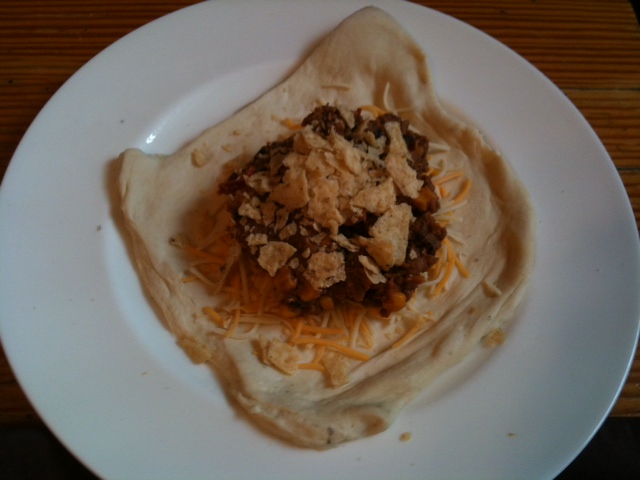
Presenting: The Chili Doughboy:

Here’s how it went down:

1) Make chili. Serve with cheddar and monterey jack shredded cheese blend, sour cream, and tortilla chips. Enjoy chili with your wife’s family. Receive lots of compliments on chili, because the chili is delicious. Save remaining chili in tupperware in fridge. Also save remaining cheese, sour cream and chips.

2) Plan to make pizza. Buy small ball of pizza dough from local pizzeria. Scrap plans to make pizza. Something else came up.

3) A couple of days later, remove pizza dough from fridge and bring to room temperature. Using kitchen shears, cut pizza dough into quarters. Pre-heat oven to 400-degrees.

4) Stretch out one of the pieces of dough until it is roughly eight inches in diameter and lay it flat. You don’t want the dough to be NY-pizza-style thin.

5) Grab some of that shredded cheese — remember the cheese? — and spread it in the center of the dough, creating a little cheese-bed. I didn’t try it any other way, but I suspect this is important: You’re going to (SPOILER ALERT) put chili on top of the cheese, and I worry that if you put the chili right on top of the dough, the grease from the chili might seep through and jeopardize the structural integrity of the entire thing. The cheese is there to protect against that. It is also delicious cheese.

6) Put chili on top of the cheese. I used about two scoops, using a tablespoon. But not two measured tablespoons — I was just using a regular old tablespoon, like from my silverware drawer, and they were big heaping spoonfuls. Eyeball it. Use whatever you think looks like the right amount of chili for that amount of dough. This isn’t rocket science.

7) OPTIONAL: Crumble a couple of tortilla chips on top of the chili. I say “optional” here because I did it, but in truth it’s completely unnecessary. I was hoping I’d capture some of the magic of Taco Bell’s Crunchy Red Strips, but… well, more on that to follow.

8) Wrap that mother up. Brush with a little bit of olive oil, and dust with salt and chili powder. Repeat if you want more than one.

9) Bake at 400 degrees for 15 minutes, or until the top is lightly browned. You know what cooked things look like. Let cool — these things are hot. You might want to poke a hole in the top with the fork to let some of the steam escape.

10) Eat the Chili Doughboy. I mixed sour cream with sriracha to use as a dip, but it turned out the sriracha part was probably unnecessary. The chili itself was spicy enough that I really didn’t need any more heat. Just the sour cream would have been fine.

Turns out the Chili Doughboy is amazing. And despite all those steps, really easy to make — provided you already have leftover chili. It’s the bread-bowl approach to chili, without even the need for finding a worthy bread bowl (which is always way harder than it feels like it should be). Plus the pizza dough is fresh baked and piping hot, and just a touch sweet, which makes for a nice complement to a spicy chili.

The crumbled tortilla chips did nothing for this. They got lost in the mix with all the other flavors and textures, and I suspect they got sogged down by the chili in the cooking process and didn’t have the crunchifying effect I was hoping for. No matter. What I failed to consider was that the top part of the dough had a nice crust to it, which provided all the crunch this thing needed.

When I next make these — and I’m going to make them again, probably within the next few days because I still have some chili and some dough — I’m going to try making them a bit smaller, closer to appetizer-sized. I think I’m on to something here, you guys.

Zombie SABR

To figure it out, we grabbed a stopwatch and went through both seasons to find out what percentage of each had hot zombie action. We started the timer whenever a zombie scene started up, and kept it going until the scene either ended or it started getting distracted by intra-refugee squabbling. And it turns out we weren’t imagining a net loss of undeaddery: There have been fewer zombies this year. In total, the six-episode season one had roughly 47 minutes total of zombie action in 292 minutes of episode run time, which means that they accounted for 16 percent of the season. Meanwhile, this first half of season two (seven episodes) had 40.5 zombie minutes in 319 minutes of run time, which is 12.7 percent.

Alexandra Martell, NYMag.com.

That is some good zombie SABR right there. I’d be interested in expanding that research, too — it felt like way more of the first season of The Walking Dead occurred under threat of imminent zombie attack, whereas most of the second season has happened at this stupid farm that is for some reason invisible to zombies and/or unbound by all the rules for keeping zombies at bay that were carefully laid out in the first season.

Most notably: Are the zombies no longer attracted to loud noises? Because though the (SPOILER ALERT) climactic zombie massacre at the end of the mid-season finale last night was pretty awesome, I was led to believe that much gunfire would draw the attention of every zombie in a 10-mile radius. But this season they’re going out in the woods taking target practice like it’s no big deal, even though we know there are zombies in those woods. What gives?

When you outline a zombie scenario, you set up your own list of rules: The Walking Dead’s zombies aren’t smart or fast, but they’re persistent, they can survive on non-human meat, and they’re attracted to the sounds and smells made by living people. Once that general set of rules no longer seems to apply, it sort of trivializes the whole thing and the show just becomes a silly soap opera about terrible actors who whisper really loudly.

Also, why don’t they get more crossbows? I guess it’s pointless now that the loud-noise thing doesn’t matter anymore, but for a while when it did matter, they only had one crossbow, and the crossbow-wielding dude was by far the most badass and valuable zombie-killer. They’re in the south; there’s got to be a sporting goods store around somewhere. You have to figure these people with the wherewithal to survive the zombie apocalypse can get their hands on another crossbow or at least a slingshot or something.

For obvious reasons you want to minimize your close-range hand-to-hand combat with infectious zombies. There are so many ways to do that besides just sort of hoping you can stab them or bludgeon them with something before you get desperate and shoot them.

Mostly, though, the show has gotten stupid in its second season because it has spent almost the entire time focusing on the characters and I could hardly care less about them.

Even when it became clear that the creators of Lost had no real plan and were grasping at nebulous mystical ideas, I still wanted good endings for most of the characters. If on the next episode of The Walking Dead, every single character besides Darryl and Glenn became a zombie, and the rest of the show was just Darryl and Glenn eluding zombies and sometimes killing them with crossbows, that’d be fine by me. And even Glenn seems like he might be getting lame.

Just a whole show about Darryl crossbowing zombies and eating squirrels would be better than seeing Andrea rebel against Dale’s misguided parental efforts to keep her away from the self-destructive Shane. T-Dog seems like he might be OK but he doesn’t get enough screentime anymore for us to know.

Lastly — and this is just a nitpick, I realize: When they’re talking about bad stuff that happened in the past, why do they only refer to the stuff that has happened on screen? Like, “Oh, those zombies killed Amy!” It’s the zombie apocalypse, bro. That dude in the CDC called it humanity’s extinction event. Pretty much everyone you ever knew and loved is dead or a zombie. Why do you keep harping on that girl who spent five minutes in a boat with Andrea in one episode of Season 1?

Point is, the show kind of sucks now. I’m going to keep watching, because I’m a sucker like that. But I’m going to do so begrudgingly, and just so I can keep saying how stupid it is. WHY IS THIS SHOW ABOUT ZOMBIES SO UNREALISTIC?

CFL banquet turns into old-man fight

In what ranks as one of the most bizarre episodes in the proud history of the Canadian Football League alumni luncheon, former Cal quarterback and head coach Joe Kapp, 73, got into a fight with old nemesis Angelo Mosca, 73, in Vancouver, British Columbia, on Friday.

The fight had it all: fisticuffs, a swinging cane and, of course, flowers.

Mike Wolcott, S.F. Chronicle.

Apparently these fellows have had bad blood since a dirty hit in a Grey Cup game in 1963. Anyway, the video (embedded below) reveals this to be a pretty serious old-man fight.

My dad’s maternal grandfather was something of an old-man fighter himself, a Scottish soccer hooligan long before that Saturday Night Live sketch ever came out. My dad grew up near a model-train store called “Mulroney’s Trainland,” run by an old Irish guy named Mulroney.

One day, my dad told his mother that he was taking his younger brother down to Trainland. She told him she didn’t think that was such a good idea. “Your grandfather punched out Mulroney outside the bar Friday night,” she said.

Oh and another old-man fighting story: One time a distinguished architect told an architecture class I took about a physical altercation between extremely old-man Frank Lloyd Wright and much-younger Philip Johnson at some architecture conference in the 50s.

Apparently Wright walked in, spotted Johnson and said, “Little Philip Johnson, all grown up and building houses out of doors” — which is a serious architect burn. Johnson got all up in Frank Lloyd Wright’s grill, so Wright went to work on his legs with a cane.

Anyway, here’s that video: