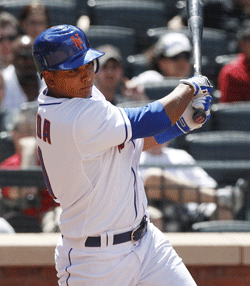
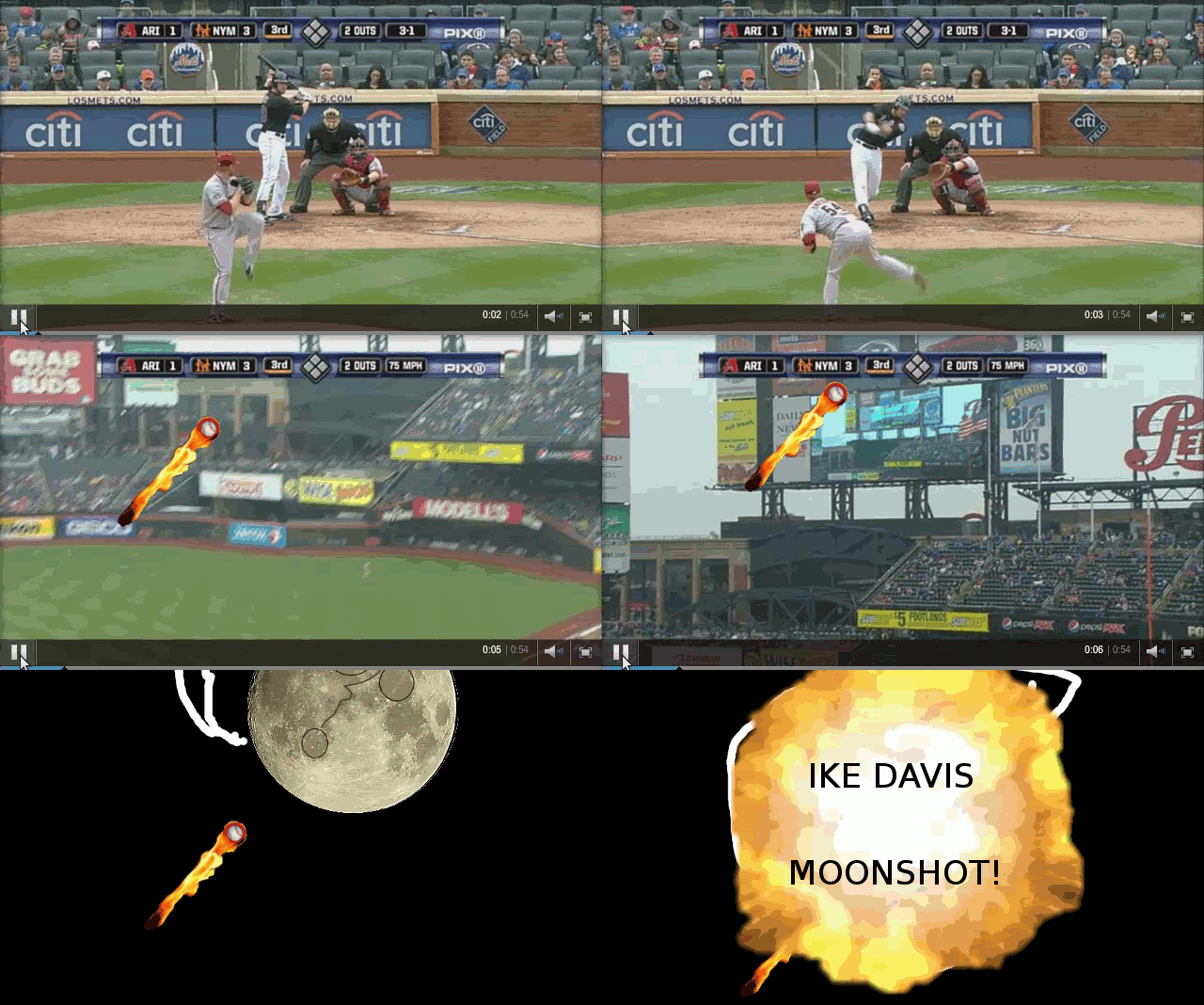
Over the line, Smokey

We’ve got four or five guys that I would call ‘above the line,’ that we could go into the season with, in the rotation.

Sandy Alderson.

This comment led to a lot of speculation about where exactly “the line” is. I doubt Alderson was letting us on to the team’s internal calculations or whatever. He probably just meant the Mets have four or five guys they consider Major League starters — Jon Niese, R.A. Dickey, Mike Pelfrey, Dillon Gee and Johan Santana.

And obviously that’s got people fired up, because people want to argue that Mike Pelfrey is less than a viable member of a Major League rotation. Pelfrey had a bad year, but for reasons discussed three months ago, he should be offered arbitration and brought back in 2012.

Is that rotation a great one? Hardly. But is it so bad it will single-handedly prevent the Mets from competing in 2012?

Not at all. If you’re looking for an example of a team that can win with a good offense and a bunch of innings-eater types, look no further than the reigning World Champions.

I know Chris Carpenter has the “True No. 1 Ace Bigtime Frontline Show-Pony” label everyone craves in a pitcher, but Carpenter posted an 105 ERA+ in 2011. The Cardinals’ best pitcher on the season was Kyle Lohse, who sported a 107 ERA+.

Mostly, the Cardinals got innings from their starters. Lohse, Jaime Garcia and Jake Westbrook each turned in over 180 frames, and the 36-year-old Carpenter was good for 237 1/3. By ERA, Cardinals starters were eighth in the National League. The Mets’ group finished 10th.

The Cardinals made the playoffs because they had by far the best offense in the National League and a pitching staff good enough to keep the team in games. Remember: The object is only to score more runs than your opponents. There’s no real set formula for the way you have to do that.

So yeah, while the Mets’ pitching staff could stand to improve, signing free-agent starters is almost always a terrible idea. And since any upgrade available via trade would likely cost the Mets a ton in terms of young players, their best approach for 2012 is to try to improve the team’s offense and defense and hope the pitching holds together.

Of course, it’s going to take a lot of work and a couple of big bounce-back years for the Mets’ offense in 2012 to hit anything like the way the Cardinals did in 2011. But that’s at least easier to imagine than Niese, Pelfrey and Gee pitching like Halladay, Hamels and Lee.

Kevin Durant awesomeness

Kevin Durant tweeted that he was looking to play flag football in the Oklahoma City area. An Oklahoma State fraternity obliged.

It turns out Kevin Durant playing flag football with a bunch of college kids looks about exactly the way you’d expect. My question is: Why would the opposing quarterback ever throw to the receiver being covered by the 6’9″ NBA star? Was he trying to prove something, or just trying to keep Durant in the action?

Via Seth Greenberg.


And they’re blue

Moving sucks and everything hurts. I’m back in the office today, trying not to think of all the boxes piled up in my new apartment waiting to be unpacked.

While I was without the Internet, the Mets apparently announced they’re reconfiguring the Citi Field walls. Presumably you knew that already. But maybe you haven’t yet checked out Gerard Schifman’s work at Roosevelt Avenue Rant, investigating Citi Field’s effects on line-drive hitters. His big finish:

You’ll notice that as LD% goes up, less home runs are hit both on the road and at home.  On the road, Slugging remains fairly constant, slightly decreasing as LD% increases.  But at Citi Field, as LD% goes up, fewer home runs are hit and Slugging hugely decreases.  So no, it doesn’t appear that the Mets have regained any total bases as a result of the ballpark’s dimensions, further justifying the forthcoming changes.  The BABIP and Slugging differences show us that the ballpark is currently the punchless hitter’s dream.  Hopefully now, with reconfigured dimensions, the Mets can channel their inner Ike Davis a little more than their inner Luis Castillo in 2012.

Dear Taco Bell

Originally posted Aug. 31, 2011:

Taco Bell chief marketing officer David Ovens has resigned from the company. Mr. Ovens, who has been with Yum since 2007, reportedly resigned for personal reasons and is returning to Australia with his family. Mr. Creed is expected to oversee the company’s marketing function until a replacement for is found.

Maureen Morrison, Advertising Age.

Dear Taco Bell,

Perhaps you know me. I write a sports and sandwich blog of minor repute and I am your biggest fan.

I chose my current place of residence in part because of its proximity to a Taco Bell location. I went to Taco Bell on my wedding day, in between the ceremony and reception. I own an autographed copy of Glen Bell’s authorized biography, Taco Titan. I co-founded the Taco Bell Wiki.

I enjoy my current job very much; I cover the baseball team I grew up loving and I have the freedom to write about pretty much anything I want. But I’m willing to give all that up to be Taco Bell’s new Chief Marketing Officer, assuming the position comes with a hefty salary and a boatload of free tacos. A company car would be nice too, but we’ll settle that when we get to the negotiating phase.

And though I lack any sort of marketing experience, I trust you’ll follow the sage advice of my predecessor and Think Outside the BunTM on this one. What exactly does a Chief Marketing Officer do? I have no idea. But I bet it involves telling people about how great Taco Bell is, and so I bet I’d be pretty damn good at it. I believe in your product, Taco Bell.

If I were to be hired as your Chief Marketing Officer, I would implement my Triple-Decker Taco agenda, the following three-tiered plan to further strengthen the Taco Bell brand. The three tiers are: Interactivity, Accountability, and Crunchy Red Strips.

Interactivity: Let’s face it, Taco Bell: They’re onto you. Every savvy taco eater realizes that almost all new Taco Bell menu items come from creating new combinations of ingredients already present on the Taco Bell menu. Let’s put pretense out to pasture and turn taco innovation over to the community.

I’ve presented this idea before but I fear it fell on deaf ears: The Taco Bell website should feature an interface wherein Taco Bell fans can create new menu items out of existing Taco Bell ingredients. Think of it like a paper doll, except instead of putting clothes on a doll we’re putting Lava Sauce on a theoretical Gordita. Then someone with access to a Taco Bell kitchen — specifically me — can test out the most promising suggested Taco Bell creations and select a few to feature in an online poll. Users vote on the best-looking new product, and we serve it for a limited time at participating locations.

That’s Taco Bell 2.0, brother.

We could also poll users on which classic limited-run menu item to bring back. Except we’d have to rig the poll, because I’d really like to try a Bacon Cheeseburger Burrito.

Accountability: Have you ever been to the Taco Bell restaurant in Elmsford, N.Y.? It’s the Worst Taco Bell in the World. Sometimes you have to wait like 20 minutes in the drive-thru line. You could make your own tacos in that much time. Plus, they almost never have the red shells for Volcano Tacos. And heaven forbid you want no tomatoes on your Baja Beef Gordita, it’s practically even money they’ll serve it to you with tomatoes and without Baja Beef.

We can’t have this happen, Taco Bell. Someone needs to hold local franchisees accountable for their restaurants so that every Taco Bell store can operate as efficiently as the ones in Hempstead and Oceanside, N.Y. — fine Taco Bells both. The only way I can think of to ensure quality-of-service across all locations is to have one guy travel the country ordering and eating Taco Bell.

I can be that guy, Taco Bell.

That bell on your logo should mean something. I know it means something to me. We need to make sure it resonates with the melodious ring of cheese-drenched awesomeness, not the discordant clang of a disappointing dining experience.

Crunchy Red Strips: Seriously, Taco Bell, do you have any idea how good the Crunchy Red Strips are? Why are they not in more stuff? They’re the perfect way to add crunchiness to portable menu items, and yet they’re only included in like four things.

Let’s change that. As Chief Marketing Officer, I would see to it that we create more driver-friendly menu items featuring and/or focused around the Crunchy Red Strips. And I’d make sure all Taco Bell employees are trained to add Crunchy Red Strips to any existing menu item (for a small additional charge, of course) in an even and appropriate manner.

Clearly, increased interactivity, accountability and Crunchy Red Strips will help power Taco Bell — all Taco Bells — to the forefront of fast-food dining experiences. This is how we win the franchise wars. I am your destiny, Taco Bell.

I eagerly await your response, Taco Bell. My resume is available upon request.

Love,
Ted

Exit Carlos Beltran

Originally posted July 27, 2011:

I started and scrapped this post a couple times. To be honest, I tried to pre-write it the way newspapers do with celebrity obituaries, though by the time I got around to actually doing so the news of Carlos Beltran’s trade had already started to leak out. And I meant to hold off on publishing it until the deal was made official, but now Beltran is out of the Mets’ lineup tonight and it sounds by all accounts like the announcement is a mere formality.

The first draft included an introduction explaining how real sadness is universal and comes in near-infinite supply, and how in that context Beltran’s departure is not really sad at all. But that’s patronizing. Presumably you know that sadness is a relative thing, and you can distinguish sadness for actual tragedies from the sadness we feel when a favorite baseball player is traded across the country to play out the final few months of his contract with a new team.

There’s no good reason to dwell on it now regardless. Any Mets fan paying attention the last couple of months has heard about and likely reasoned through Beltran’s being moved, a deal that makes a whole lot of sense for a club with little chance of a postseason berth in 2011.

In the trade with the Giants, Sandy Alderson reportedly scored Zack Wheeler, a young player better than the ones many – especially me – expected the Mets would get in return for Beltran. Wheeler is a Single-A pitcher so he’s still a ways off from contributing in the big leagues, but he’s a former first-round draft pick twice ranked in Baseball America’s top 100 prospects and with over 10 strikeouts per nine innings in the Minors.

And Beltran’s exit provides one final excuse to celebrate the man’s career in Flushing. In his tenure with the Mets, Beltran played 831 games. He hit 148 home runs, drove in 552 runs, stole 100 bases, and posted an .867 OPS. Statistically, his 2006 campaign stands among the very best seasons any position player has ever provided the club. He ranks in the team’s all time Top 10 of too many categories to bother listing.

That feels like it’s somehow understating it though, no?

Not long ago, a Kansas City Star reporter wrote, “If you want to know how to approach the game, teammates or life, watch Jeff Francoeur.” Though the author was merely upholding the rich journalistic tradition of writing ridiculous things about Jeff Francoeur, the comment rightfully inspired a ton of hilarious Internet snark.

Swap in Beltran for Francoeur, though, and the guy has a much better point.

And I don’t mean in terms of off-field stuff. We only think we know baseball players from what little they reveal of themselves to the press and the fans: We heard Terry Collins rave about Beltran’s leadership this year, we read about his charitable efforts and saw the professional way in which he handled every single one of the incessant questions about his future, but for all any of us know Beltran punts puppies on his home from the ballpark.

Let’s accept that we don’t really know Beltran as a person and just think about the ballplayer. Could you imagine what the world would be like if we could all do everything the way Beltran plays baseball? If we demonstrated that same elegance and efficiency in our morning commutes, our jobs, our yardwork? What if we could all stay so calm and so patient under pressure, and remain so humble upon success? What a place that would be!

Or would that entire world be mistaken for joyless?

Oh, whatever. I made it this far without mentioning the infernal haters, and it’s probably best to just leave them stewing in their pathetic corners, pissed about whatever it is they’ve chosen to be pissed about next. Let’s applaud Beltran now, not waste time defending him from those that will never understand. Know this: People who don’t appreciate Carlos Beltran by now don’t deserve to.

I’m going to rehash the point I made in regards to Jose Reyes earlier this summer. I apologize for repeating myself: What we’ve seen from Beltran is ours to keep forever, no matter what team he’s playing for tomorrow. Carlos Beltran playing baseball at the peak of his ability is a beautiful sight to behold, and we got to watch it hundreds of times.

The sad thing about baseball is that greatness is fleeting. The awesome thing about baseball – or one of the many, at least – is that more great players and great moments are always on the way. Who knows? Maybe Zack Wheeler is one of them.

So Beltran is off to San Francisco to put the Giants’ putrid offense on his shoulders, and we’ll watch him in the playoffs then hear unsubstantiated and likely fruitless rumors that the Mets are pursuing him in the offseason.

I’m not sure how to wrap this up. Last time through I had some dumb story about the old-man version of me, 30 years in the future, describing Beltran to some punk kid. But it sucked and now I’ve got a train to catch. So we move forward.

What we carry

Originally posted June 15, 2011:

A white-haired couple got on the train yesterday and stepped toward the first pair of open seats while I fumbled with my headphones. The woman sat first, across from me, then grabbed her husband’s hand and steadied him down into the seat next to mine.

“It just hurts sometimes,” he said. Then he leaned toward me and smiled. “Never get old.”

“Hey, beats the alternative,” I said.

———————————————————————————————————

My brother would have loved Jose Reyes. Who could blame him, really?
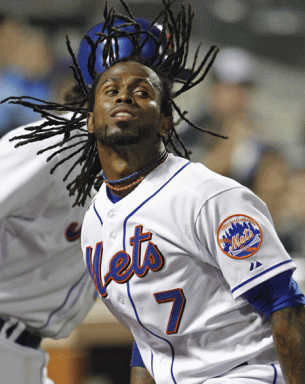
Hold up. I’m going to get to the personal part of this post in a minute, but I want to focus on Reyes first.

Let’s pretend for one moment that we could all manage to successfully tune out the constant speculative noise surrounding Reyes, and that we have the capacity to put everything else aside to just appreciate the things Jose Reyes is doing on baseball fields around the country.

Holy hell. Have you ever seen anything like this?

There’s Jose Reyes lashing a liner in the gap, bounding out of the box. Jose Reyes stealing second, stealing third. Jose Reyes diving to his left to stop a hard grounder, Jose Reyes firing the ball across the diamond from deep in the hole.

Jose Reyes is dancing off the base, in the corner of the pitcher’s eye and the front of his consciousness. He’s chasing down a pop-up near the foul line in left field. Jose Reyes is celebrating in the dugout and he’s looming on deck. Jose Reyes just smashed a frozen rope past your office window and now he’s sprinting through your backyard. Look to your left: It’s Jose Reyes. Now to the right: Jose Reyes. Jose Reyes, Jose Reyes, Jose Reyes.

This is your summer blockbuster: The Jose Reyes Spectacular.

Only they don’t often make movies this grand and this good, the type you can watch over and over again and still find new details to appreciate: minor plot points, aesthetic intricacies. It is a production massive in scope and so richly rendered in every particular, like the work of a great auteur afforded an unlimited budget and – oh dammit, there’s that money thing we’re avoiding.

My brother Chris loved triples, even more than most. He had what you might call the triples mentality, if not the requisite speed. The way Reyes aims for third base so brazenly on hits that seem certain to be doubles, the irrepressible gusto of it – that was the approach Chris took to pretty much everything.

And I know he was my big brother and I probably aggrandize him a bit, especially now that he’s been gone almost nine years. But when I run into his old friends, they practically tell Bill Brasky stories about the guy: about his exploits in sports, in frat-house shenanigans, even in school.

Apparently, he once took a class at MIT in which teams of students were charged with creating the best design for a machine to lift panels of sheetrock. At the course’s outset, the professor joked that any student who could lift the sheetrock on his own would be excused from the assignment. So Chris – according to the story – marched down to the front of the lecture hall, lifted the sheetrock above his head and carried it out of the room. He returned for the next class and his team ultimately won the contest.

I have no way of verifying if the story is real or apocryphal, and a quick Google search tells me panels of sheetrock weigh about 80 pounds – unwieldy, perhaps, but certainly well within the range of normal human strength. But regardless of its accuracy, the story sums up my brother pretty nicely. He was competitive, cocky, funny, brilliant, ox-strong and doorway-wide.

He was the type of dude it would have been easy to envy if he weren’t always so damn awesome to me. Other than his abject refusal to let me win at anything, Chris provided me everything an older brother could, from guidance and big-picture life lessons to mixtapes, and beer when I was underage (sorry, mom).

More than anything, though, he gave me baseball. He taught me the rules, players and teams. He bought me cards and taught me how to scale them. When he was old enough to drive, he took me to games. Tons of them. Though eventually Chris and I differed on certain finer points, he is responsible for the very fundamentals of how I watch and appreciate the game. After all, he’s responsible for me watching and appreciating the game.

Late in the summer of 2002, Chris moved from his home in Boston to my parents’ house, to a hospital bed set up in our living room. What started as melanoma on his shoulder had spread through his body and into his brain. We knew – though we never said it out loud – he was dying, and it became clear it was easiest for everyone to let him do it there. Weird time.

The best I can figure it was Saturday, Aug. 31, when I watched my last game with my brother. Baseball-reference tells me the Mets lost a 1-0 tilt to the Phillies, an unlikely pitchers’ duel between Randy Wolf and Steve Trachsel.

I can’t recall any of it. All I remember is that I was charged with carrying my brother from a wheelchair to the easy chair in the den where he would watch the game. And I remember how light he was, how frail he felt – this guy who weighed 230 pounds just a year earlier, the football stud with the broad shoulders, my big brother. And I could feel the cancer just under his skin, invasive little bumps. It was everywhere, and terrifying.

The next day I packed up my car, told my brother I loved him, and headed off for my senior year of college. He died two days later.

I skipped the Mets’ home opener in 2003, the first I missed in 16 years of being a Mets fan. Soon after I graduated and moved back home, the Mets called up their top prospect – the 19-year-old shortstop, you know the guy.

It is only now, eight years later, that I realize Chris never saw Reyes play. Or David Wright, for that matter, but he would have hated Wright – that’s a different story. A whole generation of Mets players have come up and grown up before me without him there to share it. And now, maybe, they’re going away. It’s… well, it’s strange to think about.

But he would have loved Reyes. Of that much I am sure. Hell, we all love Reyes.

We love him. We watched him develop, and we have seen so many of his trials and triumphs. We know the way he gets when he’s happy, when he’s sulky, when he’s angry, when he’s jubilant. He feels, well, almost like family.

Note that I say almost like family, which is very different than actually being family. We are not actually related to Jose Reyes and the love we feel for him as fans is not the love we have for our real-life loved ones. Obviously. And the prospect of losing Reyes, weighing so heavily on the minds of Mets fans these days, is not the same as losing a family member. You don’t have to remind me.

But it is, on the orderly plane that baseball provides for us to try to sort some of these things out, some distant, more palatable version of that. Here is someone you love. And now, due to circumstances beyond your control, you might lose him too soon.

So understandably, Mets fans gather on blogs, in the airwaves and out on the Shea Bridge on Friday nights desperate to show the world their love for this great player, underscoring the pain we will feel if he leaves for some other green pasture elsewhere.

I can’t say if Reyes will be a Met at the end of this season or the beginning of the next one. Few can. And while I’m not as resigned to his departure as many in the media and fanbase, I know this for certain: He’ll be gone someday. Everything goes away eventually. If not next year for Reyes, then five or seven or ten years down the road.

We can lament the hand Reyes – and all of us, really – has been dealt, with so many of his best years wasted by a subpar front office, bad players around him, crappy bullpens, mishandled injuries, everything. Not to mention his contract coming up now, with the Mets in financial flux and hamstrung by a slew of bad deals. That all sucks, no doubt.

But we should celebrate, too, that we have this right now. No matter what happens with Reyes later this year or after the season, the special things Reyes has done and is doing every night this season are some we can carry forever. It is an awesome spectacle, a confluence of immense talent and pure joy on the baseball field, with the churning legs and flying dreadlocks and beaming smile. This is ours to keep.

And I can sit here now regretting that my brother never got to see this, knowing how much he would have loved it. But that’s useless. Besides, I carry with me my brother’s love of baseball. I carry him every day, and it’s not traumatic; it’s awesome. He exists now as an inextricable part of me, a part I can celebrate.

We are alive and we get to enjoy Jose Reyes playing baseball. It beats the alternative.

Did anyone see that awesome baseball game?

Originally posted June 2, 2011:

Oh!

Did anyone see that awesome baseball game?

In the first Mike Pelfrey lets up three runs without really even allowing a hard-hit ball, and it’s like, “oh that sucks, but that’s baseball, I guess.” Only then in the second, Pelfrey lets up three more runs on a bunch of hard-hit balls, and now it’s all, “OK, between the Mets’ offense and bullpen this one’s going to get ugly.”

Only the Mets also have Carlos Beltran on their team, and Carlos Beltran is totally sweet. So he hits a three-run home run in the bottom of the third and everyone gets to thinking how maybe at least it won’t be a total blowout if the Mets’ recently crappy bullpen can not suck for once.

Then — then! — in the bottom of the sixth, Beltran doubles off the top of the wall and Jason Bay figures out a way to get to first base, so the Mets wind up with runners on second and third with one out after Ronny Paulino taps out to the pitcher. Now Nick Evans — who always walks up to bat to Tom Petty music — comes up, and he’s taking this laid-back approach at the plate like he doesn’t want to swing at all, just chillin’, mentally listening to some Tom Petty, but Paul Maholm walks him on a full count.

Next Ruben Tejada, who’s 21 but doesn’t look a day older than 12, rips a single to right and two runs score and all of a sudden whoa, too bad the Mets bullpen stinks or else they might really have something here. And then Terry Collins throws strategy to the wind and puts in left-handed Daniel Murphy to pinch-hit against lefty Paul Maholm instead of going with a righty bat like Dillon Gee or Jason Isringhausen, and Murphy rewards his manager’s unconventional thinking by lifting a single to left that scores another run.

Now the Pirates are playing really terribly, and after an error and a passed ball, Tejada scampers home and everyone’s thinking, “man how crazy they tied this thing up, shame about that bullpen thing.”

But oh!

A little bit later, Paulino singles to lead off the eighth and Collins uses Willie Harris to pinch-run for Paulino and Chris Capuano to pinch-hit for Jason Isringhausen. This seems like it might be a pretty crummy thing to do to any position player, even Harris, but Collins says Capuano’s the best bunter on the team and he’s in there to get Harris over to second.

Only he doesn’t need to. In a very confusing sequence of events, Jose Veras balks on what looks like the second strike of the at-bat. So everyone’s all confused as to how and why Harris is suddenly standing on second and Josh Thole’s coming in to pinch-hit with a 1-2 count, and things get even worse when Thole takes a called strike and everyone figures he’s out but he’s still standing there. And by the time everything’s cleared up, Harris is on third on a wild pitch.

Long story short, Veras struggles from there and the Mets score two and now it’s like, “OMG I think they’re really going to pull this one out, what a comeback!” But obviously the first guy up in the ninth hits a triple off Francisco Rodriguez and it’s all, “Oh so this is how it’s going to be K-Rod?”

Only no! That guy scored but no one else did, and the Mets won 9-8. A bunch of other cool stuff happened too.

It was sweet.

Baseball

Originally posted Sept. 30, 2010:

It started happening just before the bottom of the sixth inning began.

I caught the pitcher’s final warm-up as I stepped out of my crouch to throw down to second. I cocked my hips, transitioned the ball to my bare hand, and felt my insubordinate fingers lock onto the baseball, refusing to release it at the top of my throwing motion. The ball darted into the all-sand infield just left of the pitcher’s mound, skipping off toward where the shortstop would have been if he weren’t covering second, and rolling to a stop in short left field.
“My bad,” I yelled.

No one ever gets caught stealing at this level; it has happened maybe twice in three years of weekly play. Pitchers aren’t good enough at holding runners on, catchers aren’t good enough at blocking balls in the dirt or throwing to bases, infielders aren’t good enough at receiving throws and tagging runners. There are just way too many variables that could go wrong on the defensive side, and all the baserunner has to do is haul his ass 90 feet.

But a catcher with a strong or accurate arm can at least dissuade the casual basestealers — the fat guys, the hungover crowd, the smokers, and the one fat, smoking, hungover dude.

Last week, I caught 10 innings and my throws were sharp. Not hard, but on target, and good enough to limit only the speedy runners to taking bags when the situation called for it, instead of beckoning every runner to steal every time he reached base.

This week, after the errant warmup throw, the latter happened. This week, they ran wild, taking advantage as, with increased concentration on controlling my hand, my throws grew worse: pop-ups 15 feet to the left of second base, bloopers over the third baseman’s head.

I knew I shouldn’t have caught before I even arrived at the ballfields in Red Hook. The pain in my back and shoulders nagged me for days before, knifing into my neck and radiating down my arms into my hands.

No one here would judge me if, while we divvied up positions before the game, I grumbled something about my back acting up and begged out of catching. But when no one else immediately volunteered, I stepped up, knowing what I do about how much more value a slap-hitting, poor-defending backstop offers to his team than a slap-hitting, poor-defending corner outfielder.

I started playing pickup baseball in Brooklyn three years ago this month, and, coincidentally, just a few weeks after I first felt the symptoms of M.S.

The game started because a guy named Grant heard about adult hardball leagues that played around the borough, then got drunk and put up a Craigslist ad inviting players to Prospect Park to come try out for his team. When a bunch of people showed up the next day, Grant copped to having no idea how to get involved in any organized league but the group decided to break into two teams for a pickup game anyway. They played again the next week.

I heard about it from a couple of friends a week later, and I’ve been playing pretty much every week since, work and weather permitting.

Grant followed a girl to South America that winter. New leaders emerged, and slowly, the game became better organized: equipment purchased, vague bylaws and codes of conduct established. Eventually enough guys started playing regularly that we had to cap the roster and stop welcoming passing hipsters in skinny jeans and hiking boots, even though we all agreed that was kind of awesome. Fewer guys smoke cigarettes during play now, and more wear real baseball pants.

We even legitimized and secured permits for fields, though our disagreement with the Parks Department over the actual length of baseball season — they say April-to-Labor Day, we say March-to-Thanksgiving — means we still wind up itinerant for a few months of each year, playing at whatever Brooklyn diamond seems least likely to be overrun with flag football or LARPers or leftover temporary fences from a concert.

During that time, what started as some pain in my upper back gave way to a variety of stranger problems: numbness in my hands, tingling in my foot when I worked out too long, difficulty grabbing certain chords on the guitar, a buzzing sensation in my neck when I tilted my head downwards, and a few terrifying episodes in which I entirely lost control of my left arm.

It took five doctors, countless tests and over a year to get a diagnosis, then a five-day hospital stint for steroid treatment (which did nothing for my power!) and now a bevy of pills and vitamins and a weekly injection to reach some semblance of stasis.

I still have the pain — some days and nights worse than others — plus an odd hypersensitivity to uncomfortable seating arrangements and a Zoolander-like inability to turn my head all the way to the left. Sometimes the drugs leave me feeling a bit sick, light-headed, or just dumb. Plus there are the times when, if my body gets too hot or too tired, certain parts don’t seem to comply with my brain’s instructions, ever a strange sensation. That’s what was happening that Saturday in Red Hook.

But my doctor says the lesions on my brain and spinal chord that cause all those issues have stopped growing, and claims that an M.S. diagnosis is not the damning sentence it was even a few years ago. He says, with treatment, I should expect to remain at least this healthy into old age.

In other words, I have no reason to believe I’ll have to stop playing baseball anytime soon.

That’s important.

I’m lucky enough to say that the worst effect M.S. ever had on me was the pervasive uncertainty it unleashed. The symptoms of the disease can be so vague and potentially so comprehensive that it’s easy to become concerned that every little thing represents a symptom, every twitch and pain and hiccup, every lost memory and unrecalled word emblematic of the onslaught of sickness. It’s frightening.

Playing baseball helps keep that paranoia at bay. Being able to compete, even at a casual level, with a group of men who presumably do not have M.S. reminds me that the disease cannot have made all that much headway before the doctors stopped the progression. It’s not like I was ever that good at baseball in the first place, and I’m still decent enough now to mostly avoid embarrassing myself among a bunch of guys who played high school and college ball.

I’m conscious of the disease while I play, of course. There are rare humiliating moments like that inning behind the plate, and slightly less epic ones like just dropping a flyball in the outfield and wondering if I would have made the play if my fingers weren’t numb under my glove. But my errors, I’ve realized, are no more costly or common than those of plenty of other guys on the field. Stranger, perhaps, but not necessarily more egregious.

Sometimes I fantasize about what might happen if I could be magically freed of the symptoms of the disease — the knots in my back loosened, all feeling in my extremities restored — while maintaining all the new skills I’ve certainly developed to compensate, some great Harrison Bergeron unveiling. But I know that’s not to be, that who I am now is who I am. And I know, rationally, that it doesn’t really matter if I dropped that flyball because I have M.S. or I dropped that flyball because I’ve been a crappy defender my whole life, because both M.S. and crappy defense are now invariable parts of my constitution.

Playing with mostly the same group of guys for several years, you develop pretty strong scouting reports. I assume the others see me as a good contact hitter without a lot of power, and a poor defender occasionally prone to the yips. Other than the two guys that know me personally, they have no idea I have a decent excuse for an awful throw here and there. That’s fine. The last thing I want is pity or mercy.

And though most of our bench conversations focus on baseball, through the years I pick up more about the guys around me on the field and learn which guy needs surgery but lacks insurance, which guy runs the bases with a helmet because he fears a seizure, which guy is suffering through a brutal divorce, which guy was uprooted by Katrina, and I realize how silly I am, how selfish, to assume that I’m the only one here playing to prove something to myself, or to escape some rough reality.

With enough experience in baseball or life, we are doomed to endure a great deal of misfortune. That’s universal. Frozen ropes sometimes fly right into fielder’s gloves and loved ones sometimes die young. And we can harp on the awful things that seem to happen for no good reason, let them weigh us down and ruin us, or we can accept that they are likely random, the pitfalls of existence, and shoulder them as best we can and focus on the dribblers that squeak through the infield.

Right around the time my back started hurting, some guy got drunk and put up a Craigslist post. I am still playing baseball three years later.

Cool.

Sandwich of the Decade

Originally posted Sept. 8, 2010:

“Where you are going — this is a good neighborhood?” the cabbie asked as we sped south, past the crush of skyscrapers, the chain stores giving way to empty storefronts, then empty lots.

“I don’t know, man. You tell me.”

“I don’t usually come so far south,” he said as we pulled up alongside a few concrete, cylindrical, vaguely Soviet apartment towers pocked with evenly placed circular windows.

This part of Chicago didn’t make the guidebook. Underbelly. A promising sign, perhaps. I didn’t come here for a tourist’s sandwich.

It’s not hard to spot Ricobene’s once you reach 26th st. Its glowing red neon sign hangs between a freeway overpass and a Chinese live-poultry market, the squawking audible as you walk by. Across the street stands a massage parlor and a dive bar with a few happy-hour revelers huddled outside around cigarettes. Inside is a pleasant dining room, a clean well-lighted place brimming with nostalgia and black-and-white photographs, bursting with warm smells. An oasis.

The sandwich: Breaded steak from Ricobene’s, multiple locations in the Chicago area.

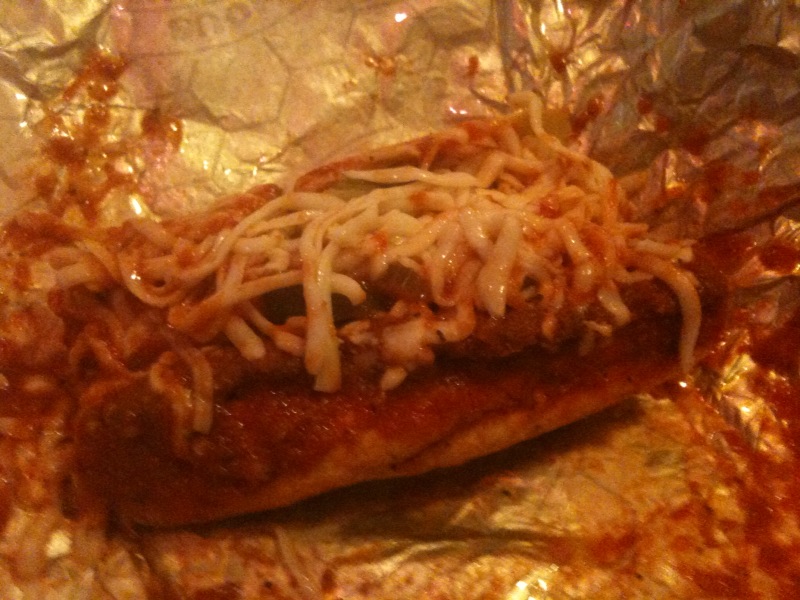
The construction: Thinly sliced steak, breaded and fried, on Italian bread with hot peppers, marinara sauce, mozzarella cheese and giardiniera — a type of pickled vegetable relish, here consisting of peppers, olives and celery.

The peppers and mozzarella cheese were optional. Obviously I opted for both. The woman asked if I wanted “hot or sweet.” I assume she was referring to the peppers. I went with hot.

Important background info: Cerrone faded by Sunday, sick with a sinus infection, but I still wanted to try more Chicago specialties. I settled on breaded steak because it was breaded steak, and Ricobene’s because it was open. The tip came via the excellent Jan and Michael Stern of the Road Food book series, which I could not recommend more heartily. Those people are heroes.

What it looks like:


(My apologies, this picture sucks)

How it tastes: You might know by now that I’m prone to hyperbole. But I don’t think it’s an exaggeration to say the breaded steak sandwich from Ricobene’s is the pinnacle of human achievement.

Holy hell. Every single flavor I could want on a sandwich was on this sandwich. The beef was tender like veal, and the breading savory. The sauce was sweet and flavorful. The bread was sturdy enough to hold the thing together, but soft and delicious as well. The cheese was heaping, moist, cheesy. All those aspects added up to something like the best veal parmigiana hero I’ve ever had, and I’ve had a lot of veal parmigiana heroes. Some really, really good ones, too.

But what put this thing over the top were the giardiniera and hot peppers. The former added a tangy flavor, plus crunch from the celery. The latter set my mouth on fire, and amplified all the other amazing flavors in this sandwich.

The thing probably weighed about a pound and a half, but I wolfed it down, possessed.

When I finished, I stumbled out to the curb, dizzy and delirious. A couple of cops pulled up, and instinct told me to run — I felt like I had just done something illegal. I couldn’t, though. I couldn’t bring myself to leave the front of the restaurant.

I knew I had to leave Chicago the next morning, but I tried to consider ways I could have another breaded steak sandwich before I did. I thought about walking back in and ordering another right then even though the coma was already setting in.

Not knowing what else to do, I tweeted a few nonsensical things. Playing with my phone gave me an excuse to keep standing there.

It started raining. I kept standing there. I knew I probably looked like a crazy person. I didn’t care. I was a crazy person. I was standing outside a restaurant, right next to a live-poultry market and under the freeway overpass, in some odd area of a city I don’t know because I couldn’t tear myself away after eating an inconceivably good sandwich.

Finally I approached the crowd outside the bar. I wanted to accost them. I wanted to say, “good lord! What in hell are you doing at this bar, don’t you know what they’re serving across the street? Why are you wasting space on beer when that sandwich is available to you right there? You maniacs!”

But instead I collected myself and asked them where to find a cab. They pointed me to a depot down the block and I headed back to the hotel, forever changed.

What it’s worth: This sandwich cost like $6 or something. The cab rides were about $10 each way. This was easily worth $26, plus I’m always down for a sandwich adventure anyway. I could have taken the El train there, too, I just got lazy.

Hell, if I were working with a larger sample I’d say you should probably travel to Chicago for this sandwich, but since I’ve only had one I don’t want to send you packing on the possibility of an outlier. This was a sandwich worth traveling for, though.

The rating: 99 out of 100, and only because I’m not sure I’m willing to give out 100s. Best sandwich I’ve had in years, though, and since there’s no Chicago baseball player that makes for an appropriate comparison, I’m just going to have to go for it: The Michael Jordan of sandwiches.

From the Wikipedia: Action Park

Originally posted Dec. 30, 2009:

Today’s From the Wikipedia comes upon request by multiple readers, but does not aim to make light of the numerous deaths — at least six, according to the Wikipedia — that occurred at the theme park in question.

It does very much aim to make light of the horrible, horrible planning that led to said deaths, and I sincerely apologize if anyone out there lost a loved one due to the carelessness and downright stupidity involved in the creation of these rides. Death due to any circumstance — theme park mishap, bear attack, leprosy, whatever — is tragic and not funny, and please do not take this post to imply otherwise.

From the Wikipedia: Action Park.

Action Park was a water park and motor-themed park that opened in Vernon Township, New Jersey in 1978 and stayed open, against all odds, for 18 years. I’ll quote the Wikipedia directly:

Many of Action Park’s attractions were unique. They gave patrons more control over their experience than they would have at most other amusement parks’ rides, but for the same reason were considerably riskier.

In other words, unlike most theme parks, Action Park made no attempt to idiot-proof its rides. Then, as if to tempt fate, they put it right in the middle of New Jersey.

(That’s not to say, of course, that everyone in New Jersey is an idiot. Plenty of the most brilliant readers of this very blog are from Jersey. It’s just that every place in the world has idiots there, and the suburban New York variety of idiot is a particularly brazen and callous idiot, like the cast of Jersey Shore or 30 percent of the drivers on the Turnpike — precisely the type of idiots that strike me as likely to injure themselves if trusted with their own safety on theme-park rides.)

Oh, and they served beer there. Brilliant.

The Action Park Wikipedia page is amazing. Absolutely, blisteringly amazing. It basically goes into detail about how every single ride contained serious design flaws that led to injuries. It’s far too long to even summarize here.

The best part is that I remember most of them. I used to go with my family about once a summer. On my block, we called it “Traction Park,” though other nicknames listed on the Wikipedia include “Class Action Park” and “Accident Park.”

We called it Traction Park and we went anyway, because no matter how dangerous it was, Action Park was still really, really fun.

The Wikipedia mentions that the Go-Karts were regulated by governor devices which limited their speed to 20 miles per hour, but that park employees knew how to disable the governors so they could race the Go-Karts at up to 50 miles per hour when the park was closed.

I didn’t know that backstory, but I’ll tell you this much: I sure remember that every once in a while, one Go-Kart in the race would be zipping around the track about twice as fast as the rest. No joke. Amazing. My dad got one once. He was terrified, but at the same time really proud to have so handily beaten my brother and me in the Go-Kart race.

Even the mini golf course at Action Park was dangerous. Why? You guessed it: Snakes.

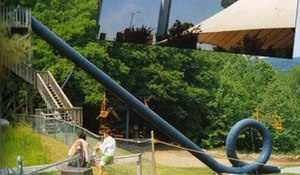
The biggest and best symbol of all that was awesome and ridiculous about Action Park was the looping water slide. A water slide with a loop-de-loop. How would that even work? You’re not harnessed into anything, like you are on a roller coaster. Doesn’t seem to make any sense, right? But it made perfect sense at Action Park.

The Wikipedia claims it was actually operated on occasion, but I never saw it open. And anytime you asked anyone about why it was closed, you always heard the same thing:

“Some fat guy got stuck in there and drowned.”

It turns out that was probably an urban myth, as were the stories that crash-test dummies sent down the tube to test it out came back dismembered. But who really thought a looping water slide was a good idea?

The Action Park people, that’s who.

Some of the Action Park rides are still open today at Mountain Creak Waterpark, but the Wikipedia mentions a “vastly increased emphasis on ride safety,” which I’ll take to mean they’re “incredibly lame now.”