At Amazin’ Avenue, an embarrassing GIFs of Shane Victorino compilation.


At Amazin’ Avenue, an embarrassing GIFs of Shane Victorino compilation.
I was about twelve when I started writing my own rhymes. One day in junior high, there was this lone kid, wearing a knapsack, walking about twenty or thirty feet in front of me. It was just the two of us in the hallway. He was kind of diddy boppin’ and singing his version of the children’s song “This Old Man”—”This DJ, he gets down, mixing records while they go round.” I couldn’t see his face, but I could hear the echo in the hallway. It was as if he was in another dimension, in slow motion, like a dream. But the way he did it, I was, like, “I wanna do that right now!” After that, I was writing, writing, writing. At fourteen, I started sending out demo tapes.
– L.L. Cool J.
Click through to check out GQ’s excerpt of the new oral history of Def Jam by Bill Adler and Dan Charnas. Easter Egg: Among friends and family, LL Cool J goes by his middle name, “Todd.”
It’s pretty hard to assess the Jets’ performance in their 30-21 loss to the Patriots yesterday without a firmer sense of how good (or bad) New England’s defense really is.
 If it’s as awful as it played in the first few games of the season, so is this loss. Though Nick Mangold’s return helped the Jets’ offense look a hell of a lot better than it did last week against the Ravens, Gang Green still couldn’t sustain many long drives and managed only 97 yards on the ground. Bill Belichick and the Patriots countered the Jets’ attention to stopping their passing game by letting BenJarvus Green-Ellis run wild, and the Jets didn’t appear apt to adjust in turn.
If the Patriots’ defense is actually closer to that team’s normal (excellent) standards, then the Jets’ loss Sunday is not all bad. Mark Sanchez, afforded a bit more time to throw the ball, played well in spite of some butter-fingered (and allegedly mutinous) receivers. Shonn Greene flashed some of the bruising ability he hasn’t shown much of in almost two years. And the Jets’ defense, for better or worse, managed to rough up Tom Brady a bit.
Maybe I’m being a bit too optimistic, but this didn’t feel like a game that belongs in the same category as the losses in Oakland and Baltimore. It seemed more like the type of football game that could have easily gone the other way had a few close calls fallen in favor of the Jets: If Deion Branch had lifted his knee off the ground before being touched on the would-be fumble, for instance, or had Plaxico Burress’ toe landed an inch short of the sideline instead of an inch over it.
But they didn’t, so the Jets sit below .500, with critics beating their chests and hooting with glee.
And again: If the Patriots’ defense is actually terrible, this game could forebode an awful season for our blustering heroes. I strongly suspect that it isn’t.
Also: Seems pretty clear that opposing offensive coordinators are going to try to exploit Eric Smith’s lack of speed. Smith can tackle anybody, but he’s vulnerable in coverage. Of course, he’s hardly the only guy to fault in the loss.
Remember a couple of weeks ago, when I was wondering why we don’t have graham cookies? I made some.
I used actual graham flour. It’s in the Bob’s Red Mill section of my local supermarket, and maybe yours too. The recipe called for regular flour, but that’s seemed like a cop-out to me. The graham flour seemed to give them an interesting, heartier texture than most cookies. I liked it.
Ice-cream sandwich on graham cookies.

The recipe goes like this:
1) Follow this recipe. Substitute graham flour for all-purpose flour if you so choose. Or don’t. See if I care. Make the cookies a little bigger than they tell you to, otherwise you’re not going to get as much ice cream as you want.
2) When the cookies are done and cooled a little, lay one face down on a plate. Scoop on some ice cream. I used vanilla, but go nuts.
3) Place another one of the cookies down on top of the ice cream, creating an ice-cream sandwich.
4) Eat ice-cream sandwich.
Alex drops an f-bomb, altering the Baseball Show forever:
Scottish golfer Elliot Saltman made a hole-in-one during his second round at the Madrid Masters and earned a tasty prize — his bodyweight in ham.
Saltman made the shot from the par-3 third hole at El Encin Golf Hotel. Heavily cured and salted ham is a Spanish delicacy….
Saltman’s only problem is getting the “excess baggage” back to Scotland.
“I don’t think they’ll let me take that on the plane,” he said.
Good news everyone: There’s a massive ham-eating party at Elliot Saltman’s hotel room in Madrid. BYO mustard.
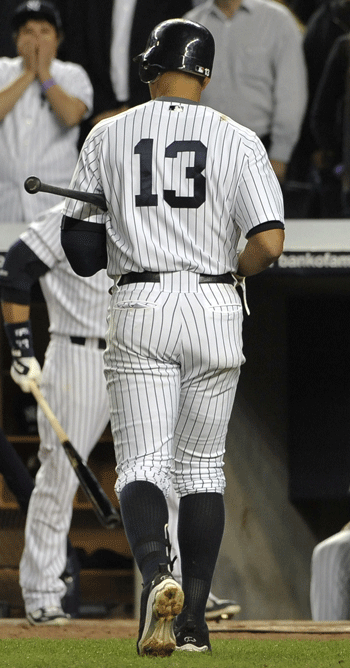
It makes more sense to call [Alex Rodriguez] the same kind of October bust he was for the Yankees before he had his one shining moment in 2009….
Benoit struck him out, swinging.
Two outs now. Still a big swing from Mark Teixeira – who has so often been as small as a jockey in his big games for the Yankees – would bust the game open. Only Teixeira seemed perfectly content to take a walk in that moment, take the walk that made it 3-2.
– Mike Lupica, N.Y. Daily News.
A Mostly Mets podcast listener emailed in a good question last week about the Mets’ worrisome home-road split in 2011. He wondered why the Mets went 31-44 at Citi Field this season and 42-36 on the road.
 The obvious, satisfying answer is that the park got into the Mets’ heads. All year long we heard about the psychological effects Citi Field’s distant home-run fences had on the Mets’ hitters, and then late in the season we even heard from Dan Warthen say that the dimensions let some of the team’s pitchers grow comfortable throwing bad pitches they felt they could get away with due to the spacious outfield.
And maybe that’s true, despite the randomness suggested by Patrick Flood’s research. Maybe some of that did happen, or maybe it happened even a few times — enough to convince the team’s coaches that it happened frequently, and then, you know, confirmation bias and all that.
Either way, it’s not likely to continue happening. In 2010, in fact, the Mets finished 47-34 at home and 32-49 on the road. Jerry Manuel suggested then that the team’s hitters pressed on the road, swinging too hard for the home runs they knew they wouldn’t compile in Citi Field. In 2009 they finished 41-40 at home and 29-52 on the road. They were much better at Shea Stadium than elsewhere in 2008, but much worse at home than on the road in 2007.
Perhaps calling any of that random statistical noise is too easy. Maybe there was something unique about the makeup of each of those teams and their coaching staffs that could explain the way they performed at home and on the road, even if rosters (and sometimes coaching staffs) tend to be fluid throughout a season.
Point is, none of it appeared to be continuous from year to year.
So here we have A-Rod, great in the playoffs in 2000 and 2004, bad in 2005 and 2006, pretty good in 2007, great in 2009, and bad again in 2010 and 2011. His aggregate postseason batting line looks a whole lot like his career regular season line, but hell, maybe he really did tighten up under the pressure in those down years. Anyone watching the games will say with certainty that he looked more comfortable in that 2009 postseason, though, of course, players generally look pretty comfortable when they’re beating the hell out of the ball.
And everyone in this great city knows that only New York players dictate clutchness, that guys from Detroit and everywhere else in flyover country are more or less robots performing to their expected levels with remarkable consistency. Who cares if Jose Valverde is now 51-for-51 in save situations this year? If A-Rod were clutch he could have overcome that. And if Mark Teixeira were clutch he would have knocked a pitch off the plate over the wall in the seventh.
Let’s forget for now that A-Rod and Teixeira have thrived in countless pressure situations throughout their baseball careers: in high school when big-league scouts came to watch, in the Minors with promotions looming, and in thousands of regular-season at-bats in the Majors. Let’s say for the sake of argument that postseason baseball represents some magical threshold at which the weight of pressure becomes overwhelming for even professional athletes accustomed to it, and that in those situations A-Rod and Teixeira are no different from all of us run-of-the-mill human beings, subject to the whims and burdens of our pathetically imperfect constitutions.
My question to Mike Lupica and the legions of Yankee fans convinced A-Rod is irreparably unclutch, then, is this: Have you ever failed in a big spot? Have you struggled with an important test or botched your lines in the school play or panicked on the parkway or frozen up in a job interview or embarrassed yourself on a date with someone beautiful?
I bet you have. We all have. It happens.
But do you expect it will always happen like that? Do you think that because you failed once or twice or even three times under pressure that you are doomed to do so every single time?
I don’t. Maybe you do. But I imagine anyone with such a defeatist attitude doesn’t often allow himself the opportunity to achieve great successes, and certainly nothing on par with a flourishing career in professional sports.
Existence precedes essence, and A-Rod is essentially one of the greatest athletes of his generation. That he struck out to end the game last night — while playing through injury, no less — should imply nothing other than that he struck out to end the game last night. He will undoubtedly find himself in many pressure situations to come. In some he will certainly fail, and in others he will just as certainly succeed.
 Tedquarters