
Twitter Q&A-fashioned product

Have I previously mentioned my feelings for Oreos here or is Gerald just making an educated guess?

Either way, Oreos are f#@$ing amazing. If someone offered me Oreos before a social gathering — let’s say a wedding, something where there’ll be lots of pictures — I’d first ask if they’re Double Stufs. And then regardless of the answer, I’d probably eat a ton of Oreos.

The only thing that might stop me would be if I knew for a fact there would be amazing food at the wedding and I could conjure up enough will-power to avoid ruining my dinner (or cocktail hour) with cookies. But even if that happened, I’d probably stash a few Oreos in my suit pocket just in case. Wedding cake often sucks, and if there aren’t going to be many other dessert options you’re going to want those Oreos for the ride home.

Of course it’s worth noting that I’m married now and no longer at all dedicated to convincing strangers to make out with me at or after social events. Still, any woman so superficial as to reject a man because of a little chocolate on his teeth doesn’t deserve to love me.
This is a good question, and if I could answer it definitively I’d be… well, smarter than I am currently. I’m never eager to diagnose mental issues in professional athletes that I do not know personally. And I’d remind anyone doing so that players will almost always look less confident and more crazy when they’re not performing. No one appears to have the much-sought closer mentality when he’s blowing leads.

The command issue is an easier one to tackle: Yes, he has a command issue. Parnell has walked 4.1 batters per nine innings for his career and 4.4 on the season. There are plenty of effective relievers who can work in that range, but most of them strike out even more batters than Parnell does — in this season and across his career.

And practically none of those guys allow hits at the rate Parnell does — steadily above 10 per nine innings for his entire career. As Patrick Flood has pointed out, it doesn’t seem to make sense for Parnell to allow so many hits on balls in play, since he generally yields a high rate of groundballs. Tough as it is to believe, it’s still too early in Parnell’s career to say for certain that it will keep up and it’s not an awful run of bad luck (compounded, of course, by the walks).

The most frustrating part about watching Parnell, for me, is the utter predictability of his pitch sequences. I have no good way of quantifying that relative to other pitchers, but I feel like I can almost always guess what’s coming. Part of that is obviously because he really only throws two pitches.

I wonder, though, if there’s something else to Parnell’s much-discussed habit of struggling every time he’s given a more important role. Could it be that by the time Parnell’s role is expanded, he has pitched so well and so often in the middle innings that he’s doomed to fail? He has pitched in 10 games in less than 14 days since Aug. 29, including six times in seven days from Aug. 29-Sept. 4.

Obviously I don’t know that’s the problem. Plus even if it is, a team needs to be able to count on its late-inning relievers to shoulder heavy workloads for certain stretches.
“Every pro player… has probably played with a gay person”

I’d rather have a gay guy who can play than a straight guy who can’t play… Any professional athlete who gets on TV or radio and says he never played with a gay guy is a stone-freakin’ idiot. I would even say the same thing in college. Every college player, every pro player in any sport has probably played with a gay person … I’ve been a big proponent of gay marriage for a long time, because as a black person, I can’t be in for any form of discrimination at all.

Charles Barkley.

It’s either bad on me or bad on society at large that I’ve seen Barkley’s unfortunate mugshot about 100 times yet never before heard or seen this quote. Here’s a reason to like the man beyond his noted Taco Bell advocacy and remarkable rebounding skills. (Though it’s patently turrible that we still feel the need to laud people for taking stances that should be obvious.)

Click through and read all of Will Leitch’s piece.

Worth noting

For all my bluster about being sick of the incessant charting of prospects years away from the Majors, I spend a lot of time doing exactly that.

And I figured it’s worth noting that though two of the Mets’ most well-regarded prospects coming into the season endured rough seasons in the Florida State League, their numbers appear worse than they actually are.
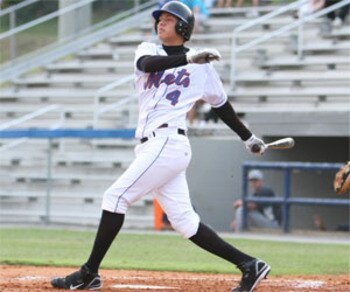
Wilmer Flores posted a .269/.309/.380 line for St. Lucie. But because that league and that park are particularly rough on hitters, his numbers translate to similar stats in Double-A Binghamton according to the Minor League Equivalency Calculator: .273/.307/.380. Presumably if he was putting up those still-unspectacular numbers as a 19-year-old in Double-A, no one would be ready to call him a bust yet.

Something similar goes for Cesar Puello. Puello hit merely .259/.313/.370 in St. Lucie after a breakout 2010 season in Savannah. Puello’s line translates to an underwhelming .262/.289/.396 at Binghamton, more palatable for a 20-year-old player. Most alarming for Puello is a sharp decline in walks from 2010 to 2011, though that is perhaps a trade-off made in pursuit of better power numbers.

Of course, the obvious corollary is that impressive performances from pitchers Darin Gorski and Zack Wheeler need also be taken with several grains of salt.

Naturally all the players involved still have a lot of development in their future, but I imagine we’ll see tons of Mets prospects lists this offseason that fail to factor in the effects of the unfavorable hitting environment in the Florida State League. So consider this when you read those.

Classless Jets undefeated

The Cowboys gifted the Jets a win yesterday, but Gang Green deserves credit for accepting it graciously.

The good guys mustered only 45 yards on 16 carries on the ground but threw for 335, a modification in game plan that Rex Ryan insisted came not by design but due to the Cowboys’ effective defensive front.

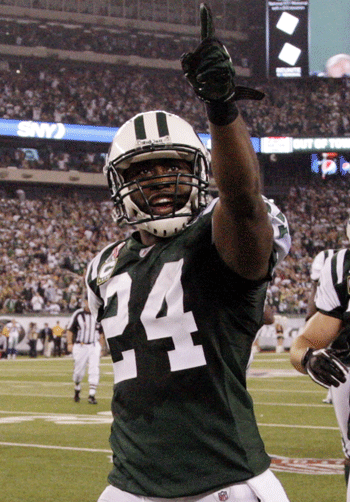
After a shaky start, Mark Sanchez took advantage of Dallas’ depleted secondary whenever he had time to and cut down on the ill-advised throws he appeared prone to attempt in the early weeks of his first two seasons. Plaxico Burress showed little rust despite two seasons spent behind iron bars.

Fans will likely fret this week about Wayne Hunter’s shaky performance blocking — or attempting to block — DeMarcus Ware, but Ware is a rare talent capable of making even the league’s best tackles look lead-footed and overmatched. Better tests for Hunter will come in the next few weeks.

Darrelle Revis got beat one time, but looked typically awesome for most of the game. Antonio Cromartie: Less so.

Of course, it’s hard to read too much into this game because a) it’s one game and b) we have no idea if the Cowboys are good yet. They sucked for most of last year, but they’ve got talented players all over the place, plus a newish head coach and a new defensive coordinator.

The good news is the Jets are undefeated. It’d be nice for them to win a bit more convincingly (and cover the spread, for goodness sake), but the team and its fans will gladly take the victory.

Q&A with Val Pascucci

I spoke with Val Pascucci before yesterday’s double-header. Obviously.

Ted Berg: So when did you find out you were coming up?

Val Pascucci: After our last game in Scranton, we finished the game there and Tim Teufel called me into his office to basically thank me for having a great season and everything I did over there. Then he said, “And it’s not over yet, they’re calling you up to the Mets. Keep it going over there.”

TB: What’s going through your head when you hear that?

VP: Well people were kind of whispering about it throughout the week. After Sept. 1 when they called [Josh] Satin up, people were saying there’d be more moves after the season ended. So I was looking forward to that, hoping to be one of them or at least be in the talk. When I finally found out, it was just great. I think it was a seven year absence since Montreal. I was just excited to get everything together and get up here.

TB: What do you remember from your last time in the Majors?

VP: The last time, I got to play against the Mets in the last game ever as a Montreal Expo. We finished in Shea, so that was something I always remember. I had a good day that last game against Tom Glavine. I think I went 3-for-4 or something, so that was a good day for me. But just being there – that was my first time up, and I got to go up and down a couple of times that year.

TB: And then after that season you went to Japan?

VP: I went to spend ’05 and ’06 over there, with Bobby Valentine’s team. We actually went to the World Series in ’05.

TB: How’d you come to that decision?

VP: Well, the season ended and I was actually still on the roster, but I got a couple of random phone calls from international agents saying Japanese teams were interested in me going over there. And then once I found out I told my agent about it, and he looked into it to see who it was and one of the teams was Bobby Valentine’s team. I went and met with him in New York. He told me all about it and I said, ‘Why not? Let’s do it.”

TB Was it about the money, or just the opportunity?

VP: It was just to get a chance to play every day. Bobby had seen my numbers and said, ‘I can’t believe you haven’t had more of a shot in the big leagues with all the numbers you put up for Montreal. I want to give you a chance to play every day, and if you come to Japan you’ll have that chance -– you’ll be playing right field for me every day.” I was excited about it, and the Expos were switching over to the Nationals and they had a new GM coming in -– [Jim] Bowden. My agent asked him what the plans were for me and he didn’t really have an answer, so it seemed like a good choice to have a chance to play every day, and it happened to be in Japan.

TB: You mention the numbers — and we’ve talked about this before — but do you ever look at them at scratch your head a little bit about why you haven’t had more shots?

VP: Like I said before, all I can do is go out and put up the numbers and hope somebody takes notice. I had another good year of doing all that, and I got a nice reward from the Mets for it. So I guess the perseverance pays off in this case.

TB: You joined the team in Florida, I know — What’s it like being back in a big-league clubhouse?

VP: It was nice. I walked in and it was like I knew everybody already –- it’s not like walking in somewhere where you don’t know anybody. I played with a lot of these guys in the Minor Leagues, and then, being in big-league camp got to play a few days. It was nice. I got in and it was a warm welcome; people were excited to see me. They knew some of the numbers I had put up already, so they were happy for me to be here.

TB: I assume some of these guys picked your brain a bit about pitchers in Triple-A. Is there a sort of role reversal now that a few of them have been up a while and you’re just joining the team?

VP: A little bit, yeah. There are a lot of guys who have faced guys who have been here that I haven’t seen in a while. They have the videos here and everything, and I’ll see ‘em and be like, ‘Oh yeah, I remember facing this guy three years ago.’ But he’s here now and if I haven’t seen him in a while, I’ll talk to someone. [Nick] Evans and I were looking at the starting pitcher yesterday — I faced him a couple years ago. Stuff like that — guys who have been around, I ask them what they’ve seen from different people.

TB: Has Terry Collins or anyone said anything to you about what to expect in terms of playing time?

VP: Not really. There are a lot of guys here, guys who have been here and pinch-hit and have that role. I’m ready to go whenever they need me. If I get in the starting lineup that’s great, if they call on me to pinch hit, I’ll be ready to go.