Selfish Carlos Beltran yada yada yada. From Kyle.
Classic Beltran
Reply

Selfish Carlos Beltran yada yada yada. From Kyle.
Hey Ted, how’s the Pascucci watch 2011 coming? It looks like he’s having another great year. Anything you can blog about?
– Wayne, via email.
I hoped the departure of Carlos Beltran was going to mean a big-league call for Val Pascucci, in what would have to be the most bittersweet TedQuarters moment imaginable. Nearly every position player the Mets had in Triple-A who was on the 40-man roster was either hurt or still within a 10-day window of being sent down, and the team has room on the 40-man and can make more by moving Ike Davis to the 60-day DL.
 But alas, they called on the only position player in Triple-A who was healthy, on the 40-man and eligible to come up: catcher Mike Nickeas.
Meanwhile, Pascucci just keeps crushing the ball. The 6’6″ masher is rocking a .282/.393/.515 line, alarmingly similar to his career Triple-A mark of .277/.396/.515. The guy is as regular as… I don’t know, a quartz clock? Someone with an extremely high fiber diet?
So yeah, Wayne: Pascucci Watch continues. But I don’t know what more anyone has to see. The guy destroys Triple-A pitching, and no one seems eager to find out if he can do the same in the Majors. He apparently isn’t much one for defense, he strikes out a bunch, and he’s 32. Soon enough, the window will close.
September is coming, and the Mets don’t have many obvious candidates for call-ups that aren’t already on the 40-man. Throw the guy a bone, huh?
Jordan Zakarin passes along word that the following is available for sale in SkyMall, America’s most essential in-flight catalog:

SkyMall has really outdone itself this time. Among pages upon pages of ridiculous, unnecessary products, perhaps most absurd of all: Jeff Francoeur, Clutch Hitter.
If you’re playing at home, Francoeur’s career line in high-leverage situations is a hefty .252/.301/.384, meaning he is a clutch hitter in roughly the same way that Yuniesky Betancourt is a hitter, in that both men are often charged with the task regardless of if they are up to it.
In fact, since Francoeur’s career rates in medium- and low-leverage situations are well higher than in those highly pressured spots, one might even argue that Jeff Francoeur is a decidedly unclutch hitter if one believed such a thing exists at the Major League level.
But then SkyMall says otherwise, and SkyMall sells the Litter Robot.
Eno Sarris takes time away from bashing Ruben Tejada to praise SABR-savior Sandy Alderson. All snark aside, a series of good points here. With role players it’s always hard to tell how much was shrewd general-managing and how much was luck, but Alderson seems to have optimized the 25-man roster this year.
Talking Zack Wheeler with Baseball America‘s executive editor.
I spotted Josh Thole playing catch before Tuesday night’s game using a regular fielder’s glove, so I asked him about it. He dismissed it as something he used for fun in warm-ups and said he didn’t think it helped or hurt or affected his catching at all. So no story there.
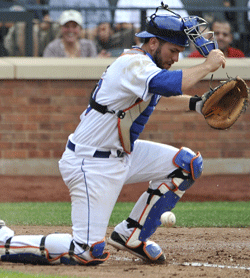 Thole called his defense “a work in progress.” “There are growing pains,” he said. “But it’s coming along.”
After an encouraging 2010 campaign, Thole’s work behind the plate in 2011 has shown more growing pains than progress. Until recently, he struggled to throw out basestealers. He sometimes appears to stab at or try to backhand pitches in the dirt, rather than block them with his body. He leads the league in passed balls, though part of that is due to being charged with handling R.A. Dickey’s knuckleballs every fifth day.
Citing batters who claim that swinging at a knuckleball screws with their timing against conventional pitchers, I asked Thole if he thought catching the knuckleball might affect his handling of the rest of the staff.
“Not at all,” he said. “The stance is a bit different, but it’s all the same thing.”
So nothing there, either.
Defense is tough to quantify, especially behind the plate. Beyond the Boxscore takes crack at it by assigning run values to catchers’ errors, passed balls, wild pitches allowed, and stolen-base rates relative to the league averages. As of July 19, Thole ranked 91st of 94 big-league catchers in 2011.
Granted, part of that is because he serves as Dickey’s personal catcher, a task that inflates his number of passed balls and wild pitches allowed. Also, Thole has thrown out a handful of runners in the past week, and since the stolen-base rate stat inherently deals in relatively small numbers, the recent run of success is probably enough to lift him up a bit in that category.
And it’s worth noting that in 2010, Thole’s defense rated as above average by the same methodology. It seems likely that the fluctuation has more to do with the innate finicky-ness of defensive metrics than Thole actually getting worse, and his actual level of ability behind the plate — by stats or otherwise — lies somewhere in between: passable, but not great. His struggles this season, though real, have not come with such an alarming frequency to forebode further or worse problems moving forward; even struggling, he is within the range of Major League catchers
There’s more to catching than blocking balls and throwing out runners, but for as much as pitchers talk about their batterymates’ game-calling, it’s difficult to find any evidence that any one catcher is better at it than any other. It seems possible and even likely that some catchers work better with some pitchers, but if you look at teams’ ERA splits by catchers from year to year, you’ll see there’s no real pattern to it.
Pitchers throwing to Thole in 2011 have yielded a slightly higher ERA (4.14) than pitchers throwing to Ronny Paulino (3.94), but Thole boasted a better catcher’s ERA than Rod Barajas in 2010 and the memorable Brian Schneider/Omir Santos tandem in his small sample in 2009. It’s not a stat worth investing much time or space in (whoops).
Offensively, Thole has also taken a step backwards this year after a promising half-season in 2010. Though he has not completely collapsed, his numbers are down across the board in 2011.
Still, the largest possible body of evidence for Thole — 166 games now — shows a 24-year-old catcher with a career .271/.350/.347 hitting line. That’s a hair better than the league-average .243/.315/.380 mark for Major League backstops in 2011.
Thole hits for almost no power, so he’ll never maintain that aspect of the Mets’ catching tradition. But there’s a lot to show he can hit like at least an average big-league catcher, if not a touch better. He’s 24, after all, so he’s probably still improving.
Around the trade deadline, talk spread that the Mets could be looking to upgrade behind the plate, and it seems likely the same discussion will resurface this offseason. And indeed, Thole is not now and does not look apt to ever be a great catcher on either side of the ball, so it’s a position at which the Mets could feasibly improve.
But Thole is young, under team control through 2016, and a left-handed hitter — especially valuable at a position that demands some form of time-share. So I question the logic of dedicating much of the team’s offseason resources to a spot at which it has what appears to be a viable and inexpensive if unspectacular Major Leaguer. Not when they have a shortstop to re-sign and need pitching help like they do.
I’d chalk up Thole’s 2011 to growing pains, like he said. Sometimes it’s difficult to stay patient through the struggles, but it’s important to remember that not every young player hits the big leagues and starts consistently producing like David Wright did. There’s a growth curve, and Thole should still be on the front side. This is what this season is for.
There was some debate in the comments section yesterday, so I figured I’d survey a larger group. I only included the toppings that come for free at Nathan’s, since that seemed like a good general barometer. Obviously there’s no limit to the things people can and do put on hot dogs, but you can’t find cream cheese and Sriracha at your standard street-corner hot-dog cart, no matter how delicious that sounds. I left off chili and cheese because they cost extra, and because when you get chili and cheese on your hot dog it alters which other condiments you choose. Check all that apply.
[poll id=”31″]
What follows is fiction, obviously.
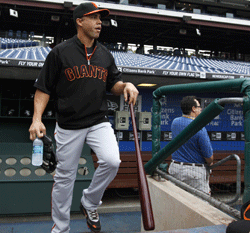 House of Pain’s “Jump Around” blares from an iPod dock in the visitors’ clubhouse in Citizens Bank Park. Members of the defending World Champion, first-place San Francisco Giants bounce giddily around the room, preparing for their game against the Phillies. Jeremy Affeldt and Sergio Romo pass an iPad back and forth, laughing at something on the screen. Miguel Tejada and Mike Fontenot take turns flicking a paper football through deodorant-stick uprights.
Carlos Beltran enters, wheeling his luggage behind him.
“Hey bro,” says Brian Wilson, bounding across the room. “It’s me, Brian Wilson! The wacky guy, with the beard! Do you like cheesesticks?”
“I know who you are,” says Beltran. “We met last week, and you’re on TV constantly. You’re the most overexposed man in America. Have you no shame?”
The music stops. Eli Whiteside puts down the bust of Bruce Bochy he is whittling and stares at Beltran.
“Aw, it’s just… I… I’m me being me,” Wilson says. “I… ahh… do you like cheesesticks?”
“You’re not even the most talented or craziest Brian Wilson,” says Beltran.
Beltran rolls by the lockers belonging to Tim Lincecum and Matt Cain. “Hey, Mitch from Dazed and Confused and Badger from Breaking Bad. Big fan, guys.”
A few lockers down, Pablo Sandoval changes into his uniform. “Brother, I thought they said you lost weight,” says Beltran as he passes.
Hitting coach Hensley Meulens meets with the rest of the Giants’ starting lineup near the locker assigned to Beltran. Beltran sees the group and doubles over in hysterical laughter.
The Giants are 1-5 since Beltran’s arrival.
I kind of went into panic mode there…. I just messed up.
– Justin Turner.
The ellipsis there replaces Turner detailing the plan the infielders discussed before the fateful play in the Mets’ 4-3 loss to the Marlins on Tuesday: Throw to second on a hard-hit grounder or to home plate on a soft one.
When the ball found his glove, Turner did neither of those things. Instead he moved to tag baserunner John Buck between first and second, then froze when Buck froze, then threw the ball in the general direction of but nowhere actually near first base. Turner described it best: Panic mode.
It happens to the best of us. Only when I go into panic mode, I scramble onto the express train when I need the local or order something I’ll regret at a restaurant because the waitress is standing there and I haven’t really thought about what I want but I need to pick something now since who knows when she’ll be back and aw, screw it, “Fajitas,” BUT I DON’T EVEN REALLY LIKE FAJITAS!
The downside to playing baseball professionally is that when you enter panic mode, thousands of people see it, then you have to tell them about it afterward. The upside is just about everything else.
These things happen. Again. Three straight gut-punch last-inning losses. Say what you will about the 2011 Mets, they’re not boring.
I was sort of aimlessly roaming Citi Field’s concourses looking for an as-yet-unreviewed sandwich to eat when a friend pulled me on to the front of the line at Shake Shack. Obviously that’s not an opportunity I’m willing to pass up, but since I’ve already had the burger, I went for the Shack-ago Dog.
This brings up an important point: A hot dog is a sandwich.
Several readers and friends have insisted otherwise in the last couple of weeks. But if you believe that’s the case, define “sandwich” for me. I’ll amount that I operate under a particularly liberal definition of the term, but a hot dog should be an obvious sandwich to even the most conservative sandwich stalwarts. I guess if you’re really picky you could argue that a hot-dog bun is only one piece of bread, but so is the roll they use for cheesesteaks. And everyone agrees a cheesesteak is a sandwich, right?
The only reason anyone has given me that even makes a tiny scrap of sense is that we have a name for a hot dog — several, actually — and it doesn’t include the word “sandwich.” So, they say, a hot dog is its own thing, distinct from a sandwich. But that doesn’t make sense. No one calls it a BLT sandwich, but there’s no doubt a BLT is a sandwich.
Look: a hot dog is a piece of meat — or in some cases “meat” — shoved in bread. It’s about as sandwichy as sandwiches get, no matter what we call it. Here’s the Shack-ago Dog:
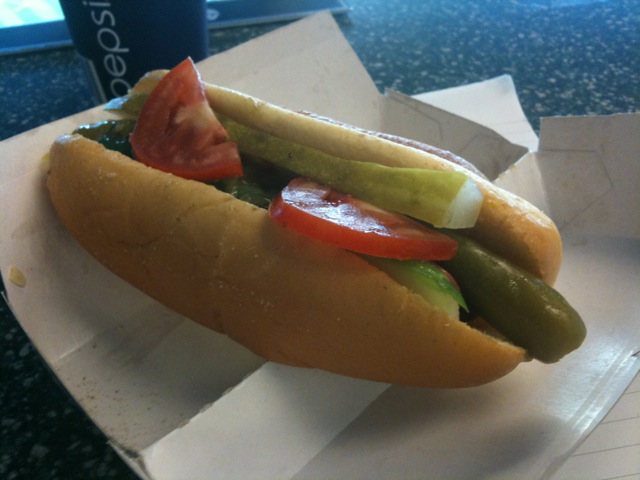
First off, note that the green thing coming off the end of the bun there looking for all the world like a green hot dog is not a hot dog. That’s a pepper. The actual hot-dog part of the hot dog is buried underneath there somewhere.
The Shack-ago Dog is a split-grilled hot dog with relish, mustard, peppers, tomatoes, onions, celery salt and two different types of pickle. I ordered mine with no onions.
For whatever reason, the people of Chicago strongly prefer that you not add ketchup to your hot dog. I resent that, as I do not like to be told which condiments I’m allowed to use on my sandwiches. But in deference to that city’s rich tubed-meat tradition, I ate the Shack-ago dog as it came.
It’s delicious. I thought I would regret snagging a spot on the front of the Shake Shack line and not using it for a wait-free burger, but this dog is a worthy alternative. The pickles give it crunch, the peppers give it spice, the mustard makes it tangy, and the tomatoes and relish make it sweet.
The hot dog itself is secondary to the condiments, but I think that’s the way it should be. At best, a hot dog is a meaty conduit for toppings, there to add some snap and a hint of salty hot dog flavor.
Also, split-grilling hot dogs needs to catch on beyond Westchester and (apparently) Chicago. More surface area. It’s a no brainer.
 Tedquarters