Once again, Mets probably need a second baseman

So I’ve slacked really hard on my position-by-position review of the Mets farm system. Well, that and the team went out and hired a new General Manager and reshaped the entire front office, which is kind of a big deal. I’m using these to start lining up my thinking for my overall rankings. I want to finish the infield with shortstops and third baseman this week and finish the series the week after.

So, today we move on to second base. Second base was a black hole for the Mets in 2010. By Fangraphs’ WAR, the team’s -0.4 WAR was the second-worst in all of baseball, ahead of only the Cleveland Indians. The Mets’ keystoners combined on a .269 wOBA, making their offensive contribution dead last in all of baseball. Since the Mets derived so little value from secondbase in 2010, it should be the easiest place to improve in 2011.

Toby Hyde, MetsMinorLeagueBlog.com.

Toby’s right, you know. Second base should be the easiest place for the Mets to improve in 2011.

Problem is, I’m not sure there’s an obvious answer. Everyone loves Orlando Hudson, and if he’s available for as reasonable a cost as the one-year, $5 million deal he got from the Twins last year, he seems like a good choice for a quick upgrade. According to Fangraphs, Hudson has not been worth less than $5 million — or less than $7 million, really — since 2003.

For a while I was certain the Mets would be best-served by signing a utility guy who could open up the season starting at second, back up shortstop, and transition into a backup role if and when one of the Mets’ younger second-base options proved worthy of everyday play. I mentioned Edgar Renteria as a possibility in this space, and I know others have brought up Juan Uribe and David Eckstein.

None of those guys represents as certain of an upgrade as Hudson does, though they should all come a bit cheaper. Hudson has never played shortstop in the Majors or Minors, though, so his acquisition would mean the Mets likely need an additional infielder to back up Jose Reyes. Ruben Tejada could theoretically field both middle infield positions in the Majors, but it seems silly to commit a 21-year-old to a backup role when he could be polishing his game in Triple-A.

Justin Turner has a career .806 OPS in over 200 games at Triple-A. He played some shortstop and some second base for the Bisons in 2010, though I don’t know much about his defensive acumen.

If the Mets opt not to look outside the organization for middle-infield help, Turner probably represents their best option. Daniel Murphy is now playing second regularly in the Dominican Winter League, though, again, I have no idea how he’s performing at the position. If Murphy can capably field the spot, perhaps he could fill the lefty-hitting half a platoon with Turner.

But again, I’m not sure there’s an obvious choice. With Murphy, Turner, Tejada and Reese Havens in their system, it seems like the Mets would be best served not handing out any multi-year deals to veteran options. At the same time, none of those prospects (except perhaps Turner) appears ready to man the position in the short term.

These thoughts are haphazardly compiled because I’ve had a long day of meetings and studio responsibilities, and I’ve got to leave early to boot. And I feel like I’ve been trying to come up with a good, creative way for the Mets to fill their second-base spot every offseason since I started writing for SNY.tv in 2006. At this point I might be out of ideas, so if you’ve got any, feel free to share ’em.

And of course, they’ve still got Luis Castillo under contract for another year.
What?

So Topps is hosting a vote to name the 60 greatest baseball cards of all-time, but the company “pre-selected the 100 greatest cards [it has] ever produced.”

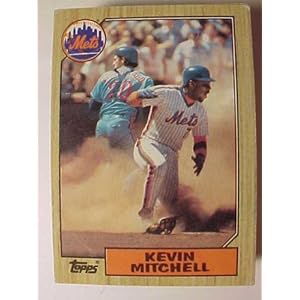
I have no idea by what standards they determined those 100, or how they define “great,” but any list of top baseball cards that does not include the following gem does not deserve to be voted on.

Also, I remember thinking that when Kevin Mitchell led the league in homers in 1989 it was something of a meteoric breakout season. But looking back at his stats now, I see that Mitchell was an excellent hitter from the time he came up and for pretty much the length of his Major League tenure. Career 142 OPS+. Not shabby.

Shin-Soo Choo at the Asian Games

As Craig Calcaterra points out, if Shin-Soo Choo and his teammates on the Korean national baseball team can win the Asian Games this month, they’ll likely get out of their military commitments to South Korea. Choo, it should be noted, is awesome at baseball. He is one of the top handful of hitters in the Majors, he is already undoubtedly the best position player ever born in Korea, and he surpassed countryman Chan Ho Park in career WAR late last season.

On conspiracy theories, briefly

OK, if you feel like hatching a conspiracy theory, by all means, go ahead. They’re fun sometimes, and ever now and then touch on a kernel of truth, no matter how silly or outlandish they seem.

But if you don’t bother providing or even considering the motivation driving the conspiracy you fear, your theory will lack punch.

For example, if you were to say that the government puts chemicals in our food to make us gay — as at least one person unironically has — you must then tell us why: To control the spiraling population.

Although the entire idea is ridiculous, at least you’ve provided a vaguely viable motive. It would probably behoove the government to control the population, even though “the government” as a single unified entity does not really exist, nor, clearly, does it have the wherewithal or organization to enact a scheme so nefarious.

If you were to argue, then, that the media is out to get someone, you must tell us why the media would be out to defame that specific person. Otherwise, it makes no sense. Even if “the media,” like “the government,” were a single agent operating on behalf of a single agenda — even if we’re granting that, though it’s clearly not true — you must define that agenda and explain why it benefits the media.

When I was in high school, I spent a lot of time thinking — maybe fantasizing — that certain teachers “hated me.” This is a common refrain among high school students with disappointing grades: My chemistry teacher hates me; all my teachers hate me. I figured certain segments of the faculty got together over lunch and talked about what a wiseass I was and how they were going to make my life hell.

Then I went back and worked in that very same high school, and realized that it is an extremely rare case when a teacher actually hates a student. The worst teachers are completely indifferent to their students, the best ones want badly for their students to succeed.

For a teacher to hate a student, he would have to be both emotionally invested in his work yet not interested in or actively opposed to one student’s success: contradicting objectives. And on the rare occasion that an insubordinate kid’s name actually does come up at lunch in the faculty, maybe one teacher will shrug and say, “kid’s a pain in the ass,” but it never, ever launches a plan to conspire against that kid.

I realized then that my high-school teachers more likely felt for me some combination of pity, impatience and frustration, or, in many cases, just didn’t really feel anything at all besides, “I must shut this kid up to control the classroom.” They have no strong motive to conspire against their students, so they don’t do it.

So please, if you’re a fledgling conspiracy theorist, take heed: For your conspiracy theory to make sense, you must explain how it benefits the interests of those conspiring.

Sandwich of the Week

You probably won’t be able to recreate this sandwich at home. After my pulled-pork experiment last month, I ate obscene amounts of pulled pork and still wound up freezing a bunch of it.

I dug it out of the freezer last week in an attempt to make chili, substituting it for turkey and vaguely following this recipe, in that chili recipes are ever really followed.

Problem — I guess I should say “problem” — was that I wildly underestimated how much pulled pork I was working with, not to mention pulled pork’s surprisingly absorbent nature. I wound up with a giant pot full of chili-inspired pork glop, undoubtedly delicious but not soupy or stewy enough to really be called chili.

For the purposes of this write-up I’ll still refer to it as “chili” because “pork glop” doesn’t sound overwhelmingly appetizing and I can’t think of any way to accurately describe the stuff that does. Plus, consistency issues aside, it’s still flavored like chili, which is what mattered most for the purposes of the following sandwich.

The sandwich: Chili-cheeseburger from the analog Tedquarters in Westchester.

The construction: Burger with cheddar cheese, pork chili and a dollop of sour cream on a toasted challah roll.

The sour cream and chili I had already. The ground beef, cheese, and rolls I bought at the Grand Central Market, before my commute and after a late-day sandwich epiphany at work.

Important background information: I’ve mentioned this before, but I really can’t stress it enough: You really want the fattiest beef you can find for good burgers. In-N-Out uses chuck that’s 40% fat, which is way, way fattier than you can normally find at the supermarket. Five Guys uses beef with 20% fat, which is about the upper limit of reasonable.

I was working with ground sirloin here, which — while more impressive-sounding to guests, or something — means it was a lower fat content than I’d like to use for burgers, probably about 10% or so. I seasoned it with a little black pepper. Sometimes I go overboard with seasoning the beef and in this case I didn’t want the burger to overwhelm the chili.

“Seasoning the beef” sounds like it could be a euphemism, though I have no idea what for. In this instance I mean it literally.

What it looks like:


How it tastes: Eh, pretty good. I could have done better, I think.

For one thing, I overcooked the burgers a little bit. It was my first time cooking burgers on the stove for the season, and I guess I overshot how long I’d need to grill them on there, accustomed as I am to the barbecue. But that’s not a great excuse; truth is I just didn’t time it right. I wound up with burgers that were decidedly well-done, and I’d have preferred them on the rare side of medium.

The chili was, like I said, spicy and delicious, and definitely worked really well on the burger. But as I feared, the flavor of the chili was a tiny bit overwhelmed by the burger — not because I overseasoned the meat, but because I probably made the burgers a bit too thick (if that’s even possible). The cheddar cheese, too, got lost in the mix. The slices were real thin, and I’m not certain I even tasted it with all the other stuff going on.

My wife raised her eyebrows a bit about the presence of the sour cream, but I figured if I like sour cream on chili, I should also like a little on a chili-cheeseburger. I was right — it added some moisture (remember: both the chili and burger were drier than I’d like), combined well with the chili, and gave the whole thing a bite that it didn’t get from the cheddar.

I chose the challah rolls by default — they were the only roughly burger-sized roll at the Grand Central Market and I really didn’t feel like stopping somewhere else. But that turned out fortuitous, as the sweetness of the challah added a whole different dimension to the burger. Really, the rolls were probably the best part. Hat tip to Zaro’s.

All in all it was good, but it didn’t match my hopes. Give it a 9 for inspiration and a 5 for execution, which is pretty much the story of my life.

What it’s worth: Not easy to estimate since I had some of the ingredients already, and bought way more than two slices of cheese and everything (plus it was almost a full week ago now). I think these things cost me about $6 each, plus about 20 minutes of prep time.

How it rates: 70 out of 100.