Mets Minor League Report: Darin Gorski
Video
Reply

I almost forgot!
Most importantly: Peter at the So Good Blog reviews — without judgment — Taco Bell’s new Firstmeal offerings and provides some clarity on the mysterious third orangey goo from the Breakfast Crunchwrap photos. He guesses that it’s their rarely used jalapeno sauce — familiar mostly from the chicken and steak quesadillas — and asserts that it provides the flavor both of us wanted in previous Taco Bell breakfast offerings. The whole review is worth a read. Obviously I haven’t had the new products yet so I can’t vouch for them, but this guy’s tastes seem to align so closely with mine that I suspect he’s on the money with it. For what it’s worth: this is my first time stumbling my way to the So Good Blog but I expect I’ll be back. Entertaining and unpretentious.
A look into the future: Commerce City, Colorado is getting a new Taco Bell prototype that is being described as both “upscale” and “a beacon in the night.” Clearly another important step in the Franchise Wars. Check it out:

Flamas Doritos Locos Tacos testing: Toledo, Ohio — where it all started — is now selling the long-speculated new Flamas flavor of Doritos Locos Tacos. Will friend of friend of TedQuarters Nat Cristiano make the drive? Also inside: Word that the biggest hurdle in the creation of the Doritos Locos Taco was “Doritos are triangles, but triangles don’t make good taco shells” and that “it was a true impasse for awhile, one that needed to be resolved by the presidents of both brands directly.” So that’s hilarious. Lastly, Columbus Business First staff reporter Dan Eaton does a good job putting on a suit and smart glasses to look like a business reporter, but something about his hair and beard screams “Fourthmeal Enthusiast.” I guess there’s no reason you can’t be both. You’re all right by me, Dan Eaton. Keep up the good work.
Word spread this morning that the Mets could consider trading Ike Davis, which prompted me to Tweet this:
https://twitter.com/OGTedBerg/status/248051067835777024
This isn’t about what I tweeted so much as the responses to that Tweet, which included multiple Mets fans decrying the joke idea of trading Davis for awesome awesome McAwesomestein superhuman home-run thing Giancarlo Stanton (which the Marlins would never do, obviously) because it would leave the Mets without a first baseman.
OK.
The Mets don’t have outfielders, and you’re going to have to give something to get something. Also, to all those who’re reading to anoint Ike Davis the first baseman of the future and trade Lucas Duda, remember how you felt in, I don’t know, June. Davis is a better defender than Duda, is a year younger and has a larger sample to suggest he’s a capable Major Leaguer. He also has a better prospect pedigree, for whatever that’s worth (i.e. very little). But to date, Davis and Duda have been almost identical hitters in their careers. Davis has a 115 OPS+, Duda has a 114 OPS+.
Since Duda is indeed a year older, it’s more reasonable to expect improvement from Davis than Duda, whose career line looks a lot like that of average 2012 National League first basemen. But is that extra year of development from Davis, plus whatever value he has on defense at first base over Duda, worth more than the difference between Giancarlo Motherf–
Wait, why am I even indulging this?
Depends on the deal, depends on the deal, depends on the deal.
The documentary Knuckleball!, directed by Ricki Stern and Annie Sundberg, opens this week in theaters in New York and Boston and is available on-demand and online. Information on tickets and screening times is available here.
 In the film’s opening sequence, the directors use audio clips from baseball and talk-radio broadcasts to establish the way the knuckleball is stigmatized in the game: It is “a trick pitch,” “a mediocre pitcher’s best friend,” something not to be trusted. Next, one of the movie’s stars outlines what is perhaps its central theme:
“You look at the course of my career, it’s been up and down, the good with the bad, the twists and the turns,” says Tim Wakefield. “That’s what my pitch does.”
Using a combination of recent and archived game footage, on- and off-field material shot for the film, interviews and still photos, Knuckleball! follows Wakefield and R.A. Dickey — the big leagues’ only knuckleballers — through their 2011 seasons. But like its namesake pitch and the careers of its practitioners, Knuckleball! swoops and bends and breaks and wiggles in flight, veering into both pitchers’ histories and winding through the mindset the pitch requires and the supportive brotherhood of knuckleballers that help each other maintain it.
Yet through all its twists, the movie never feels disjointed. Rather, it is beautiful for its digressions, for helping the audience feel every high and low and swivel and plunge in a season or a career but still somehow keeping its course. Again, like a knuckleball itself.
One thing no documentary or game coverage can ever quite seem to capture is what a knuckleball actually looks like to a batter or to an observer standing right behind the plate. Undoubtedly if you’re a baseball fan you’ve seen video of pitches flying free of spin, but there’s something about the way they flutter and wobble up close and in person that defies the cameras. I don’t know why this is, whether it’s actual physics or an optical illusion, but occasionally a good knuckleball will even appear to dart upwards mid-flight. There must be an explanation, but to a layman it shouldn’t matter much: Whether it’s actually happening or just appears to be happening, it’s a spectacular thing to behold.
Interviews drive Knuckleball!, so Stern and Sundberg benefit from Wakefield’s workmanlike candidness and Dickey’s professorial panache. But maybe it’s no coincidence that Major League Baseball’s two knuckleballers also come off as two of its most interesting and introspective people: It must take a special type of dude, after all, to do what they do.
Think about what Tim Wakefield did for a minute. After his flare-up and fizzle-out with the Pirates, Wakefield caught on with the Red Sox in 1995. Think of the type of personality it must take to last through the entire length of one of baseball’s greatest offensive eras, pitching in one of its greatest hitters’ parks, in front of a notoriously hostile fan base — them that never quite took to Ted Williams — throwing the same 67-mph pitch over and over again. And yeah, baseball is a game and Wakefield was compensated handsomely for the work he did, no doubt. But baseball breaks people all the time, and Wakefield’s ability to remain upright through his struggles in 2011 shed light on why he was able to succeed as a knuckleballer at all.
If I’m going off on tangents myself: No one in the film comes off seeming as wise or as entertaining as the elder statesman of the knuckleballing community, Wakefield’s mentor Phil Niekro. And for all the justifiable talk about Dickey’s stellar 2012 season, Niekro’s work in the late 1970s might not get enough credit in the pantheon of knuckleball lore. From 1977 through 1979, Niekro threw over 1000 innings in three seasons and amassed 25.2 bbWAR — three more than Tim Lincecum has to date in his entire career.
The action in Knuckleball! closes before the 2012 season began, so Dickey’s current campaign, which now appears to be darting and diving its way toward a Cy Young Award, does not make the film. It is, for the sake of the metaphor, one of those knuckleballs that rocket upward in apparent defiance of documentation and logic and belief.
Dickey has said in the past that he believes the knuckleball resonates with so many fans because there’s something populist about it: Since the pitch does not, on face, require any inhuman strength, everyone thinks he can throw a knuckleball and everyone believes it is his best shot at a Major League career — even if it is in truth nearly impossible to do successfully. But I suspect there’s something else about the knuckleball that grips us, something enormously poignant and universal and something that Dickey alludes to in the film’s final moments. To throw the knuckleball is to live at the whims of the wind, to harness an enormous amount of skill to ultimately yield to randomness as everyone must almost all the time, suffering or succeeding from our slightest slip or lightest touch.
“Once it leaves your hand,” Dickey says, “it’s up to the world what it’s going to do.”
Why isn’t this getting more press? What is even happening here? Is Bryce Harper’s idea of fun standing on a rooftop at sunset being pelted by baseballs?

On one hand, he’s 19 and we probably shouldn’t fault 19-year-olds for doing the stupid things 19-year-olds do. On the other hand, he’s really awesome at baseball and plays for a different team in my favorite team’s division. So, you know, get him.
The Jets lost yesterday and Mark Sanchez looked pretty bad. Mark Sanchez is an NFL quarterback and NFL quarterbacks tend to bear the bulk of the blame when their teams lose, so the going sentiment this morning seems to be that the Jets lost yesterday because Mark Sanchez looked pretty bad. But I’m not certain that’s the case.
 For one thing, most of the Jets offense looked pretty bad. Sanchez’s much-maligned run of incomplete passes wasn’t helped by some lousy play from his receivers, including a couple of notable drops and miscommunication with Jeff Cumberland.
And mostly, focusing on Sanchez’s struggles in the game overlooks what was likely a bigger factor in their loss: The absence of their best player — and arguably one of the very best football players in the world — cornerback Darrelle Revis.
Check this out: The Daily News’ feature off the game focuses on the Jets’ problems with the Pittsburgh secondary. Its notes article highlights Tim Tebow’s reception in Pittsburgh, LaRon Landry’s costly penalties, and the tight ends the Jets used to replace Dustin Keller, a column from Hank Gola insists the Jets’ offense needs to be better, and in a column under two pretty photos of Tim Tebow, Bob Raissman argues that CBS shows too much of Tim Tebow. In five articles about the Jets’ loss to the Steelers in the Daily News, Revis’ absence is mentioned once, in the 11th paragraph of the recap, after a bunch of stuff about Sanchez.
The Post, to that paper’s credit, mentions Ben Roethlisberger’s dominance of the Revis-less Jets’ secondary in two news stories off the game. It also featured a sidebar on Tebow’s absence and one on Landry’s penalties. One column mentions Roethlisberger’s shredding of the Jet D but ultimately blames Sanchez anyway, and the other is about how anybody can lose to anybody in football and how the Jets always seem to lose in Pennsylvania — both of which are true.
The Times mentions Revis’ absence in the 14th paragraph of its recap but not in its blog post about why the Jets lost. There are two other recent Jets stories in the Times. Neither of them appear to have anything to do with Revis, but I can’t read them as I’m past my article limit for the month.
So of 15 articles in the three New York City papers about yesterday’s Jets game, only a third even mention the absence of the team’s best player, and really only one — from the Post — focuses on how poorly the Jets’ secondary played against the Steelers’ passing attack. Does anyone anywhere think Roethlisberger even attempts that 3rd-and-16 touchdown pass to Mike Wallace if Revis is covering him? And if by some chance Roethlisberger does, is there any way Wallace is able to make that catch if the best cornerback in football is hanging all over him? C’mon.
That’s a game-changer right there. But tack on the way the Jets could have schemed for the Steelers with Revis in the game versus the way they had to without him and figure his presence means a couple more sacks, a few less third-down conversions, a narrower gap in time-of-possession, less pressure on the Jets’ offense to force the ball downfield late in the game and thus more opportunities for Tim Tebow and the Wildcat crew — all those things you wanted out of the Jets’ offense, courtesy one awesome man on the Jets’ defense. Guy’s really good.
It’s not the Jets’ fault that Revis missed the game, of course. It’s nobody’s fault but circumstance, and that doesn’t make for very good headlines. But putting this one on Sanchez and the Jets’ offense, no matter how bad they looked, is undercutting the contributions Revis makes to the defense every week he’s healthy. They could not stop Roethlisberger and the Steelers’ passing attack. That’s the story here.
The sandwich: Chopped pork sandwich from Allen & Sons Barbecue, Chapel Hill, North Carolina.
The construction: Chopped pork and cole slaw on a hamburger bun. Served with an East Carolina-style vinegar-based barbecue sauce. Came with a side of hush puppies, which were amazing.
Important background information: As I mentioned, I spent most of last weekend on the road. Before I went, I researched the best barbecue places that were on my general route — as I pretty much always do. Since I was going to be in Eastern North Carolina, I was looking for the type of barbecue typical of that region. Presumably you know all about regional barbecue styles by now, and how Eastern North Carolina is one of them.
What it looks like:
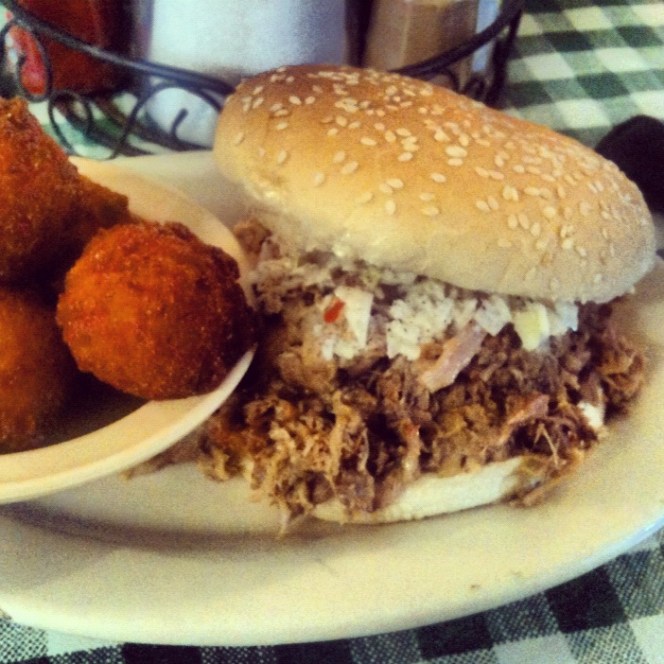
How it tastes: Pretty delicious, because pulled pork sandwiches with cole slaw are pretty delicious. I wished the pork itself had a little more smoke flavor and some more diverse texture — those qualities, in reviews of Allen & Sons, were what drew me to the place. But maybe mine was not the best example of their barbecue, the last scraps from a butt or something, which would speak pretty well of their barbecue because it was still porky and tasty. With the vinegar sauce, especially, it sang. It added a great peppery tang to the sandwich, and the only thing stopping me from drenching the thing in the sauce was the fear I’d soak the bun.
The cole slaw was cole slaw. It added creaminess, texture and sweetness to complement the saltiness of the pork.
What’s worth noting, I suppose, is that as fine a sandwich as this was, I’ve had better East Carolina-style barbecue pork sandwiches in New York City. Multiple times, really. And that makes some sense: It’s a widely heralded cuisine, and there’s nothing about North Carolina that should make it the only place able to produce its own styles of barbecue. I mean… right? It’s not like it’s in the water or in the pigs. You want to reproduce any one of this nation’s barbecue cultures elsewhere, there really shouldn’t be anything holding you back (save maybe some ordinances about where you can cook with woodsmoke). And so people do. These last 10 years have been great ones for barbecue.
And that’s not to big-time Chapel Hill, North Carolina. I use New York as the example because it’s where I live and where I’ve tried the most pork sandwiches. I guess I’m wondering if my now 15-year-old habit of driving places to eat local stuff is growing increasingly silly as communication and lines of distribution improve — even if I’ll still always eat local stuff when I drive places.
But then if that’s the case, why am I not regularly eating hush puppies this good?
What it’s worth: I believe it cost about $9 with the hush puppies.
The rating: 72 out of 100.
If you regularly read this site, you probably know that I am a fan of the wildly underrated actor and former NFL defensive end Terry Crews. I am also a fan of the wildly underrated TV series Arrested Development.
Catsmeat, who is a reasonable man and also a fan of these two things, passes along word that Terry Crews will appear in the forthcoming new episodes of Arrested Development. I have nothing to say. Please don’t let me down, forthcoming new episodes of Arrested Development.

