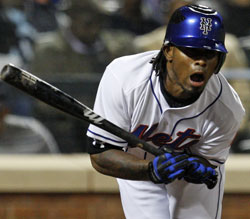
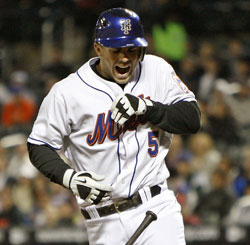
The second baseman must always bat second

Just got tonight’s Mets lineup from our producer Carly:

Pagan
Castillo
Reyes
Bay
Wright
Davis
Francoeur
Barajas
Maine

I spent some time weighing in on batting orders before the season started, but it’s been such a hot-button topic lately that I’ve sort of soured on the subject. Bottom line is it just doesn’t make a huge difference.

Reyes will finally bat third, which means we can finally stop hearing about it, which will likely be the single best outcome from this lineup. To me, it doesn’t seem like a great plan to drop your best hitter down in the order, but the batting-order optimizer actually calls for the fifth hitter to be better than the third and fourth hitters, so you know, what do I know? Plus it’s not like Wright’s exactly destroying the ball lately.

And I don’t know if Jerry Manuel thinks there’s a rule in place stating that the second baseman must always bat second, but he’s done that in every game this year, including the ones when Cora started. Maybe I understand the logic in putting a batter there who could knock the leadoff hitter over, but that assumes the leadoff hitter got on base, of course, which won’t happen somewhere between 60 and 65 percent of the time.

And I’m not certain I love the idea of Barajas, who rarely takes pitches, batting eighth, where he’s likely to get pitched around. Yesterday’s walk notwithstanding, Rod Barajas has shown that he will not be pitched around.

Whatever, whatever. That’s already more thought than a lineup shakeup probably merits, especially for a team struggling to score runs. And if Jerry Manuel thinks batting Reyes in front of Jason Bay might get Bay out of his slump, then, well, cool.

Whiff counts and pitch counts

I was a guest of my buddies Scott and Ted on last night’s Rockiescast to forward my longstanding and mostly baseless theory that the Marlins are baseball’s most hilarious bro squad.

You can listen, but the funny part about the Marlins mostly focuses on their efforts against Dodgers’ knuckleballer Charlie Haeger a couple weeks ago. Though the Fish ultimately won the game, Haeger struck out 12 Marlins in six innings. And while Haeger is obviously his own unique snowflake and all, you rarely see knuckeballers whiff batters at that rate.

In fact, Tim Wakefield has fanned 12 batters — his career high — in precisely one of his 424 starts, and it took him eight innings to do it. He’s only cracked double digits five times. Charlie Hough whiffed a career-high 13 in a complete-game win over the Royals in 1987, but he only thrice managed to strike out 10 or more batters in 440 starts.

So it seems at least mildly notable that the knuckleballing Haeger managed to whiff so many in only his fifth career start, especially considering his 6.3 career K/9 rate in the Minors. And it makes me laugh to consider that fact in light of my supbrosition about the Marlins.

“BRO! WHAT THE F@#$ WAS THAT?”

“I dunno, bro… we better swing harder.”

Anyway, before we even got to that point we meandered onto a tangent about pitch counts, specifically in regards to Ubaldo Jimenez throwing 121 yesterday coming off his 128-pitch no-hitter on Saturday. I questioned Jim Tracy’s logic bringing Jimenez back out for the eighth inning after he was already up well over 100 pitches, then went off on my standard Nolan Ryan spiel (though I got some of the details of his ridiculous 1974 start wrong).

I expressed my skepticism that 100 pitches should be the magic number for every pitcher, since it almost seems too perfect, and since, presumably, all arms are different.

Then today I stumbled onto this massively interesting graph from Sabernomics charting the median and range of pitch counts for starting pitchers since 1988, when STATS first started tracking pitch counts. Turns out 100 has pretty much been the median MLB pitch count for the past 22 years, it’s just that the range has gotten significantly narrower.

And according to The Book Blog, Dodgers starters were averaging right around 100 pitches per start back in the late 50s and early 60s.

Clearly there are a ton of elements to the whole pitch-count conversation I haven’t touched on, but my point is this:

Maybe the next time I run on about how no team will ever find the next Nolan Ryan if everyone keeps limiting pitchers, I will consider just how special Ryan was, in his time or any. Obviously.

And while I can lament that we may never see another pitcher throw a 13-inning, 19-strikeout, 10-walk outing, I should recognize that pitchers are limited for the sake of prolonging their careers.

So maybe we won’t ever find out if Ubaldo Jimenez has the capacity to do what Ryan used to do, but we should remember that we’re sacrificing that knowledge for a better chance of seeing Jimenez pitch every fifth day for the next 10 seasons. That seems like a tradeoff worth making.

Dallas does anger

The whole thing started when Rodriguez went from first to third on a foul ball by Robinson Cano. On his way back to first, Rodriguez ran across the pitcher’s mound, which Braden saw as a sign of disrespect.

“I don’t care if I’m Cy Young or the 25th man on the roster, if I’ve got the ball in my hand and I’m on that mound, that’s my mound,” Braden said. “… He ran across the pitcher’s mound foot on my rubber. No, not happening. We’re not the door mat anymore.”

Rodriguez said he had never heard the unwritten rule that a player shouldn’t run across the mound. When Braden started yelling at him, Rodriguez didn’t know what it was about. “I thought it was pretty funny, actually,” Rodriguez said.

Chad Jennings, LoHud Yankees Blog.

Probably worth checking out the video of the incident. Dallas Braden really loses it. Dude freaks out.

For the most part, I think the unwritten rules of baseball are dumb. If it absolutely needs to be a rule, write it down, and don’t get all bent out of shape if a guy bunts to break up a no-hitter or whatever. As far as I’m concerned — and I know Leo Durocher is with me on this one — a baseball player should do everything he can to win, letting sportsmanship and respect and all the vague and illusory ethics of the game fall to the wayside. Sure, it wasn’t particularly nice of A-Rod to yell, “Ha!” in Toronto, but it worked, and so good for him.

In this particular instance, though, I kind of understand where Braden is coming from. Granted, he probably overreacted a bit, but Rodriguez running over the mound and stepping on the rubber offered the Yankees no actual advantage in the game, and likely felt to Braden like a violation of his personal space. That’s how all his quotes made it sound, for sure.

I wasn’t watching the game and I haven’t seen a whole lot of Braden, but pitching in a Major League Baseball game requires a whole lot of focus and, for most guys, a great deal of intensity. Think of Johan Santana and his whole “I’m a man” thing. Smart money says Braden was in that type of zone (albeit a less effective one), A-Rod interrupted it, and he flipped.

Understandable, and not really a story in the grand scheme of things. Just another reason for opposing players to dislike A-Rod, beyond the whole “awesome hitter who punishes us at every opportunity” thing.

Videos two

First, talking Jets with Brian Bassett. In person, this time:

Second, making up a game show as we go along, challenging Mets fans to play GM. This was fun to tape, even if it was extremely loud in McFadden’s.

I taped the comment about Omar being not so bad compared to some Mets fans before I saw which footage our video guys chose for this show. Not pictured: The several people who said “trade David Wright” or “trade Jose Reyes,” just on principle, for the sake of trading them.

The two fellows in this screengrab are heroes, for what it’s worth:

Sean Carroll on time travel

It’s likely that we can’t do time travel. But we don’t know for sure. The arrow of time comes from the increase of entropy, meaning that the universe started out organized and gets messier as time goes on. Every way in which the past is different from the future can ultimately be traced to entropy. The fact that I remember the past and not the future can be traced to the fact that the past has lower entropy. I think I can make choices that affect the future, but that I can’t make choices that affect the past is also because of entropy. I can choose to have Italian food tonight, but I cannot choose to have not had it last night. But if I travel into the past, all that gets mixed up. My own personal future becomes part of the universe’s past. We’re not going to make logical sense of that. So the smart money would bet that it’s just not possible.

Physicist Sean Carroll, in a New York Times interview.

This is a pretty tremendous — if too brief — interview. Carroll puts a whole lot of crazy, big-picture science stuff into layman’s terms and nails precisely why I never paid much attention in my high-school science classes but now read Discover and the Science Times whenever I can.

As for the time travel thing, it strikes me that he’s probably right, and that’s depressing. I fantasize about time travel a lot, and I read and watch enough science fiction that sometimes I feel like it’s inevitable that we’ll eventually figure out a way to manipulate time. But when you really, really think about the implications of it, as Carroll suggests, it just doesn’t seem possible.

For what it’s worth, I wonder if time-travel narratives are more popular, relatively, in somewhat recent Western culture than in others. This Wikipedia page mentions incidences of time travel in ancient Hindu mythology and a Japanese folk tale from the 8th century A.D., but naturally it would take a lot more research to determine exactly when, why, and how often people started speculating about moving forward or backwards in time.

It feels like something that should be universal, but I guess I have only lived in a world where speculating about time travel is a regular happenstance. To me it seems at least partly driven by the Butterfly Effect; probably half of my time-travel fantasies involve going back in time to convince myself against some decision I made — even if it’s not something I particularly regret — just to see how it would impact my life now.

The other half involve tasting dinosaur meat, observing a dystopian future, harassing historical figures, and all the standard time-travel fare.

John Maine is unimpressed with your heroics

Huge kudos to Shamik for pointing this out: Check out this highlight of Ike Davis’ ridiculous gymnastics catch yesterday. I’d embed it here but I think you need to see it in high quality. I recommend full-screen, actually.

When the ball — and Davis — come flying toward the dugout, a bunch of guys scatter and a few duck away. Then, when he makes the catch, Alex Cora celebrates appropriately and Jon Niese runs over to assist Davis.

But check out the 30-second mark in the video. John Maine sits there on the bench watching the whole thing and doesn’t react even a tiny bit. Stone faced. Is John Maine deep in some sort of Zen-like baseball trance, or is he just wholly unimpressed by Davis’ spectacular grab?

Booing David Wright, pt. 2

Everyone’s bitter and anxious about the economy and the government and all sorts of awful things, and now baseball — a pastime that’s always provided an escape from all those realities — is inextricably linked to them. The Mets have a brand new home, this throwback ballpark that’s become a throw-back-the-ball park, and it has a bank’s name attached to it, and all those open concourses and fine-dining options and massive team shops make the temptation to spend money even greater. And there’s just not a whole lot of cash to throw around. Plus the team’s off to a slow start after three straight disappointing finishes, and it was 90 degrees on a late April afternoon on Sunday, so maybe the specter of global warming had people hot and bothered, too.

Just so many people and concepts and environmental phenomena to jeer. What a moment for emotivism. What a time to breathe deep, rear back and boo heartily.

But David Wright? Really?

Listen: I will go to my grave defending fans’ right to boo. In the right situation, it’s one of my favorite activities. At the Citi Field opener, when I was roaming the press area of the field and the ESPN folks were setting up their broadcast, I noticed Steve Phillips chatting with Jim Duquette. It took every inkling of my professionalism (of which there is not much) to refrain from booing the pair point-blank, and it was pretty much only the knowledge that doing so would cost me my press credential — my ticket to Mets games — that stopped me….

We hear stories of Red Sox fans booing Ted Williams and Phillies fans booing Mike Schmidt and we cringe. But then here we are, booing the guy who could very well become the defining hitter of this franchise like those players were for theirs, and we’re doing it less than three weeks into a six-month season.

Me, SNY.tv, April 27, 2009.

I genuinely liked that column, and I don’t often feel that way about the things I publish. That’s probably why I couldn’t resist excerpting so much of it here.

But I recognize now that it was pointless. Booing, like cheering, is a spontaneous, emotional response, and attempting to employ reason to argue against it is plain silly. Booing is not something you rationalize.

You never think, “Well, even though David Wright is well on his way to being the best position player in Mets history, I am displeased with his recent performance with runners in scoring position. And though I recognize that his enormous walk totals probably mean he’s not seeing a whole lot of good pitches to hit in general, I expected him to find some way to succeed in this situation and so I will jeer him now.”

You think, “F#@$ DAVID WRIGHT! THIS UNCLUTCH #@$@#$ HAS FAILED ME AGAIN! BOOOOOO!”

And that’s your right, I suppose.

I don’t do it, but only because I think the way I watch and appreciate baseball is now deeply woven into my emotional response to the on-field action. Certainly I get upset when Wright fails in a big spot, but my appreciation for Wright as a hitter, and my knowledge that great hitters will do plenty of great things with enough opportunities, overwhelm the momentary dissatisfaction. I feel lousy, sure, but not angry.

When I’m not in the press box — where booing is tempting, but a strict no-no — I boo when I feel the situation calls for it, even though I realize it’s not, you know, a nice thing to do. (As I’ve said before, if people paid as much attention to my day-to-day decisions, behavior and performance as we do the Mets, I’d get booed on the streets of Manhattan.)

Baseball is entertainment, and the most compelling forms of entertainment provide us some canvas upon which to project, contemplate and untangle our emotions. Booing is a visceral, almost primal response to frustration and anger, but it is inappropriate to boo our bosses if we disagree with their decisions or boo our friends if they fail to come through when we’re relying on them.

So, you know, f@#! David Wright.

It’s not wrong or right, I think, it just is. Mets fans have a lot of pent-up vitriol they’re eager to release, and the well-paid, handsome face-of-the-franchise makes for an easy target when he lets them down.

And I could point out that he’s got a .467 on-base percentage in 15 plate appearances with runners in scoring position, meaning he has not only succeeded in the spot this year but also that he’s probably not seeing a whole lot to hit when he can do real damage. But again, no fans factor that into their decision to boo.

I’m more likely to boo the guys that more accurately embody the things about the franchise that frustrate me, but plenty of Mets fans view Wright that way. And until he gets some big hits, and until the team starts winning, and until those fans feel better about just about everything, they’re going to boo him.

Whatever. Dude can handle it.

On Jason Taylor

The Jets signed Jason Taylor yesterday. I have my doubts about Jason Taylor’s ability at this point in his career.

Rex Ryan’s got your doubts about Jason Taylor’s ability right here, buddy.

That’s the thing. I’m going to continue assuming Ryan and Mike Tannenbaum know more about scouting football players than I do and have a better sense of the remaining missing pieces to the Jets’ puzzle. If they think they need Jason Taylor, then, you know, go for it.

Do I like Jason Taylor? Of course not. I’m a Jets fan. I’ve spent the better part of the last decade hating everything about Jason Taylor, and so I’m going to have to at least see him in uniform before my gut feelings about him change. But they will I’m sure, because I’m a Jets fan. That’s what being a fan’s about.

Yankee fans, as Ryan pointed out, came around to Johnny Damon. I’ll come around to Jason Taylor as soon as he makes his first sack, if not before.

I just hope he brings his automaton: